Recruit workers, buy projects, build ships. And use the ships to open new commercial routes to eastern Africa and India, to earn money and glory.
This is a resource management game, with an element of risk management, that works like this:
Beginning with the start player, each player takes one numbered disc and places it on top of his own coloured disc in one of the four action areas of the board. A Vasco da Gama tile states a number; everything above this number is free of charge, anything below will have to be paid for, so players will take this into account when taking numbered discs. When all players have placed four discs, a modifier to this 'activation number' is shown, and discs are worked by number. In the crew area players may hire crew and a captain, but this costs money. Each round there is a window of ships. The number on the left is the navigation strength, the number on the right is the required amount of different crew. Players choose a ship, pay for the crew and turn the tile to its other side - with a captain on top. In the navigation area, a player takes his ship and places it in a row of his choice, but he has to take care not to exceed the navigation strength of the ship.
The game lasts five rounds, after which the player with the most points has won.
A brief description from the rule book:
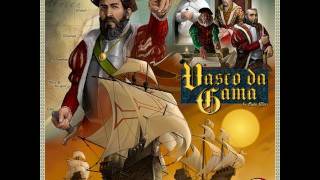
Vasco da Gama was charged with finding a maritime route to India.
Players play the part of rich shipowners who, under his patronage, aim to achieve prestige and riches.
To succeed in the enterprise, they must manage the money and actions at their disposal in order to hire captains, recruit crew, build ships, launch them, and send them to the landings of Natal, Terra de Boa Gente, Mozambique, Malindi, Mombasa, and Calicut.
For each ship sent, players will receive an immediate reward and will gain prestige (Victory Points).
The farther the ship is sent, the lower the compensation, but the higher the victory score that the player will earn.
Ships at landings that are "complete" at the end of the round (i.e. reached by a certain number of Ships) will earn further Victory Points for their owners and will then advance, under certain conditions, to the next Landing. This creates the opportunity to earn again Victory Points in the following Rounds.
During each Round, Players take actions in various Areas (Navigation, Recruiting, or Purchase Projects or Characters).
Planning is fundamental: The right to take an Action could be free of charge or paid for.
The earlier a Player plans to take an Action, the more likely that he will have to pay for it.
Players will have to ask themselves if and how much they are ready to pay for the right to act first in a certain area.
Vasco da Gama himself will decide which is the first free of charge Action for each Round. He will also help some of the Players by making some money available to them.
This great maritime enterprise raises the interest of 4 influential Characters.
Aiming to have a substantial role in the development of the new commercial route, they will also provide their favors free of charge to the Players.
Francisco Alvares (The Priest) will make available a number of Missionaries to be used as crew members, Girolamo Sernigi (The Merchant) will organize Ships built and manned, Bartolomeu Dias (The Leader) will grant an increased initiative and additional Victory Points, and Manuel 1st (The King) will allow Players to take an additional Action in the name of the Portuguese Kingdom.
The winner is the Player with the highest Victory Points score at the end of the game.
- tight race for action slots creates dynamic pacing
- layered planning with initiative values and bidding at times
- heavy and brain-burning; steep learning curve
- initiative-driven worker actions and resource collection
- age of exploration and empire building
- strategy-leaning, intensive planning
- Vasco da Gama
Mechanics (from transcript analysis)
- worker programming / initiative-driven action — each worker has an initiative value; players place workers to trigger actions in a determined order
Video topics + discussion points
Quotes (from this video)
- the potential for this mechanism is you know we've barely scratched the surface
- there are so many ways you can invert that mechanism and make it different
- it's a brain burner it definitely makes you think in a different dimension
- mind games that can come into play here in terms of trying to intimidate your opponent
References (from this video)
- Decisions matter with every move; strategic depth
- Quality components and board
- Rulebook includes many examples and becomes clear after practice
- Appeals to players who enjoy medium-to-high complexity
- Heavy rules; not ideal for casual gamers
- Steep learning curve; may deter new players
- Wealth, prestige, and naval exploration under Vasco da Gama's patronage
- Age of Exploration; late 15th to 16th century, maritime trade routes
- Historical-economic strategy with resource management and route planning
Mechanics (from transcript analysis)
- Action discs and placement — Use discs to select and resolve actions; order and costs affect availability.
- Expedition and navigation — Launch ships with captains and navigate within limits to earn points.
- Project purchasing and progression — Purchase and complete projects using crew and resources to gain VP.
- Recruitment and character tiles — Recruit sailors, captains, and missionaries to gain abilities and fulfill costs.
- Resource management — Coins, crew, missionaries and other tokens are spent to recruit, travel, and complete projects.
- round-based scoring — Game spans five rounds with scoring tied to ships and completed actions.
Video topics + discussion points
Quotes (from this video)
- we really enjoy this game
- every decision from move to Gold spent is extremely important
- it's heavy laden with rules and we don't really recommend it for casual board gamers
- for those of you who like a medium to high complexity game level Vasco da Gama might be for you
- we didn't cover all the rules and there's plenty of them
- after a couple of games we got the hang of it and wanted to play more
- the quality of the components and board is really good as expected from most of Rio Grande games
- we did enjoy it very much and as such we're giving Vasco da Gama an 8 out of 10
References (from this video)

- Might be pirate game
- Sailing
- Age of exploration
Mechanics (from transcript analysis)
- Time management — Plan your day in a non-linear manner to launch ships beware of changing tides
Video topics + discussion points
Quotes (from this video)
- We love trick taking games
- This game is so much freaking fun
- I adore GMT games, they are becoming one of my favorite game publishers
- If you remember Vast Crystal Caverns is in my top five games of all time
- We bloody love it
- We can't stop playing
- It's a blimp game not a train game
- That's just work
- I don't think I want to play it
- I'll get it eventually
References (from this video)

- tight design for two to four players
- clear progression and sense of advancement as you commit to actions
- variety from character powers adds strategic spice
- satisfying potential for tie scenarios and late-game comebacks
- theme can feel thin and very abstract
- perceived dryness and heavy mechanical feel for some players
- initial plays can be frustrating as the sequencing and planning click into place
- navigation, crew management, and ship building
- Age of Exploration with ships, crews, and cargo
- mechanical, somewhat abstract theme that can be mapped to various settings
- Fresco
Mechanics (from transcript analysis)
- action_discs_and_phase_order — players place numeric action discs and then execute actions in numeric order each round.
- character_powers — choose from characters that grant special abilities, providing a risk-reward dynamic.
- crew_and_ship_management — build and crew ships; deployed ships can be navigated to achieve objectives.
- money_economy — money is earned and spent to access actions and fuel progression.
- multi_phase_rounds — the game unfolds over multiple rounds with progression toward victory points.
Video topics + discussion points
Quotes (from this video)
- the earlier they wake up the sooner they will get to take actions throughout the round
- it's an excellent introduction to planning for the next turn
- Fresco is an excellent introduction
- the theme is strong
- you keep your paints hidden
- it's dry and it's mechanical and mathematical
- the theme could be almost anything
- the theme is very thin