In the sleepy English countryside, life continues undisturbed as it has for centuries. It is up to you to travel to every corner of this land, bearing the promise of modernisation, accommodating the oddly specific demands of the locals, and ushering in the age of steam.
In Village Rails, you will be criss-crossing the fields of England with railway lines, connecting villages together, and navigating the complex and ever-changing demands of rural communities. Connect stations and farmsteads to your local network while placing your railway signals and sidings ever so carefully. Meet the exacting standards of cantankerous locals planning strangely specific trips, and weigh their demands against your limited funding. There is much to balance in this tricky tableau-building card game of locomotives and local motives.
Microbadge:
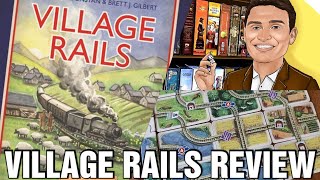
- Puzzly and elegant economy with a compact footprint
- Accessible-yet-thinky design that rewards optimization and planning
- Strong interaction through drafting and the economy, affecting opponents
- Solid production values and clear iconography
- Playable in a concise window (around 30–45 minutes)
- No solo mode, which limits solo play and solitaire experimentation
- Potentially limited replayability after several plays
- Some train types look similar and colorblind players may have difficulty distinguishing icons behind artwork
- Railway construction, route optimization, scoring by terrain patterns and line completion.
- Railway-building on a compact 4x3 grid, with a personal tableau and a supply of coins.
- Abstract puzzle framed by charming railway imagery
- Village Green
- Spiralopolis
Mechanics (from transcript analysis)
- drafting — Players draft rails from a column by paying coins; the bottom card can be taken for free, others require payment.
- End-game scoring with multiple criteria — Scoring is computed across lines using terrain variety, symbols, signals, tractors, and end-game terminus bonuses.
- Objective cards and termini interaction — Objective cards provide targeted scoring triggers; terminus cards influence money and scoring outcomes.
- Resource management / economy — Coins fuel drafting; terminus and objective cards modify earning potential and endgame scoring.
- tableau building — Place drafted cards on a 4x3 grid to form scoring lines that connect to terrain types and objectives.
Video topics + discussion points
Quotes (from this video)
- this game is very puzzly in its nature
- I like the way that you have to manage your Terminus cards here
- the production for the game is of a good standard
- I would you know give it a soft recommendation because it is a photo it's not going to take up much space on your shelf
- it's going to be around 30 to 45 minutes
- I actually do think I prefer this game to Village Green
- the replayability factor is lacking somewhat
- the game becomes more restrictive as it progresses
- there isn't that much room to explore
- no solo mode
- it's a nice charming little game
References (from this video)
- Strong bang-for-buck value
- Beautiful artwork and component quality for an Osprey title
- Tense drafting and engine-building interplay
- Dial for scorekeeping is functional and clean
- Color-blind accessibility not ideal due to small color cues on cards
- Slightly fiddly setup with track/card interactions
- Might not scale well for casual players; best with at least 3 players
- Railways and route optimization
- Rail-focused transport network in a compact grid
- Factual, game-theory driven
- Village Green
Mechanics (from transcript analysis)
- drafting — Players draft one or more cards from a deck or piles, paying costs to skip or select options.
- grid-based tableau building — Players build a 3x4 grid with tracks and trip cards around the edge, forming connections as the game progresses.
- resource-management with money — Money is tight early; spending influences which cards you can take and how you optimize rails for points.
- set collection / scoring by routes — Tracks extend from the grid edges and scoring depends on the combination of trip cards and track icons collected.
- terminus cards as goal boosters — Terminus cards provide tiered money incentives when you meet the criteria, boosting revenue with better lines.
Video topics + discussion points
Quotes (from this video)
- Village Rails is a cool little filler you know, a tight drafting game that still feels substantial.
- Revive is actually pretty damn good yes it is definitely one of my favorites this year.
- Unconscious Mind is a heady puzzle; it is a very entertaining puzzle but man this is going to drive AP players up the wall.
- Deal with the Devil is very niche; you need a very specific group to get the most out of it.
- Coffee Traders is good but not great; at the price point it’s hard to justify without an extensive base game experience.
References (from this video)
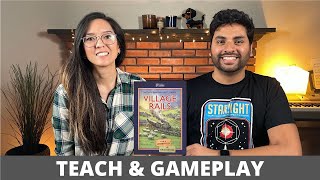
- Engaging two-player puzzle with variable scoring
- Clear spatial puzzle and route-building decisions
- Strong end-game scoring tension
- Endless planning and card-drawing variance can slow pace
- Complex scoring features may overwhelm new players
- Rail network construction and optimization
- Sleepy English Countryside
- Turn-by-turn strategic planning
Mechanics (from transcript analysis)
- card drafting and market refills — players draw from a central market and refill as cards are taken, driving card availability and cost.
- endgame scoring via sightings and terrain variety — points come from endgame features like sightings and terrain diversity on lines.
- route completion and scoring — lines are completed by extending from borders to ends, then trips and line features score.
- terminus cards — terminus cards provide money when lines are completed, influencing economy.
- tile/track placement — players place track cards adjacent to existing ones on a 4x3 grid, with horizontal orientation.
Video topics + discussion points
Quotes (from this video)
- Welcome to the Sleepy English Countryside
- plan a trip
- complete a line
- signals they'll score you points
- Terminus cards
References (from this video)

- solid engine-building
- cohesive rail-based decisions
- artwork could be improved
- some may find it a bit dense for family games
- railway expansion and drafting
- rail network and town-building
- mid-weight strategy
- Village Green
- Railroad Ink
Mechanics (from transcript analysis)
- card drafting — build a tableau with railroad maps and routes
Video topics + discussion points
Quotes (from this video)
- we are raiding our last 16 games yes from 2022
- we slept on that one too
- it's a gateway game
- I love the little wagons
- I love the Terracotta soldiers
References (from this video)

- Fun thematic rail-building vibe
- Solid engagement for city-rail style play
- May not stand out among numerous card/route builders
- Potentially heavy for casual players
- rail construction and logistics in a community setting
- Wavelength
- Scout
Mechanics (from transcript analysis)
- tile/rail network building — Placement and optimization of routes/assets to score points.
Video topics + discussion points
Quotes (from this video)
- this is a game that anybody can play with a standard deck of cards
- the real awesome part of this game is taking those cards from the Tableau
- Carnegie is right up there and I've played it dozens of times
- I strongly recommend it I don't think it's necessarily going to blow you away and be the best game you've played this year but I found it fresh I found it interesting and very enjoyable
- it's a really smart Super Fresh really easy to teach game that everyone can play
References (from this video)
- concise and small footprint
- puzzly and satisfying to connect routes
- charmingly presented as a light tableau builder
- card-driven decisions can feel fiddly for some players
- may require careful planning to maximize scoring
- infrastructure expansion and network optimization
- railway network-building
- puzzly, concise gameplay
- Pillars of the Earth
- Merlin
Mechanics (from transcript analysis)
- economic management — Money resources are used to acquire cards; coins on cards can be captured by others.
- network scoring — Different scoring conditions apply to rail routes, encouraging strategic placement and timing.
- tableau building — Players assemble a network by drafting and layering cards to form railway routes.
Video topics + discussion points
Quotes (from this video)
- I'm kind of making an effort to go through Knizia's back catalog because his games just resonate with me so well
- this is a 60 Minute area control game by Konitzia
- it's very concise, it's nice and small
- I'm always interested in trying games that do fly under the radar
- almost zero luck... deterministic
- I might have to think twice whether to cover this one on the channel
References (from this video)

- Accessible and quick to teach, with satisfying spatial decisions.
- Compact box with elegant track drafting and grid placement.
- Strong, quick play that scales well for 2-4 players.
- Iconography on terrain tiles can be a bit opaque at first glance.
- May benefit from a few more variants or trackers to aid counting.
- Railway expansion and strategic route placement
- Early-to-mid 19th-century railway route planning and track construction
- Euro-style with a crisp, modular route-building progression
- 46 Euro-route builders
- Gaia Project
Mechanics (from transcript analysis)
- card drafting and track placement — Drafting track cards and placing them on a four-by-three grid with border constraints creates a spatial puzzle.
- grid-based route planning — Players plan and lay down routes across a small grid, with scoring triggered by completing lines and matching trip criteria.
- trip cards and scoring — Trip cards provide scoring opportunities tied to routes and terrain-type tokens; completing lines yields points.
Video topics + discussion points
Quotes (from this video)
- Terra Nova is designed by Andreas Fowl and plays two to four players, and the sweet thing about this bad boy is that it only plays 60 to 90 minutes.
- This is a pure racing game; the gear-shift and curve mechanics create real tension as you balance speed and heat.
- Village Rails... these are the type of games that I love; they’ll stay on my shelf.