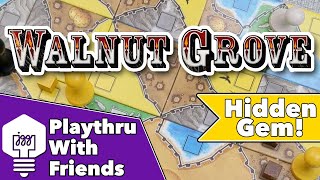
Walnut Grove borrows ideas from jigsaw puzzles and worker placement games, as players add tiles to their farm, and perform actions in the city. Each player manages their farm over 8 years, expanding their plots each spring, harvesting each summer, doing business in the city each fall, and hunkering down each winter. Each worker must be fed, and provided with heat.
Walnut Grove could be described as drawing inspiration from Carcassonne (tile laying) and Agricola (running a farm). The goal of the game is to build and run own farm, to score points at the end of the game. Players can improve their farm during the game by adding new land tiles to it, hiring more workers, building improvements, etc
The game play is divided into eight years, and each year is divided into Spring, Summer, Fall and Winter phases. During Spring, players add 1 or 2 land tiles to their farm. During Summer, players position their workers in their fields to gather resources. When Autumn comes, all players get to visit the city. Finally, during the Winter phase, players need to feed their workers and heat their homes.
When placing tiles, their sides do not need to match. But you generally want them to, because each land area will produce resources based on its size, when you send a worker there.
In the city you can hire more workers, sell goods to gain coins, build improvements, and so on. Each player may do only one action in the city each year. The city is a kind of rondel that is divided into halves; each time you cross the midline you have to pay a coin. Therefore it is wise to move as slowly as possible on the rondel, but then again, you have consider what actions you want to take! This part of the game is worker placement with a single worker, since you can only move to a vacant space.
Spring, Summer and Winter phases can be done simultaneously, providing fast game play. This is a very tight game, with limited actions and scarce resources. Solo rules are included.
- Tight, fast, and highly thematic with meaningful choices
- Strong use of simultaneous play to speed up turns
- Interesting coin/bag mechanic that adds risk/reward
- Engaging endgame scoring with multiple paths
- Coin randomness can create large swings and punishing moments
- Low-scoring nature may feel grindy for some players
- setup and rule clarification can be tricky in early plays
- farming, subsistence, neighborly help, community
- A realistic farming village with seasonal cycles and resource management
- procedural, rustic realism; focus on farming life and communal interaction
- Eclipse
Mechanics (from transcript analysis)
- coins as variable scoring and wilds — Coin tokens grant victory points or can act as wilds when paying costs, creating swing
- endgame scoring tied to enclosures and buildings — Points are awarded for fenced-in areas and completed houses/barns at game end.
- production from contiguous areas — Producing goods from all tiles in an activated contiguous area yields corresponding resources.
- Rondell-style worker placement — A circular track where workers move around; crossing spaces costs coins and some spaces are shared.
- seasonal phases (Spring/Summer/Fall/Winter) — Each season triggers different actions: drafting, producing, relocating workers, and feeding labor.
- Simultaneous action selection — Players secretly choose actions for a season and reveal simultaneously, driving fast-paced decision-making.
- storage and building upgrades — Limited starting storage; players can buy houses/barns to expand capacity and endgame scoring.
- tile drafting and placement — Draw and place season tiles to grow your personal board layout and optimize production areas.
Video topics + discussion points
Quotes (from this video)
- Hidden Gem.
- mindfulness exercise
- the game is mean and punishing
- it's a farming simulation
- coins are wild
- you can play this game however you want to play it correctly or incorrectly
- this is a farming simulation