Collection Status
Your Rating
Description
This is the 4th edition of Games Workshop very popular tabletop miniature game. The rulebook is mainly a revamped version of the 3rd edition with various rule simplifications throughout. Overall, the mechanics of the game have stayed the same. Rich in background this book offers all kinds of modelling tips, terrrain building and painting guide.
From the back of the rulebook:
" Warhammer 40,000 is a tabletop game for two or more players where you command the forces of the Imperium or one of its many enemies. This book provides you with all the rules you need to play, and guides you through collecting and painting your own army of Citadel miniatures."
Year Published
2004
Transcript Analysis
Browse transcript mentions, sentiments, pros/cons, mechanics, topics, quotes, and references.
Total mentions: 1
This page: 1
Sentiment:
pos 1 ·
mix 0 ·
neu 0 ·
neg 0
Showing 1–1 of 1
Video mRTry9-i5BY
Unknown Channel general_discussion at 0:00 sentiment: positive
video_pk 13157 · mention_pk 38469
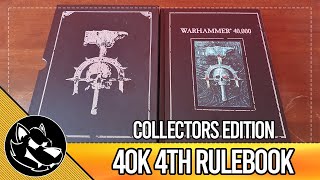
Click to watch at 0:00 · YouTube ↗
Overall sentiment (raw)
positive
Pros
- Strong codices and a robust, well-regarded core rule set in 4th edition
- Value in the starter set and the delicious mix of hobby and gaming that encouraged painting and assembly
- Clear, accessible deployment and force organization that helped players plan battles quickly
- Rich, DIY-friendly terrain guidance that inspired offline table setup and community play
- A large, iconic model range with memorable sculpts (especially Imperial Guard and related factions) that fueled hobby enthusiasm
Cons
- Rule complexity for newcomers, especially around older hit charts and line-of-sight rules that require careful study
- Greater emphasis on model density and codex expansion in later editions (codex creep) that contrasted with the simpler aesthetic of 4th edition
- Collector’s edition pricing and heavy investment into metal minis could be prohibitive for new players or casual hobbyists
- Artwork and presentation (black-and-white era) may feel less vibrant compared to later, color-rich publications
- Terrain and board construction, while accessible, required effort and materials that not all players could easily source
Thematic elements
- Military strategy, model collection, and hobbyist painting as entry points into a sprawling fictional universe.
- Sci-fi grimdark imagined in the 41st millennium; Imperium of Man clashing with diverse xenos and Chaos factions.
- nostalgic/experiential—retrospective exploration of the edition’s impact and evolution
Comparison games
- Third Edition
- Fifth Edition
- Grim Dark Future
- Kill Team
- Combat Patrol
- Armageddon (campaign/setting)
Mechanics (from transcript analysis)
- Combat Scenarios and Small-Scale Play — The book covers a wide array of missions and small-scale game formats (e.g., Combat Patrol-like concepts), along with a large number of missions, which the speaker notes as a major strength of the edition’s breadth and replayability.
- Force Organization Chart (FOC) and Deployment — Deployment is organized by a set of slots (HQ, Troops, Elites, Fast Attack, Heavy Support, etc.), with a clear mission deployment flow. The book presents straightforward hard limits on what you can bring and how you deploy, which the speaker recalls as simple and intuitive.
- Line of Sight, Fire and Terrain — Old LOS concepts and terrain rules govern what can be targeted; line-of-fire considerations and terrain effects make positioning critical. The speaker contrasts this with newer, more abstracted systems that allow aiming at any target more freely.
- Terrain, Boards, and Template Construction — The rulebook and companion guides provide guidance for creating terrain sets, boards, and even templates to build battlefields. The speaker highlights that templates, cardboard terrain cutouts, foam boards, and practical, DIY terrain ideas were part of the appeal and accessibility.
- To Hit and Wounding — Combat resolves with weapon skill versus opponent profile; hits generated by the attacker's WS, then wounds depend on Strength versus Toughness, followed by saves. The speaker notes the presence of hit charts and the stepwise math involved in resolving attacks, which could feel precise and tactical.
- Unit-specific vs Universal Rules — 4th edition used a mix of universal rules and unit-specific rules. The speaker remarks that, compared to later editions, there was a balance between universal effects and distinct unit mechanics, which could be simpler to grasp but demanded careful attention to each entry.
Video topics + discussion points
No key topics recorded for this video.
Quotes (from this video)
- fourth edition has probably the best codexes that they ever made
- this is my baby basically for my reminiscence
- I think the fifth edition starter set is the best starter set Games Workshop ever did, for what you actually got in the Box
- I didn't read any of this not a single thing
- it's jam-packed... it's worth the money even now
References (from this video)
No references stored for this video.
Transcript Navigation
Showing 1–1 of 1