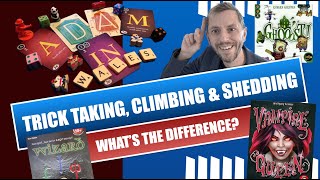
The trick-taking game Wizard uses a sixty-card deck that consists of the traditional 52-card deck (1-13 in four suits) along with four Wizards (high) and four Jesters (low).
Players compete over multiple rounds based on the number of players, and whoever ends with the highest score wins. In each round, players are dealt a hand of cards — one card in the first round, two cards in the second, three in the third, etc. — then trump is determined by flipping the top card of the undealt deck; if a suit is revealed, that suit is trump, while if the card turned up is a Jester, it is turned down and there is no trump for that round. If the card turned up is a Wizard, the dealer chooses one of the 4 suits as the trump suit. The dealer cannot choose "no trump". On the last round of each game all cards are dealt out so there is no trump. Players then state how many tricks they expect to win in the round.
The playing and winning of the tricks uses mostly standard trick-taking rules. If a player leads a suited card, then all other players must follow suit, if possible. If a player leads a Jester, then the second player determines the suit led. If a player leads a Wizard, then those who follow can play whatever they want. However, in all cases a player may always play a Wizard or Jester, even if they hold cards in the suit led.
After each player has played a card, determine the winner of the trick as follows: If one or more Wizards were played, the player of the first Wizard wins the trick, collects the cards, and leads to the next trick. If not, whoever played the highest trump wins the trick. If not, whoever played the highest card of the suit led wins the trick. If all players played Jesters, whoever played the first Jester wins.
After all tricks have been played, players tally their score for the round. If a player matched their bid, winning exactly as many tricks as stated at the start of the round, they score 20 points, plus 10 points for each trick taken. If a player missed their bid, they lose 10 points for each trick that they were off, whether they took more or fewer than predicted.
A common variant in Wizard is to not allow the total number of tricks bid in a round to match the round number, thereby forcing (at least) one player to be off each round.

- Love trick taking games
- Widely available in board game stores
- Trick-taking
- Fantasy
Mechanics (from transcript analysis)
- Trick-taking — Predict how many tricks you'll win with the help of wizards and jesters
Video topics + discussion points
Quotes (from this video)
- We love trick taking games
- This game is so much freaking fun
- I adore GMT games, they are becoming one of my favorite game publishers
- If you remember Vast Crystal Caverns is in my top five games of all time
- We bloody love it
- We can't stop playing
- It's a blimp game not a train game
- That's just work
- I don't think I want to play it
- I'll get it eventually
References (from this video)
- Engaging bidding mechanic that adds anticipation
- Clear alignment between prediction and scoring
- Accessible for players familiar with standard trick-taking games
- Requires careful counting and memory to optimize bids
- Some players may feel the luck of the draw can overpower strategy in the short term
- magic and spellcasting as a framing for card play
- Fantasy-themed trick-taking, with betting and round-based play
- semi-theatrical, with emphasis on prediction and risk-taking
- Skull King
Mechanics (from transcript analysis)
- round-based scoring with bids — Points are awarded for meeting or exceeding bids, with penalties for miscalculated bids, creating a push-pull between risk and reward across rounds.
- special cards with exceptions — Certain cards (like wizard or jester) can override standard rules and be played at any time, affecting the outcome of a trick.
- Trick-taking with bidding — Players bid the number of tricks they expect to win each round; a trump suit is determined for the round, and tricks are won by following suit or using trump cards to conquer higher cards.
Video topics + discussion points
Quotes (from this video)
- This is a shedding game and the defining feature of shedding is getting rid of all your cards before the others.
- It's a trick-taking shedding game, you’re blending three different genres into a single play experience.
- Vampire Queen is a climbing game for three to twelve players; it’s trick-taking, it’s shedding, and it’s climbing all at once.
- The seven-trick scoring in Front Gherkin is the crown jewel for how you measure endgame value, and that choice shapes how players pace their risk.
- Fool sits at that interesting intersection of bid, bluff, and penalty, where the loser gets punished for a misstep and the winner enjoys the lead again.
- Wizard’s bidding and trick-taking dynamic creates a natural tension between prediction and execution, very much in the spirit of Skull King but with its own twist.
- The history lesson here is that the East and West diverged in their design philosophies, and we now live with a delightful spectrum of games that sits between climbing, shedding, and trick-taking.