The Zapotec were a pre-Columbian civilization that flourished in the Valley of Oaxaca in Mesoamerica. Archaeological evidence reveal their culture going back at least 2,500 years. Remnants of the ancient city of Monte Albán in the form of buildings, ball courts, magnificent tombs, and finely worked gold jewelry testify of this once great civilization. Monte Albán was one of the first major cities in Mesoamerica and the center of the Zapotec state that dominated much of the territory that today belongs to the Mexican state of Oaxaca.
In a game of Zapotec, you build temples, cornfields and villages in the three valleys surrounding the capital to generate resources needed for building pyramids, making sacrifices to the gods, and performing rituals.
Each round, players simultaneously pick a card from their hand to determine their turn order and the resources they collect. Players then perform individual turns and spend resources to build new houses, gain access to special abilities, make sacrifices to the gods and build pyramids. The played action card determines three important aspects of each player's turn:
The resource printed at the top of the card determines the row or column to activate on the resource grid to collect income.
The icon in the middle of the card matches one of the nine properties of the building spaces on the map (one of three building types, one of three regions, or one of three terrain types). On their turn, players may build only on spaces that match that icon.
The number at the bottom of the card dictates the turn order for the round when the card is played.
At the end of the round, players draft new cards from the central offer, with the final undrafted card becoming the scoring bonus card for the following round.
After five rounds, players score points for pyramids, for their position on the sacrifice track, and for their ritual cards. The player with the most victory points wins.
—description from publisher
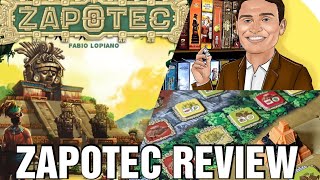
- Temples snap together brilliantly and look great on the table
- Card drafting and hand management system feels clever
- Engine-building potential with resource conversion and pyramids
- Good depth for a 60-75 minute euro game
- Scales well with player count and maintains tight interaction
- Decision space is not as deep as expected; often feels obvious
- End-of-round pool and scoring can feel predictable or underutilized
- Two-phase action structure (construction then capital) feels fiddly and unnecessary
- Early engine development is brittle; many players default to spammy resource collection
- Pyramids are expensive to build and often not worth the points
- Production quality is mixed: light cardboard, bland tokens, flimsy player sheets
- Temple construction, resource management, and pyramid-based scoring within a ritual-driven economy
- Ancient Mesoamerican-inspired civilization-building with pyramids, temples, and rural development; features a sacrifice track and ceremonial motifs
- Strategic euro-game storytelling through modular board growth and card-driven actions
- T-series (Bored & Dice)
Mechanics (from transcript analysis)
- Capital actions and resource conversion — Between rounds, players spend coins to acquire bonus tiles, or convert resources to other resources, altering the engine's shape.
- Card drafting and pool management — A communal pool feeds end-of-round drafting; what you draft affects your hand and what remains affects future scoring pools.
- end-of-round and end-of-game scoring — Points come from buildings, pyramid bonuses, ritual cards, track progression, and other round-based incentives.
- Pyramid construction and hierarchical scoring — Players stack pyramids on their boards; pyramid levels contribute to scoring and interact with other players' pyramids.
- Resource engine on personal boards — Pyramid levels and a personal grid accumulate resources over time, enabling deeper engine-building as the game progresses.
- Ritual cards and sacrifice track — Rituals provide end-game bonuses and scoring options; advancing on the sacrifice track costs tokens and yields benefits.
- Simultaneous action selection — All players secretly choose a card each round and reveal simultaneously to determine actions, creating tense ordering and anticipation.
- Terrain- and statue-based placement — Building placement is restricted by terrain types and god-statue zones, influencing where buildings can go and what incentives apply.
Video topics + discussion points
Quotes (from this video)
- Zapotec is a wonderful euro resource management board game.
- Temples snap together brilliantly and look great on the table.
- The hand management initiative system is quite clever.
- The decision space in the game was a bit lacking for me.
- Not one I can recommend.
- It does feel like you're getting a full euro game here.
- The game does scale pretty well.
- There is a fair amount of player interaction.
References (from this video)
- tight, thinky design
- quick, intense interaction
- can be fiddly for new players
- colorful resource management and architectural placement
- Zapotec/Mesoamerican civilization
- thinky euro with simultaneous actions
- Ragusa
- Kalimala
Mechanics (from transcript analysis)
- scoring through pyramids and cards — End-game scoring tied to pyramids and scoring cards
- Simultaneous Actions — Players reveal and resolve actions in numbered order
- tile/resource placement — Place house tiles on a 3x3 grid to generate resources
Video topics + discussion points
Quotes (from this video)
- we are proud members of the old people's club
- taste buds, taste buds, taste buds
- this is going to be a long one
- the fog of war of the cards
- you maximize everything you can every turn
References (from this video)

- Fast, engaging filler with good theme
- Solid decision points and replayability
- Tile-laying / area majority with quick play
- Ancient Mesoamerican culture
- Accessible, fast Euro with a strong cultural hook
Mechanics (from transcript analysis)
- area majority — Control areas for scoring bonuses.
- tile-laying / tile placement — Place tiles to form patterns and gain points.
Video topics + discussion points
Quotes (from this video)
- the rules are quick and easy to get through
- my daughter really likes birds
- the game uses the game trays making it a lot better easier to set up and take down
- one of the best components that I've ever seen
References (from this video)
- Fast, accessible, good for a quick game night
- Likely popular with families and casual players
- Short, quick Euro with relics and tile elements
- Ancient Mesoamerican civilization
- Compact, accessible, family-friendly
Mechanics (from transcript analysis)
- area control / scoring by tiles — Control tiles to maximize points and influence outcomes.
- Tile-laying — Tiles determine actions and scoring opportunities.
Video topics + discussion points
Quotes (from this video)
- the rules are quick and easy to get through
- my daughter really likes birds
- the game uses the game trays making it a lot better easier to set up and take down
- one of the best components that I've ever seen
References (from this video)
- Fast and approachable for a filler
- Solid theme integration
- Tile-laying and area control with quick play
- Ancient Mesoamerican civilization
- Accessible and fast-paced
Mechanics (from transcript analysis)
- area majority — Control areas for scoring benefits.
- Tile-laying — Tiles determine actions and scoring opportunities.
Video topics + discussion points
Quotes (from this video)
- the rules are quick and easy to get through
- my daughter really likes birds
- the game uses the game trays making it a lot better easier to set up and take down
- one of the best components that I've ever seen
References (from this video)

- Family-friendly
- Accessible
- Cultural sensitivity concerns around theme
- ancient civilizations
- Central American themes
Mechanics (from transcript analysis)
- area_control — control territories or regions
- set_collection — collect resources for scoring
Video topics + discussion points
Quotes (from this video)
- the gateway is open up and we're welcoming new players
- we've gotta spread the gospel
- be that opening to something new and wonderful
- gatekeepers into the hobby