Diplomacy, the classic boardgame of pure negotiation has taken many forms over the years.
The first The Avalon Hill Game Co version has perhaps the widest release, but Avalon Hill re-released the game in 1999, complete with a colorful new map and metal pieces. In 2008, Avalon Hill released a 50th anniversary edition with a new map and cardboard pieces representing the armies and navies.
In the game, each player represents one of the seven "Great Powers of Europe" (Great Britain, France, Austria-Hungary, Germany, Italy, Russia or Turkey) in the years prior to World War I. Play begins in the Spring of 1901, and players must negotiate and make deals with other players in order to have any success in expanding their borders. They will make both Spring and Autumn moves each year. with two kinds of military units: armies and fleets. On any given turn, each of your military units has limited options: it can move into an adjoining territory, support an allied unit in an attack on an adjoining territory, support an allied unit in defending an adjoining territory, or hold its position. Players instruct each of their units by writing a set of "orders." The outcome of the various orders is basically determined by the total strength of the units involved. There are no dice rolls or other elements of chance. With its incredibly simplistic movement mechanism fused to a significant negotiation element, this system is highly respected by many gamers.
Avalon Hill Complexity rating - 3
Re-implemented by:
Colonial Diplomacy
Diplomacy: Classical Variant
Diplomacy: Hundred Variant

- Deep, high-stakes social dynamics and negotiation
- Rich narrative payoff when betrayals land and alliances collapse beautifully
- Historical flavor paired with dense human interaction
- Extremely long play sessions (often several hours)
- High potential to damage real-world relationships and feelings
- Older design can feel unwieldy and mechanically brittle by modern standards
- Alliances, betrayal, negotiation, and political realism
- Europe, circa early 20th century leading into World War I
- Social-dramatic, human-centered storytelling with high interpersonal stakes
- Pax Premiere
- Blood on the Clock Tower
- Root
Mechanics (from transcript analysis)
- Alliance formation and betrayal as core gameplay — Cooperation is essential to advance, but long-term relationships are continually tested by backstabbing and shifting loyalties.
- Diplomatic negotiation as a main activity — Players spend significant time in dialogue to form agreements, betrayals, and strategic alignments that influence map control.
- Secret orders and simultaneous execution — Players secretly plan and submit orders; resolution occurs without chance elements and relies on social trust, misdirection, and perception.
Video topics + discussion points
Quotes (from this video)
- The betrayal mad.
- Diplomacy isn't a game you spring on people. It's a game you forewarned them about.
- You're not really playing a board game. You're playing a people game.
- The game outwardly advertises that this would happen. It's on the box, not a game of kindness, sweeties, and happy Labradors.
- The knife in your back feels that much sharper when you've spent six hours building a relationship only to spend the next two hours watching your former ally win with your land.
- Betrayal is strategy. And if you sit down to play Diplomacy and suddenly you're shocked that someone lied to you, that's a failure of communication before the game even began.
- The outplayed mad is weirdly respectful.
- 4D chess, while you were playing checkers.
References (from this video)

- negotiation
- world conflict
Mechanics (from transcript analysis)
Video topics + discussion points
Quotes (from this video)
- hey everyone who just kind of made it in time i'm not going to say it was a shall we say the easiest time to get here
- come on seriously i need to get on with a stream in a minute
- what is going on at fantasy fly at the moment they're just not bringing out any major good games
- every time they try to do a spin-off game that isn't a card game they tend to fail
- root's okay but i think the fact that you've got to have a balanced group of players who know what they're doing to play it i think it's just too much
- i just i'm okay with rue but i would never seek it out
References (from this video)

Mechanics (from transcript analysis)
Video topics + discussion points
Quotes (from this video)
- I'm vocalizing what's going on in my head.
- Gen Con is not a convention that I ever foresee myself going back to.
- This is going to be a very long stream if I'm going to take this much time going through each of these.
- We are going to do a BG auction cuz I imagine everybody that watches this is on BGG.
- The designer is going to send it to you. He's going to pay the shipping and y'all are going to pay us and we get to keep the money.
References (from this video)
- deep social interaction and negotiation-rich play
- high replayability through shifting alliances
- no dice luck; outcomes hinge on player interaction
- can lead to lengthy sessions and stalemates
- heavy reliance on player dynamics; betrayal can frustrate some players
- diplomacy, alliance-building, betrayal
- pre-World War I Europe with global power plays
- historical-political
- Risk
- Lords of Waterdeep
Mechanics (from transcript analysis)
- area_control — control territories via army presence to influence scoring and power dynamics
- movement_and_support — orders move pieces across a map to contest regions and support each other
- negotiation_and_alliances — players form temporary treaties and backstab opponents through talks rather than luck
Video topics + discussion points
Quotes (from this video)
- Diplomacy by email explicitly by email
- i don't want to sit at a table with you and play that game
- it's such a minimalistic game where the players themselves drive all of the fun and interaction of the game
- it's the first time in a game where i felt incentivized for certain strategies to die
- a box of cardboard chits that does everything that i want a game that is full of Twilight Imperium-esque plastic armies marching across the board
- there's room for betrayals, there's room for deal making
- the apex of like pure dudes on a map area control games
- my blood rage to me is where area control was starting to get played with
References (from this video)

- Alliance, betrayal, and negotiation
- European powers in the early 20th century
Mechanics (from transcript analysis)
- negotiation — Players form and break alliances through verbal diplomacy.
- order resolution — Simultaneous orders with indirect competition and conflict.
Video topics + discussion points
Quotes (from this video)
- Terraforming Mars. I'm not going to lie to you.
- You can't win three times.
- Never give up. Never give up.
- This is a World Series championship. Australia, the Netherlands, I mean it's all over.
- The three people or four people that really need to be recognized and that is Mr. Chris George, Marcy Stark, Ernie Gazowski, and Shane McB.
References (from this video)
- Illustrates the importance of negotiation and strategy in multi-agent conflict
- Cited as the first game where a particular system of record-keeping or play-tracking was widely applied
- Player dynamics can dominate outcomes beyond pure tactics
- Older production values may feel dated
- diplomacy, negotiation, alliance-building
- early 20th-century Europe with alliance diplomacy
- socio-political simulation
- Stalingrad
- D-Day
Mechanics (from transcript analysis)
- negotiation and alliance-building — players form and break alliances, issue commands, and resolve outcomes through negotiated diplomacy
Video topics + discussion points
Quotes (from this video)
- you cannot understand our times without games and other digital media
- board games are print artifacts and that's right in that
- the main obstacles are legal
- it's a night and day kind of thing
- documentation... that's what historians do anyway
References (from this video)

- Psychological depth and player-driven drama
- High replayability through different personalities
- Absolute focus on human interaction as the core experience
- Very long playtime and heavy player elimination by modern standards
- Requires seven committed players; not casual-friendly
- Alliances, betrayal, and negotiation
- World power politics and supply centers
- Two-phase play: diplomacy (negotiation) then resolution
- Dune
- other negotiation-focused strategy games
Mechanics (from transcript analysis)
- negotiation and alliance-building — Players form and break alliances through verbal agreements and deception.
- perfect information with imperfect trust — All moves are public, but intent and promises are unreliable.
Video topics + discussion points
Quotes (from this video)
- Code Names did something that sounds impossible. It made a party game that's actually legitimately good.
- Dune eroded everything around it to pure theme. It succeeded through the devotion to its fiction and the corresponding chaos that comes from that.
- Diplomacy is all about perfect information and imperfect trust.
References (from this video)

- clever negotiation and alliance dynamics
- rules are approachable for a social game
- emphasizes long term strategy and bluffing
- lacks strong thematic feel compared to other games
- can become lengthy and fragile with player dynamics
- alliances, backstabbing, negotiation
- Europe 1900s era of great powers
- political intrigue with shifting loyalties
- Risk
- Game of Thrones
Mechanics (from transcript analysis)
- Area Control — Regions border and conflict drive player influence
- Hidden/face down actions — Players plan moves with face down markers and reveal later
- negotiation and alliance building — Players bargain with others to gain advantage and betray when beneficial
Video topics + discussion points
Quotes (from this video)
- This is a board game that was one of the first games I really loved a game of negotiation and diplomacy which has the same system of playing tokens facedown and then you reveal and you see what peoples plans really were
- you can create alliances with other players and you can talk about what youre going to do you can maybe lie to people
- it's a beautifully simple system it packs a lot into a quite a small box it's a breeze to learn the rules
- for the right group this could really sing but for me it didn't really hit the spot
- I love Sushi Go and I feel this kind of system doesn't work with a deeper more involved game
- Queen Domino hasn't worked for me all of the ideas feel tacked on
- it's a nice push your luck aspect and there are seasons with weather that make harvesting decisions tense
References (from this video)
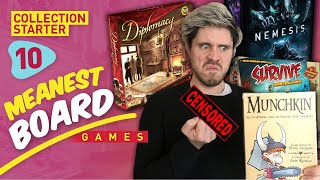
- iconic for serious negotiation and strategic depth
- emphasizes human psychology over dice luck
- can destroy friendships and lead to long-lasting grudges
- rules and diplomacy-heavy play can be off-putting to casual players
- alliances, betrayal, strategic positioning
- Early-20th-century European political landscape.
- grand, ruthless, political
Mechanics (from transcript analysis)
- hidden orders; private diplomacy — Players chat privately, form backroom agreements, and reveal orders at the same time.
- no dice combat; simultaneous orders — Movement and combat outcomes are decided by simultaneous planning and negotiation.
- support mechanics and alliance building — Players back their allies with supports and promises, often breaking them later.
Video topics + discussion points
Quotes (from this video)
- meanest board games ever made
- the unofficial tagline is ruining friendship since 1959
- that's mean
- there are so many ways to hurt people in the estates
- the heart of the game is traveling around fighting off beasties and trying to complete tasks vital to your own personal success
References (from this video)

- deep historical feel and negotiation depth
- high emphasis on player interaction and strategy
- long play time; rules and negotiation can be intimidating for newcomers
- cooperation, negotiation, betrayal, strategic planning
- interwar Europe with grand strategy and alliances
Mechanics (from transcript analysis)
- Negotiation and alliances — Players negotiate with others to form pacts and plans; no randomization reduces luck, emphasizing diplomacy.
Video topics + discussion points
Quotes (from this video)
- we're not here to make friends we're here to break people
- one of the biggest personalities in a board game space
- it's a good investment
- the idea and it's it's mostly illegal now I believe
- this version is a ton of fun
- the table presence is terrific
References (from this video)

- Illustrates AI's interaction with social reasoning, negotiation, and bluffing
- Imperfect information remains a key limitation for AI in real-time bargaining
- Negotiation, alliance-building, and deception
- Geopolitical strategy with 1900s-era powers
Mechanics (from transcript analysis)
- Diplomacy and bargaining — Deals, threats, and shifting alliances drive outcomes
- Imperfect information — Players do not know opponents' hidden intentions
Video topics + discussion points
Quotes (from this video)
- oxo was born
- imagine having to go into cambridge just to have a bash at naughts and crosses
- the problem is not that of designing a machine to play perfect chess which is quite impractical nor one which merely plays legal chess which is trivial
- move 37. it was a move that outwardly looked like a mistake
- alpha zero learned to play so well by playing the game against itself
References (from this video)
- rich social interaction, high replayability
- fragile relationships, potential to harm real-life dynamics
- diplomacy and strategy
- geopolitical negotiation and alliance-building
- mechanics-driven social dynamics
- A Game of Thrones: The Board Game
- Confrontation
Mechanics (from transcript analysis)
- asymmetric information — players infer others' intentions; information is not fully shared.
- negotiation — players form and break alliances through verbal deals.
Video topics + discussion points
Quotes (from this video)
- Bridge as a game is kind of dying
- it's just a game it's not great for people with addictive personalities but what it has going for it is it only takes this deck of cards
- Monopoly isn't that bad if you're playing with the auction rules
- Go is the oldest game on this list I believe
- Scotland Yard is the genre defining game for hidden movement
- Diplomacy is a unique experience and its influences can be found in games like A Game of Thrones