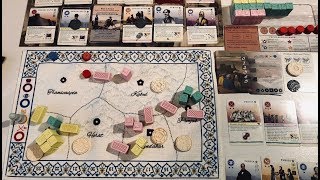
In Pax Pamir, players assume the role of nineteenth century Afghan leaders attempting to forge a new state after the collapse of the Durrani Empire. Western histories often call this period "The Great Game" because of the role played by the Europeans who attempted to use central Asia as a theater for their own rivalries. In this game, those empires are viewed strictly from the perspective of the Afghans who sought to manipulate the interloping ferengi (foreigners) for their own purposes.
In terms of game play, Pax Pamir is a pretty straightforward tableau builder. Players spend most of their turns purchasing cards from a central market, then playing those cards in front of them in a single row called a court. Playing cards adds units to the game's map and grants access to additional actions that can be taken to disrupt other players and influence the course of the game. That last point is worth emphasizing. Though everyone is building their own row of cards, the game offers many ways for players to interfere with each other directly and indirectly.
To survive, players will organize into coalitions. Throughout the game, the dominance of the different coalitions will be evaluated by the players when a special card, called a "Dominance Check", is resolved. If a single coalition has a commanding lead during one of these checks, those players loyal to that coalition will receive victory points based on their influence in their coalition. However, if Afghanistan remains fragmented during one of these checks, players instead will receive victory points based on their personal power base.
After each Dominance Check, victory is checked and the game will be partially reset, offering players a fresh attempt to realize their ambitions. The game ends when a single player is able to achieve a lead of four or more victory points or after the fourth and final Dominance Check is resolved.
- rich historical flavor and political intrigue
- high replayability and depth
- strong player interaction and diplomacy
- beautiful and thematic component design
- steep learning curve and long rulebook
- complex setup and heavy analysis required
- scaling can be challenging for new players
- political intrigue, empire-building, shifting alliances
- Central Asia during the Great Game (19th century, Afghanistan and surrounding regions)
- historical simulation through faction influence and diplomacy
- Bernard Cornwell's Sharpe series (historical fiction)
Mechanics (from transcript analysis)
- action_selection — Turns are driven by selecting actions from the drafted deck.
- area_control_and_influence — Players vie for influence across regions and factions on a map-like influence system.
- asymmetric_play — Different factions or roles come with unique powers and victory conditions.
- deck-building — Players draft and build a personal deck that determines available actions each turn.
- negotiation_and_diplomacy — Players negotiate with each other to form alliances and counter other players' influence.
Video topics + discussion points
Quotes (from this video)
- Harry Flashman is supposed to be reprehensible.
- there's a massive content warning for sexual assault.
- I would put warnings on it and think about who I'm recommending it to.
- what are we talking about when we talk about history and then what are we doing when we write historical fiction?
- I would absolutely assign something like this to college kids because I sort of feel like at that point you are old enough but I would put warnings on it.
References (from this video)
- Dynamic and strategic depth with richer coalition play
- Improved balance and more fluid game state in second edition
- Encourages long-term planning and tactical response
- Increased complexity can affect playability and pace
- Spy/hostage rules add cognitive load and potential confusion
- Market and dominance mechanics can slow decision-making if not managed
- imperial influence, coalition-building, political intrigue
- Afghanistan and surrounding regions during the late 19th century imperial scramble
- card-driven geopolitical negotiation with historical setting
Mechanics (from transcript analysis)
- card-driven diplomacy — cards govern influence, loyalties, and actions for regional control
- dominance checks — market-based checks determine victory points and coalitions
- event cards and climate/loyalty shifts — event cards alter climates and rearrange suits, affecting available actions
- region control and military deployment — armies and tribes move to control regions and defend against opponents
- resources and influence cylinders — cylinders, coins, and limited actions drive player power
- spies/hostage mechanics — spies can tie up actions and defend or threaten cards, adding layer of anti-hostage dynamics
Video topics + discussion points
Quotes (from this video)
- the idea of moving to type player spies is that the theory is you're putting spies on important cards and cars that you consider important are therefore important to work on so it's kind of leaning on players intelligence
- it does make for a more dynamic game with the first edition rules
- playability means y cans turn happens quickly you don't think about it too much
- we're going to battle and remove these tribes first using count Ivan
- it's interesting because in a solo game where can kind of acts like two players because I'm British she kind of acts like Russian and Afghan hence why lots of stuff is coming out so it's harder for players unless they work together to get a coalition dominant so it kind of feels like a three-player game
References (from this video)

- deep political intrigue and elegant design
- strong thematic cohesion and components
- longer, heavier play; steep learning curve
- empire-building and alliance networks in a volatile social landscape
- Pamir region; political intrigue among competing factions
- highly thematic, political negotiation and strategy
- Root (multi-use card concepts, but distinct feel)
- Ethnos (influence/area control lineage)
Mechanics (from transcript analysis)
- area influence and negotiation — control influence in a volatile, alliance-based environment.
- deck-driven action selection with rondel dynamics — players choose actions using hand cards and influence markers; alliances shift as factions change.
- variable player powers / asymmetry — factions offer unique abilities and endgame conditions.
Video topics + discussion points
Quotes (from this video)
- Gen Con is my number one show of the year; the energy is like geek paradise.
- Non-stop bombardment of games and energy everywhere you turn.
- Indianapolis has embraced Gen Con to the point that even the airport has tables to play games.
- These are our people; the hobby is a shared language and vibe.
- Pax Premier Second Edition is a heavy, rewarding experience with deep political intrigue.
- The Search for Planet X uses a 360-degree sky view and rotating clues—it's a clever deduction challenge.
- Evenfall is gorgeous; the art and depth are top-notch, though it can be challenging to learn.
- Offsite publisher events can offer a more relaxed, focused environment for discussion and play.