Ra is an auction and set-collection game with an Ancient Egyptian theme. Each turn players are able to purchase lots of tiles with their bidding tiles (suns). Once a player has used up his or her suns, the other players continue until they do likewise, which may set up a situation with a single uncontested player bidding on tiles before the end of the round occurs. Tension builds because the round may end before all players have had a chance to win their three lots for the epoch. The various tiles either give immediate points, prevent negative points for not having certain types at the end of the round (epoch), or give points after the final round. The game lasts for three "epochs" (rounds). The game is easy to learn.
From the Box:
The game spans 1500 years of Egyptian history in less than an hour!
The players seek to expand their power and fame and there are many ways to accomplish this: Influencing Pharaohs, Building monuments, Farming on the Nile, Paying homage to the Gods, Advancing the technology and culture of the people. Ra is an auction and set collecting game where players may choose to take risks for great rewards or... And all this is for the glory of the Sun God Ra!
- Classic abstract with strong play across multiple plays
- New edition (25th Century) refreshed experience
- Some may find the pacing a bit slow
- Older design quirks persist in certain editions
- Ancient Egypt
- Kier
- Isle of Sky
Mechanics (from transcript analysis)
- Rondel-style action selection / set collection — Players compete for tiles and actions; strategic timing to maximize points from monuments and categories.
Video topics + discussion points
Quotes (from this video)
- this is where I talk about all of the non new to me games that I have been playing
- thoroughly thoroughly enjoyed this recent play
- it's just a lovely T placement game
- this is one of the best two-play games of all time
- I love this game
- an absolute blast of a game
- the combos are fantastic
References (from this video)

- simple and repeatable
- easy to teach
- very card-driven, could be luck-heavy
- economic card game
- Card-based system about land and rewards
- simple and quick
Mechanics (from transcript analysis)
- Card-driven actions — Play card to use same-color combos for rewards.
Video topics + discussion points
Quotes (from this video)
- This month I played a board game that if I would have played it sooner would have been in my top 20 of all time.
- Welcome to Hot Streak, the wackiest racing game that you've ever played, but in a good way.
- It's simple, it's exciting, and it's very, very different.
- NAR is one of those simple little card games that I want to play again and again and again.
- This game is surprisingly mean.
- I loved every minute of it.
- If this concept sounds fun, it's for you.
- NAR is a giant card game. Everything you do in this game is with cards.
References (from this video)

- tension in two-player form is great
- timely decisions with bid tokens
- bidding games can be unforgiving if early decisions go wrong
- bidding and resource management
- auction-based ancient Egypt themed
- classic, elegant
Mechanics (from transcript analysis)
- auction/bidding — pre-assigned auction tokens used to bid on tiles, impacting scoring and resources
Video topics + discussion points
Quotes (from this video)
- I think Concordia is one of the best games ever made, full stop
- two players it works extremely well because the downtime is gone
- it's a brain burner game
- the tension in the two-player game is great
- loads of content to explore, tons of replayability
References (from this video)

- clear, fast to teach
- engaging auction tension
- may feel lightweight for some players
- tile bidding and set collection
- ancient Egypt auction
- economic, competitive
Mechanics (from transcript analysis)
- Auction — Sun tiles are auctioned to gain points and benefits.
- end_game_scoring — Points awarded for end-game tile sets and effects.
- tile_selection — Choosing tiles from a display grants bonuses.
Video topics + discussion points
Quotes (from this video)
- Rising Sun is absolutely fantastic.
- La Havre broke the cycle of Agricola clones and gave us something brand new.
- Ra was given a deluxe reprint not that long ago.
- The Voyages of Marco Polo is a dice placement game.
References (from this video)
- Simple to learn
- High player interaction
- Compelling auction mechanism
- Beautiful new artwork
- Civilization building
- Ancient Egypt
- Auction-based
- Chinatown
- Lost Cities
Mechanics (from transcript analysis)
- Auction — Players bid on tiles to build their civilization
Video topics + discussion points
Quotes (from this video)
- 2023 was a great year to play board games because tables and board games continued to exist
- they don't make them like Ra anymore, but they do reprint them
References (from this video)
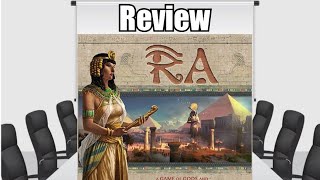
- Clean, elegant design with deep, nuanced decisions that reward careful planning
- High interaction and meaningful player engagement; players must read and react to opponents’ strategies
- Excellent replayability due to tile variety, different scoring routes, and the interplay between auction and set-collection systems
- Accessible entry with a clear core mechanic, yet rich enough to sustain long-term strategic play
- Strong aesthetic and thematic atmosphere with solid component quality; Egyptian motif is visually appealing and fits the game’s feel
- May feel intimidating to newcomers who are not familiar with auction dynamics or set-collection puzzles
- Luck can influence tile availability and draw order to some extent, though skilled play tends to dominate in the long run
- Auction-driven civilization-building with Egyptian iconography; abstracted scoring that reflects ancient society dynamics
- Ancient Egypt, temple-building and pharaonic rule expressed through ancient Egyptian motifs and imagery
- Historical/abstract with thematic flavor rather than a strongly narrative storytelling approach
- Ra (multiple editions) and other Knizia auction/set-collection hybrids
Mechanics (from transcript analysis)
- auction/bidding — Players receive a limited set of bidding tokens with numerical values (ranging from low to high). In each round, each lot is contested via a single opportunity to bid per player, forcing careful value assessment and timing. The bid value chosen by players is revealed and resolves who wins the tile or lot. The tokens are scarce across three rounds, so players must balance current gains with future bidding power. The mechanism emphasizes strategic patience and risk assessment rather than rapid, high-volume bidding.
- Player interaction and information management — Despite a clear, elegant core mechanic, Ra places significant emphasis on reading opponents and predicting intentions. Players must monitor what others are pursuing, how their bids might influence others’ decisions, and how to time their own moves to maximize payoff while minimizing giving opponents easy paths to scoring.
- Rattle/timer mechanic — A “rattle” event is used to trigger auctions and push the round toward its end. As rattles accumulate on a top row, a timer counts down the round, pressuring players to resolve bids and manage the end-of-round timing. If players run out of bidding power before the round ends, they miss opportunities and reduce potential scoring, which adds a real-time pressure dynamic to an otherwise largely strategic Eurogame style of play.
- Set collection / scoring by diversity — Tiles represent different categories (Pharaohs, Monuments, Professions, and other thematic icons). Scoring is driven by a mix of set collection objectives: having the most of certain types, collecting diverse tiles, and sometimes owning specific combinations. Some categories award points for abundance, others penalize missing categories. The scoring system rewards planning across multiple categories and depth of planning beyond simply collecting high-value tiles.
- Tile swap and board state interaction — Winning a lot can involve swapping the bid tile with the tile on the board that was used in the last auction. This rule creates a dynamic interaction where value shifts not only by what you win, but also by how you disrupt or improve the board state for subsequent rounds. It adds strategic depth and counterplay, as players must anticipate how a favorable swap will influence future auctions.
- Token management and round-based economy — Bidding power is serialized into tokens with varying values. Players start with a hand of these tokens and must strategically deploy them across three rounds. The finite nature of the tokens forces players to think not just about the current auction, but also about how much power to carry into subsequent rounds. This creates a layered economy where early rounds can set up late-round dominance—or wipe out a player’s bidding capability.
Video topics + discussion points
Quotes (from this video)
- it's such a clean and simple mechanism that it's just so full provoking
- the decisions as you can probably tell are absolutely juicy
- this game is one of the most nuanced games that I've ever played
- interaction fantastic
- easy to rules overhead
- the game is a clean elegant design with a mountain of depth
References (from this video)

- Delicately balanced bidding system
- Blends party-like elements with euro-depth
- Elegant tension with each round
- Can feel opaque to newcomers
- Themes and mechanisms may clash for some players
- auction mixed with light party/euro elements
- Ancient Egypt, temple tiles and auction dynamics
- clever balance with strategic bidding
Mechanics (from transcript analysis)
- auction/bidding tokens with value — Bids are based on the value of tiles you already own, not just money you can spend.
- layered interaction — Player decisions influence others through shared board state.
- tile drafting and scoring — Select tiles to score in various ways, balancing risk and reward.
Video topics + discussion points
Quotes (from this video)
- I love the sense of urgency when it comes to rushing to these islands and getting them populated as quickly as you can.
- This game is the absolute best of the best. You know, the top 1% of the top 1% of the games that I've played.
- I could not speak more highly of this design.
- The dice-driven twist, the engine-building, the tension—this is why I play board games.
References (from this video)
- Really like the way it looks
- Really really liked it when played
- Clever mechanisms
- Haven't played in a long time
- Couldn't make top 100 without replaying
- Only played once
- Auction-based civilization
- Ancient Egypt
- Thematic
- Priests of Ra
- High Society
Mechanics (from transcript analysis)
- Auction — Bidding on lots
- set collection — Collecting sets for points
Video topics + discussion points
Quotes (from this video)
- It wasn't just the hundred sort of best designed games this was the hundred games that I feel that I'm particularly sort of connected to
- The games that have a place in my heart really games that I've got a lot of nostalgia for
- It felt a bit like doing a roll and write game but without all of the sort of convenience
- I wish I still had castles of burgundy and notre dame
- The main thing that got in the way for me was all the iconography
- I do use board games as an escape from screens and technology
- I really like the production of cockroach poker
- I found it was a game where I could see the ending coming and then someone would just go and there we go we've got another 20 minutes now
- It feels like something other than a board game
- The decisions you make in the game are very very slight
- Right up my alley
- I do really like push your luck
- That's my favorite game
- Abyss is my second favorite game
- I love pekka pig
- I just think it's ugly
References (from this video)
- Widely regarded as one of the best auction games
- Offers deep strategic decision with luck balancing elements
- Can be intimidating for new players
- Bidding can feel brutal at times
- Realistic auction with strategic bidding and set collection
- Auction/set-collection in pre-allocated bids
- Layered decision-making with multiple scoring dimensions
Mechanics (from transcript analysis)
- Auction — Bidding to acquire tiles; bids shape endgame possibilities.
- set collection — Pre-allocated bids limit how many tiles you can collect; timing matters.
Video topics + discussion points
Quotes (from this video)
- This is a very nasty auction style game.
- I think it's a great design.
- One of my favorite games if not my favorite game.
- It's nice that it plays in about 30 minutes.
- I think it's a wonderful design.
References (from this video)
- Recognized as a top-tier game by the host; strong personal affinity.
- No explicit cons discussed beyond initial enthusiasm.
Mechanics (from transcript analysis)
- set collection / card drafting — players draft cards to form pyramids and optimize scoring opportunities.
Video topics + discussion points
Quotes (from this video)
- One of the biggest mistakes I ever made was forcing friends to play games that they're just not interested in.
- Don't be like me. Trust me.
- Board games are absolutely everybody.
- I spent $250 going all in on Rising Sun and I've played it three times.
- Istanbul is one of my favorite games now and we play it absolutely all of the time.
- Ra currently sits in my top five games of all time. I absolutely adore it.
References (from this video)
- strong, approachable auction mechanics
- components and reprint quality are solid
- compact enough to teach quickly for quick sessions
- passing the bag can be fiddly and a bit grating over the course of a game
- relatively limited variety once you’ve seen most tiles
- older design showing its age; box and storage considerations
- Auction bidding and tile collection
- Ancient Egypt
- historical tableau-building through bidding
- Power Grid
- QE (Auction game)
- Modern Art
- High Society
- Biblos
- Canvas
Mechanics (from transcript analysis)
- auction/bidding — Players bid used sun tokens to claim tiles; tokens swap with the central value; tiles in the middle are contested and influence end-of-round scoring.
- Set collection / scoring variety — Tiles score in different ways; players try to balance acquisition for points.
Video topics + discussion points
Quotes (from this video)
- the artwork is drop dead gorgeous I mean really solid nice artwork
- it's a very straightforward game and I've tried to pimp it up slightly because…
- this is a keeper it is a solid game
- the box is way too big for what it is
- Isle of Skye is a cool tile-laying game
- Pandemic Iberia is my choice of all the pandemics
- the board looks gorgeous this is Michael Menzel and you know this is what he does best
References (from this video)

- deep layering of bidding strategies
- rich, multi-layered end-game scoring
- high time-to-depth ratio
- heavy bidding may overwhelm some players
- rule complexity can be a barrier
- auction mechanics with fixed bids and point scoring variety
- Egyptian themed auction and tile-laying
- layered, strategic bidding
Mechanics (from transcript analysis)
- fixed bid auction — bid for tiles; advancing bids swap with previous ones; strategic timing matters
- tile/monument scoring — score for pharaohs, monuments, and other tile-based objectives
Video topics + discussion points
Quotes (from this video)
- there aren't that many euros that do take an hour or less
- tons of different ways to win this game
- it's a very nice looking game you know nice fantasy feel
- this has a very distinct gamer; nothing else like this in my collection
- Ra has one of the best time-to-depth ratios I've ever seen
References (from this video)
- Timeless classic with clean, tight decisions
- Elegant bidding mechanics
- Older design may feel austere to newer players
- Classic Knizia abstract with auction tension
- Ancient Egypt temple-building/auction flavor
- Pure strategy with minimal theme
- Patchwork
- Isle of Skye
Mechanics (from transcript analysis)
- auction bidding — Players bid resources to claim scoring opportunities
- Resource conversion and timing — Strategic timing to maximize value of bids and scoring opportunities
Video topics + discussion points
Quotes (from this video)
- this is one of many games i'm talking about here that i did purchase at the uk games expo
- i think i can give it a 7 out of 10
- it's a very neat game
- it's multiplayer solitaire with a race aspect
- one of the all-time classics
- this is a very well-rounded game
References (from this video)

- tight auction tension
- clear path to victory through strategic collection
- depends on player interaction and timing
- variety between editions
- auction dynamics, risk, and collection
- Ancient auction world (abstracted)
- auction-driven with multiple paths to victory
- Dune: Imperium
Mechanics (from transcript analysis)
- Auction-based bidding — Players bid kinetic sets of tiles to acquire cards and resources.
- Card collection and timing — The value of each card improves with score tiles acquired later.
Video topics + discussion points
Quotes (from this video)
- Be excellent to each other.
- Sidereal Confluence is grand. It is so grand it will not be contained by such trivialities as a table.
References (from this video)

- Classic auction game
- Cool sun disc auction system
- Neat currency system
- Recently reviewed
- Works well at 5 players
- Good tactical play
- Element of luck from tile draw
- Annoying to pass around large bag of tokens
- Needs moderator to draw tiles efficiently
- Not the absolute best auction game
- Ancient Egypt
- Civilization Development
- High Society
- Other auction games
Mechanics (from transcript analysis)
Video topics + discussion points
Quotes (from this video)
- I'm one of these people that just likes to play the game for fun I'll try to win and if I don't win then whatever doesn't matter
- as soon as you start putting cash prizes ranking statistics and things like that into board gaming I find that some people take it a little bit too far and you lose that sense of fun
- I don't even like the ranking system on board game arena frankly
- I give reviews top tens and my honest opinions regardless of the consequences
- it's still only a game so remember to have fun that's the main thing
- I certainly wouldn't be very good if I played it in the tournament
- Love 10 out of 10 game
- I hate this game I hate it I hate it
- it's one of those ones where I'm in the minority
- this is a speed run through the world series of board games main games
References (from this video)

- clever auction tension
- deep strategy for a relatively light footprint
- can be harsh or feel punishing to newcomers
- Auction-driven civilization advancement
- Ancient Egypt; auction and card drafting
- classic Knizia auction design
- QE
- Kellogg auction-style games
Mechanics (from transcript analysis)
- auction/bidding — bidding to acquire cards with different values and effects
- set collection / resource conversion — collect cards that convert into points and resources
Video topics + discussion points
Quotes (from this video)
- this list was actually made probably about a month a month and a half ago and obviously when you make these lists it's a bit of a snapshot in time
- it's a really nice condensed game we can get it done in half an hour
- despite the relatively off-putting theme and artwork i don't like the the design of this game at all but the gameplay itself is fantastic
References (from this video)
- Excellent component quality (thick wood sun disks)
- Simple rulebook with good quick reference
- Snappy auctions at higher player counts
- Clear, readable scoring board and tokens
- Ingenious sun-disk currency system that keeps bidding dense yet readable
- Box and bag storage is awkward; bag doesn't fit neatly in the box
- Too many red tiles can slow or prematurely trigger auctions
- Two-player game feels under-provisioned; more tiles help with pacing
- Passing the bag around can become tedious and disrupt turn order tracking
- auction and set collection with Egyptian motifs
- Ancient Egypt, temple-building era during dynastic times
- abstracted theme with historical veneer
- High Society
- Biblios
- District Noir
- Power Grid
Mechanics (from transcript analysis)
- Auction — Players bid with sun disk tokens to claim tiles that will score differently.
- set_collection — Final scoring uses different tile types and bonuses.
- tile_draw_from_bag — Tiles are drawn from a bag creating randomness.
- variable_phase_scoring — Tiles score in several ways depending on color/types.
Video topics + discussion points
Quotes (from this video)
- these sun disks are thick wood
- this production is insane
- it's a straight up auction game
- I would rather play High Society over this
- not top tier but it's a good auction game
References (from this video)

- Interesting auction mechanism
- Clever bidding dynamics
- Tension in decision-making
- Thin theme
- Civilization building
- Ancient Egypt
- Set collection
Mechanics (from transcript analysis)
- Auction — Players bid on tiles using fixed bidding tokens
- set collection — Collecting monuments, Pharaohs, and civilization tiles
Video topics + discussion points
Quotes (from this video)
- I've been making videos for eight years and I've never once made sponsored content
- I depend on my Patreon to pay the bills
References (from this video)
- Unique auction mechanic with bidding discs
- Strategic decisions about when to use high-value discs
- Multiple scoring opportunities (round and end-game)
- Push-your-luck element adds tension
- Beautiful theme and components
- Complex tile interactions
- Can be frustrating with overly dramatic players
- Requires careful tile and disc management
- Ancient Egypt
- Pharaohs
Mechanics (from transcript analysis)
Video topics + discussion points
Quotes (from this video)
- It's getting hot in here - be safe family
- I can't play green then I will play purple
- Go get the expansion and put the green in there
- Five Tribes is my number one analysis paralysis game
- I taught chat GPT to teach me board games and now I won't ever go back
- Netflix now has announced Bridgerton the board game
- Those games are not really solid games they don't have the right mechanics
- Everything Western - you've got it
- The hype is real
- You're eliminating, eliminate yes
- Simple rules but hard to master
- Watch the playthrough all the way to the end
- Don't cut it off family don't you cut it off
- She cannot handle it and I love it
References (from this video)
- Intense bidding
- Psychological gameplay
- Limited bidding opportunities
- Pressure-filled auctions
- Auction and kingdom building
- Ancient Egypt
- Epoch-based progression
Mechanics (from transcript analysis)
- Auction — Players bid using numbered tiles
- set collection — Collecting tiles to build kingdom
Video topics + discussion points
Quotes (from this video)
- If I was on death row because I'd murdered an anthropomorphic animal and the guards asked me what my final request was, I'd ask them to let me out and then I'd go home and play these awesome games.
References (from this video)
- Elegant closed-economy bidding with meaningful consequences
- High drama and tension as auctions unfold
- Clear components (sun disks) and intuitive scoring
- Strong interdependence between tiles, epochs, and player decisions
- Replayability across multiple editions and setups
- Can be punishing if resources are mismanaged
- Thematic flavor may feel abstract to players seeking explicit theme
- Iconography and edition differences can affect visual readability
- Auction and set-collection of monuments in an abstract Egyptian tableau
- Ancient Egypt during the Pharaonic era
- historical yet abstract
- Other auction games (not named) in the same genre
Mechanics (from transcript analysis)
- auction/bidding with sund disks — Players bid using a limited pool of sund disks; the highest bid wins the available tiles.
- closed economy — Winning bids spend disks to the center; currency circularly drains from the players and is not replenished by wins.
- disaster tiles and consequences — Disaster tiles can negate or alter what you won, forcing recalibration of strategy.
- epochs and persistence — The game is organized into epochs; some tiles persist into later epochs while others do not.
- forced auctions and dynamic play — Drawing new tiles can trigger auctions, creating surprise shifts in player plans.
- tile-based set collection — Tiles represent monuments and Nile-related elements; scoring rewards diverse sets and strategic acquisition.
Video topics + discussion points
Quotes (from this video)
- RA is an auction game from Dr rer Knizia
- it's the feeling of teetering on the edge of a wrong decision but not knowing where the line is
- this is the best auction game period
- the sandwich is now complete but this final layer just begins to highlight what's so magical about this game