/pic1149172.jpg)
/pic1106275.jpg)
/pic2945432.jpg)

The world you know no longer exists. There is no government. No army. No civilization. The United States have collapsed. And now, thirty years after the war started, new powers finally try to take control over the ruined country, try to establish a new order, try to control others and create a new country, a new State: the 51st State.
51st State is a card game in which players control one of the four powers (mutants, traders, New Yorkers and Appalachians) and try to build their very own new country. Players put new locations into the game, they hire leaders, and send people to work in buildings to gain resources and new skills.
Every card in 51st State can be put into play in three different ways. You can invade a location to gain many resources once, or you can sign a contract with this location to gain one resource every turn, or you can attach the location to your State so you can use its skill. One card, three possibilities. Lots of decisions and choices that matter.
This page includes videos and mentions from the whole 51st State family. Drill into a specific game below.
/pic1149172.jpg)


51st State - How To Play


- Best version due to inclusion of all expansions and wooden tokens.
- Plays well solo.
- Appealing dark, gritty theme.
- Less popular and harder to get to the table than Imperial Settlers.
- Original version was tedious.
- Factions vying for superpower status after a major war
- Post-apocalyptic United States
- Imperial Settlers
- Empires of the North
Mechanics (from transcript analysis)
- Area Control — Building out a narrow board with things on the left or right as you're building out.
- Set Collection — Signing contracts with other people.
- Worker Placement — Invading locations, similar to rating.
Video topics + discussion points
Quotes (from this video)
- this Ultimate Edition has all the expansion materials you know everything out for it and also really nice wooden you know tokens and stuff so it makes it it's this is the best version like if you can find this this is this is the best
- it has one of the best senses of exploration
- this is a super unique worker placement game where your cards your workers are cards
- this is just this is just a classic
- this one for all intents of purposes killed Firefly because you're pretty much doing the same thing but it's a smaller smaller footprint like and it's doesn't take nearly as long
References (from this video)

Mechanics (from transcript analysis)
Video topics + discussion points
Quotes (from this video)
- The Squirrelies are the type of award show that you would expect from RDTN.
- Get it? Gy. Not like game as in the smell, but gy as in playing board games. Get it?
- Man, brevity, I love it. You know, it speaks to me.
- Autobots roll out.
- So, the other guy gave me the award, not not Marty, you know, who's the guy, right?
- I wonder if they do automatic draft over there at Fantasy Flight from your checking account.
- And we really need to give that one another shot.
References (from this video)

- More tense and engaging endgame than Imperial Settlers.
- The race to the end creates a tense experience.
- Factions are less distinct compared to Imperial Settlers.
- Post-apocalyptic or rebuild setting, implied by 'state'.
- Imperial Settlers
Mechanics (from transcript analysis)
- endgame trigger — The game ends when the first player reaches a set number of points.
- Engine Building — Players build up their engine over rounds.
Video topics + discussion points
Quotes (from this video)
- it's gonna be a standalone game for the original game stronghold but it's gonna be published by stronghold games
- we are proud and thrilled to announce a new line of expansion for you for detective written and designed by the best storytellers in the industry robbed of you pandemic legacy and Mike's a linker Pathfinder this will be a standalone case is a one case you can save your friends not campaign not something you have to devote the whole crew for that some of the weeks
- I love the name of this I love it Imperial settlers rolling right it leaves nothing to the imagination you know exactly what the theme is you know exactly the time for game of it it is it's like so blunt that it's perfect
- the fact that you can sit down and this this is true the example that they use with monolith arena is a fantastic idea because I can totally see sitting there and and asking a question hey how does this unit work and I'll explain to you how that unit works so I think that's a fantastic idea
- I personally I like it when publishers put out less games cuz you could put more focus on those games
- I was honestly surprised honestly surprised that he didn't have a video montage I may be looking at a portal through the years some games they released early on pictures of them early in the year so I'm really surprised that he didn't put that that together maybe on his youtube channel maybe the eventually he'll do that in the future
References (from this video)
- Described as 'good'
- Familiar yet different enough for fans of Imperial Settlers
- Imperial Settlers
Mechanics (from transcript analysis)
Video topics + discussion points
Quotes (from this video)
- "Marty it's our anniversary month so it's going to take a lot to drag me away from you there's nothing that a hundred men or more could ever do just move on to the intro you're so unromantic."
- "I don't know whether people like them or not but hey you know we're gonna do a couple of them."
- "I one day i will pay you back for this."
- "A card laid is a card played."
- "Why did you pick round tokens that just floors me I don't understand that."
- "I'm an old man it's a little small on cards people i know i know you got to get it in there yada yada yada whatever but the font was kind of one of those um Ignacio odds they're intense that's what we're gonna call it now yeah the annossy fine big na SI phan which now for from here on that would be known as a small small fun yes."
- "Everybody knows your gay oh dude that was pretty I was nice was that their slogan you just make that up it's actually on his business card dude."
- "I cannot believe that somebody hasn't come out with one of these before now."
- "You need to drop start craft on them one down man just do that just come drop that on the table and say go for it."
- "It's just it's a nagging gnawing type of feeling I have but I'm going to let those that are way smarter than me to tell me whether or not I'm wrong or right after they have a whole bunch of plays in their pros at these euro games."
- "I'm a blind hog and found an acorn and saw it come it just hit me a blind hog finding an acorn yeah that's a common expression blind squirrel is blind hog Google a hog a hug are you serious why would a hog find ok for squirrels find a core is it a hug Hyundai corns too but ok for this show it's a blind squirrel finding an acorn."
- "Anthony was possessed devil you know anyway I try to tie it together and you messed me up but that's okay I'm good with that."
- "That's only one third of a 20-ounce coke in the hotel i'm at right now."
- "It was abysmal dude it was like being releasing a horror flick in the middle of summer which you picked which idea which was an idiot pic but anyway."
- "Our Marty obviously did not pay attention to that very well because he has been sharing it with every other guy and not me."
References (from this video)
- Love this game.
- Prefer it over Imperial Settlers.
- Simple enough to learn on the first play.
- The engine building and ramp-up mechanic is enjoyable.
- Great artwork and theme.
- Plays fast.
- Love the speed of play.
- No cons, everything is a pro.
- Includes two expansions in the master set.
- Multiple ways to play with variants and additional locations.
- A frantic race to the end.
- Always ready to play again.
- Easy to teach.
- The contact mechanic is different and requires thinking outside the box.
- Both hosts want it on their shelves.
- A game that can be taught easily.
- The master set is very satisfying.
- Requires reading glasses for the font size.
- The game can feel slow at the beginning due to engine building.
- Attacking and generating red contact tokens can be difficult and costly.
- Early game can be slow if card draw is unfavorable.
- The reliance on card draw can put players behind early on.
- Building a faction in a post-apocalyptic world
- Post-apocalyptic world of New Carthage
- Imperial Settlers
- Three is the Magic Number
Mechanics (from transcript analysis)
- Card Drafting — Players draft cards from a common pool after selecting factions.
- Combat/Attack — Players can use red contact tokens to attack and destroy opponents' buildings.
- Resource Management — Manage resources (guns, fuel, bricks, gears) to acquire contact tokens and build locations.
- Set Collection (Implicit) — While not explicit set collection, generating specific colored contact tokens (grey, red, blue) is crucial for building.
- Tableau Building — Players build a tableau of cards (locations) to generate resources and actions.
- Variable player powers — Each faction board provides unique starting elements or strategic leanings.
- Worker Placement (modified) — Uses 'workers' to take actions and can place workers on opponent's cards for 'open production'.
Video topics + discussion points
Quotes (from this video)
- the whole goal of this game is to try to finish first in a race
- the wackiness of not being able to see what your opponent done to your opponent what your teammate is picking is the crazy part of the game
- I love the artwork I love the artwork it's totally different than imperial settlers
- the franticness I enjoy that
- there are no cons for me in this game
- if you're playing Imperial settlers you need to check this one out
- there is a place on your shelf for both
- I love this game
- 51st state people seriously go out play it you're gonna fall in love with it
References (from this video)
Mechanics (from transcript analysis)
Video topics + discussion points
Quotes (from this video)
- It's Indiana Jones in the age of sail.
- The players going crazy - that's a nice little spin on it.
- I want to be a designer, I want someone else to figure this all out.
- The United States spent less time in World War Two than I spent on Sea Fall.
References (from this video)
Mechanics (from transcript analysis)
- card-driven gameplay — An expansion is in development, involving new cards that are being playtested.
Video topics + discussion points
Quotes (from this video)
- you don't realize how long you've played until it's over because you just start playing and you're talking and discussing and all the time all of a sudden time goes by and when you're done you look up and stoic wow it's been 2 to 3 hours and it doesn't feel like it at all
- this is the fantasy universe
- it's a lot of strategy not only around getting the monolith out but also trying to keep them from expanding their mana left
- the campaign is as you mentioned about the story of the colonel Fossett who got missing in this area and players are the rescue team who needs to find him and bring him back to to Great Britain
- Amazons sounds amazing
- I really enjoyed playing it I was like okay I like this a lot better than the base
- the monolith that's it that's really the two differences too Oh bigger tiles bigger tiles the graphics are gorgeous heart and everything's good the the play mats or the the player boards for the different factions are like a vinyl type material with nice cloth print on the front so production is really nice the thicker are bigger tiles which I really appreciate
References (from this video)
- friendly local game store
- dystopian future
Mechanics (from transcript analysis)
Video topics + discussion points
Quotes (from this video)
- hi everyone welcome to the sixth season
- it played my name is Rodney Smith and for the last 5 years it's been my privilege to create board game media content because of your support
- why don't we go to the table here and I'll show you what they look like
- I do hope you'll have fun finding a familiar face in your colony to fight off zombies and betrayers
- I hope you'll enjoy adding this building to your faction's territories
- so I hope you'll find the options on this encounter helpful in your Quests for dominance in eastern Europa
- when you finish your adventuring down below come above and we'll have some cider waiting for you
- at that level your name will go in the credits of every video we release during the sixth season
- and I'd love for you to be one of them if you've watched this show in the past and youve found value in it then do consider donating to this season's fundraiser but either way thanks for your time and thanks for watching
References (from this video)

- variety of cards and engine-building potential
- expansions add replayability
- Euro-style tableau/engine with card-based actions
- Imperial Settlers
Mechanics (from transcript analysis)
- multi-expansion setup — box includes two expansions that can be shuffled into the game
- Tableau Building — cards are played to build a personal engine; cards provide resources and VP
- variable deck interaction — as in Imperial Settlers lineage, with card-based actions and engine building
Video topics + discussion points
Quotes (from this video)
- This is a really great worker placement game that came out of the blue for me.
- I think it's a very goofy theme and it's a beautiful looking game.
- This is a neat little game where you have a bunch of simple decisions that have really complex results.
- There are a ton of neat stuff going on here and I've been impressed with the game.
References (from this video)

- High quality and detailed components.
- Humorous rulebook that adds to the experience.
- Includes expansions in the current edition.
- Pre-order extras are not in the retail version.
- Post-apocalyptic setting with factions
Mechanics (from transcript analysis)
- Card Play — A significant number of cards are included in the game.
- Resource Management — Mentions placing resources near the victory point track.
- Worker Placement — Includes 'little worker dudes' as components.
Video topics + discussion points
Quotes (from this video)
- We often have some questions in advance that we receive from our guild, but then we also try to take your live questions. We end up going through a lot of these questions and not as many of the live and you guys are showing up live so we're going to try to actually put the focus more on your questions and then we'll have some of these to fill in as well.
- Well, first of all, it was pretty funny. It did make me laugh at a number of things. And they were typically like there's none of that humor in the rule summary.
- My main objective with the instructional videos is get you in get you out. We'll try to be funny in our gameplay videos.
- If I don't like it, I'm not going to spend 15, 20 plus hours creating videos for it and then answering questions about it for 5 plus years.
- There's not really a magic answer to this necessarily, but there are a couple of things you can do. Try. You try.
- Shut up. Shut up already.
- If you have 10 people and then the next day you have eight and the next time you have six, don't worry, more people will come.
- It's like, oh, this is too late. There'd be no point in creating an instruction video for it.
- I don't really have a good answer. Um I think that was a great one.
- My biggest board game nemesis? I don't think I have one, honestly.
- I do like being Pep because he's he wins a lot. So, anytime I beat Pep, I feel like I've accomplished something.
- I think it's it's all about that first part that you qualified. It's about whether or not the person is trying to keep it in mint condition. If they aren't, then go at it and have some fun.
- Gen Con is my most favorite and least favorite convention. So busy. Yeah, it's I've said that a million times, but I'll say it again. It's a gong show.
References (from this video)
- Straightforward engine builder
- Simple core mechanics
- Easy to learn with depth
- Nice art and components
- Good expansion content
- Excellent, funny rulebook
- Multi-use cards offer many options
- Ends just as the game gears up
- Theme feels typical post-apocalypse
- Humanity attempts to rise from the ashes of North America.
- Aftermath of an apocalypse
- Scythe
- Arctic Scavengers
Mechanics (from transcript analysis)
- Card Drafting — Players draft cards from an open pole.
- Engine Building — Your state must work efficiently and effectively.
- Multi-Use Cards — The multi-use card system where cards can be used for different actions.
Video topics + discussion points
Quotes (from this video)
References (from this video)

Mechanics (from transcript analysis)
Video topics + discussion points
Quotes (from this video)
- I don't think there's any wrongdoing or ill-will or evil intent on stone wire games behalf
- Jamie sells to the distributor Flat River Group
- be good to each other
- it's foggy and murky as ever
References (from this video)
Mechanics (from transcript analysis)
Video topics + discussion points
Quotes (from this video)
- space the final frontier other than like our minds but no one wants to go in there because that would be terrifying
- terraforming mars ares expedition where we again return to mars to give it a good old once over making it fit for human life but this time only using cards
- you'd be forgiven for thinking that mars was well and truly terraformed but hey gloomhaven looked pretty finished until they released jaws the lion
- if you find a mysterious board game possibly magical don't play it
- bigfoot is real i fundamentally believe that
- i do love modules in games like first class and taverns of teeth and phone and while this is probably going to be different to those something about having various modules to pit against each other that just sounds cool
- i prefer to
- is sagrada legacy yep that's pretty much all we know so far about that one but i do love sagrada so a legacy version where the game evolves and changes as you play from game to game sounds good no idea how it will work but i'm very interested
- red raven have announced now or never the next game in the raven verse which is what i call it and almost no one else does but it follows near and far above and below and one north hollywood branch of in and out now or never has you and up to three of your friends though i prefer to play with my enemies competing to best rebuild your ancestral village and guide the rest of the villagers on their way home and although the creatures of the meteorite yep apparently there's a meter right now have lost much of their strength many of them remain and you must fight them off to protect traveling villagers now never is a competitive strategy game that has you choose one of four asymmetrical characters to play and you'll be rebuilding your village so that the returning villagers have a place to live and you interact with the other players by hiring their specialists to perform special actions they'll also have to combat dangerous creatures to rescue villagers or while you explore a fancy landscape filled with bizarre places technologies people and meteorites for heaven's sake watch out for meteorites and it includes two modes of play standard and story when playing in story mode you read from a storybook when you explore making choices and learning more about the characters and the world
References (from this video)

- strong engine-building
- deep, multi-use card synergy
- thematic and engaging
- card-driven engine-building, factional control
- Post-war ruin where powers vie to establish a new country (the 51st state)
Mechanics (from transcript analysis)
- card_drafting — Players draft cards to shape their strategy and engine.
- engine_building — Cards build an engine that generates resources and abilities.
- multi_use_cards — Each card can be used for its normal effect or combined for other effects.
- resource_and_skill_acquisition — Gaining resources and new skills through card effects.
Video topics + discussion points
Quotes (from this video)
- it's simple sleek and really goodlooking it's super easy to learn but each choice is Meaningful
- what a cool two-player game
- it's brilliant
- it's such a good engine builder I like 51st state
- Zenith is marvelous
- Lone wolves is a two-player dueling trick-taking area majority game
- delicious decision
References (from this video)

- Great game
- Canada
Mechanics (from transcript analysis)
Video topics + discussion points
Quotes (from this video)
- I may have regret backing the latest Cthulhu Death May Die.
- Fabulous minis.
- I remember when they were cool mini or not, and and I liked that.
References (from this video)

- really good game
- original version is the better version
- tight gameplay loop
- really good game
- iconography heavy
- takes a while to get used to and understand
- You still got to look stuff up.
- Post-apocalyptic, rebuilding society
- Minnesota
Mechanics (from transcript analysis)
- Action Point Allowance — everything you can do in the game, you can only do three times. So, it's the rule of three.
- iconography — So, in the original version, I mean, it's a lot of iconography, which is kind of takes a while to to get used to and understand. You still got to look stuff up.
Video topics + discussion points
Quotes (from this video)
- I liked Heat Pedal to the Metal more than I have previously.
- Texas Showdown was surprisingly fun.
- Cockroach Poker was of course still awesome.
- And Hacker Lackin is great.
- the one that I have played in the past but played again that just reiterated to me like how slick I like just how much I enjoy the design was Crusaders. Thy will be done.
- It's a super solid game, too.
- I don't envy publishers right now trying to figure out what the heck to do.
- My favorite part about 51st state was you you you'd hire you'd hire a leader and your leader would give you bonuses or whatever and do your things. That's not in the new version.
- I like the original much more than the new one.
- The guy just felt the need to come back in every three or four minutes and talk about quite literally [ __ ] nothing.
- Small talk is just my kryptonite.
- I don't know how to make small talk. I only make big talk.
- My wife hates bugs. Which is why I'm trying to make the camper nicer.
- It's just like, Oh, you got your camper nice and like you could charge 50 bucks a night. It's lakefront.
- I will be the president of the Sparta Conservation Society bookmark one day.
- My dad might get to prison.
- I just hope I can make money off of it.
- Don't knock until you try it, man.
- It's a good chunk of voting power.
- My son is 13 and he wears size 13 wide shoes.
- He's just like, 'Oh, can I do it too, Dad?'
- I'm going to name it. I'm naming that chunk of road.
- It's just exciting when your parents be like, 'Oh, which way are you going to go?'
- It's just like, 'Oh, yeah, we got the robot. The robot broke down.'
- My daughter still enjoys going out there and summer's starting soon.
- Yeah, but you could just have the Airbnb and be like, 'All right, I'm going to be here what four weekends out of the summer?'
- It's just like, 'Oh, yeah, dad might get to prison.'
- I was like, 'Okay.' Just went back to playing Marvel Rivals.
References (from this video)
- Original version is preferred
- Rule of three provides tighter gameplay
- New version changed mechanics
- Iconography can be difficult to learn
- Nation building
- Post-apocalyptic
- Imperial Settlers
Mechanics (from transcript analysis)
- Card Drafting — Implied by discussion of leaders and resources.
- Set Collection — Implied by discussion of scoring and resource management.
- Tableau Building — Mentioned that the 'new version' is not like the original where leaders provided bonuses to your board.
Video topics + discussion points
Quotes (from this video)
- I liked Heat Pedal to the Metal more than I have previously.
- Texas Showdown was surprisingly fun.
- Cockroach Poker was of course still awesome.
- And Hacker Lackin is great.
- the one that I have played in the past but played again that just reiterated to me like how slick I like just how much I enjoy the design was Crusaders. Thy will be done.
- It's a super solid game, too.
- I don't envy publishers right now trying to figure out what the heck to do.
- My favorite part about 51st state was you you you'd hire you'd hire a leader and your leader would give you bonuses or whatever and do your things. That's not in the new version.
- I like the original much more than the new one.
- The guy just felt the need to come back in every three or four minutes and talk about quite literally [ __ ] nothing.
- Small talk is just my kryptonite.
- I don't know how to make small talk. I only make big talk.
- My wife hates bugs. Which is why I'm trying to make the camper nicer.
- It's just like, Oh, you got your camper nice and like you could charge 50 bucks a night. It's lakefront.
- I will be the president of the Sparta Conservation Society bookmark one day.
- My dad might get to prison.
- I just hope I can make money off of it.
- Don't knock until you try it, man.
- It's a good chunk of voting power.
- My son is 13 and he wears size 13 wide shoes.
- He's just like, 'Oh, can I do it too, Dad?'
- I'm going to name it. I'm naming that chunk of road.
- It's just exciting when your parents be like, 'Oh, which way are you going to go?'
- It's just like, 'Oh, yeah, we got the robot. The robot broke down.'
- My daughter still enjoys going out there and summer's starting soon.
- Yeah, but you could just have the Airbnb and be like, 'All right, I'm going to be here what four weekends out of the summer?'
- It's just like, 'Oh, yeah, dad might get to prison.'
- I was like, 'Okay.' Just went back to playing Marvel Rivals.
References (from this video)
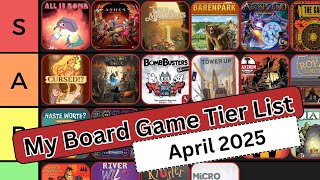
- absolutely love this game
- really really good
- haven't played it very often yet
- don't know where it will be in the long run
- could also go down to B depending on like how it will develop
Mechanics (from transcript analysis)
Video topics + discussion points
Quotes (from this video)
- Count of the Nine Estates. Um, a game people keep suggesting to me and I've played it over the years off and on and I think it's not bad.
- Distilled clear Srank. It's such an amazing game. I absolutely love this.
- Draftosarus, also the game I very much enjoy. I will give this an A. S would be too much, but it's such a cute and nice uh drafting game.
- Cluster. Uh you have um a circle made of like a rope like a ropes circle rope circle so to speak and everybody gets like the same number of magnets and you put the magnets in the middle and when you put down your last magnet you win.
- Exobase also a game that I will bring a video to you at some point.
- Magic Keys in English. I think um this is like a children game actually. It's a children's game, but we play like with like I think we were like four adults playing that.
- Malus Hotos. I just released a preview video for that for the Kickstarter campaign and I enjoyed this game a lot.
- Micro City is a pretty decent game in a small box. Um, but it's also nothing all too amazing, right?
- Reforest clear as this is an absolutely amazing game.
- Sally Face Strange Nightmares uh for the video game uh Sally Face and I found this game quite decent actually.
- Stone Spine Architects uh in the roleplayer universe. And I like this a lot. I will give this an A.
- Switch and signal. I'm a little conflicted on that one.
- Yatsi. Yeah, this is like a guilty pleasure, right? We all know it's not an amazing game, but Yatsi is the basis for like a lot of other games with this mechanism of rolling your like rolling your dice and then being able to reroll some of them twice.
- Buds and Blooms from Mark Tuck. Also a game that I enjoyed playing.
- And actually, you know what? I'm actually missing one game. I also played Wingspan.
- Wingspan would also be an S of course and would be up here.
References (from this video)

- Amazing game.
- Difficult to read the text on the cards.
- Font size is too small.
- Imperial Settlers
Mechanics (from transcript analysis)
Video topics + discussion points
Quotes (from this video)
- So, it's funny after after that happened, I went, 'What's their biggest songs?' And it was like summer breeze obviously.
- Sky Joe should not take an hour.
- But, you know, Sky Joe, great family game.
- It is such a great So, Sky Joe's great game. Flip seven with Avengers. Great game.
- It's the one thing in the middle about the pushing and everything.
- This is an under the radar type game. So, if you get a chance, definitely give it a play.
- The two things that really stand out about this to me is one, the revolving actions that you'll take.
- So, you're battling here. were thinking, 'How am I going to get these worship tokens so I can do these better actions?'
- The game will end as soon as somebody has placed all their tokens and rivers.
- It gave me the vibe of Small World, and I like the fact that there's a semi-ooperative in in this game.
- You are not joking about the Imperial Settller's font size.
- Damn it, I'm getting older.
- Nuance upon nuance that it's just puts a little twist in your regular trick taking game that is just going to really elevate a lot.
- Great family game.
- It's the memory element.
- Because she was always being told no in Hollywood because of her face and she was like they were constantly saying no to her and getting any show your your face is not the right shape d she said screw it I'll just do it myself.
References (from this video)
Mechanics (from transcript analysis)
Video topics + discussion points
Quotes (from this video)
- snake-like fashion of drafting
- symbiotic relationship, very nice
- I got to 25
- we're wheeling and dealing
- open production
References (from this video)
- Symbiotic dealer interactions between players
- Rich production and token economy
- The Thieves Den expansion feature for resource storage
- End-of-round scoring opportunities and multiple ways to gain VP
- High management complexity and token tracking can be heavy
- Gear/resource management led to a few disappointing rounds when certain combinations couldn't be executed
- state-building, resource management
- post-apocalyptic world
Mechanics (from transcript analysis)
- Card Drafting — Cards are revealed in a group and drafted in a snake order before each round.
- Distance-based actions — Actions require paying tokens and have a distance value that determines reach.
- End-game scoring — The game ends when a player reaches 25 points; end-round scoring then occurs.
- First player order — The first player is decided by a short roshambo (rock-paper-scissors) at the start.
- Open production — Some cards are 'open production' cards that allow building actions and resource generation.
- Production Phase — Each player collects workers, fuel/brick, and gray contact tokens, plus draws a card.
- Raising locations — Players can raise locations by spending weapons/guns and tokens to gain spoils.
- Token-driven deals — Blue, gray, and red tokens are spent to make deals, construct locations, or raise locations.
Video topics + discussion points
Quotes (from this video)
- snake-like fashion of drafting
- symbiotic relationship, very nice
- I got to 25
- we're wheeling and dealing
- open production
References (from this video)
- Straightforward engine builder with a simple card-based core system
- Easy to learn with depth
- Nice looking cards and nifty resource tokens
- Excellent and funny English-language rulebook
- Excellent multi-use card system providing many options
- Game ends just as you feel it's gearing up
- Typical post-apocalypse theme and setting
- Humanity attempting to rise from the ashes and create a domain within ruins.
- North America in the aftermath of an apocalypse, 30 years after the war ended.
- Imperial Settlers
- Arctic Scavengers
Mechanics (from transcript analysis)
- action selection — Players then alternate taking actions until they all pass.
- Area development — Developing requires brick or a development token and allows you to upgrade a region and score of a victory point.
- Card Drafting — Players draft cards from an open pool.
- Engine Building — Your state must work efficiently and effectively.
- Resource Management — The main resources are iron, guns, fuel and bricks with ammo being a wild card resource.
Video topics + discussion points
Quotes (from this video)
- hello and welcome to the 51st state
- in the aftermath of the apocalypse humanity attempts to rise from the ashes of North America
- the winner is the state with the most points at the end of the game
- if a card has a star on it like this it's part of your path to victory
- the main resources are iron, guns, fuel and bricks with ammo being a wild card resource
- the game uses the same core engine but has a lighter brighter theme and art
References (from this video)

- Gaining victory points for developing locations.
- Actions on locations and faction boards offer strategic choices.
- The game includes expansions (new era, winter) that can be mixed in.
- Players cannot target opponents who have passed.
- Raising an opponent's location requires spending red contact tokens and yields less than building.
- Unspent goods and tokens are generally returned to the supply during cleanup, with few exceptions for stored goods.
- forming your own state by conquering lands and businesses
- post-apocalyptic world
Mechanics (from transcript analysis)
- action selection — Players choose from seven possible actions on their turn or pass.
- Area Control — Players conquer lands and take over lucrative businesses to form their own state.
- Card Drafting — Players pick cards from a display during the lookout phase.
- Engine Building — Players build locations that provide ongoing benefits and can be enhanced by other buildings.
- Hand Management — Players are dealt cards and must choose which to keep and which to discard, with no limit to hand size during the game.
- Resource Management — Players manage resources such as bricks, fuel, guns, and iron, as well as contact tokens (red, blue, gray, universal).
- Set Collection — Players collect different types of symbols on locations to enhance their production.
- Take That — Players can attack rival gangs, and one of the actions allows players to 'raise' an opponent's location, turning it into ruins.
- Worker Placement — Players can place workers on opponent's locations with the 'open production' keyword to gain goods.
Video topics + discussion points
Quotes (from this video)
- In 51st state, you'll be working to expand your influence over a variety of different locations, gang members, and resources that will provide you with different benefits that you can use to enhance your own state as well as attack your opponents.
- The player with the most victory points at the end of the game will be the winner.
- The game is played over a series of rounds divided into four phases, beginning with the lookout phase.
- Building a location is an action that can be done in one of two ways.
- Another action you can instead take is called making a deal.
- Another action is raising and there are two ways to do it.
- Actions on locations that you've built.
- All factions also have a separate action found here that allows you to spend two workers to gain either a single brick, gun, fuel, iron, or draw a card.
- The game will continue until the round in which one of the players reaches or crosses 25 points.
References (from this video)
- Rich engine-building with broad expansion content
- Great variety and replayability through multiple expansions
- Complex rulebook; heavy on setup
- Iconography can be dense for newcomers
- Card-driven engine-building and resource management
- Post-apocalyptic United States / environment-altering factions
- Strategic, empire-building
- Innovation
Mechanics (from transcript analysis)
- Deck Building — Draft and build a deck to optimize actions and production
- deck-building — Draft and build a deck to optimize actions and production
- Engine Building — Develop a faction board for ongoing bonuses and income
- engine-building — Develop a faction board for ongoing bonuses and income
- market/deals — Generate resources and trade to fuel expansion
Video topics + discussion points
Quotes (from this video)
- I've been grinding to just really understand the game and get to a point where I feel very comfortable about putting out more content for glass Road
- Glass Road is so quick that you don't need to worry about that too often
- This game offers a lot of Randomness in the cards that come out
- it's a solo only game it's pretty easy to pick up
- the Mundus expansion to world wonders
- King Domino is a classic game
References (from this video)
- Engaging deck-building and action economy
- Tight scoring with opportunities for dramatic comebacks
- Rich thematic flavor with production and market tokens
- Can be heavy and lengthy for casual players
- Rules and scoring can be complex and intimidating for newcomers
- Expansion content (New Year) adds more complexity
- Resource management, engine-building, and faction development
- Post-apocalyptic rebuilding of a new faction after societal collapse
- Competitive, evolving board with card-driven actions
- Waves of the Galaxy
Mechanics (from transcript analysis)
- area advancement / redevelopment — Redevelopments allow transforming locations or abilities for victory points.
- combat / conflict — Direct or indirect combat elements through card plays and token effects.
- Combat: Deck/Hand — Direct or indirect combat elements through card plays and token effects.
- Deck Building — Players build a personal deck that determines actions and combinations for generating resources and taking moves.
- deck-building — Players build a personal deck that determines actions and combinations for generating resources and taking moves.
- Resource Management — Gaining and spending resources like bricks, weapons, and fuel to perform actions and score points.
- sabotage / interaction — Inter-player interactions include sabotaging opponents' factories or plans.
- Traitor Game — Inter-player interactions include sabotaging opponents' factories or plans.
- Worker Placement — Workers are placed and used to execute actions, gain resources, or develop the board.
- worker placement / action resolution — Workers are placed and used to execute actions, gain resources, or develop the board.
Video topics + discussion points
Quotes (from this video)
- good game well played
- I hope you've learned how to play 51st state
- we were neck and neck all the way up that track
References (from this video)
Mechanics (from transcript analysis)
Video topics + discussion points
Quotes (from this video)
- This video is brought to you by the 3minut board game patrons. Keep us independent by supporting us on Patreon.
- It's to talk these games out of my collection to say goodbye to them.
- The bigger the game boxes are, the easier they are to get rid of.
- The purpose of these videos is really catharsis for me.
- Two copies of Pandemic Legacy sheltered away.
- I have to thank my patrons and everyone who watches these videos for giving me this opportunity as well.
References (from this video)
- Compelling solo mode with an AI that challenges pacing and strategy
- Card drafting with three usable modes per card adds depth and flexibility
- Production-driven engine-building creates a tangible, recurring reward loop
- Location-based scoring and end-game trigger provide layered strategic planning
- Deal-building and token economy create meaningful choices each turn
- AI can accumulate VP through locations and automatic scoring, potentially outpacing the player
- Round-end resource waste is possible if storage is not secured or prioritized
- Rule comprehension and strategic planning can be dense for new players
- Early-game drafting balance may require nuanced understanding to optimize engine
- Component density and iconography might impose a learning curve
- engine-building, area control, and alliance-building within a ruined America
- post-apocalyptic United States, rebuilding a new society
- faction-driven reconstruction narrative with tangible location-based scoring and resource interplay
Mechanics (from transcript analysis)
- Card Drafting — each turn begins with drawing four cards; players choose one to keep, one to discard, and the remainder flow through the drafting sequence, determining immediate options and future opportunities.
- Card drafting and hand management — each turn begins with drawing four cards; players choose one to keep, one to discard, and the remainder flow through the drafting sequence, determining immediate options and future opportunities.
- Combat: Dice — after the AI’s turn, it executes automated attacks; card symbols determine whether an attack harms you or alters your board, with Rubble and Spoils mechanics shaping board state.
- combat/attack sequence against an AI opponent — after the AI’s turn, it executes automated attacks; card symbols determine whether an attack harms you or alters your board, with Rubble and Spoils mechanics shaping board state.
- deal-making and token economy — blue, red, and grey tokens enable deals, raises, and building actions; deals can grant free VP or other advantages at production rounds.
- end-of-round cleanup vs. storage — resources are cleared at the end of each round unless you possess storage, introducing a trade-off between rapid growth and retention of assets for future rounds.
- location-based scoring and end condition via VP — the objective is to reach 25 victory points; locations contribute to scoring, and bonuses from certain actions or deals can accelerate the pace toward the end condition.
- Multi-Use Cards — every card can be played in three ways: as an action, as a deal/raise mechanic using tokens, or as a direct resource/income source, enabling flexible play paths.
- multi-use cards and flexible actions — every card can be played in three ways: as an action, as a deal/raise mechanic using tokens, or as a direct resource/income source, enabling flexible play paths.
- production phase and resource management — production occurs automatically based on your current locations; you accumulate workers, bricks, grey tokens, and cards that enable future actions and raises.
- Resource Management — production occurs automatically based on your current locations; you accumulate workers, bricks, grey tokens, and cards that enable future actions and raises.
- spoils, rubble, and priority rules — when conflict occurs, certain outcomes become rubble or spoils based on a priority list; this affects what gets discarded or flipped and can shift control of locations.
Video topics + discussion points
Quotes (from this video)
- we are racing against that AI player to be the first to get to 25 victory points
- every car that's in your hand you can choose to play in three different ways
- the end of each round you clear out all the stuff that you accumulated unless you have a storage facility
- the AI attacks you
- production is probably my priority right now
- I'm gonna pay three and I'm gonna destroy one of the pubs because the spoils for a pub is three cards
References (from this video)
- Flexible ammo as wild card resource
- Strong endgame scoring potential via rubble and locations
- Diverse drafting and building options
- Aggressive interaction with AI adds tension
- AI can accumulate locations quickly
- Endgame can be lengthy and analysis-heavy
- Complexity may be steep for new players
- Resource management and faction building with combat and diplomacy
- Post-apocalyptic city-building competition across a war-torn state
- Dry, instructional narration of playthrough events
Mechanics (from transcript analysis)
- action drafting / card drafting — Drafting connection cards and action cards to plan turns
- Area Control — Gaining victory points from number of locations and their effects
- area control / location scoring — Gaining victory points from number of locations and their effects
- Card Drafting — Drafting connection cards and action cards to plan turns
- combat / attack — Attacking opponent's actions and destroying their cards using tokens
- Deck Building — Drafting and playing cards to acquire resources, actions, and buildings
- deck-building — Drafting and playing cards to acquire resources, actions, and buildings
- Resource Management — Managing bricks, gas, ammo, and workers to build and develop
Video topics + discussion points
Quotes (from this video)
- ammo is actually great because it is basically like a wild card
- building is always good in this game
- I just hit 24 victory points once I get to 25 the game's gonna be over
- it's 51st State thanks for watching
References (from this video)
- Crunchy puzzle with strong hand management and engine-building interplay
- Tight two-player balance through asymmetry (Mutants Union vs Merchants Guild) and token economy
- Narrative feel of a post-apocalyptic engine-driven race with satisfying chaining of actions
- Open production and development options create meaningful choices each turn
- Expands well with expansions; base game provides a solid, dense experience
- Can be space-intensive on the table due to tokens and multiple card zones
- Early game can feel punishing or slow as players gather tokens to build engines
- Two-player game can still be dense and occasionally slow due to heavy card/text interactions
- engine-building through multi-use cards, resource production, and area/territory feel via tokens and ruins
- post-apocalyptic city-state where factions contend for control and survival
- thematic, somewhat dystopian, with a strong emphasis on faction asymmetry and opportunistic card play
- Imperial Settlers
Mechanics (from transcript analysis)
- deals_and_rewards — making deals converts tokens into resources and VP over time; deals can be upgraded or converted into ongoing VP effects.
- develop_action — bricks and symbols enable development to upgrade existing cards, with rewards such as VP or new capabilities.
- engine_building — cards when built or activated generate resources and provide ongoing benefits, enabling players to chain combos across turns.
- hand_management — players curate a hand of production, feature, and action cards, then decide which to keep, discard, or destroy to optimize engine results.
- open_production_buildings — certain buildings can be activated by either player; involved in dynamic engine shaping and can be stolen/contested.
- ruins_and_development — ruins count as multiple icons and can be developed into more powerful cards, changing the board state and VP potential.
- token_economy — blue, gray, red, and other tokens are used to buy, build, and enable deals; tokens also power denial/interaction with opponents.
- two_player_turn_structure — players alternate actions with lookouts/turn milestones; end of round triggers and first-player token rotation influence pacing.
- victory_point_race — the game ends when someone crosses 25 VP; location points and post-round bonuses can swing the final tally.
Video topics + discussion points
Quotes (from this video)
- the game is a race to 25 victory points
- it's largely a multiplayer solitaire game
- the mechanics of the game present a great puzzle like it's like most hand management games
- the asymmetry between Mutants Union and Merchants Guild adds a lot of spice
- this is a puzzle that rewards careful resource conversion and timely upgrades
References (from this video)

- Rich card interactions and engine depth
- Familiar feel for fans of engine-building
- Appears to have saturation in replay value over time
- Some expansions needed to refresh the experience
- engine-building and deck-building
- post-apocalyptic faction-building
- deck-driven, card synergy with long-term planning
- Imperial Settlers
Mechanics (from transcript analysis)
- Deck-building / card-driven engine — Build and optimize a deck to generate resources and actions.
- Resource management / combat options — Trade and compete for resources; can engage opponents for value.
Video topics + discussion points
Quotes (from this video)
- there are stories in a giant book and it randomizes when you go down in the caves
- it's always a new adventure
- the one thing I like is the way that people can take people on missions
- it's got aspects of why I love Battlestar Galactica and the hidden Trader
- the stock market of this game
- it's still there, it's still a great game to play
- the Rondell is so neat
- you can lock out tiles if you take one of the scoring spaces
- the more cards you pull back to your hand when you recall them the better the benefit is
- the minis are really cute, this like cute chibi style
- the artwork and graphic design of this game it is just gorgeous
- it's fascinating to watch people and their logic for figuring out who is The Insider