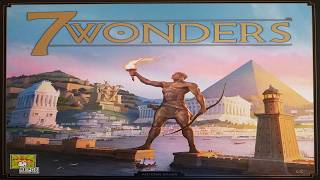
You are the leader of one of the 7 great cities of the Ancient World. Gather resources, develop commercial routes, and affirm your military supremacy. Build your city and erect an architectural wonder which will transcend future times.
7 Wonders lasts three ages. In each age, players receive seven cards from a particular deck, choose one of those cards, then pass the remainder to an adjacent player. Players reveal their cards simultaneously, paying resources if needed or collecting resources or interacting with other players in various ways. (Players have individual boards with special powers on which to organize their cards, and the boards are double-sided). Each player then chooses another card from the deck they were passed, and the process repeats until players have six cards in play from that age. After three ages, the game ends.
In essence, 7 Wonders is a card development game. Some cards have immediate effects, while others provide bonuses or upgrades later in the game. Some cards provide discounts on future purchases. Some provide military strength to overpower your neighbors and others give nothing but victory points. Each card is played immediately after being drafted, so you'll know which cards your neighbor is receiving and how her choices might affect what you've already built up. Cards are passed left-right-left over the three ages, so you need to keep an eye on the neighbors in both directions.
Though the box of earlier editions is listed as being for 3–7 players, there is an official 2-player variant included in the instructions.
Mechanics (from transcript analysis)

Video topics + discussion points
Quotes (from this video)
References (from this video)
Mechanics (from transcript analysis)
Video topics + discussion points
Quotes (from this video)
- That's insane to me.
- I get to be involved in those conversations.
References (from this video)
- Promising idea of simultaneous drafting with accessible play.
- Presents quick, memorable decision moments and city-building flavor.
- Illusion of hidden information often collapses quickly as players understand pools.
- Once optimal strategies are known, simultaneous reveals become routine.
- Resource system is forgiving to the point of reducing meaningful choices.
- Simultaneous drafting and civilization-building
- Ancient civilizations drafting cards to develop wonders
- Fast-paced, macro-level strategic drafting
- Ticket to Ride
- Dominion
- Wingspan
Mechanics (from transcript analysis)
- card drafting — Build a column of cards to gain resources and points.
- Resource management — Trade and manage resources to activate buildings and wonders.
- simultaneous drafting — Players pick and reveal cards in simultaneous rounds.
Video topics + discussion points
Quotes (from this video)
- BGG's rating system struggles with distinguishing between this is an excellent party game and this offers repeated strategic depth.
- Accessibility isn't the same as complexity. Beautiful components aren't the same as mechanical richness.
- Memorable first plays aren't the same as longevity. These games are genuinely excellent gateways.
- If you're brand new to modern board gaming, many of these are fantastic entry points. They teach mechanics painlessly and generate fun.
References (from this video)
- Widely accessible and quick to teach
- Scales well from 3 to 7 players
- Moderate luck with card splash
- civil development via card drafting
- Ancient world civilizations
- fast-paced civilization-building
- Castles of Burgundy
Mechanics (from transcript analysis)
- card drafting — Draft cards to build a civilization and earn resources and points.
- multiplayer card interaction — Cards chosen by players influence neighbors and scoring.
- simultaneous play / seating rotation — Draft in a way that accelerates play across rounds.
Video topics + discussion points
Quotes (from this video)
- The action selection and so whatever action you choose when it's your turn to choose everybody else also gets to take that action just on a lesser scale.
- the two player variant of this is perfection it gives you the exact same feel of a higher player count
- it's tight there's not a lot of time to do all the things that you need to do
- it's all about the math and it's all about the area control
- this game just stole the show on the drive home
References (from this video)
- fast and accessible entry point
- great for beginners
- high replayability
- depth may be limited for experienced players
- civilization-building and resource management
- Ancient world civilizations
- fast-paced civilization-building drafting
Mechanics (from transcript analysis)
- card drafting — draft cards to build structures and develop civilizations
- Compound Scoring — score across three ages with different cards and combos
- multi-age scoring — score across three ages with different cards and combos
- set collection — collect resources to build wonders and advance civilization
Video topics + discussion points
Quotes (from this video)
- This is the underrated gem.
- Let's do a giveaway.
- I love city building games.
References (from this video)
- Accessible and quick to teach
- Good gateway for families or casual gamers
- Often perceived as shallow or less deep compared to heavier euros
- Limited strategic depth for some players
- civilization development; building wonders
- Ancient world civilizations building wonders and competing for points
- card drafting with simultaneous planning
- Blood Rage
Mechanics (from transcript analysis)
- card drafting — Draft cards to gain resources and build wonders for points
- Resource management — Manage coins and resources to fuel development
- set collection — Assemble a collection of cards to maximize scoring potential
- Set collection / engine building — Assemble a collection of cards to maximize scoring potential
- simultaneous action planning — Players secretly plan their turns in a shared draft environment
Video topics + discussion points
Quotes (from this video)
- the two ultimate wind conditions are nice but the rest now pass
- all locks and only a little bit of substance
- pandemic legacy is a game played over 12 months in an involving story that I wrote spoiled base basically pandemic you make to play a lot
- I don't mind pandemic I just don't want to play it again after playing it once
- the clues in the name
- it's a contrived under-produced game
- I love this game the first couple of times I played but I played it as a true gateway game into Euro games
- now no I don't want to try it with the expansion I don't care if it makes the game better I want to play a proper euro I'm all grown up
References (from this video)
- Fits large groups well
- Easy to learn, quick to teach
- New version may be more approachable; discussion notes it's a newer entry
- Seven Wonders Architects
- King of the Table
Mechanics (from transcript analysis)
- Combat: Dice — Dice-driven group play; discussed as a large-group friendly, easy-to-learn title
- unknown — Dice-driven group play; discussed as a large-group friendly, easy-to-learn title
Video topics + discussion points
Quotes (from this video)
- The power of math.
- anecdotal evidence, but sometimes it's all we got.
- This is a Dice Tower push and the dice tower is pushing these games.
- It's a good warm-up. Or, hey, it's only 40 minutes before dinner.
- Disarms people a bit when you pull the map out of the box.
- I really do want to upgrade Bomb Busters.
References (from this video)
- classic drafting mechanic
- solid family-friendly gateway with expansions
- civilization-building via card drafting
- ancient civilizations around the world
- light, accessible
- Concordia
Mechanics (from transcript analysis)
- closed drafting — pick one card from a hand and pass the rest to a neighbor
- color-coded card types — green, yellow, blue, red, purple cards provide different effects
- Resource management — build using resources produced by cards
Video topics + discussion points
Quotes (from this video)
- Cascadia is my number 10, it is a fantastic puzzly tiling game
- the veil of Eternity this game is so good
- Twist on Hadrian's Wall in Paladins feels similar but fresh
- Wayfarers of the South Tigress, carvan mechanic is one of my favorite things in a game
- Castles of Burgundy is my number one game of all time
References (from this video)
- Iconic gateway with many expansions
- Fast play with high player interaction
- Some balance concerns with expansion cards
- Engine-building through card drafting
- Ancient civilizations and wonders
- Heroic, quick-to-play
Mechanics (from transcript analysis)
- allegedly table-driven scoring — use multiple scoring mechanisms via guilds and wonders
- card drafting — draft cards that provide resources and synergies
- Compound Scoring — use multiple scoring mechanisms via guilds and wonders
- set collection — collect cards to build civilizations and wonders
Video topics + discussion points
Quotes (from this video)
- My heart is set on Miyabi it's happening
- Paint the Roses is gonna win
- Seize the Bean that's the winner
- I think I'm going with Katan y'all
- I think Cascadia is still going to be my choice
References (from this video)
- engaging engine-building feel with dice-driven decisions
- solid player interaction through military dice and endgame competition
- quick setup and scalable with players
- can feel abstract for players who want heavy euro crunch
- some strategies may hinge on luck of dice outcomes
- ancient civilizations and wonder construction
- civilization-building with dice for a modular wonder-building puzzle
- puzzle-driven with some interaction via end-game scoring
Mechanics (from transcript analysis)
- Combat: Dice — choosing military dice can pressure neighbors by launching attacks with different defenses.
- dice drafting — rolls determine actions and spaces to fill on a personal puzzle board.
- dice drafting/roll-and-build — rolls determine actions and spaces to fill on a personal puzzle board.
- engine building — built pieces enable more efficient future actions and synergistic combos.
- engine-building — built pieces enable more efficient future actions and synergistic combos.
- military dice interaction — choosing military dice can pressure neighbors by launching attacks with different defenses.
- multiplayer solitaire with interaction — players mostly solve their own boards, with limited competitive interaction at ends of boards.
Video topics + discussion points
Quotes (from this video)
- The game itself at face value feels very simple, but there's a lot of different nuances you want to be thinking about as each location has its own abilities.
- And the person who gets to trigger that actual effect is the one who has majority at that location.
- I've really enjoyed my time with Silos, and this is a game I'd really pull out only for three to four player groups.
- This is Moon Colony Bloodbath—engine-building survival with a communal deck that creates constant tension.
References (from this video)
- diverse dice outcomes with strategic planning
Mechanics (from transcript analysis)
- dice drafting — Draft and assign dice to build a civilization-inspired tableau.
- dice_drafting — Draft and assign dice to build a civilization-inspired tableau.
- set collection — Acquire cards/resources to fulfill ongoing needs and combos.
- set_collection — Acquire cards/resources to fulfill ongoing needs and combos.
Video topics + discussion points
Quotes (from this video)
- a simple but tricky area control game.
- a ladder climbing game, but with a fun little twist.
- a fast-paced word game.
- simple but hilarious betting game.
- Moon Colony Bloodbath, a deck building game about survival, and woo, so good.
References (from this video)
- All expansions fit in one box with organizers
- Keeps track of multiple packs and expansions
- Price of dedicated insert may be high
- Some expansions require careful sorting to avoid clutter
- Card drafting to build a civilization
- Ancient world civilization building
- Competitive engine-building with simultaneous play
- Arcadia Quest
Mechanics (from transcript analysis)
- card drafting — Players select cards from a hand to shape their civilization
- multi-expansion handling — Box insert accommodates base game and expansions
- Set collection/engine building — Combining cards to trigger bonuses and build engines
Video topics + discussion points
Quotes (from this video)
- these inserts are fantastic
- I think these inserts are fantastic. And they certainly do their job and they make setting up the game, storing it, and putting away so much easier.
- All right, so for the last insert, we're going to take a look at Suburbia.
- Thanks for watching.
References (from this video)
- Timeless classic with deep strategic depth and broad appeal
- Rich expansion content adds replayability
- civilization development with wonder construction
- ancient civilizations
- classic, widely-known themes
- Sushi Go
- Sushi Go Party
Mechanics (from transcript analysis)
- closed drafting — Draft a card from a hand and pass; build civilizations with varying card types and wonders
- set collection — Develop a civilization by drafting cards that contribute to science, resources, and wonders
- set collection / tableau — Develop a civilization by drafting cards that contribute to science, resources, and wonders
Video topics + discussion points
Quotes (from this video)
- Remember, you are somebody's reason to smile.
- I absolutely love this game. It is in my top 100 games of all time.
References (from this video)
- Civilization building, resource management, competition
- Ancient civilizations vying for glory and famous wonders
- Abstract to thematic progression
Mechanics (from transcript analysis)
- card drafting — Players draft cards to build structures and wonders.
- Resource management — Players manage resources to pay for buildings and wonders.
- set collection — Players collect sets of resources and structures for points.
Video topics + discussion points
Quotes (from this video)
- Seven Wonders to finally open up that
- Can't wait to share them with you.
References (from this video)
- Turns are fast and easy to teach compared to the heavier card-based cousin
- Asynchronous wonder boards add variety and can keep momentum strong
- Presents a satisfying, puzzle-like decision-making loop
- Balance can feel stressed or fractured in certain play configurations
- In multiplayer games it can feel like multiplayer solitaire until combat engages
- In seven-player games, interaction with several players can be limited and less visible
- Civilization development and wonder construction through resource management and quick actions
- Tabletop session focusing on building civilizations through a dice-driven engine
- Abstract, competitive, puzzle-like with light thematic framing
- Rolling Wright
- Seven Wonders (base game)
Mechanics (from transcript analysis)
- Action Following — Use the die-chosen action to gain resources, activate abilities, or trigger bonus effects.
- action selection — Use the die-chosen action to gain resources, activate abilities, or trigger bonus effects.
- Board scoring — Tick off boxes on the board to unlock bonuses and accumulate victory points.
- Combat option — Optional military or conflict element that introduces interaction with neighbors.
- dice drafting — Roll dice and choose one to claim its quadrant action, shaping your strategy for the round.
- resource collection — Gaining resources based on the chosen die result and the quadrant you land in.
- Turn pacing and player interaction — Turns are quick but effectively paced by the slowest player; interaction varies with player count.
- Wonder board interaction — Asynchronous wonder boards provide different paths and pacing, influencing choices.
Video topics + discussion points
Quotes (from this video)
- It's an interesting and fun puzzle.
- Turns are quick.
- The game's a lot quicker and easier to teach than its heavier card playing cousin.
- Multiplayer solitaire until somebody selects the combat option.
- In a seven-player game, you don't really care about what four of the players are doing.
- I would happily play this again, but I may come back to this one in the future.
References (from this video)
- classic, highly replayable
- well-suited for tournament play
- acquired taste for newer players
Mechanics (from transcript analysis)
- deck-building / draft — draft cards to build a civilization and military/commerce scoring
Video topics + discussion points
Quotes (from this video)
- Castles of Burgundy oh my goodness I love this game so much
- Cascadia is definitely one of the lighter of the bunch
- I would freaking love in the future to compete in this
References (from this video)
- tight, iconic card-drafting experience
- great with larger groups
- new players can struggle with optimal paths
- wonders and building an ancient metropolis
- ancient civilizations
- medium-scale civilization-building
- Catan
- Tapestry
Mechanics (from transcript analysis)
- card drafting — draft a hand of cards to build structures and wonders
- engine building — chain discounts and benefits via card choices
Video topics + discussion points
Quotes (from this video)
- this is where it's at
- Scout has this really interesting aspect of you can only play cards that are next to each other in your hand to try to beat things
- it's a great escalation
- such an amazing feeling of like oh my gosh we're gonna go another round
- you either lose because you miscommunicate with your own team twice or you win because you intercept the other team's code
References (from this video)
- Supports seven players, making it suitable for large groups and families
- Flexibility with player count and social interaction
- Notoriously difficult to teach for first-time players
- First-time play can be less enjoyable due to teaching friction
- Civilization-building through resource management and card drafting
- Ancient civilizations across the ancient world; building wonders as civilizations rise
- Competitive/abstract progression with public drafting
- Seven Wonders Duel
- Seven Wonders Architects
- Seven Wonders Dice
Mechanics (from transcript analysis)
- card drafting — Players draft cards from a hand and pass the remainder to the neighbor each round across three ages.
- card_drafting — Players draft cards from a hand and pass the remainder to the neighbor each round across three ages.
- Compound Scoring — Three ages with evolving card sets and scoring opportunities.
- multi_age_structure_and_scoring — Three ages with evolving card sets and scoring opportunities.
- Resource management — Acquire and spend resources to play cards and build structures.
- resource_management — Acquire and spend resources to play cards and build structures.
- set_building_and_wonder_construction — Construct buildings and wonders to generate resources and points.
Video topics + discussion points
Quotes (from this video)
- The way that I feel about Seven Wonders
- it's not a fun game to teach
- I want a game that you can play and it's fun the first time you play it
- Seven Wonders Dice, best Seven Wonders game made so far, except maybe dual.
- Best Seven Wonders rendition to date and plays Seven People beautifully.
References (from this video)
- Very transparent and accessible for kids and new players
- Open information reduces teaching friction and speeds onboarding
- Fast play that scales well to seven players
- Dice-based progression of civilizational milestones
- A dice-driven interpretation of the Seven Wonders universe
- transparent/open information; roll-and-build feel
- Seven Wonders
- Seven Wonders Duel
- Seven Wonders Architects
Mechanics (from transcript analysis)
- board_visibility_and_open_information — All players can see each other's boards and each die's effect/costs.
- dice drafting — Dice are rolled into a tray; players select a die showing its cost; must pay gold to claim it.
- dice_drafting_and_costing — Dice are rolled into a tray; players select a die showing its cost; must pay gold to claim it.
- turn_based_progression_with_marking — Players mark progress on a shared board by selecting dice outcomes; progression is transparent from turn one.
Video topics + discussion points
Quotes (from this video)
- The way that I feel about Seven Wonders
- it's not a fun game to teach
- I want a game that you can play and it's fun the first time you play it
- Seven Wonders Dice, best Seven Wonders game made so far, except maybe dual.
- Best Seven Wonders rendition to date and plays Seven People beautifully.
References (from this video)
- Flexible for larger groups
- Smooth pacing with quick rounds
- Deep strategic choices without lengthening play time
- Requires 3+ players to shine
- Setup and rule familiarity can be steep for newcomers
- History and civilization building through card drafting
- Ancient civilizations vie for glory and wonders
- Abstract, competitive civilization development
- It's a Wonderful World
Mechanics (from transcript analysis)
- card drafting — players pick from a common pool to build their tableau and score
- set collection — players aim to acquire sets of cards that boost scoring and resources
- Simultaneous action selection — rounds occur with all players selecting actions at once
- Simultaneous Actions — rounds occur with all players selecting actions at once
Video topics + discussion points
Quotes (from this video)
- Gen Con is the biggest convention in the US
- I would love to hang out with you guys there and play some games
- I'm just so so excited to do it
References (from this video)
- Iconic theme and accessible for new players
- Good interaction and direct competition for stages
- Can drag on a bit on larger player counts
- Score tracking can be complex for new players
- building wonders
- Ancient World civilizations
- card drafting with set collection
Mechanics (from transcript analysis)
- card drafting — Players draft cards to gather resources and build wonders
- set collection — Aim to collect types of cards to assemble wonders
Video topics + discussion points
Quotes (from this video)
- the number of centimeters away you are from the location is the number of points you will score at the end of the game
- lowest score wins
- the score you score will be two times the number of centimeters we are from the right question answer the right answer
- it's blackout Hong Kong yeah it's by Alexander V
- not luck of the draw this game is seeing those combinations and being able to work through them on the board
References (from this video)
- Easy setup
- Quick to play and replayable
- Engaging engine-building
- Satisfying building combos
- Tight puzzle feel
- Limited player interaction
- Civilization and city-building through dice
- Ancient world city-building
Mechanics (from transcript analysis)
- Combo-based building — Certain buildings trigger powerful synergies as you collect the right resources.
- Compound Scoring — Military actions influence scoring through opponents' defenses.
- Dice rolling — Rolls determine resources and actions to build your city.
- engine building — As you acquire resources, you unlock a growing set of actions that enable stronger future plays.
- engine-building — As you acquire resources, you unlock a growing set of actions that enable stronger future plays.
- Flip/Roll and Write — Players record results on a sheet to track buildings and scores.
- military scoring — Military actions influence scoring through opponents' defenses.
- roll-and-write — Players record results on a sheet to track buildings and scores.
Video topics + discussion points
Quotes (from this video)
- In this game, you'll be chucking dice
- Seven Wonders Dice is a roll and write game.
- Setup is incredibly easy.
- It's quick and when you finish, it's super easy to just play again.
- I really do enjoy how you build a small engine as you collect resources.
- There isn't a lot of player interaction in this game, but the little that there is is great.
References (from this video)
- lightweight and accessible
- family-friendly with quick play
Mechanics (from transcript analysis)
- card drafting — Players draft cards to build their civilization while competing for resources
- set collection — Players collect cards representing diverse civilizations to build structures and score points
Video topics + discussion points
Quotes (from this video)
- Life finds a way.
- AI can't do that.
- Talk is cheap because supply always exceeds demand.
References (from this video)
- Fast setup and quick rounds that scale to large player counts
- Simultaneous drafting keeps everyone engaged and reduces downtime
- High depth of strategy within a short playtime
- Strong replayability with unique wonders and variety of cards
- Works well with up to seven players; strong social dynamics
- Can be too complex for very casual or new gamers due to iconography and card types
- Teaching can be challenging; players must understand prerequisites and resource rules
- Strategic depth can be influenced by luck of the draft and neighbor blocks
- Theme can feel secondary to mechanics for some players
- Civilization building through wonder construction, science, infrastructure, and military.
- Ancient world civilizations across three ages, building wonders and competing for resources and military influence.
- Abstract, game-driven, with light thematic flavor that fades into mechanics.
- Ticket to Ride
Mechanics (from transcript analysis)
- card drafting — Players choose a card from their hand and pass the rest to their neighbor; all players draft simultaneously each age.
- Compound Scoring — Scoring comes from science, structures, wonders, and guilds; certain cards unlock late-game bonuses.
- engine/building tableau — Each player builds a personal tableau of cards that unlocks future options and points.
- military conflict — Military strength is compared with neighbors at the end of each age to award points or drawbacks.
- Resource management — Players collect and manage resources to pay costs for building cards and advancing their wonder.
- scoring via diverse card types — Scoring comes from science, structures, wonders, and guilds; certain cards unlock late-game bonuses.
- tableau building — Each player builds a personal tableau of cards that unlocks future options and points.
Video topics + discussion points
Quotes (from this video)
- Seven Wonders plays well across a wide variety of player accounts mainly because of its use of simultaneous card drafting
- it's not the easiest game in the world to teach
- I love Seven Wonders but man it is so hard
- we recently reviewed Ticket to Ride and it's a game I feel very similarly about
- the game remains interesting after many plays largely because there's a lot of room for your strategy to play out differently
References (from this video)
- Lots of action
- Interesting card play
- Complex to follow
- Less enjoyable than 7 Wonders Duel
- Building civilizations
- Ancient Civilizations
- Strategy
- 7 Wonders Duel
Mechanics (from transcript analysis)
- card drafting — Drafting cards to build civilization
- Simultaneous Play — All players play simultaneously
Video topics + discussion points
Quotes (from this video)
- Foster the Meeple - a channel all about board games
- we have our team jeff team jamie patreons who are going to be voting on what the loser has to do
- i love res arcana res arcana is quickly becoming one of my favorite games
- adult where's waldo
- knocked our socks off
- i love it
- so much fun
- winter is coming
- board game city up in here
References (from this video)
- Too complex for 4-6 year olds
- Referenced as example of inappropriate game for children
- Not age-appropriate
- Building civilizations
- Ancient civilizations
- Complex strategy
Mechanics (from transcript analysis)
- Heavy game — Complex civilization building
Video topics + discussion points
Quotes (from this video)
- a series of videos where I take a bunch of different possible scenarios some of them provided by you the viewers and I shuffle them up into a deck of cards I reveal a scenario and roll a dice to see how many players I've got
- I got in lots of trouble last time for using the word dice as a singular so we'll be sticking with die as long as I remember today
- everything economic uh that I really really love seems to cap out at five players
- I can't imagine how long it would take so I think that would probably ruin ruin game
- frankly I played that with uh two players once and we gave up after about seven hours
- there's some good ones but most games before 1995 would ruin game night if you tried to play them today
- you're not allowed to speak to each other and you're playing against the time so it's very frantic
- the only way you're able to communicate is by tapping this wooden token to say look I need you to do something
- I think Mysterium would fall apart if they didn't speak the language and that's odd isn't it because it does isn't a game that has any text in it
- I think a terrible idea there's not that much interaction and the game gets longer with each player that you add
- I don't understand the people who put down a big you know they stick down Scythe in front of kids or boast about the fact their four-year-old can play sides
- there's no reason to be playing um Snakes and Ladders or or Candyland I would say not that Candyland is a big thing in the UK
References (from this video)
Mechanics (from transcript analysis)
- tableau building — players assemble and optimize a personal tableau of cards representing wonders, resources, and actions.
- tableau construction — players assemble and optimize a personal tableau of cards representing wonders, resources, and actions.
Video topics + discussion points
Quotes (from this video)
- tableau builders feature a wide and diverse range of markets and currencies
- the beauty of this mechanism is the chain reactions that it creates when you take your turn
- it's a really nice feedback loop
- the world feels bigger than your own little player area
- tableau building is a core, solid mechanic that many designers build around
References (from this video)
- Fast to teach, quick rounds
- Accessible for new players
- Can drag with larger player counts
- Iconography can confound newbies without guides
- Civilization development through card drafting
- Ancient civilizations competing to build wonders and structures
- Fast-paced, competitive, light-to-moderate depth
Mechanics (from transcript analysis)
- card drafting — Draft cards to build your civilization and wonders
- Compound Scoring — Many routes to victory via different structures and wonders
- Scoring Variety — Many routes to victory via different structures and wonders
- set collection — Gather resources and build relatively simple combos
- set collection / resource management — Gather resources and build relatively simple combos
- Simultaneous Actions — Fast rounds that keep tempo high
- simultaneous play / quick turns — Fast rounds that keep tempo high
Video topics + discussion points
Quotes (from this video)
- Spirit Island's fantastic it is one of my favorite co-ops of all time
- it's not for everybody
- I love teaching games
- I just want a nice Speedy game
- The Crew is a great trick taking game
- Scythe is not a fun one to teach
- it's got the most stuff in it which also makes it the harder one to play with Noobs
- ironically the first game I ever played at a board game club that got me into the hobby was Seven Wonders with leaders included where I actually won the game
- it's a fantastic fun game
- I've played this game a lot
References (from this video)
- well-known, plays up to 7 players
- fast with multiple players
- not considered a party game
- civilization building via cards
- ancient civilizations
- abstract civilization development
- Forgotten Waters
- Watergate
Mechanics (from transcript analysis)
- card drafting — players draft cards to construct structures and advance their civilization
Video topics + discussion points
Quotes (from this video)
- it's very important that kids and grown-ups enjoy it
- you either lose together or win together
- menara would be a great unique option for this
- one guy is a quick polyomino speed game ... it's a bit thinky
- the avengers robin hood is a storytelling adventure game
- it's a story game where you are pirates and try to fulfill your destiny
- you can play magic maze... it's a real-time experience
- don't blame the kid if you lose
References (from this video)
- Iconic in the evolution of card drafting; quick to play; scalable
- Can feel repetitive after many plays without variants
- Card drafting and civilization building
- Ancient civilizations
- Fast-paced, light-to-moderate strategy
- Civitas
- Century: Spice Road
Mechanics (from transcript analysis)
- card drafting — Draft cards to build civilizations and score points
- Simultaneous action selection — Players reveal actions at the same time, creating fast table dynamics
- Simultaneous Actions — Players reveal actions at the same time, creating fast table dynamics
Video topics + discussion points
Quotes (from this video)
- This goes to Times Up Title Recall. Ryan's now calibrating how many more plays.
- Carcassonne is a classic. I would totally be down to still play Carcassonne.
- The OG of Quacks of Quedlinburg. We have the OG of it.
- This is Summoner Wars being a fantastic game.
- The decks have their own identities. Day-long KeyForge experiences are special.
- The 3D Santorini with god powers is just incredible.
References (from this video)
- scales well from 3 to 7 players
- easy to teach with substantial depth
- can feel luck-driven at times
- table presence can be large
- building wonders and advancing civilizations
- ancient civilizations
- rapid, simultaneous card drafting with depth
- 7 Wonders Duel
Mechanics (from transcript analysis)
- card drafting — players draft cards to build wonders and score points
- set collection — points come from combinations of cards and wonders
- Simultaneous action selection — players pick cards at the same time, speeding play
- Simultaneous Actions — players pick cards at the same time, speeding play
Video topics + discussion points
Quotes (from this video)
- all the interactions between players are positive
- this list is designed around people just getting into the Hobby
- easy to learn and once some people know the game you can mix them up
- Forbidden Island teaches the basics of cooperative gaming and can be used as a launching point to other games in the Forbidden series
- the Resistance is probably the best of them
- Seven Wonders scales incredibly well from three to seven players
- One worker mechanic is an awful lot of fun
- Memoir 44 is the most accessible of them mostly because it feels like playing with toy soldiers
- Small World looks really dinky and inviting but it's a mercenary and brutal game
References (from this video)
- fast-paced drafting with approachable rules
- good for groups; scalable
- can feel cutthroat with negative interaction through drafts
- some players dislike card-passing dynamics
- card drafting and engine building
- ancient civilizations building wonders
- quick, competitive drafting with theme)
Mechanics (from transcript analysis)
- card drafting — Draft cards to build a personal tableau and score.
- set collection — Assemble combinations of cards to maximize points.
- Set collection/engine building — Assemble combinations of cards to maximize points.
Video topics + discussion points
Quotes (from this video)
- the interaction essentially comes from sitting around a table and working on this puzzle together and then comparing your relative skill
- it's interesting to see where Cooperative games are going now
- these are the true solo games you could play by yourself with no problems at all
References (from this video)
- Introduced drafting as a core mechanic in a huge way
- Influential on hobby development
- civilization building
- ancient wonders
- historical progression
Mechanics (from transcript analysis)
- civilization building
- drafting
- Simultaneous action selection
- Simultaneous Actions
Video topics + discussion points
Quotes (from this video)
- We are coming up at the end of a decade and that's an important thing
- There have been monumental shifts, an absolute monster releases this decade
- The game that has most inspired my imagination and stretched my strategic muscles in the most satisfying way of the 2010s
- It changed the way that gamers thought about games as experiences
- No more was it about a game that I could replay eight bajillion times but one in done experiences or disposable experiences that convey a specific story
- When gaming historians are looking at the most important games that have come out amongst the last 100 years I honestly think that pandemic legacy is going to be one of those milestone games
- Gloomhaven has brought so many new people to the Hobby because the mainstream success of it
- As far as a game that is this in depth and this meticulously put together could appeal to as many as possible gloomhaven has succeeded like no other game has
References (from this video)
- Engaging drafting with quick play
- Accessible and appealing theme
- Some players seek deeper strategy
- Civilization building
- Ancient civilizations
- Card drafting with simultaneous play
- Sushi Go
- Fairy Tale
Mechanics (from transcript analysis)
- card drafting — Each turn, players pick one card and pass the rest.
- city building — Develop a civilization by constructing structures and wonders.
Video topics + discussion points
Quotes (from this video)
- be more boring if the audience anticipated a particular plotline
- the beauty of wingspan is not that it's innovative it's that it's gloriously masterfully boring
References (from this video)
- Accessible and engaging drafting with neighbor interaction
- Strong replayability and variety via leaders and expansions
- Balanced playtime, scales well with player count
- No single dominant strategy emerges every game
- Some players may prefer tighter or more thematic eurogames
- Civilization development through card drafting and wonders
- Ancient civilizations across the known world as the ages progress
- Historical-cultural strategy with modular chosen paths
- Sushi Go!
Mechanics (from transcript analysis)
- card drafting — Players select a card from a hand and pass the remaining cards to the next player.
- neighbor interaction — Pay attention to neighbors’ choices to avoid being blocked and to leverage interactions with adjacent players.
- Set collection / card-based engine building — Players collect resources and build wonders to score points.
Video topics + discussion points
Quotes (from this video)
- There’s really no one clear best strategy.
- The feel around the table is a little bit more interactive than just a normal drafting.
- This is the first dice builder I’ve ever played.
- Sandboxy open it does feel like it’s got some bloat to it, but man, it’s still incredibly fun.
- The final play together finished really, really strong.
References (from this video)
- Dice tray is excellent and functional
- Gameplay flows quickly with simultaneous actions
- Asymmetric boards add variety and replayability
- Accessible teach after a quick learning curve
- Fast loops and clear end-game tension
- Theme is minimal; limited immersion
- Iconography can be challenging to teach to newcomers
- End-game can end quickly, reducing long-term growth on some plays
- Dice randomness may be more pronounced than in the card version
- Civilization-building with dice; minimal theme
- Civilization-building around ancient wonders
- dice drafting / roll-and-write style with asymmetric boards
- Seven Wonders
- Seven Wonders Duel
- Lord of the Rings Duel
Mechanics (from transcript analysis)
- Asymmetric player boards — Each player board provides unique bonuses and paths, altering strategy.
- asymmetric player powers — Each player board provides unique bonuses and paths, altering strategy.
- dice drafting — Players select dice from a central pool as they are rolled and placed, shaping their options each round.
- dice drafting and rolling — Players select dice from a central pool as they are rolled and placed, shaping their options each round.
- End-game trigger by section completion — Game ends when a player completes all three sections; other players finish round.
- Resource management — Crossing off symbols to track resources; paying costs to acquire additional dice.
- Resource management and costs — Crossing off symbols to track resources; paying costs to acquire additional dice.
- Scoring via buildings, technologies and die-powered bonuses — Different tracks yield points; endgame bonuses for completing areas.
- simultaneous action — Turns are resolved concurrently rather than strictly turn-based.
- Simultaneous Actions — Turns are resolved concurrently rather than strictly turn-based.
Video topics + discussion points
Quotes (from this video)
- Seven Wonders Dice is a pretty easy game to learn and play for gamers.
- The dice tray is awesome.
- Not as strong as the first two in my opinion.
- The theme is almost gone.
- The game ends when someone fills in three whole sections.
- I am very nervous about the resource part.
- Time on the table was very happy with that.
References (from this video)
- Quick gameplay (20-25 minutes)
- Simultaneous play
- Colorblind friendly
- Historical Civilization Development
- Civilization Building
- Seven Wonders
- Seven Wonders Duel
Mechanics (from transcript analysis)
- Flip/Roll and Write — Players roll dice and mark scoring on a sheet
- Roll and Write — Players roll dice and mark scoring on a sheet
Video topics + discussion points
Quotes (from this video)
- All aboard the mama train!
- I always say a game is a great game and it can be even greater with dice.
References (from this video)
- familiar concept with a new dice twist
- short play sessions
- skepticism about necessity of a dice variant
- dice-driven wonder construction
- Ancient world
- rolled, then drafted
- Seven Wonders
- Seven Wonders Duel
Mechanics (from transcript analysis)
- Dice rolling — roll dice to acquire resources and take actions
- dice_rolling — roll dice to acquire resources and take actions
- set collection — collect cards/tiles to maximize points
- set_collection — collect cards/tiles to maximize points
Video topics + discussion points
Quotes (from this video)
- We love Santorini. It is so much fun.
- Lightning Train is a bag builder.
- Mystery Flux is fun, but it has player elimination quickly.
- The cover art is amazing.
- Earth Abundance expands Conservas with seeds and sprouts.
- Message in a Bottle is a unique packaging idea.
References (from this video)
- Engaging card drafting creates dynamic player interaction and opportunities for bluffing.
- Clear strategic guidance with concrete tips for decision-making across ages.
- Multiple board sides offer viable options and boost replayability.
- Diverse card types (military, culture, science) provide multiple viable paths to scoring.
- Military pressure and defensive options add strategic tension and neighbor interaction.
- civilization development, competition for wonders
- Ancient world civilizations and wonder construction
- instructional with strategic, light-humored commentary and think-aloud guidance
Mechanics (from transcript analysis)
- age progression — Three ages with distinct card pools and interactions shaping strategy.
- card drafting — Players draft cards from a hand to build structures and advance through ages.
- Compound Scoring — Military cards affect neighbors' scores, influencing risk-reward decisions.
- cost reduction / free plays — Certain cards provide discounts or free resources (e.g., aqueduct) to accelerate builds.
- military scoring — Military cards affect neighbors' scores, influencing risk-reward decisions.
- Resource management — Trade and manage resources to pay for cards and build efficiently.
- set collection — Collect symbols from science cards to build bonuses and score points.
- set collection / science cards — Collect symbols from science cards to build bonuses and score points.
- Wonder construction — Construct Wonders in several stages across ages for victory points and special effects.
Video topics + discussion points
Quotes (from this video)
- if you don't roll the dice you'll never win the game oh unless it's a game that doesn't have dice in which case don't roll any people
References (from this video)
- excellent fit for larger groups
- tight drafting mechanics with meaningful choices
- strong tension around decisions and neighbor competition
- lighter weight may not satisfy heavier gamers
- group size can constrain certain strategic options
- Civilizational growth through card drafting and interactive neighbor dynamics.
- Ancient civilizations competing to build wonders and advance on a shared civilization track.
- strategic drafting with simultaneous play and tension around neighbor competition
- Seven Wonders Architects
Mechanics (from transcript analysis)
- card drafting — Players select and pass hands of cards to shape their civilization.
- card_drafting — Players select and pass hands of cards to shape their civilization.
- neighbor interaction — Choice and strategy are influenced by what neighbors are building and passing.
- neighbor_interaction — Choice and strategy are influenced by what neighbors are building and passing.
- Resource management — Balancing cards, coins, and resources to optimize structures.
- resource_management — Balancing cards, coins, and resources to optimize structures.
- Simultaneous Actions — All players act within a round concurrently, creating fast-paced tension.
- simultaneous_play — All players act within a round concurrently, creating fast-paced tension.
Video topics + discussion points
Quotes (from this video)
- this is the card game for me.
- it's a great system.
- the collector's edition is amazing.
- this is the best party-dungeon hybrid we've played.
- it's old now at this point in the board game world but I will always down to play a game of Seven Wonders.
- I still am surprised that this is the game that's ranked number one on BoardGameGeek.
- There is nothing like it that I've played.
- the way the dice, cups, and cards interact creates moments of suspense that are unforgettable.
- you could not have made this easier for me to select.
References (from this video)
- Elegant combination of drafting and engine-building
- Rich lore via card flavor and iconic wonders
- Numerous expansions and a long shelf-life
- Iconography can be a learning curve for new players
- Civilization-scale development through card drafting
- Ancient civilizations and world-building with a civilization-building arc
- Icon-driven, compact engine-building in a fast, neighbor-interaction-centric format
- Leaders expansion
- babel expansion
Mechanics (from transcript analysis)
- card drafting — Draft cards from your hand and pass them to your neighbor each round.
- engine building — Develop science, culture, military, and wonders to maximize scoring.
- Engine-building / civ progression — Develop science, culture, military, and wonders to maximize scoring.
- tableau building — Play cards to build your tableau and generate resources and points.
- tableau-building — Play cards to build your tableau and generate resources and points.
Video topics + discussion points
Quotes (from this video)
- this is an absolutely astonishing achievement the bloku designers came up with the idea himself
- it's replaced crocodile for us
- you really should get hold of this one
- the greatest real-time game ever made and made even better by the new iteration
- Seven Wonders is one of the greatest board games card games ever made
- Obsession is without doubt one of the finest board games that we've played for a very, very long time
- Cyclades is the complete package
References (from this video)
- Excellent color combinations
- Evocative title
- Images of seven wonders around border
- Nice central statue
- Looks like proper civilization game
- Civilization building
- Ancient world
- Historical
Mechanics (from transcript analysis)
- card drafting — Civilization game about seven wonders
Video topics + discussion points
Quotes (from this video)
- The box cover makes a promise to the customer
- Every box cover tells me what I'm going to be doing and how I'm going to be feeling
- This artist is one of the best board game artists working in the industry right now
- This is how you do it
- This cover is a mess
- Striking iconic design
- The box cover is not selling the game