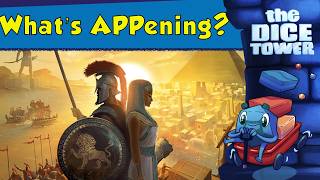
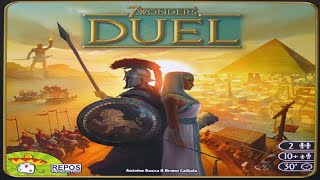
In many ways 7 Wonders Duel resembles its parent game 7 Wonders. Over three ages, players acquire cards that provide resources or advance their military or scientific development in order to develop a civilization and complete wonders. What's different about 7 Wonders Duel is that, as the title suggests, the game is solely for two players.
Players do not draft cards simultaneously from decks of cards, but from a display of face-down and face-up cards arranged at the start of a round. A player can take a card only if it's not covered by any others, so timing comes into play, as it can with bonus moves that allow the player to take a second card immediately. As in the original game, each acquired card can be built, discarded for coins, or used to construct a wonder. Each player also starts with four wonder cards, and the construction of a wonder provides its owner with a special ability. Only seven wonders can be built, though, so one player will end up short.
Players can purchase resources at any time from the bank, or they can gain cards during the game that provide them with resources for future building; as they are acquired, the cost for those resources increases for the opponent, representing the owner's dominance in this area.
You can win 7 Wonders Duel in one of three ways: each time you acquire a military card, you advance the military marker toward your opponent's capital (also giving you a bonus at certain positions). If you reach the opponent's capital, you win the game immediately. Or if you acquire six of seven different scientific symbols, you achieve scientific dominance and win immediately. If none of these situations occurs, then the player with the most points at the end of the game wins.
- military, science, and wonder cards
- civilization-building in a two-player duel
Mechanics (from transcript analysis)
Video topics + discussion points
Quotes (from this video)
- Stellar is not a super well-known, well-talked-about game. I found it randomly in a local board game store.
- it's basically a two-player only game, asymmetric
- Lost Cities is a hand management game
- Patchwork is a tight, solid Uwe Rosenberg design
- Santorini is my favorite abstract game
- Castles of Burgundy... there's nothing like it for me in two-player
- Race for the Galaxy is my number two two-player game of all time
References (from this video)
- luck can come into play in ways that circumvent strategy
- possible frustration due to card/pyramid reveal choices
Mechanics (from transcript analysis)
Video topics + discussion points
Quotes (from this video)
- we're going to be doing our updated top 50 games of all time pretty soon
- be critical about the things you love because nothing is perfect
- healthy debates and discussions
- we can all be looking at things we love more critically
- this is a really important exercise
- don't tell me anything you like about it or why it's your number one; tell me what you don't like about it
References (from this video)
- Santorini
- El Dorado
Mechanics (from transcript analysis)
Video topics + discussion points
Quotes (from this video)
References (from this video)
Mechanics (from transcript analysis)
Video topics + discussion points
Quotes (from this video)
- it's the meanest game in my top 10, no question
- there's just always something exciting to do on your turn
- it's an absolute hit
- it's the best social deduction experience I've ever had
- the shortest playing time
References (from this video)
- clean, fast-paced two-player experience with minimal mental accounting
- strong thematic flavor via map-like decisions and territorial considerations
- deep strategic depth with multiple viable paths and emergent play across sessions
- high production value and tactile components (in the context of two-player, premium feel)
- depth can feel shallower for players seeking long-term, tournament-grade depth
- expansions may be more impactful than base game for sustained play
- symbol literacy is a potential barrier for newcomers, though Lore Duel is argued to have lower entry
- not as table-presence-oriented as some larger-box games
- civilization development, resource management, and wonder construction with a focus on efficient, compact decision-making
- Two-player civilization-building within a shared geopolitical and cultural framework inspired by the Seven Wonders universe
- tableau-driven, symbolic; abstracted progression through cards representing resources, military, science, and wonders
- The Lord of the Rings: Duel for Middle-earth
Mechanics (from transcript analysis)
- card drafting — pyramid-style drafting system where players select and remove or reveal cards from a shared structure
- Military Track — combat-based scoring via a linear military track with direct impact on victory potential
- Resource management — managing coins and symbols to acquire cards and build structures that generate ongoing benefits
- science/wonder synergy — specialized card types (science) and wonder-building effects that grant points or strategic advantages
- set-collection and tableau-building — building a personal tableau of cards that synergize toward strategic paths (military, science, or points)
Video topics + discussion points
Quotes (from this video)
- Zero. The designers replaced it with three equally valid instant win paths.
- Turns are snappier because nobody's doing mental accounting.
- You're racing for the quest, getting the fellowship to Mount Doom, or building alliances by collecting tokens from six races, or controlling all seven regions.
- In Lot, you're thinking about concentrating armies in one defensible region with fortresses there.
- Lore Duel is architecturally superior for most people buying today.
References (from this video)
- Elegant two-player design
- tight, fast play with meaningful decisions
- Can hinge on early science strategy; counterplay exists but timing matters
- civilizational development and technological arms race
- two-player civilization advancement
- highly abstract, card-driven
Mechanics (from transcript analysis)
- card drafting — players draft cards to build their civilization and pursue goals.
- science/victory paths — strategies focus on combination of cards to unlock science and military progress.
Video topics + discussion points
Quotes (from this video)
- It's not engagement. It's everyone doing their own puzzle in the same room.
- Gorgeous production quality, but multiple simultaneous subsystems that can feel complex initially for new players.
- Turn order determines a lot in this game's economy.
- One wrong move with how the link network system works, and you've completely invalidated your entire strategy.
- The clue giver walks a razor line between clever and intuitive that new players haven't calibrated.
- Eight-hour day commitment, full group attendance, full mental energy required throughout.
References (from this video)
- Concise, engaging two-player format
- Proves you don't need long plays to be immersed
- Fewer players and less broad strategic scope than the full game
- two-player civilization development and resource management
- Ancient civilizations
- Lord of the Rings Duel for Middle Earth
Mechanics (from transcript analysis)
- closed drafting — A compact two-player version of Seven Wonders with built-in drafting and building mechanics.
- two-player civilization-building — A compact two-player version of Seven Wonders with built-in drafting and building mechanics.
Video topics + discussion points
Quotes (from this video)
- Mental health is something that is really important to us and ever since then it's kind of been a big proponent of our channel and of our community.
- This allows us more opportunities to do topics like that on the podcast.
- bi-weekly podcast every other Friday.
- Carcasson being my true love in my wife's wedding vows.
- Seven Wonders Duel showed how you don't need to play a three-hour game to be completely enraptured by a board game.
- Gloomhaven opened doors to ongoing legacy and campaign experiences for us.
- There is now an entire audience that might not have found us because they don't consume YouTube or watch video content; podcast opens that door.
References (from this video)
- condensed experience of Seven Wonders
- great two-player civilization building with clever mini-cards
- some players prefer the original for its scale
- Seven Wonders
Mechanics (from transcript analysis)
Video topics + discussion points
Quotes (from this video)
- this time on allies or enemies we are counting down our top 10 small box games for two players
- these are great games at low cost that don't take up too much room
References (from this video)
- Two-player efficiency and tension
- Nice thematic fit with timer experiments
- Drafting pressure can be intensified by timer
- Some players may prefer higher interaction
- Array
- ancient civilizations
- Splendor
Mechanics (from transcript analysis)
- card drafting — players draft cards to develop civilizations and wonders
- set collection — gems/resources are used to build wonders
- set collection/resource management — gems/resources are used to build wonders
Video topics + discussion points
Quotes (from this video)
- I love playing with the chess timer
- it's addicting
- my final say is to at least try using a chest timer for one of your two player games
- we could finish brass Birmingham under 75 minutes
- this chest timer is My Little Secret Weapon to use with a handful of friends to get through our favorite games faster
- I definitely think we could do it more games less time
References (from this video)
- deep strategic options with elegant drafting
- multiple viable strategies and counter-strategies
- compact playtime with substantial decision space
- pyramid drafting can be intimidating for new players
- scenario planning requires careful memory/monitoring of cards already seen
- duel civilization-building with constrained choice
- ancient civilizations engaged in civilizational development
- compact, strategic interplays with multiple win conditions
- Lord of the Rings version (variant)
Mechanics (from transcript analysis)
- card drafting — three ages with pyramid-like drafting where players select visible cards
- engine building — cards enable engines toward military, science, and civilian victory paths
- hidden victory points — three distinct routes to victory: military, science, or civil points
- multi-path victory — three distinct routes to victory: military, science, or civil points
Video topics + discussion points
Quotes (from this video)
- top 10 two-player games of all time
- the top 10 were very difficult because I think there's a lot of factors that I had to consider
- the production quality really matters when a game feels like Parks-level polish
- the core of this game is adapting
- it's a cozy fun game you can play with somebody else
- we can open this game and play it immediately maybe not having played it in a while
- the clicky clacky of the tile H yeah good
References (from this video)
- tight and elegant two-player design
- high strategic depth with clear win conditions
- streamlined rules relative to multi-player cousins
- steeper learning curve for new players
- some players may miss the direct interaction of larger player counts
- civilization advancement through wonder-building
- two civilizations racing to build wonders
- two-player strategy with card drafting and resource management
- Rumble Nation
- Lord of the Rings Duel
Mechanics (from transcript analysis)
- card drafting — Draft cards to build wonders and develop your civilization.
- card_drafting — Draft cards to build wonders and develop your civilization.
- competition_tracks — Military and scientific progress as key victory pathways.
- Resource management — Utilize resources and coins to fulfill development requirements.
- resource_management — Utilize resources and coins to fulfill development requirements.
- Time track — Military and scientific progress as key victory pathways.
Video topics + discussion points
Quotes (from this video)
- Board games evolved. Will we evolve with them or will we get lost in the shuffle?
- Games get remade, reprinted, and importantly, rethemed all the time.
- Chaz, you're in control now.
References (from this video)
- Shows that two-player games can be deep and engaging
- tight, fast play with meaningful decisions
- May lack the grand scale of the base Seven Wonders for some players
- civilizational progress, resource management
- Two ancient civilizations competing for supremacy
- compact, strategic drafting
- Ticket to Ride
- Dominion
Mechanics (from transcript analysis)
- dice drafting — Players draft from a common pool to build civilizations.
- resource management and card drafting — Set collection and card-based engine building with little randomness.
- two-player drafting — Players draft from a common pool to build civilizations.
Video topics + discussion points
Quotes (from this video)
- Exploding Kittens was raised $8 million on Kickstarter for many years. It opened the floodgates for other publishers to look at Kickstarter as a viable medium.
- I don't think we'd have Gloomhaven without Exploding Kittens.
- Blood on the Clock Tower is the de facto social deduction game taking shape.
- It's a beautiful game about nature reserves.
- ARCs has done very very well and other games in the leader lineup as well as the sister company.
References (from this video)
- compact, two-player take on the Seven Wonders concepts
- engaging and accessible for two players
- some expansions add complexity that change balance
- contrast to main Seven Wonders with card drafting in center
- ancient world two-player civilization
- short, strategic engine-building
- Seven Wonders
Mechanics (from transcript analysis)
- card drafting — draft cards from a shared board to build wonders.
- Resource management — spend resources to activate cards and build wonders.
Video topics + discussion points
Quotes (from this video)
- "Cascadia is a fantastic game"
- "Time's Up is such a fantastic game"
- "Lacrimosa is a great game Francis and I really enjoyed it"
- "Architects of the West Kingdom... I love this game"
- "Kid-friendly, cozy and cute, Creature Comforts is the cutest thing"
- "Thank you so much for including me in this Charity Auction"
References (from this video)
- tight two-player engine with elegant constraints
- replayable with different strategies and wonders
- balanced, highly regarded duel experience
- some players prefer the base Seven Wonders experience with more interaction
- civilization-building through card drafting and wonders
- antiquity civilizations
- micro-simulation with competitive tension
- Seven Wonders
- Qwirkle Duel
Mechanics (from transcript analysis)
- drafting / strategic card selection — two players draft cards to build wonders and advance civilization while competing for wonders
- hand management — limited hand space and card visibility create a high-information game with bluffing elements
Video topics + discussion points
Quotes (from this video)
- "tile placement and open market..., it's a smooth and perfect tile placement game"
- "Cascadia is a fantastic game that you can play with everyone"
- "endless winter paleo Americans is wide and thinky; a big, ambitious euro"
- "mind management is the best sort of one game you can buy"
- "production is insane—deluxe, beautiful components"
- "unsettled is a giant puzzle with every planet different"
- "Iki is a tremendous Euro game I absolutely love"
References (from this video)
- Unique two-player drafting experience
- Varied paths to score through wonders and science
- Balancing and planning can be disrupted by distraction
- Learning curve for drafting patterns and table dynamics
- Civilization-building through card drafting
- Ancient civilizations in a two-player duel
- Two-player, table-wide interaction with card uncovering
Mechanics (from transcript analysis)
- card drafting — Two-player drafting with open/hidden card patterns and uncovering.
- military conquest and scoring — Military strength can influence the duel with opponents.
- set collection — Acquire resources and build cards to advance Wonders and score.
- Set collection and resource management — Acquire resources and build cards to advance Wonders and score.
Video topics + discussion points
Quotes (from this video)
- the real meat of the game is that first phase which is a real-time tile laying game
- Saving Grace with Galaxy Trucker is the game gets better the worse you are at it
- the D10 from Hell the single most evil die in board game history
- it's a Scrabble killer
- Friday is just a really clever small deck building game that's solo only
- I will always overindulge in piracy
References (from this video)
- Tight duel abstraction with strong interaction around card drafting
- Elegant engine-building through a pyramid mechanic
- Two-player centric design may limit experience for larger groups
- Blocking and pacing can be harsh if you’re unlucky with reveals
- short, competitive civ-building with card pyramids
- Ancient civilizations vying for supremacy via wonders.
- engine-building from a card pyramid with indirect interaction
Mechanics (from transcript analysis)
- card drafting — Draft from a depicted pyramid of cards to build your engine.
- Card drafting/selection — Draft from a depicted pyramid of cards to build your engine.
- pyramid exposure — Taking a card reveals new options for the next player, adding tension.
- Resource management — Accumulate stone, wood, brick, and other resources to buy cards and triggers.
Video topics + discussion points
Quotes (from this video)
- We absolutely adore this game. It's super super fun.
- the big Mayan calendar in the middle
- you can place a worker on the symbol that matches the god card.
- This is a big deck building game where you are going to have a different nation.
- Every game I feel like is a little bit different because the board map will change.
- Civolution is very good.
References (from this video)
- efficient two-player design
- tight playtime
- some players may prefer more interaction/additional flavor
- civilization development and wonder-building
- Ancient civilizations competing to build wonders
- historical/abstract
Mechanics (from transcript analysis)
- asymmetric two-player competition — direct competition via military and science tracks with limited direct conflict
- card drafting — players draft cards to build their tableau of structures and wonders
- resource management / set collection — players manage resources and coins to activate cards and gain bonuses
Video topics + discussion points
Quotes (from this video)
- I'm primarily a solo gamer when I'm not playing solo I'm actually usually playing either at a game night with a whole lot of people or at a game Club at my school with my students
- the best way to start with downsizing my collection was to think about what I really never use
- there are only couple of exceptions in terms of two-player games I plan to keep
- that thing is a treasure that people and our family will fight for after I die
- so definitely keeping that one
- I have seven Wonders Duel here
References (from this video)
- two_player_exclusive
- best_version_of_seven_wonders
- unique_pyramid_mechanic
- strategic_card_access
- excellent_two_player_game
- jamie_not_huge_fan
- difficult_to_get_to_table
- jeff_loves_but_jamie_less_interested
- wonders
- civilization
- ancient_monuments
- 7 Wonders
Mechanics (from transcript analysis)
Video topics + discussion points
Quotes (from this video)
- no guilt no shame no mercy
- it is pure magic pure gold
- build like a mortal win like a god
- tiny box biggest table presence experience
- this is a game i wouldn't want to play at higher than two
- jamie knows when she's one and i can see it in her face
- i have a very difficult time comparing games that are that drastically different
- castles of burgundy is heavier therefore i put castles of burgundy at one
- i know myself well enough by now you know i've got 34 years into this body i know i know what i'm into
- don't be a meanie or weenie it's okay to hate things
References (from this video)
- Smooth, fast drafting with deep strategic choices
- Strong two-player design with tension
- 7 Wonders
- Twilight Struggle (implied classic drafting contrast)
Mechanics (from transcript analysis)
- drafting — Draft cards to build a civilization in a two-player duel.
- Resource management — Manage resources and military/science tracks to gain advantages.
- resource/track management — Manage resources and military/science tracks to gain advantages.
Video topics + discussion points
Quotes (from this video)
- I love how streamlined this game is.
- it's a drafting style game as you're trying to build up the civilization of cards
- one world worthy of all the hype
- this engine builder
- it's the crunchiness
- this is widely considered to be one of the best if not the best economic style board game of all time
- it's a joy to play
- you are destined to love it
References (from this video)
- well-designed two-player variant
- streamlined rules
- not as expansive as base game
- civilization building
- Ancient civilizations with wonders
- thematic but streamlined
- Patchwork
- Sushi Go
Mechanics (from transcript analysis)
- drafting — two-player exclusive drafting that differs from the base game.
- set collection — collect cards to build engine and points.
- set_collection — collect cards to build engine and points.
Video topics + discussion points
Quotes (from this video)
- Two-player only games tend to lend themselves to deduction games
- I could play deduction games like Mr Jack all day
- plenty of scope for new stuff
References (from this video)
- Civilizations
- Wonders
- History
Mechanics (from transcript analysis)
Video topics + discussion points
Quotes (from this video)
- 170,000 logged plays... almost 500 times each day - how can this be the most played game
- the news must be fake in 365 days
- by the mission 35 you're like are we even playing the same game
- you have to go fast but the faster you go the closer the corner gets
- took something classic trick taking games been around for hundreds of years and made it into something more modern
- a lot of people play solo and if you play game solo it's much easier to get the gaming group together
- what's on the board stays on the board
References (from this video)
- condensed, elegant two-player design
- deep strategic depth for a ~30 minute game
- clear sense of progression and multiple viable paths to victory
- not as approachable to casual players compared to other two-player fillers
- civilization building, competition, and exploration
- Two-player civilization-building conflict inspired by the Seven Wonders universe
- tight, competitive engine-building with direct interaction
- Seven Wonders (base game)
Mechanics (from transcript analysis)
- card drafting — Players draft cards to build their tableau and advance their civilization.
- military vs science vs culture scoring — Three primary victory conditions requiring balance and strategic tradeoffs.
- set collection — Managing resources to construct buildings and advance science, military, and culture.
- set collection / resource management — Managing resources to construct buildings and advance science, military, and culture.
Video topics + discussion points
Quotes (from this video)
- it's a lovely slice of bluff and Double Bluff
- the presidency can switch hand many times as players try to get the best deal for themselves
- how much corruption can you get away with
- it's very easy to get into it, plays in about 30 minutes and yet has an incredible depth of strategy
- Pantheon is a solid expansion; it adds a few extra elements without overcomplicating things
- the gods are powerful, copying symbols or boosting science can create big moments
- Checkpoint Charlie works well for what it is a simple speed deduction game
- there's so much going on in this game that it's very hard to pull off thought out moves
References (from this video)
- excellent two-player design
Mechanics (from transcript analysis)
Video topics + discussion points
Quotes (from this video)
- one of the best two-player games ever
- it's not amazing it's just fun
- it's an amazing deduction game it's really hard to get
References (from this video)
- tight two-player design that preserves the feel of the original
- fast play with meaningful decisions
- engaging combat and science paths
- counterpart may be too tight for some players new to drafting
- civilization-building with direct head-to-head tension
- ancient civilizations in a two-player strategic duel
- structured drafting with symmetric play
- Seven Wonders
- Lost Cities
Mechanics (from transcript analysis)
- multivariable victory paths — players pursue scientific, military, or civic milestones
- pyramid/drafting card layout — cards are drafted from a face-down pyramid; decisions affect both players
Video topics + discussion points
Quotes (from this video)
- it's really quick five minutes to teach and play
- the art is just so clean and the color scheme is so pleasing to the eyes
- you're busy rolling Yahtzee dice but you're attacking each other
- it's a role-playing game
- Lost Cities is a fantastic gateway game
References (from this video)
Mechanics (from transcript analysis)
Video topics + discussion points
Quotes (from this video)
- Seven Wonders Duel is one of my favorite games of all time. Period.
- The beauty of Seven Wonders Duel is extraordinary amount of tension and opportunity cost in all you do.
References (from this video)
- Tight two-player experience
- Elegant, accessible rules for a head-to-head strategy
- Some players miss the original game's feel
- Less scaling for more players
- Construct wonders and develop science/culture
- Ancient civilization-building duel
- Abstracted historical flavor
- Seven Wonders (the original), Race for the Galaxy (card-driven drafting context)
Mechanics (from transcript analysis)
- Contrasting pathways — Two players push toward different victory conditions
- deck-building / card drafting — Each player selects cards to build structures and wonders
Video topics + discussion points
Quotes (from this video)
- you can't stop
- the more people are into it, the better it is
- it's a Dice Tower essential
- a masquerade of classic and modern designs
References (from this video)
- iconic two-player distillation of Seven Wonders
- better version of original game
- theme comes to life
- brilliant drafting system
- tight economy
- three-way tug-of-war tension
- incredibly accessible
- understandable immediately
- one of favorite games of all time
- favorite two-player game
- ancient civilizations
- wonder building
- cultural development
- Seven Wonders
Mechanics (from transcript analysis)
- drafting
- Economic system
- military race
- pyramid card reveal
- Race
- science race
- victory point race
Video topics + discussion points
Quotes (from this video)
- there are a lot of great games and there are a lot of great games that play excellently at two players
- so simple and so elegant and so refined and yet so puzzly and ingenious
- one of the best tactical miniatures games out there without any miniatures whatsoever
- the thing is is that if you sell in bulk you get extra bonuses but if you sell early then you get the most valuable versions
- it gives you so much to consider and be cognizant of as you are drafting every single card but it is incredibly indelibly accessible
References (from this video)
- Limited, meaningful choices; encourages forward planning; interactive tension
- Drafting civilization cards for scoring
- Ancient civilizations
- historical strategy
- Santa Monica
Mechanics (from transcript analysis)
- positional drafting — drafting cards from a grid where access is limited by position and revealed options.
Video topics + discussion points
Quotes (from this video)
- positional drafting is one really clever way of reducing the number of available choices
- you've got limited choices which is great because it means you're not going to sit there for ages thinking about all these options
- catch-up mechanism is essential in any game really
- i really enjoy real-time mechanism when it works and when it's simple when i understand what's going on
References (from this video)
- extremely accessible for two players
- variety and strategic depth in a compact package
- highly replayable with strong theme
- some players feel it lacks the grandeur of the original Seven Wonders
- civilization building via drafting and card development
- Ancient civilizations, two-player civilizational race
- compact, elegant, accessible two-player experience
- Seven Wonders
Mechanics (from transcript analysis)
- Resource management — collect cards and resources to build wonders
- reveal_and_tradeoffs — hidden choices and revealed cards affect strategy
- set_collection_and_resource_management — collect cards and resources to build wonders
- two_player_card_drafting — draft cards in a streamlined two-player format
Video topics + discussion points
Quotes (from this video)
- "the greatest tabletop simulation of city building that i've played today"
- "the comfort food of board games"
- "the primo area control game"
- "it's one of the best euro games"
- "my favorite donald x game and one of my favorite abstract games of all time"
- "Five Tribes is easily one of the most played games in my collection"
- "it's 7 wonders duel it's so much better than 7 wonders itself"
- "this is the best of the best when it comes to the descent system"
- "it is the best space opera game out there"
- "it is my number one favorite game that is at least five years old"
References (from this video)
- civilizational progress and science/war balance
- ancient civilizations in a head-to-head duel
- abstracted civilization-building
Mechanics (from transcript analysis)
- card drafting — build a civilization by drafting cards to gather resources and points
Video topics + discussion points
Quotes (from this video)
- I've been jack and I'll see you next year
- this is one of the best looking games in the biz
- thank you so much for supporting the cardboard Herald