
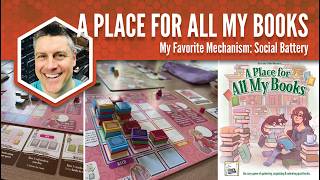


















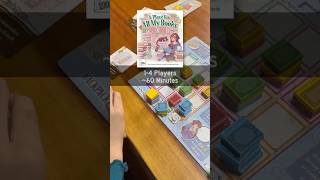


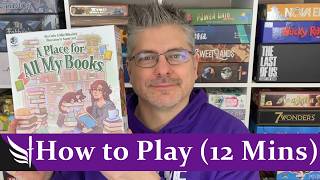





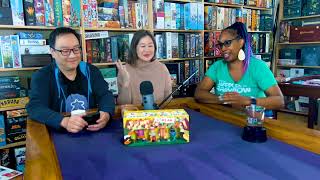









A Place for All My Books is a puzzley book gathering, sorting, and organizing game in which players arrange stacks of books in different rooms of their apartment as personal projects. When done, they can admire their accomplishments and gain their rewards – not least of which is renewed energy, which they can then spend to head out into the village...to pick up more books!
This competitive game for 1-4 players feels rather zen as you play. The organizational puzzles are easy to accomplish, with the challenge being how many of them you can accomplish all at once to optimize each "admire" action.
A Place for All My Books includes a solo mode in which you must beat the game's rival: Penelope Eveready, an untiring extrovert who seems to be grabbing all the books you had wanted.
—description from the publisher
- Themed, cozy aesthetic with books, libraries, and a home-life vibe that many players find endearing and charming.
- Accessible door for a lighter, puzzle-focused worker-placement with a strong color/stack-management core.
- Strong visual and tactile cues (kitties, accessories, color-coded stacks) that are appealing and provide satisfying moments of pattern completion.
- Moments of vivid player banter and table-talk that enhance live-stream engagement and replay value.
- Rule clarity is inconsistent, leading to frequent discussion about what counts as a valid move or how refill and endgame bonuses interact.
- Stacking and refilling mechanics can be fiddly and prone to misinterpretation in multi-player games (especially 4-player), slowing down rounds.
- Some players found the engine complex for a 'cute' theme and felt the game could benefit from a clearer glossary and FAQ.
- Endgame scoring can feel punishing or opaque without careful tracking and mutual agreement among players.
- Array
- Modern day domestic setting focused on home life and a local neighborhood with a library, bookstore, and village shop.
- Casual banter with playful, self-aware commentary; meta jokes about rule interpretation and social dynamics.
- Boop
Mechanics (from transcript analysis)
- Admire / Reward Actions — Admire actions on the player board grant rewards (e.g., social battery, points, or other bonuses) for completing certain conditions or projects.
- Endgame Scoring / Scoring by Objectives — Endgame scoring is driven by meeting a set of major objectives (e.g., one plus book in each space, no adjacent same-color books, two-plus tall stacks, three matching books on the nightstand) plus completed projects and other bonuses.
- Item Cards / Shopping / Village Shop — Three in-game shops (library, bookstore, village shop) purchase items and trigger bonuses; acquisition costs are paid with social battery or other resources; some actions trigger refills and extra benefits.
- pattern matching — The core puzzle revolves around arranging and grouping books by color and position to satisfy pattern-based objectives (tall stacks, color adjacencies, color coverage).
- Purple Cards / Wild Materials — Purple books act as wilds, and their color can be changed for the current turn; they also tie into scoring and board states when used strategically.
- Resource management — A temporal resource (social battery) governs when players can leave the house and perform town actions; battery levels rise and fall with actions and events.
- Resource Management (Social Battery) — A temporal resource (social battery) governs when players can leave the house and perform town actions; battery levels rise and fall with actions and events.
- Set Collection / Drafting (Book and Project Management) — Library draws five books; players select and keep some, building a hand of books and projects; shelves in the bookstore and shop purchases are tied to these selections.
- Stack Management / Sorting / Gathering — Players manipulate stacks of books via actions like 'sort', 'gather', and 'redistribute', moving books between stacks and spaces, with limits on stack height and per-action movement.
- Stacking and Balancing — Players manipulate stacks of books via actions like 'sort', 'gather', and 'redistribute', moving books between stacks and spaces, with limits on stack height and per-action movement.
- Tokens: Kittys — Cat tokens (lucky kitty, red kitty) are placed to award points based on color configurations in rooms.
- worker placement — Players place markers to take actions in the town and at home, triggering resource gain, gains of books, and progression toward end-game objectives.
Video topics + discussion points
Quotes (from this video)
- This game is a worker placement pattern matching game where we have to have enough social battery to get out of the house to go to town.
- This sounds cool because it's not that hard to do.
- This game is very silent like the library cosmic and you are slapping cheese all over my face.
- I'm never leaving the house.
- Library draws five books from the bag, keep two of them, and deal one to each shelf in the bookstore.
- The three core shops — the library, the bookstore, and the village shop — drive the engine of the game.
- Admire and you have the most yellow, which we all start with, you get three social battery.
- Two plus tall stacks where all the books are the same color.
- Purple books are wild; top of the stack, treat purple as that color till the end of turn.
- I'm going to rest and gain more projects.
- This game feels like when you read too many books — it’s adorable but a bit chaotic.
- I'm never leaving the house — the game basically keeps you at home with tasks and projects.
References (from this video)
- Beautiful art and bookmark tokens
- Accessible components with clear color-coding and shapes
- Solid solo mode integration and four-player support
- Quality packaging and components
- A Penelope piece arrived bent and requires flattening
- Some components came bent or not packaged snugly
- Yellow vs gold on top makes some bookmarks harder to see
- Array
- Home library
- Informative, enthusiastic unboxing narration
- Boop
- Hi-Fi
- Shoo
Mechanics (from transcript analysis)
- Card-driven actions / card-based objectives — Cards represent projects and actions that players acquire to gain points
- deck/card management — Multiple decks (rival deck, player cards, projects, major accomplishments) are used during play
- Resource management — Players manage books as resources on a shelf to meet requirements and score points
Video topics + discussion points
Quotes (from this video)
- A room without books is like a body without a soul.
- A book is a gift. You can open again and again.
- Once you have read a book you care about, some part of it is always with you.
- One who carries a book with a bookmark in it is in two places at the same time.
References (from this video)
- Book collection, social interaction, and life management within a cozy, domestic-to-community arc.
- In a city setting with an apartment space and a village market where books are gathered, sorted, and exchanged to complete projects and score victory points.
- instructional/tutorial
Mechanics (from transcript analysis)
- Admire — Gain social battery and complete any little projects in your hand; rewards are shown on completed projects; purple books count as wild under certain conditions with the right card in front of you.
- bag building — Draw a set of books from the bag and place them into your backpack or on the shelf according to the placement rules; the library controls how many books you can draw and where they go.
- Bookstore action — Choose the smallest, medium, or largest shelf; pay the required social battery; take books from that shelf into your backpack and draw the little project card from that shelf into your hand; future bookshelf adjustments ensure three shelves exist; books added to backpack can be placed in either slot in any order.
- Exchange — Swap books between your nightstand and the bag; move books from the bag to your backpack as part of the exchange.
- gather — Move books from several different spaces in one stack; you may take the top book from multiple stacks, up to a total stack height of six books; you can continue taking from a stack you've already drawn from; stacks cannot exceed six books; tokens may move with stacks, but do not count as books.
- Leave the house — Costs five social battery; when a player leaves the house, the sun marker advances; then you move your meeple to a village space and resolve that action.
- Library action — Draw a set of books from the bag and place them into your backpack or on the shelf according to the placement rules; the library controls how many books you can draw and where they go.
- Major accomplishments & scoring — Claim major accomplishments as you complete requirements; gain immediate rewards; score points for books, completed little projects, and other special cards; end-game scoring also factors in remaining social battery and color diversity.
- Nudging/park — If you attempt to take an action where another player sits, you nudge them into the park and gain two social battery.
- Ordering — Pick up one stack and distribute it over several spaces; you may place books on top of any stack or empty space, but you cannot add more than two books to a single stack or space; tokens can move with the stack, but tokens do not count toward the two-book limit.
- Read a book — Take any book from your apartment and place it on top of your nightstand.
- Rest — Draw two little project cards from the deck, then discard down to five little project cards in hand.
- Sort — Pick up one stack and distribute it over several spaces; you may place books on top of any stack or empty space, but you cannot add more than two books to a single stack or space; tokens can move with the stack, but tokens do not count toward the two-book limit.
- Trading — Swap books between your nightstand and the bag; move books from the bag to your backpack as part of the exchange.
- Village shop action — Gain other neat stuff cards; you may choose among face up or face down options and resolve immediate effects attached to the card.
Video topics + discussion points
Quotes (from this video)
- You will spend time in your apartment, gathering, sorting, and admiring your book collection until you charge your social battery up enough to go to the village to buy and exchange books at the local bookstore and library.
- Okay, let's look at the one thing we haven't covered so far. Major accomplishments. These can be claimed once per player as soon as they are completed.
- And that's how you play a place for all my books.
References (from this video)
- Beautiful, diverse artwork and production value
- Thematic depth that resonates with introverts
- Strategic yet approachable puzzle feel
- Introvert social battery and recharge cycles while collecting books
- Apartment rooms; book collecting, sorting, and organization
- Puzzly, domestic-life themed with social commentary
Mechanics (from transcript analysis)
- End scoring via room placement — Scores based on layouts and completed goals across rounds
- Energy/renewal mechanic — Renewed energy allows returning to the village to acquire more books
- location-based actions — Visit locations to gather books and complete objectives
- Puzzle / book sorting — Arrange stacks of books across rooms to meet objectives
Video topics + discussion points
Quotes (from this video)
- I love the game. I mean, it has table presents.
- It's a gimmick that really brings out this game and it works.
- I love big sir.
- YOU'RE ON BIG SIR.
- I was very immersed in it. I like the artwork of it cuz it was very pretty and you get the scenic, you know, router building.
- The artwork on this game. I mean, it's pretty to look at. It's colorful. It's diverse. I thought they did a really good job.
- I really do like that.
- It's a wild game.
- I went mad and crazy and still won.
- I love the way you put it together.
- It's beautiful. It looks like Christmas.
References (from this video)
- book-themed whimsy and charm
- art and theme appealing to readers
- varied points pathways
- some action names are unclear
- game feels shorter than desired by the speaker
- introvert/sociability simulation
- own book collection and the social battery to go out shopping
- domestic, thematic
- Smirk & Daggers
Mechanics (from transcript analysis)
- binary action choices — two core actions: take books or suck things in
- collection/placement — moving books around and scoring via placement
- Resource management — build energy to go to town to buy books
Video topics + discussion points
Quotes (from this video)
- Pondscape is a game about laying frogs into a pond.
- There's just too many symbols in this game.
- A Hoy has a very fun theme.
- Tiwanaku, just an absolutely fantastic deduction game.
- I adore deduction games.
References (from this video)
- cozy theme; very approachable for families
- cozy, cozy-book themed
- book collection and library organization
- pattern-building with tile-esque placement
Mechanics (from transcript analysis)
- card_play — card-driven actions paired with tile-like book placement
- Pattern Building — organizing and aligning patterns to score
- pattern_building — organizing and aligning patterns to score
- tile placement — placing book-tile elements to form structures
- tile_placement — placing book-tile elements to form structures
Video topics + discussion points
Quotes (from this video)
- I am actually going to be the host of a learn and play.
- I'm going to be wandering the halls and demoing games at packs unplugged.
- I love this game so much it is so cute.
References (from this video)
- Array
Mechanics (from transcript analysis)
Video topics + discussion points
Quotes (from this video)
- The point is, I love board games. I love this community.
- this insane hype cycle of FOMO has, I think, produced a lot of pretty good games because they're built on the backs of giants that have proven mechanics, things in which that we have already said that we loved, but then added incredible components or art or a variety in theme.
- my hope is that the cream rises to the top and the best ones survive
- Let's come together and find the great games together and get excited about the great stuff together
- I am absolutely a victim of this, but also excited just to, you know, be a victim of it, frankly.
References (from this video)
Mechanics (from transcript analysis)
Video topics + discussion points
Quotes (from this video)
- I'm vocalizing what's going on in my head.
- Gen Con is not a convention that I ever foresee myself going back to.
- This is going to be a very long stream if I'm going to take this much time going through each of these.
- We are going to do a BG auction cuz I imagine everybody that watches this is on BGG.
- The designer is going to send it to you. He's going to pay the shipping and y'all are going to pay us and we get to keep the money.
References (from this video)
- satisfying puzzle
- strong bookish/theme coherence
- highly puzzle-focused; may feel punishing to some
- organization and puzzle-solving around books
- bookish/library vibe with shelves and book organization
- cozy but puzzle-centric
Mechanics (from transcript analysis)
- tile placement — placing or arranging components to form a coherent layout
- turn sequencing — optimizing the order of actions to create an efficient puzzle
Video topics + discussion points
Quotes (from this video)
- First of all, happy new year.
- This week we're launching our gamefound campaign. This is our crowdfunding campaign where it's a support drive for the Dice Tower.
- If you'd like out all the... If you like the videos we put out over the course of the year, and we try to make all of our videos free for people to watch. If you like those, consider supporting us so we can continue doing it for another year.
- Two-player head-to-head, but doesn't feel mean.
- I found this one to be very satisfying.
- Came in at a 7.5 on it.
- Spirits of the Wild Awakening was an eight for me.
References (from this video)
- Cuddly, cozy theme with beautiful production
- Delightful solo mode with Penelope Everready as a humorous companion
- Kickstarter-level deluxe options may be pricey
- Spatial puzzle with book-arrangement objectives
- Introvert with a bookshelf-based apartment; organizing books
- Ark Nova
- King Domino
Mechanics (from transcript analysis)
- Objective-based scoring — Turn in multiple completed objectives; optimize turns for efficiency
- Spatial drafting / grid layout — Players arrange books in a 2D grid to meet objectives; energy and town-dash mechanics interplay
Video topics + discussion points
Quotes (from this video)
- "It's so simple, but it's really clever."
- "This is a two-player head-to-head card combat game."
- "We are the aliens."
- "Bot or Not has me laughing a lot more."
- "Gen Con party game of the show, Bot or Not, unanimous."
- "Flip Tunes is my Gen Con game of the year."
References (from this video)
- Cozy theme of collecting books
- Tactical play with pattern considerations
- Awesome solo automa
Mechanics (from transcript analysis)
Video topics + discussion points
Quotes (from this video)
- The boss battling was pretty interesting.
- The story was pretty cool.
- It's not my favorite boss battler or adventure games by any means this year, but still pretty fun.
- I love the stealth in this one. I'm a big fan of the IP, and I think this is an amazing video game adaptation.
- Adventure Done right.
References (from this video)
- high production quality and tactile components
- satisfying puzzle feel with turn optimization and combo potential
- strong solo mode that translates well to the theme and puzzle
- clear tutorial and approachable entry via the dice tutorial on the box
- cozy aesthetics and book-centric theme support the presented vibe
- puzzle depth can feel heavy and sometimes grindy
- luck influences objective overlap and timing, reducing agency at times
- the deck of other neat stuff includes meta advertising elements that some players find off-putting
- not as cozy in practice for some players as the packaging suggests
- organization, cataloging, and social life around books
- apartment and village where players gather, arrange, and read books to score points and manage social energy
- domestic, cozy theming with puzzle-like mechanics and light role-play of daily life
Mechanics (from transcript analysis)
- Compound Scoring — score for books, completed projects, and major accomplishments, with timing advantages for who finishes first
- course-correct decision space — players must balance going out to the village with staying home to optimize turns and objectives
- deck-based cards that modify rules — globally alter what you can do on a turn and what gets counted for scoring; some cards bend or break rules
- end-of-round progression via sun tracker — leaving home advances the sun tracker and triggers end-game timing after a set number of rounds
- pattern-based scoring and objectives — score for books, completed projects, and major accomplishments, with timing advantages for who finishes first
- Resource management — manage social battery and book stacks to optimize turns and access to locations
- set collection — gather and rearrange books into stacks and distribute them to shelves or nightstands to trigger scoring and fulfill projects
- set collection / stacking / distribution — gather and rearrange books into stacks and distribute them to shelves or nightstands to trigger scoring and fulfill projects
- worker placement — move a small worker to actions either on the apartment board or at village locations
Video topics + discussion points
Quotes (from this video)
- Lately, I've been very, very apprehensive of games that call themselves cozy.
- This is a very much a multiplayer solitary affair through and through.
- I think the production is fantastic. There's something about reaching in that bag with all those wooden bits in there and pulling out the books.
- It's not cozy and it almost sounds like you're describing it kind of as grindy.
- I really like all those different parts that you're managing to set up that perfect turn and I do feel like there is a perfect turn for you.