/pic5674430.png)
From clucking chickens to rumbling tractors, the sounds of a bustling farm are everywhere. It's up to your team of planners to turn this little farm into a flourishing ranching community!
Having developed dream cities in Sprawlopolis, it's now time to set your sights on the rolling countryside, where farm, ranches, and roads intermingle master plan, as ever, seems just out of reach.
Agropolis is a stand-alone expansion to Sprawlopolis, bringing the same card-laying, variable-scoring gameplay into a new setting: city blocks give way to orchards, wheat fields, livestock pens, and vineyards. As before, players draw three goal cards and then attempt to place cards one at a time to create a rural tableau that best satisfies those goals. New gameplay features help offset overly-powerful scoring combos and layer additional attributes onto certain types of terrain, providing even greater depth of gameplay without sacrificing the original's signature elegance.
Agropolis can be played entirely on its own, but it can also combined with Sprawlopolis using special rules and goal cards provided in the Combopolis mini-expansion.


- Wonderful story about a game
- Got a hell of a lot more enjoyment out of it than I will
- Pretty interesting
- Really good game for kids
- Donated to a games club at a primary school
- Got a hell of a lot more plays that a would off if it had stayed with me
- 3D version of Lego combined with checkers.
Mechanics (from transcript analysis)
- 3D building — Described as a 3D version of Lego.
- abstract strategy — Combined with checkers.
Video topics + discussion points
Quotes (from this video)
- I appreciate Tigris and Euphrates. I admire its design but I don't really enjoy playing it that much.
- One of the problems of Kickstarter and there are many problems with Kickstarter is that it creates games that are more flash than substance and one of those games for me was Vengeance.
- It's also quite similar to a game I really like called Pay Dirt and Paid it was on my hidden gems list.
- Gen7 for us was a hilarious experience of four people playing bureaucratic middle managers arguing and bickering while their colony ship started to burst into flames around them.
- I really didn't like tapestry I really didn't enjoyed it all and it's not because I wasn't good at it I knew how the game worked I could get big scores.
- The game keeps punching losers in the face.
References (from this video)

Mechanics (from transcript analysis)
Video topics + discussion points
Quotes (from this video)
- we are moving studios that is happening
- thank you so much for all the support
- we're hoping to attend conventions we want to start meeting some of you guys
References (from this video)

Mechanics (from transcript analysis)
Video topics + discussion points
Quotes (from this video)
- this sounds really boring but essentially i built a database of all of the content that i've made over the last eight years
- it's an incredible number i was shocked to see that
- it's now publicly available to everybody you can go to johngetsgames.com/games and that'll take you right to a read-only version of it
- these are essentially passion projects that i'm working in amongst the paying work that I do
- this is essentially a 1.0 version of the junkets games database
- it's possible at some point i will upgrade this into an actual website
References (from this video)

- Cooperative and quick (about 15 minutes) gameplay
- Accessible for groups; good for a palette-cleanser slot
- Engaging market-drafting dynamic and growth decisions
- growth and farming with cards representing crops and fields
- Cooperative ranching and agriculture-building in a growing community.
- Array
- Sprawlopolis
- King Domino
- Mariposas
Mechanics (from transcript analysis)
- Card Drafting — As above
- Card drafting/market — As above
- Compound Scoring — As above
- Cooperative Game — As above
- cooperative play — As above
- multi-criteria scoring — As above
Video topics + discussion points
Quotes (from this video)
- it's a race it is a full-on race
- this is a deck builder and you're going to turn over cards until you say I would I don't want to do any more because it's a Press Your Luck
- I really really like that feature of turning over your cards and gaining more of those symbols
- it's just fantastic
- a wonderful 15 minute kind of Cooperative palette cleanser
- King Domino with open drafting
References (from this video)
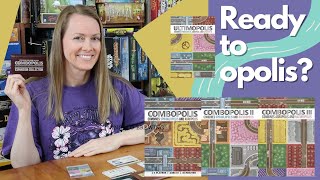
- Clear integration with Sprawlopolis for Combopolis
- Clear synergy with Sprawlopolis to create additional scoring goals
- Potentially more complex when paired with other decks
- Balancing two decks can be tricky
- Agricultural landscapes coexisting with urban blocks
- Farms and buildings integrated into urban planning
- Abstract/strategic
- Sprawlopolis
- Naturopolis
- Combopolis
Mechanics (from transcript analysis)
- adjacency-based scoring — Scoring based on adjacent regions; players must align cards by color/region.
- Card Drafting — Draw from two decks and choose a card to place.
- Compound Scoring — Scoring based on adjacent regions; players must align cards by color/region.
- Dual-deck interaction — Two decks (Agropolis and Sprawlopolis) interact to form combined scoring.
- Road penalties — Roads subtract points, adding strategic tension.
Video topics + discussion points
Quotes (from this video)
- I love my combopolises my one my two my three
- this game is so easy to transport I can put four of these wallet pockets in in my back pocket like wallet games come on
- it's fun and different every single time
- isn't it super straightforward and easy I love that
- old cinemapolis is even more challenging
- button shy games is where you can find them
References (from this video)

- lost every single one
Mechanics (from transcript analysis)
Video topics + discussion points
Quotes (from this video)
- it's really hard to describe to his friends who don't have kids what it's like to have kids
- my habit on this channel has always been to be as honest about mental health and about um life and Journeys and struggles and things that you go through and the ups and downs and the roads and not good at not showing those things and not talking about those things cuz I think they're important
- it's remarkable it's it's invaluable in the uh most undefinable or or uncommunicated way
- it's worth every sacrifice and every penny you could give it
- value it protect it cherish it beyond beyond beyond everything
- they're little time capsules of the way that I felt so that in Seasons when things change and he's a teenager with hopefully siblings and has just stormed out of the door and told me that he's very frustrated and upset with both me and and Mom and or doesn't whatever the case there's always going to be challenges like this is a good reminder and a good way to jump back and look
- as long as you're one to strap a baby to your chest you can play just about any game in front of you
References (from this video)
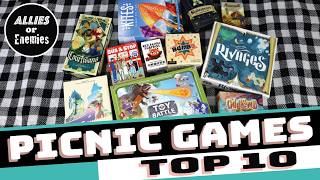
- Sequel to Sprawlopolis
- Clever card design
- Animals add variety
- Always feels like a different game due to goals
- Challenging to manage territories, goals, and roads
- Can be combined with Sprawlopolis
- Has an expert mode
- building a landscape with animals and scoring goals
- Sprawlopolis
Mechanics (from transcript analysis)
- Card Drafting — the back of all the cards are different scoring goals. The front of all the cards are different landscapes and stuff on them.
- Cooperative — it's a co-op game where you are making patterns.
- Cooperative Game — it's a co-op game where you are making patterns.
- Set Collection — you're using that landscape to score a bunch of scoring goals that you picked out at the start of the game.
- Tile Placement — You're putting cards out. They've got four different things on the cards, or sometimes three, and you're putting those cards kind of on top of each other, underneath each other, and you're trying to make a landscape.
Video topics + discussion points
Quotes (from this video)
- So today we are talking about 10 games that we would recommend for playing at a picnic.
- first of all, they've got to have a small enough box that they're going to be easy to take to a picnic.
- Second, they've got to actually fit on a picnic blanket.
- And third, we want them to be at least a little bit safe from the wind.
- If you haven't heard us mention them, go check them out. They are great backpack games.
- This is one of these games that I'm like, I why didn't I think of this? This is so smart.
- So, you're just like constantly like trying to trick each other.
- So, once you've got two of those, you're so scared of taking the upside down card.
- It feels a little bit like Bomberman, where you set off these bombs and then they're going to blow up sometimes like in all directions.
- The tiles are pretty neat. They're like this like thick paper cardboard that have this great texture.
- We do talk about this one a lot, but it's so good, especially for this, especially when you're teaching this to new players.
- I've not taught this to someone who hasn't gone out and bought it or even bought it while we're playing it.
- It is really tricky to manage that limit of 10 because most well, all of the groups will score more if you have more of them.
- I just I love a game like this that you can teach like I taught you the whole rules.
- This does play excellently for picnics, especially if there's not a lot of wind because you are playing cards down to the ground.
- To win by tragedy, which is probably the most fun way, you are trying to cause different characters to die, and they're going to die in all different thematic ways.
- it makes it really tricky to draft cuz every time when you draft cards, your opponent plays first, giving them the opportunity to possibly win.
References (from this video)
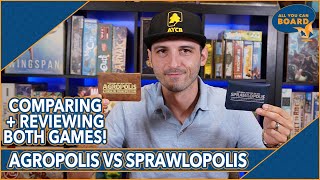
- introduces a scalable difficulty mechanic with feed fees
- more intricate and thought-provoking scoring conditions
- expands on the system with a richer thematic integration
- generally longer and more thinky; more text on scoring cards
- randomness can be a larger factor due to livestock variability
- agriculture with crops, livestock pens, and various animal types
- agriculture/farm landscape
- Sprawlopolis
Mechanics (from transcript analysis)
- Compound Scoring — some scoring cards have a symbol indicating an animal type; if scoring target is set with feed fees, you add points per animal type shown to the target score
- deck/hand management with landscape elements — similar structure to sprawlopolis with scoring condition cards and base scoring by blocks/roads; introduces livestock as a core element
- optional difficulty adjustment — feed fees provide a hard mode without changing base scoring rules
- scaling difficulty via feed fees — some scoring cards have a symbol indicating an animal type; if scoring target is set with feed fees, you add points per animal type shown to the target score
Video topics + discussion points
Quotes (from this video)
- these basically tiny little sleeves
- sprawl opolis came out in 2018
- ends when all 15 cards have been placed
- you can lay your cards over top of other cards like this
- the goal of the game is to get the target score as determined by the sum of the numbers on the scoring condition cards
- this is a nice way to have that optional added level of difficulty
- randomness definitely plays a bigger factor
- sprawl opolis is definitely the safer choice to get into
- these are going to be excellent travel games
References (from this video)
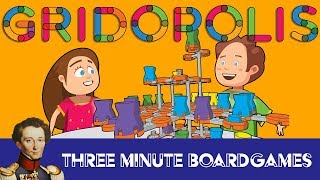
- Innovative 3D movement and capture system that extends abstract strategy beyond traditional 2D games and introduces vertically layered tactics
- Encourages player creativity through board customization and open-ended rule tweaking, enabling experimentation and personalization
- Strong educational potential for classroom settings and youth programs, with a tactile learning experience and quick teachability
- Bright color palette and tactile components create an engaging presence that invites play and exploration
- Initial setup and teardown can be time consuming when board configurations are complex, which may deter casual play
- Lacks an official solo mode, reducing appeal for solo players or practice sessions
- Three dimensional rules may be challenging for first-time players, requiring deliberate instruction and thoughtful pacing
- In homemade configurations, subtle rule interpretations can lead to disagreements unless players agree on house rules beforehand
- Strategic pursuit of space and control within a lightweight toy like framework that encourages experimentation, customization, and social play rather than rigid simulation.
- Three dimensional modular abstract strategy board game where players construct a layered playing field using components such as landers, blockers, and pads. The board evolves as the game unfolds, with pieces traveling through multiple heights and interacting via a mix of movement and capture rules.
- Abstract storytelling through spatial movement and visual design; the theme is conveyed more by the physical setup and players' choices than by a fixed narrative arc.
- Santorini
Mechanics (from transcript analysis)
- 3D movement — Pieces navigate along a stacked board, moving across levels; height and depth become essential to strategy and set-ups.
- Blockers and pads — Players can alter the board by placing blockers to block paths or adding new pads to create opportunities and threats.
- capture by jumping — On a straight-line move, a piece can leap over an opponent piece or stack to capture; the capture can occur through 3D space so that vertical distance matters.
- End Game Bonuses — The game ends when only one player remains with pieces or when two players remain with kings, driving specific late-game strategies.
- endgame conditions — The game ends when only one player remains with pieces or when two players remain with kings, driving specific late-game strategies.
- Home zones and promotion — Home zones provide destinations for promotion and serve as strategic anchors that influence how players defend and advance.
- kinging — Promotion to a King occurs when a piece reaches an opponent home zone; a King gains the ability to move backward, changing mobility dynamics.
- Multiple jumps — A single turn can feature a sequence of jumps, allowing the player to chain captures and alter the board state quickly.
- Teleporters — Teleporters connect nodes on the board; landing on one transports the piece to another unoccupied teleporter, enabling abrupt positional shifts.
Video topics + discussion points
Quotes (from this video)
- it's a pretty simple game
- the best thing about this game is that it encourages you to make your own structures and to modify the rules
- this is an unusual game for me to cover and I picked it simply because it was different
- three-dimensional movement and capturing of pieces can be tricky at times
- Spock approved