/pic5536136.jpg)
Amsterdam is a reimplementation of Macao with a new setting, improved card balance, and new gameplay elements. It challenges players to build combinations of abilities, as well as to correctly calculate the advantage of delayed gratification for actions.
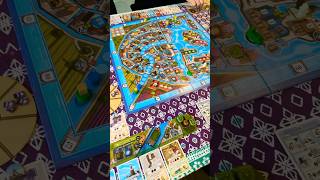
In the game, players are merchants in Amsterdam near the turn of the 20th century. At the start of the game, two district cards are placed on each of the twelve spaces on the designated board. At the beginning of a round, the next two district cards, as well as two building and two profession cards (each from a deck of 54 of each type) are drawn to form the offer of six cards. Each of these cards has a cost in colored action cubes and grants a new action, special ability, or way to score points. In turn order, each player takes a card from those on offer. Finally, a market card is revealed that allows players to exchange money for victory points on their turn.
Next, the six colored dice are rolled. Each player decides which of the six dice they would like (players may choose the same die), then takes as many action cubes in that color as the number of pips. Players place their new action cubes on their rotatable windrose as many spaces in the future as the number on the dice. Finally, the wheel is spun, so that players gain access to all cubes that were located on the 1 space of their windrose.
Action cubes are used to purchase cards that a player has taken, claim one of the nine types of goods around the city of Amsterdam, and ferry goods or workers through canals to warehouses. Players earn points for delivering their goods, as well as for bonuses on cards they purchase, and the player with the most points at the end of the twelfth round wins.

Mechanics (from transcript analysis)
Video topics + discussion points
Quotes (from this video)
- Their game choice is fantastic and to me the creative choices are all vibrant and spot on.
- Gosh Bon Trick already was pretty much the pinnacle when it came to set collection and trick taking.
- Plate's version elevates that to the next level by adding actual coins for your spending currency and a slot in the box that adds just the most delightful charm and elevates an an already surprising level of theme for what is a mathy trick taker.
- They really embrace this infusing whimsy into the production.
- I really love the way these games look on the shelf.
- I am so stoked for what's to come from play.
- I am just ecstatic, elated that one of my favorite climbing shedding games, Dickory, is going to be getting a new version, as well as Hellas, Enemy and Enemy, and even more.
- I cannot wait to play some of the new versions of these, and you can be absolutely sure that we are going to be talking about them as soon as we can.
- Really delighted by them, and I am so happy with what amazing stuff that play is bringing to the hobby right now.
References (from this video)

Mechanics (from transcript analysis)
Video topics + discussion points
Quotes (from this video)
- i would heavily recommend you start with the expansion right away
- oracle delphi is probably my favorite feld game overall
- i would love an expansion to Gaia Project that lowers the complexity
- i don't want an expansion to Gaia Project that dumbs it down
- Adventureland is incredibly simple to teach
- Consistency is key when building an audience
References (from this video)

Mechanics (from transcript analysis)
Video topics + discussion points
Quotes (from this video)
- beyond the sun is such a good game
- i am loving that game
- i would definitely not mind having a copy of kingdom
- it's a wonderful world expansion ... corruption and ascension
References (from this video)

- Area control in a village
- Macau
Mechanics (from transcript analysis)
- Area Control — Trying to gain area control on the village where you're trying to get people there and most in certain areas.
- Set Collection — Shipping people out to islands.
Video topics + discussion points
Quotes (from this video)
- heavy and light does not equal good and bad it's not we found that trap I found that trap the where the g games are only good if they're heavy and I've since come back to where all games are good not all games but you know all weight of games can be good based off of what their circumstances when you're playing them and who you're playing them with
- the heavier games these are the games that we're talking about today these are the games that have bigger Longer rule sets maybe a little bit harder to learn a little bit harder to teach um they have a lot more going on a little bit more involved and the or the decisions that you make during the game are a little bit more involved you have to really think about think a couple lay layers ahead you can't just think about can't react what's happening to you you have to think a plan ahead in two turns I'll have enough resources just to buy that then I'll be able to do that to be able to do that to be able to do that
- we're going to count down to our very heaviest
- all right so the number seven heaviest game on our list is agrica this is weighted at 3.64 this is kind of the great granddaddy of all besides Kus but beyond that agrica uh is would be I would call the great granddaddy of all worker placement games
- you can't score higher until you pay them a gem like look I'm doing stuff give me more money
- I know a lot of people compare this because they are very very similar um to um Fe free for Odin but what's the one before that caverna and caverna I think is is very cool but lacks the cards and the cards is what makes agria so special and so much fun but also makes your decision decision level really high
- I almost wish I had been introduced to this game now cuz when I was introduced to it I was a baby gamer and I was like no thank you no I don't you to feed your people that's a very stressful thing for a new game room yes yes like just that like you get punished you're like I want to have fun why am I being punished
- this is the first game I I want I don't there probably are other games like this it's just the first one that I've played that's like this where you take actions based on your D color but you can mix and match those to create different colors in order to do different actions on the board
- the more lucrative actions of course are going to be a mixed color and the more plain actions are going to be the primary colors but it's really interesting in the beginning of the game you don't feel like you have enough die to do anything and at the end of the game you're like I don't I can't even use all of these like I'm done with all of that
- this is kbon EV and has a weight of 4.3 this is based off of another game that came out called kbon which I really enjoyed but kbon EV is the newer updated version
- there's also just this supervisor named Sandra who's running around the board and every time she goes to a new section of the board she's basically inspected to see who's not doing their training and then she penalizes you based off of whatever the parameter is
- it's a funny little comedic element in this very involved game yeah I really really like this one it's it's a fun one
References (from this video)

- layered planning with elegant timing
- high interaction via shared dice pools
- heavy to learn for newer players
- some may find the theme niche
- pickup and deliver with district cards and dice-driven resources
- urban logistics and city-building in a stylized market world
- clever, modular euro with a strong mechanistic backbone
- Maau
- Orléans
Mechanics (from transcript analysis)
- city-building with district cards — cards and tiles expand the city and provide scoring opportunities
- Dice Rolling — dice values generate resources to activate actions via a rotating rondel
- dice-based resource generation — dice values generate resources to activate actions via a rotating rondel
- Rondel — a wheel determines which actions are available and who gets priority
- rondelle action selection — a wheel determines which actions are available and who gets priority
Video topics + discussion points
Quotes (from this video)
- these are just 10 games I want to play this year that I already have I don't have to wait for a Kickstarter for it arrive
- the Rats of Wester it is a euro game which has this interesting wheel mechanism which is combined with worker placement
- it's a game where you'll be leading a herd of camels through the desert as you're basically looking for water holes
- I cannot wait to get this to the table and just really see what this game is like
References (from this video)

- Artwork was not liked.
- Hamburg
- Kusco
- Marrakesh
- New York City
- Bruge
- Macau
Mechanics (from transcript analysis)
Video topics + discussion points
Quotes (from this video)
- I don't think Project L should have the video theme category applied to it. I don't think so.
- my solo cadet mode for captain's chair is the best video to watch to learn how to play the game.
- you only score points for your tracks if you have completed at least one of your missions.
- Many of you, especially Mage Knight fans, will know Ricky because he did the solo playthroughs of Mage Knight, which helped make Mage Knight what it is today.
- I have news. I am not allowed to share that news. I am under um effectively an NDA.
- Marvel Champions is a fantastic, fantastic game.
- The stream was crashing and literally every 30 minutes the stream would crash and my software would crash and people would be in the chat saying the stream's gone down.
- Too Many Bones is a good game, but me being so far out of my comfort zone that I literally cannot understand how to play the characters that I'm playing whilst hosting a live stream. Yeah, I don't want to do that again. That was uh that was horrible.
- Monopoly is in that situation where it's popular because it's popular.
- It's still a terrible game. It is. It is a terrible, terrible, terrible game.
- The Lord of the Rings: Fate of the Fellowship, the new pandemic style game from Matt Leo. I'm going to pick that one. But caveat, I've only played it once and I haven't actually played that many games that technically have come out from 2025.
- You can't. There's too many games coming out every week.
- If you are not a Patreon supporter and you want to support me directly, you can for as little as $1 a month or $3 a month if you want access to the Slack channel, patreon.com/gamingrules.
- The secret word for this month is the game that arrived this afternoon that none of my patron supporters were able to guess.
References (from this video)

- core gameplay of Macao remains great
- solo mode is a lot of fun
- not the best remake; solo has some problems
Mechanics (from transcript analysis)
- unknown (remake context) — Amsterdam is described as the remake of Macao; solo mode discussed as fun though there are noted issues
Video topics + discussion points
Quotes (from this video)
- And there you go. 10, 15, actually 17 solo games that I like way more than you.
- What are some games that you feel you enjoy more than other people? Please let me know in the comments.
- I absolutely adore it.
References (from this video)

- High component quality common to The City Collection
- Thematically appealing urban setting in Amsterdam
- Solid eurogame engine with strategic depth
- Can be heavy for casual players
- Requires careful rule comprehension and long playtime
- Ongoing need to reference multiple language rulebooks (as observed in video)
- city-building, economics, urban planning
- Urban development in Amsterdam as part of The City Collection
- strategic eurogame with point-for-area-influence and city-building pacing
- Hamburg
Mechanics (from transcript analysis)
- Area Majority — players compete for influence in districts to maximize scoring opportunities
- city-building/resource management — players acquire and allocate building resources to develop the city and gain points
- Resource Management — players acquire and allocate building resources to develop the city and gain points
Video topics + discussion points
Quotes (from this video)
- Green game made in Germany
- bag of bags
- heart elevate
- it's just one of the things as a gamer that you're like starting to expect it now
- we all love a nice recess board
References (from this video)

- Innovative wind rose action wheel creates a unique pacing and planning challenge.
- Tight integration between dice outcomes, card activations, and market mechanics.
- Engaging solo mode with a plausible NPC opponent (Tom) that drives a strong solo experience.
- Tempting end-game scoring via crests encourages long-term planning and block placement strategy.
- High variance due to dice rolls that can swing early rounds.
- Complex setup and a fairly dense iconography that may require a learning curve for new players.
- Solo play may feel punitive if RNG leads to rapid deficits;
- maritime trade, urban development, and canal infrastructure
- Canal-side city in the Netherlands, Amsterdam
- economic strategy with tile/area control flavor
- Macau
Mechanics (from transcript analysis)
- canal track / turn order advancement — Advancing along a canal track determines turn order and unlocks scoring opportunities; movement also interacts with end-game scoring.
- card activation and costs — Cards in hand require paying resource costs to activate effects that modify income, scoring, or future actions.
- crests and end-game scoring — End-game points are heavily influenced by crest placement and grouping; largest crest group yields substantial points.
- dice drafting / roll-based action economy — Players resolve actions by rolling dice that determine which actions become available; the value and color of dice influence which choices are accessible.
- Dice Rolling — Players resolve actions by rolling dice that determine which actions become available; the value and color of dice influence which choices are accessible.
- market/black market and warehouse delivery — Goods can be sold to a market, shipped via a warehouse network, or used to trigger points, with strategic placement of goods affecting scoring.
- Multi-Use Cards — Cards in hand require paying resource costs to activate effects that modify income, scoring, or future actions.
- penalty tokens — Penalty tokens reduce final scoring and incentivize careful planning to avoid penalties via activations and route choices.
- Track Advancement — Advancing along a canal track determines turn order and unlocks scoring opportunities; movement also interacts with end-game scoring.
- wind wheel / wind rose mechanic — A rotating action wheel (wind rose) shifts which actions are available when, delaying gratification and creating sequencing tension.
Video topics + discussion points
Quotes (from this video)
- that's the core brilliant mechanism here
- we reached a hundred
- we were absolutely crushed by Tom
References (from this video)
- Engaging engine-building with multiple interacting systems
- Clear tension from penalties
- Variety of actions and strategic timing
- Wheel-based resource pacing adds uniqueness
- Not explicitly discussed in transcript; potential complexity; not provided
- economic development and district management
- Urban European city-building
- engine-building with timing and penalties
Mechanics (from transcript analysis)
- card activation above the board — Up to five cards below the board must be paid for and activated to gain effects.
- Compound Scoring — Earlier deliveries yield more points; goods are delivered to different locations for scoring.
- construction and hiring — Build districts, construct buildings, and hire specialists with abilities.
- Dice Rolling — Dice are used in actions or resource acquisition.
- Multi-Use Cards — Up to five cards below the board must be paid for and activated to gain effects.
- penalties — Unpaid cards or inability to deploy resources incur penalties.
- timed scoring — Earlier deliveries yield more points; goods are delivered to different locations for scoring.
- wheel-based resource generation — Rotating wheel provides resources each turn; access is delayed by wheel segment advancement.
Video topics + discussion points
Quotes (from this video)
- I love it.
- The penalties in this game are massive.
- Early delivery yields more points.
References (from this video)

- Smart resource management and die-draft twist
- Smooth progression and satisfying long-term planning
- Modular feel with Macau heritage adds familiarity
- Thematic cohesion can feel thin
- Some players may find it mechanically dense
- resource management with pickup-and-delivery
- Rotterdam-style port and dock management in a reprint of Macau
- mechanical, planning-forward economic game
Mechanics (from transcript analysis)
- longer-term planning — Steady accumulation of resources and route planning to maximize points.
- Pick-Up and Deliver — Move resources around a map to increase presence and scoring.
- pickup and deliver — Move resources around a map to increase presence and scoring.
- resource draft via dice — Draft resources or dice to obtain actions and resources to deliver goods.
Video topics + discussion points
Quotes (from this video)
- The unpredictability with this one maybe a bit too much for my comfort level.
- The board state is very busy and hard to remember what each piece can do.
- Not for me, hence why it's number 10.
- Breezy this game is extremely easy to play.
- I love the way that you have to manage your resources.
- Everything in this game feels good.
References (from this video)
- rich, layered strategic possibilities
- language-specific cards reduce symbol lookup friction
- teaching can be long; language dependency can limit accessibility
- resource gathering and city development
- harbor-based city building with language-specific cards
- heavy on card interaction and language adaptation
- Le Havre
- Dominion
Mechanics (from transcript analysis)
- dice drafting with resource allocation — draft dice to secure resources and build cities
- hand management with high interaction — cards in hand drive actions and can be fueled by language-specific materials
Video topics + discussion points
Quotes (from this video)
- this game is a masterpiece
- infinitely replayable
- an absolute Masterpiece
- this is such a cool game
- an absolute joy to play
- seven and a half out of ten