


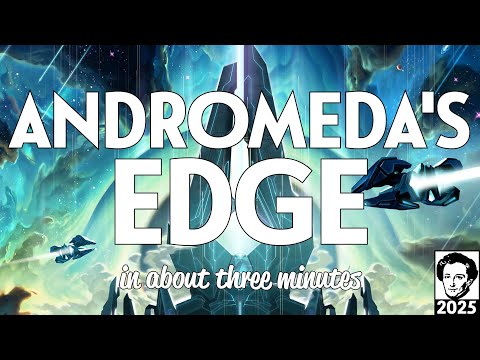












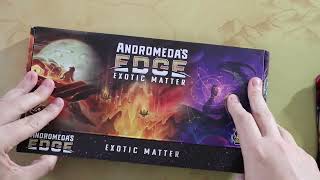




































Andromeda's Edge Deep Dive
What the Community Thinks About Andromeda's Edge
Andromeda's Edge lands on a community that is enthusiastic, divided in exactly the right places, and broadly agreed that this is a substantial game worth debating. Designed by Luke and Maximus Lurry and published by Lucky Duck Games and Cardboard Alchemy, it arrived trailing the reputation of Dwellings of Eldervale and immediately triggered comparisons reviewers cannot stop making. The consensus from those who love it is clear: Andromeda's Edge is a refinement of the Dwellings system, adding a tableau-building engine that gives the game a second layer of depth the original lacked. The Dice Tower went so far as to call it a better version of Dwellings of Eldervale, and Mike Delissio placed it at number two on his revised 2024 top 10, calling it a correction of a ranking omission from the previous year. Meeple University ranked it among their top games of August 2024. Neon Gorilla surveyed the broader community and found that of reviewers who compared the two games, the majority prefer Andromeda's Edge, citing streamlined mechanics, enhanced strategic options, and much greater replay value.
Not all reviewers share this enthusiasm. Neon Gorilla found the combat system polarizing, with a meaningful portion of written reviewers leaning negative on that element, and ultimately rated the game lower than community consensus. The space theme also splits opinion: fans of the Dwellings fantasy setting sometimes find the science fiction backdrop less engaging. What is not disputed is the game's replayability: with 15 or more factions, multiple ship upgrades, asymmetric faction powers, and modular board configurations, the game offers a genuinely different experience nearly every play.
Core Mechanics That Define Andromeda's Edge
Engine Building Through the Return to Station
The engine-building heart of Andromeda's Edge is anchored in the Return to Station turn, which Meeple University calls the defining new element over Dwellings of Eldervale. When a player retrieves their ships from the board, each one is used to activate a module in their growing tableau of science, industry, commerce, and civilization cards. Each activated module delivers resources, points, or ongoing bonuses. Once a ship has activated a module in a row, additional modules in that row can be triggered by spending energy, meaning a well-constructed engine can chain activation after activation in a single turn. Meeple University's Stella describes the timing challenge: you are "activating that thing first so timing is quite important" as you sequence activations to fuel later ones in the chain. Modules are purchased by launching to the Maximus or Odessa fields on the main board, and each module acquired both extends the engine and advances a progress track simultaneously, so building your station is never wasted action.
Worker Placement with Chains and Combat Interruptions
The launch turn functions as a worker placement system with a distinctive spatial chain rule: the first launch each cycle must go to an unoccupied region, but subsequent launches must be placed within range of an existing ship, creating an expanding network. As Before You Play explains, this network determines where developments can be built and which alliance bases are reachable. The bases are fixed action spaces: the Trade Hub converts any two resources into credits, the Monolith of Ancients trades resources for tactics cards, the Maximus and Odessa fields sell modules, the Shipyard builds or repairs ships, and the Development Office lets players place permanent developments on planets. What makes the launch turn dangerous is that it ends with a battle check: Raiders within range move into the active region and combat resolves immediately via a dice comparison, where the highest single die wins and ties break on the next-highest. Neon Gorilla observes that this combat element is "the purveyor of interest in this game," the element that distinguishes it from a standard resource-management Euro, even if the dice resolution remains contentious among reviewers.
The Andromeda's Edge Experience
Satisfying Engine with Epic Scale
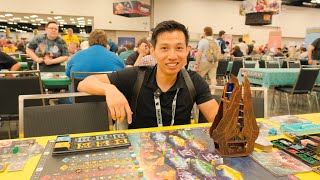
Players who connect with Andromeda's Edge consistently describe a feeling of controlled acceleration. The game starts small, three transport vessels and a handful of resources, and expands through ship construction, ship upgrades unlocked via the industry track, and a growing module tableau that compounds returns with each recall turn. The Dice Tower's Mike Delissio called the full return to station turns genuinely the best part of the game even after many plays. Faction asymmetry deepens this epic quality: each faction arrives with a unique starting configuration, a passive power, and a special ship upgrade. Tim Chuon's faction reveal videos show how differently each faction plays. The Funjinar Spore Gods convert nanocarbon into development resources and gain that resource from scrapyard ships, rewarding a battle-forward posture. The Macar and Synth Born freely exchange titanium for energy and gain bonus targeting in combat, pushing an aggressive style. Neon Gorilla counted 15 factions available across versions, and reviewers consistently cite faction diversity as the foundation of the game's replay value.
Crunchy Decision Space Under Time Pressure
Andromeda's Edge does not let players move at their own pace. The event track advances every time a player visits the module-purchase bases, and when it completes a circuit a new planet drops onto the board and an event card resolves, scoring a randomly selected progress track and deploying a new Raider class. Players must weigh the urgency of building their engine against the risk of an event scoring a track they have neglected. Before You Play explains that the Commerce track determines whether leftover resources score zero, one, or two points at game end, creating a late-game incentive that pulls against spending everything. The resource capacity limits, five each of titanium, ice, nanocarbon, and credits, mean players must burn through resources efficiently rather than hoarding. The Board Gaming Doctor's playthrough on Board Game Arena illustrates how each faction creates a different resource bottleneck: one player starved for leaders to place developments, another flush with tactics cards but light on titanium, generating genuinely different problems to solve each game.
What Makes Andromeda's Edge Stand Out
The Development System
Developments are the permanent structures of Andromeda's Edge, and they represent the game's most impactful single action. As Tim Chuon explains, building a development requires a transport ship at the target planet, matching resources, and leaders recruited from the board, a three-step qualification that gives the action genuine weight. Once placed, the development token sits on the transport permanently: the ship cannot move or be recalled, but it contributes combat dice to battles in its region and adjacent regions. The development card delivered at placement scores immediate points equal to nearby leaders, advances a progress track, provides a once-per-game flippable ability, and generates end-game points that scale with how high the player climbs on the corresponding track. Meeple University describes the dual scoring structure: "whenever you build a development you score points for your tactical placement," and again at end game based on track position. This coherent goal structure gives every launch turn a strategic purpose.
Asymmetric Factions and Ship Upgrades
The breadth of asymmetry is among the most celebrated elements of Andromeda's Edge. Every faction arrives with a unique starting configuration, a passive power, and a special ship upgrade that no other faction can access, as Neon Gorilla details when surveying the full roster: Toed Porters gain commerce track advancement by visiting alliance bases; Dark Star Acolytes can take an alliance base action before returning to station if their launch bay is empty. Beyond faction powers, every ship type can be upgraded via the industry track, with each faction holding an asymmetric set of upgrade tiles that modify range, combat dice, targeting, or grant abilities like jump (infinite range for one energy) or voyage (access to the nebula regions at the board's edge). This stack of asymmetry ensures two players pursuing ostensibly the same strategy build engines that look and function differently.
Potential Drawbacks
Combat Resolution and the Role of Chance
The combat system is the most divisive element among reviewers. Neon Gorilla articulates the concern directly: the game builds significant infrastructure around battle, including targeting values, energy-purchased dice, tactics cards, diplomacy cards, and ship upgrades, all designed to give players agency. Yet the resolution method, comparing highest dice, means a single player rolling one die can beat a fleet of six dice if that die rolls highest. Neon Gorilla finds this outcome frustrating given the investment the game asks players to make in combat preparation. Broken Meeple (as cited by Neon Gorilla) similarly found that a bad die roll can screw a combat where you were clearly the likely victor. Board Game Hangover, also cited by Neon Gorilla, takes the opposite view: losing a ship carries genuine strategic consequences, particularly if that ship was needed as a launch platform, and this weight elevates the combat above a throwaway element. The disagreement is unresolved among reviewers, which makes it worth identifying your own tolerance for high-variance dice swings before committing.
Rules Overhead and Pacing in Longer Games
Andromeda's Edge is not simple to learn. Neon Gorilla cites a BGG complexity rating of 3.69 and notes that the rules layer heavily: launching rules, battle sequencing, module activation prerequisites, development placement requirements, event timing, and icon distinctions all create a meaningful learning burden. Broken Meeple called the game bloated with rules on top of rules, and noted that player aids do not eliminate rulebook consultations in early plays. The Board Gaming Doctor's playthrough on Board Game Arena illustrates this directly, with experienced physical players still correcting mid-game on which modules could be activated with energy and when. Beyond learning overhead, Neon Gorilla raises a pacing concern: return to station turns grow longer as engines expand, creating extended waits during other players' activations. The configurable scoring range, 50, 60, or 70 points, helps moderate total length, but some players find that even the short game loses energy toward the end.
If You Enjoy Andromeda's Edge
Players drawn to Andromeda's Edge's blend of worker placement, engine building, and combat will find direct lineage in Dwellings of Eldervale, the spiritual predecessor with the same core loop in a fantasy setting. Those who love the engine activation will recognize a kindred satisfaction in Anacrony, another heavy Euro with asymmetric factions and a tableau of activated actions. Arcs, which The Dice Tower ranked above Andromeda's Edge in their 2024 retrospective, offers the combat-plus-Euro hybrid in a radically different structural form using trick-taking as its action selection engine. For players who want tableau-building without combat, Lords of Waterdeep offers a gentler worker placement experience. Terraforming Mars shares the engine-building loop and track-advancement scoring in a space-themed setting that appeals to overlapping audiences, replacing combat with market competition for project cards.
What Reviewers Are Saying
"My number two is Andromeda's Edge. It's probably 60% similar to Dwellings of Eldervale in that the way that you're placing workers, or spaceships in this case, out onto the hexes on the board, you create these little chains and take the actions. What's different is when you retrieve your workers you're doing it in a way to resolve a big tableau that you build. That tableau building and activation element is really the new thing here. It's a very satisfying chaining, putting your tableau together so that you get the best return."
— Meeple University
"I made a decision last year to keep Andromeda's Edge out of the 2024 lists because I was having to make this decision: is this just strictly a re-implementation of Dwellings of Eldervale or isn't it? I think I got maybe a little too precious about it. I think that it stands apart enough now after playing it many, many times. It's just a fantastic game, a fantastic kind of hybrid style game where it's a Euro game at heart, but it has some of the trappings of the more American style games, elements of combat going on and dice rolling."
— The Dice Tower
"The game is trying to give you a ton of agency, but it all comes down to: can your one die roll a six while the other person with four rolls five and below? You could have had brilliant ship placement ready to come in on the battle, a really high targeting number, a ton of combat dice, and someone with one die and no other alterations whatsoever can roll a six and win. That to me is just not fun. I think the game attempts to make combat the marquee mechanic with all this infrastructure around it to make it cool, and just fails with that combat system."
— Neon Gorilla