
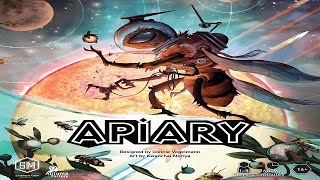












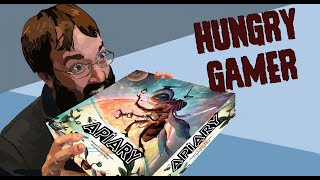





In a far-distant future, humans no longer inhabit Earth. The cause of their disappearance (or perhaps their demise) is unknown, but their absence left a void ready to be filled by another sentient species.
Over the span of untold generations, one species of the humble honeybee evolved to fill that void. They grew in size and intelligence to become a highly advanced society. They call themselves Mellifera, and they have made substantial technological advances in addition to the technology they adapted from human ruins, up to and including space travel.
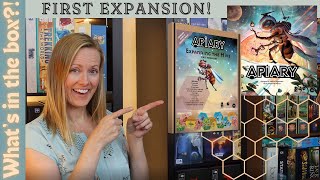
In Apiary, each player controls one of twenty unique factions. Your faction starts the game with a hive, a few resources, and worker bees. A worker-placement, hive-building challenge awaits you: explore planets, gather resources, develop technologies, and create carvings to demonstrate your faction's strengths (measured in victory points) over one year's Flow. However, the Dearth quickly approaches, and your workers can take only a few actions before they must hibernate! Can you thrive or merely survive?
—description from the publisher
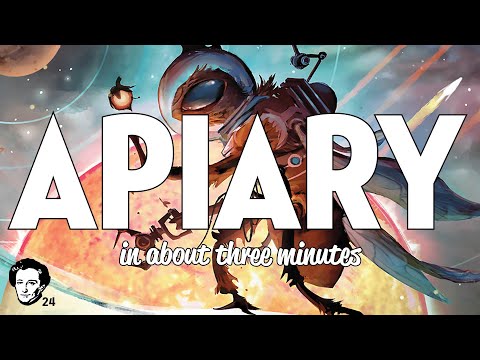
Apiary in about 3 minutes
Apiary - Playthrough & Discussion
Mechanics (from transcript analysis)
Video topics + discussion points
Quotes (from this video)
- I'm really excited about because I might have a bird in there
- tapestry digital not board game arena but the actual digital app
References (from this video)
Mechanics (from transcript analysis)
Video topics + discussion points
Quotes (from this video)
References (from this video)
- Gift guide context; she would choose Apiary for her sister
- Pendulum
- Euphoria
Mechanics (from transcript analysis)
Video topics + discussion points
Quotes (from this video)
- What has wings but cannot fly? It was Finsspan
- Apiary
- Wingspan expansion 4
- Wingspan fan promo cards. We've had so much fun playing with them.
References (from this video)
- accessible light-to-medium weight with surprising depth on repeated plays
- high replayability due to multiple asymmetric factions, seed cards, carvings, and tile order
- high-quality components and art; visually appealing and easy to read on the table
- strong solo-mode option via Atoma Factory-style implementation
- clear teaching flow and approachable entry point for gateway gamers
- multiple viable victory strategies beyond just chasing carvings
- tight endgame tension driven by the finite hibernation slots and race dynamic
- theme can feel skin-deep; bees in space thematic flavor doesn't always translate into mechanics
- dice aesthetic may be polarizing (some feel it looks worn or dirty)
- not a brain-burner; players seeking heavier mid-to-high complexity may wish for more depth
- asymmetry exists but is not extreme; some players may crave larger divergent strategies
- thematic fidelity to actual bee life is limited for players who want strong bee-from-life storytelling
- bee-themed space exploration and hive management
- far distant future where humans are extinct and sentient bees explore space
- Array
- Wingspan
- Creature Comforts
Mechanics (from transcript analysis)
Video topics + discussion points
Quotes (from this video)
- it's a light to mediumweight game but it's got you more under the hood than you'd expect
- the replayability is surprising; every game feels different
- we've enjoyed it more with each play
- this is well put together production; the art and components elevate the experience
References (from this video)
- Beautiful, rugged, and custom-looking components
- Excellent solo/Automa support with a dedicated teaching guide
- Teaching guide and DED tutorial enhance learnability
- Large, sturdy components with strong storage options
- Potential for personalization or painting of components
- Seeds/cards lack visual differentiation; artwork does not vary across cards
- The game is heavier and heftier than expected, which may deter some players
- Punch-out prep and setup can be time-consuming
- Video unboxing cannot easily show the entire board layout due to camera/setup limitations
- Bees, pollination, agriculture, and colony building
- Bee yard / hive management with multiple maps
- resource-driven, thematic emphasis with a heavy emphasis on solo play
Mechanics (from transcript analysis)
- automa / solo mode — A dedicated solo deck (Automa) governs AI actions for solo play.
- Card-based planting / seeds mechanics — Cards represent seeds/plants that influence actions and resource production.
- Modular board — Different maps support 4-5 players or 1-3 players, altering layout and play.
- Modular board / multi-player setup — Different maps support 4-5 players or 1-3 players, altering layout and play.
- Resource management — Manage pollen, fiber, water, and honey to fuel actions and build the apiary.
- worker placement — Players assign workers to perform hive actions and gather resources.
Video topics + discussion points
Quotes (from this video)
- This is a game that is good for one to five players takes about 60 to 90 minutes to play and ages 14 and up.
- It's a hefty game I have to say.
- I love punching out things.
- I always love the attention that they give solo players.
- This is a beautiful looking game.
- I imagine that most people could be up and running within this same game even if it's a learning game.
- There is a solo automa deck ... you flip over the solo cards and see what they will do on their turn.
References (from this video)
- Innovative bumping mechanic that lets you take the action you want
- Strong engine-building potential and bee-power progression
- High replayability from multiple factions and maps
- Immersive bee-themed, galactic setting
- Bees-inspired space resource management and engine-building
- Galactic beehive exploration across multiple planets
- Bee-centric sci-fi engine-building with factioned maps
Mechanics (from transcript analysis)
- action-bump — Players can bump other players from a space to take the action themselves; the bumped player increases their bee power.
- engine building — Advancing bee powers and abilities helps improve your engine over the course of the game.
- engine-building progression — Advancing bee powers and abilities helps improve your engine over the course of the game.
- factions and maps variety — Multiple factions and maps influence strategic options and synergy.
- level-based bonus actions — When a bee reaches level four, the active player can execute an extra bonus action.
- tile-based resource production — Tiles in a player's sector produce resources for their own use.
Video topics + discussion points
Quotes (from this video)
- This mother bee of a game is one of my favorite Euros of all time.
- It's called Apiary.
- Relying on a bumping mechanism lets you take the action you want.
- The variety of factions and maps really drives replayability.
- The bee-themed engine-building is a perfect fit for a Euro.
- The bumping mechanic creates tension and strategic choice without breaking the thematic vibe.
References (from this video)
- vibrant hive development with multiple paths
- strong interaction via bumping and shared tiles
- can feel busy or fiddly for new players
- be mindful of tempo with hibernation/activation timing
- bee bumping with hive growth
- bee ecology and hive management
- cheerful, life-cycle driven
Mechanics (from transcript analysis)
- multi-area tile placement / development — develop production, seed, expansion, and tech areas
- tile placement — develop production, seed, expansion, and tech areas
- worker placement with bumping / level-up dice — bees level up and unlock region bonuses; action strength scales with level
Video topics + discussion points
Quotes (from this video)
- board games are tactile they're made to be played with
- it's such a thematically rich fun experience
- this game is about attracting different types of birds into your habitat
- I love word games because not only do they represent a lot of IDs that we have in everyday life
- the tension points of the trail ... there's weather that plays into it
References (from this video)
- Rich mechanical design with high potential for emergent synergies
- Extravagant, eye-catching artwork
- Many strategic paths due to numerous powers/upgrades/tiles
- Replayability from tile and upgrade combinations
- Bee colony management and interstellar expansion
- Space-faring bee civilization exploring beyond Earth, building hives on new worlds
- System-first with emergent storytelling from powers, upgrades and seed cards; emphasizes strategic decision-making and resource optimization
Mechanics (from transcript analysis)
- Birth/respawn mechanic — When a bee is lost due to hibernation, a new bee is born at level 1 to replace it
- Bump interaction — If an opponent selects a space with another player's worker, the occupant is bumped to a higher level
- neighbor interaction — If an opponent selects a space with another player's worker, the occupant is bumped to a higher level
- Power/upgrades/seed card synergies — A set of player powers, hive upgrades and seed cards that can be combined in myriad ways
- Tile growth and income optimization — Growing the hive via tiles and seed cards to generate income
- Worker level progression — Workers start at level 1 and can be upgraded to level 4; after level 4 they hibernate
- worker placement — Players place workers on action spaces; opponents can bump occupants to higher levels
Video topics + discussion points
Quotes (from this video)
- This is a game all about discovering unique synergies between numerous possible player Powers Hive upgrades or seed cards and optimizing your income by growing your hive through the addition of many possible tiles there are endless possibilities to consider in this game.
- Making every play very different.
- I'd rate Apiary as being mechanical in its design with extravagant Artistry.
References (from this video)
- Dynamic tension from the locking/scaling board and the upgrade/takedown loop.
- Solid two-player experience with clear depth that rewards planning.
- Rich hive-building theme with crunchy euro logic.
- Potentially long playtime for heavier sessions.
- Theme may feel derivative to some players who know similar bee/industry hybrids.
- Bee-driven, post-apocalyptic future with technology and farming/production elements.
- A bee-dominated sci-fi/hive society where workers are upgraded and resources managed to build a thriving hive.
- Resource-driven, optimization-heavy Euros
- Euphoria
Mechanics (from transcript analysis)
- Bumping and upgrade loop — Placement can bump existing workers; bumped workers can upgrade to higher levels.
- Double-sided boards and scaling — Board sides and configurations scale with player count and impact tempo.
- Player Board | Main Board — Board sides and configurations scale with player count and impact tempo.
- worker placement — Workers have levels; higher levels enable stronger actions when placed.
- Worker placement with levels — Workers have levels; higher levels enable stronger actions when placed.
Video topics + discussion points
Quotes (from this video)
- it's a really excellent example of this genre
- it's short sharp like pretty easy and light together
- you pick them up and I think it just it has a really nice balance of design
- we actually enjoyed playing this more as a head-to-head
- it's driven by a card action selection mechanism
- we absolutely loved [Void Fall], although there are caveats behind us recommending it at 2P
References (from this video)
- Beekeeper theme approachable and charming
- Strong thematic cohesion with bees and hive life
- Compact design suitable for lighter play sessions
- Limited publicization; some players may find it lighter
- Potentially less depth than heavier Euros
- bees, pollination, hive-building
- Bee colony management with beehive dynamics
- thematic, light-weight strategy with tactile bee flavor
- Wingspan
- Rise
- Rise of the Hive?
Mechanics (from transcript analysis)
- Action track / board cycling — progress along tracks to unlock bonuses
- Resource management — manage honey, nectar, pollen tokens to optimize actions
- set collection — collect honey types and pollen to score
- Track advancement — progress along tracks to unlock bonuses
- worker placement — assign workers to various hive tasks
Video topics + discussion points
Quotes (from this video)
- Be kind, that's what it comes down to
- you are not your game
- the hobby is filled with games that surprise us constantly
- get it to the table even if it's just 10 cards and a scribbled index card that tells you what to do with them
References (from this video)
- Strong emphasis on positive player interaction as a core loop
- Dynamic tension created by beekeeping bumps and strength-based actions
- Thematic charm and clever reinforcement of shared action impact
- Can be conceptually complex for newcomers due to interaction depth
- Balance and component clarity depend on production quality (not defined here)
- Bees, space exploration, cooperative-competitive interplay
- Bees in a space-themed setting, framed around beekeeping and space expansion
- Mechanistic puzzle-like interdependence among players
- Earth
- Downforce
Mechanics (from transcript analysis)
- Beekeeper bump and retrieve — If a new bee is placed on a space that is already taken, it can bump the existing bee back to the player, affecting turn order and resource flow.
- Mutual interaction and calculation — Most actions impact all players and require considering how your placement changes others' options and future turns.
- worker placement — Bees with values 1-4 are placed on action spaces; the action's power equals the combined strength of bees present.
- Worker placement with strength values — Bees with values 1-4 are placed on action spaces; the action's power equals the combined strength of bees present.
Video topics + discussion points
Quotes (from this video)
- the player whose turn it is is choosing an action type, and all players get to activate all abilities of that action type.
- almost every single action in Apiary is built around concepts of positive player interaction, especially in terms of positive interaction.
- Even if you lose the race, you can win the game.
- I love talking about positive interaction. Those are three examples.
- Huddle the Fantasy Football Game... the box doesn't show you that much
References (from this video)
- Tight, crunchy decision-making in a short playtime (~60 minutes)
- High variability with 20 unique factions
- Interactive worker bumping and tension that ramps toward the end
- Compact, efficient components; nothing wasted
- Strong engine-building through six core actions and tile synergies
- The theme feels understated and somewhat generic, not fully integrated with the bees concept
- Luck of the draw (faction and seeds) can influence performance
- Some players may wish for more endgame depth or longer play with more hibernations
- Bee-led hive building with resource management and space exploration
- In a world where bees have overtaken humans and hive societies rise in a space-faring context.
- Eurogame-like with limited flavor; theme is present but not deeply integrated
- Tapestry
- Wingspan
- Euphoria
- Scythe
Mechanics (from transcript analysis)
- Area Control — Hibernate workers in sectors; the most hibernated workers in each sector scores points.
- Bumping and retrieval — When spaces are occupied, workers can be bumped; retrieved workers activate Farms or upgrade positions.
- Endgame scoring via carvings and seed cards — Endgame scoring tied to carved tiles and seed cards planted on the hive for points.
- Hibernate/area control — Hibernate workers in sectors; the most hibernated workers in each sector scores points.
- Resource management — Gather resources and convert or store them to activate actions and acquire tiles.
- resource management and conversion — Gather resources and convert or store them to activate actions and acquire tiles.
- Tile tableau / engine-building — Collect farms, recruits, developments, carvings, and seed cards to create powerful engine and scoring combos.
- Variable faction tiles — Each player has a unique faction tile with starting workers and special abilities that alter strategy.
- worker placement — Take actions by placing workers on six actions; bumping mechanics and level-based effects determine power.
Video topics + discussion points
Quotes (from this video)
- it's a compact game nothing is wasted
- AP is moderate and at the lower end of that
- if you've been a longtime fan of stone my games then this is an offering that you're really going to enjoy
- the end is player triggered
- AP is a balance between improving your worker levels to make them more efficient
References (from this video)
- high player interaction
- emergent tension around bumping and retrieval
- complexity of bumper mechanics can confuse players
- edge-case rules require clarity
- beekeeping and pollination economy
- bee-themed worker placement
- resource-management with player interaction
Mechanics (from transcript analysis)
- bumping and retrieval risk — workers can be bumped by others, affecting income timing.
- edge-case zones — landing/retrieve zones on a map to manage bumped workers.
- scaling benefit by bee level — benefits scale with higher-level bees on actions.
- worker placement — players place bees on action spaces to gain resources and abilities.
Video topics + discussion points
Quotes (from this video)
- giving players some starting resources at the beginning of the game... we like to give players a little boost
- a tiny formatting thing that actually makes a big difference
- the back of the box content packaging decision required a separate sheet to show the component list
References (from this video)
- Beautiful production and tactile components
- Strong engine-building flavor with clear synergy paths
- Excellent 2-player pacing and interaction via bumping
- High replayability due to tracks and hive development
- Slow starter for some players due to many options and tracks
- Can be dense for newcomers before the engine clicks
- Beehive engine-building and space frontier colonization
- Bees in space with colonies on a hive and a roaming queen bee around planets
- Procedural, resource-driven engine construction
- Overboss
- King Domino
Mechanics (from transcript analysis)
- Endgame tension via hibernation track — Bees enter hibernation, pushing the endgame progress when tracks fill.
- engine building — Create synergies across multiple tracks and tiles to maximize income and actions.
- Engine-building through tiles and tracks — Create synergies across multiple tracks and tiles to maximize income and actions.
- Tile and resource management — Acquire hexagonal tiles and manage resources to improve your hive engine.
- worker placement — Players place bee workers on action spaces; bumping can trigger alternate effects and keep interaction alive.
- Worker placement with bumping — Players place bee workers on action spaces; bumping can trigger alternate effects and keep interaction alive.
Video topics + discussion points
Quotes (from this video)
- I really liked it I love engine builder games and this definitely has a flavor of that
- Production is beautiful just like stunning
- Two player ramped really well
- This is the best bidding game we've ever played
- It's not complicated but there is a lot going on
- Live long and prosper my friends
References (from this video)
- Rich engine-building potential with asymmetric factions
- Deep endgame scoring with multiple routes (tiles, seed cards, and planet rewards)
- Tense two-player interaction and strategic tension at the endgame
- Long playtime in two-player games
- Steep learning curve due to many interacting mechanics and seeds
- Bee colonies, space exploration, hive management
- A far-future world where humans no longer exist and evolved honeybees explore space
- Narrated playthrough with asymmetric factions and evolving hive boards
Mechanics (from transcript analysis)
- development frames / tiles — Development tiles (frames) and recruit tiles expand capability and scoring opportunities
- endgame trigger — End occurs when hibernation tokens fill the comb or a player exhausts seven hibernation slots for two players
- exploration — Queen's Ship explores planets; discovering planets yields basic resources and special slots
- hive building / tile placement — Players place tiles and seed cards to grow their hive and unlock endgame scoring
- queen's favor track — A shared track that grants points as players advance; key for endgame scoring
- Resource management — Basic resources (fiber, pollen, water) plus advanced resources (wax, honey) drive actions and scoring
- retrieve / hibernate — Workers can be retrieved to gain income or trigger endgame via hibernation tokens
- Seed cards — Seed cards grant ongoing bonuses and endgame scoring multipliers; some seed cards modify strength or resources
Video topics + discussion points
Quotes (from this video)
- The object of the game really is just to score the most points.
- we're narrating everything that we do and explaining all the different actions that we take.
- the endgame is a real test of their engine-building and scoring potential.
References (from this video)
- high player interaction
- unique thematic mashup
- learning curve for unfamiliar bees-themed games
- bee management with science-fiction overlay
- bees and beehives with sci-fi twist
- designer-driven bee-centric design with thematic twist
- Tapestry
- Wingspan
Mechanics (from transcript analysis)
- bee_theme_resource_management — managing bees, hives, and pollination actions
Video topics + discussion points
Quotes (from this video)
- My job is to serve you. My job is to bring joy to your tabletop.
- Expeditions ... is a sequel very much mechanically and thematically.
- We are here to serve you and bring joy to your tabletop.
References (from this video)
- Dynamic worker pool adds meaningful pacing and strategic depth
- Space retheme preserves Wingspan familiarity while introducing fresh mechanics
- Seed cards and the two-resource economy deepen decision points without sacrificing accessibility
- Increased complexity compared to Wingspan may deter some casual players
- Dependence on publisher support and home community reception could affect perception
- Bees, research, space expansion
- Bees in a hive (initially grounded in beekeeping; later rethemed to space exploration)
- Naturalistic with sci-fi influences; thematic resonance beyond artwork
- Wingspan
- Catan
- Tapestry
Mechanics (from transcript analysis)
- Dynamic worker pool — A shifting set of available workers drives decisions and pacing across turns.
- Introduction of a second refined resource (wax) — Wax becomes a second refined resource in the space theme, enriching the economy and options.
- Multi-use cards — Multi-use cards that can be discarded for instant resources or used for endgame scoring, introducing card-driven tempo and timing decisions.
- Planet exploration system (space version) — Exploration is repurposed from a grid to planetary exploration, enabling new flow and space-specific decisions.
- Resource conversion to honey — Three primary resources are converted into a honey resource, forming a core economy.
- Resource management — Three primary resources are converted into a honey resource, forming a core economy.
- Seed cards — Multi-use cards that can be discarded for instant resources or used for endgame scoring, introducing card-driven tempo and timing decisions.
Video topics + discussion points
Quotes (from this video)
- bees in space
- it's sequencing puzzle
- if you love wingspan and are looking for something a little bit different you know try this game
- DC seems like such an unlikely place to be like the center of an entire game design culture
- this is an amazing opportunity to work in the Wingspan system and put your own spin on it
References (from this video)
- Turns are fast and approachable, enabling quick setup and snappy play
- Strong solo play experience thanks to a well-structured automa AI
- Clear path to high endgame scores through recruit tiles and seed-card synergies
- Hive frame mechanics and resource management provide satisfying tactical depth
- Accessibility for families and mixed-age groups without sacrificing strategic options
- Two-player meta can feel punishing or imbalanced due to token and space competition
- Hibernation bonuses and some recruit tile interactions are easy to overlook and can trip new players
- Endgame scoring can be complex and memory-intensive, requiring careful planning and scoring hygiene
- evolution, hive-like society, resource management, and the tension between individual agency and collective AI-driven opposition
- Distant future where humans have vanished and a related sentient species, the Melera melifera (bunnybee), has risen to fill the void and travel through space.
- procedural, gameplay-driven narrative with a dominant automa AI; story emerges from tile placement, hive growth, and endgame scoring
Mechanics (from transcript analysis)
- Automa AI opponent — A deterministic AI opponent (Automa) provides a structured solo experience; its actions are scripted and impact scoring and tile availability for the human player.
- Endgame condition layering — Two simultaneous endgame triggers (hibernation tokens exhausted and board frame/hive completion) create a race to maximize scoring before execution ends.
- Hibernation and tokens — Workers go into hibernation for a portion of the game; hibernation tokens trigger endgame, and bonuses earned when hibernating influence strategic decisions and scoring.
- Hive frame expansion — Frame tiles extend the hive layout; completing frames yields points and increases the capacity to place more tiles, driving endgame scoring opportunities.
- Resource management — Basic resources (pollen, fiber, water) and non-basic resources (wax, honey) drive tile purchases, cultivation, and frame placement; efficient resource conversion and storage are key.
- Resource management core — Basic resources (pollen, fiber, water) and non-basic resources (wax, honey) drive tile purchases, cultivation, and frame placement; efficient resource conversion and storage are key.
- Seed cards and plant endgame scoring — Seed cards provide versatile actions and endgame scoring potential; planting seeds can unlock long-term scoring synergies and frame-based bonuses.
- Tile lane and exploration — Exploration tokens and planetary tiles are revealed, collected, and placed on the hive; planets grant resources and sometimes special actions or endgame scoring opportunities.
- worker placement — Players place workers on a set of action spaces; spaces are organized as a lane and can push other workers forward; spaces cannot be blocked, creating dynamic tension for tempo and sequencing.
Video topics + discussion points
Quotes (from this video)
- it's a worker placement game I would put it on the more tactical versus strategical side of the spectrum
- it's a nice quick game I play it with my son
- the absolute best part of this game is just how quick the turns are
- this is not a strategy video this is to show you how to play
- I love this ability starting with two recruits for free
- the turns are snappy
- we are going to do a playthrough a solo playthrough of apier
- I actually really like this competitive as well but I have seen when I've played it competitive
References (from this video)
- Substantial content addition without heavy rules overhead
- Seven new Hive mats effectively double the original content
- Balanced updating of Ry and Secro factions; engineer and pharmacist tiles more balanced
- New Farm recruit development tiles add depth without overpowering the toolkit
- Packaging sustainability focus and minimal waste approach
- Includes updated rules reference and addressed balance concerns from base game
- Hive mats have awkward square corners
- Expansion is not mandatory; may not feel essential for casual players
- Some players may feel rebalance patches were unnecessary or understated
- Bees, growth, and spatial/resource optimization
- Bee-themed hive-building world; expansion content adds new hive mats, farms, and tokens
- abstract/strategic
Mechanics (from transcript analysis)
- Comprehensive rules reference and updated appendix — updated rules and references to streamline play
- Dance tiles / frames explore tokens — new tokens that broaden interaction with frames and exploration
- Engineers/Pharmacist tiles — tiles that previously auto-grab now require deliberate choice; rebalanced
- faction powers — updated to be less exploitable and more balanced with the base toolkit
- Farm recruit development carving tiles — 16 tiles introducing deeper development options with manageable complexity
- Gold carving tiles — new content to carve gold resources into the hive
- Hive mats — new modular mats that influence growth and placement decisions
Video topics + discussion points
Quotes (from this video)
- apiary expanding The Hive is maybe the most literal title for an expansion
- it's a more stuff expansion you know what I mean you got more seed cards more tiles more dances to buzz your busy butt
- the seven new Hive mats more than doubling the original allotment
- new Farm recruit development carving tiles not a huge amount 16 and all but there are some great additions in here
- not a mandatory expansion by any means
References (from this video)
- Accessible concept with approachable mechanics
- Thematic and family-friendly
- Some players may seek deeper engine-building options
- beekeeping and honey production
- Urban beekeeping / apiary theme
- light, approachable
Mechanics (from transcript analysis)
- Deck-building / hand-management — players build a deck and manage resources to advance goals
- Set collection / scoring cards — endgame scoring cards and in-deck opportunities drive decisions
Video topics + discussion points
Quotes (from this video)
- "we're going to do quarterly Vlogs"
- "If you are in the US feel free to be part of the giveaway"
- "the Meep store is closing"
- "two copies of this game"
References (from this video)
- 20-page rule book with one-page teaching guide
- Teaches all essential rules from teaching guide
Mechanics (from transcript analysis)
Video topics + discussion points
Quotes (from this video)
- The one thing I've realized from playing on board game arena is that I'm out of practice on scoring games. So I would say to game developers, make sure scoring is streamlined and not too convoluted.
- Musical immersion and satisfying feedback for interacting with the game. Fun game vs fun video game actions may not even have any actual utility, but they still feel good.
- Don't forget to design catchup mechanisms. The way Mario Kart World weighs its items based on racer position is such an enjoyable simple catch-up mechanism.
- Video games reward you for completing tough challenges with meaningful unlocks. Trek 12 is my favorite example of this.
- Video games stay fresh through patches, updates, and community content.
- Video games let you tailor the challenge to your comfort zone from casual mode to insane mode.
- Video games excel at simultaneous engagement. Everyone's playing all the time. Imagine Mario Kart where each player races one at a time instead of all at the same time.
- There are few things that are more intimidating than a 20 plus page rule book. Video games drop you into the action quickly and teach you as you play.
- Board games often withhold feedback until the final score tally. Video games give you constant feedback loops. Mid-game checkpoints and milestones could help players better understand how they're doing.
- I am much more of a tabletop game player than a digital game player. But I over the last few years, especially in researching Vantage, I researched a lot of video games.
References (from this video)
- clever dual-use of cards
- snappy, replay-friendly endgame structure
- potential for ties
- nature, social dynamics within a community
- bee colony and beekeeping ecosystem
- bright, bee-themed world-building
- Apistocracy
Mechanics (from transcript analysis)
- endgame trick-taking — endgame involves playing a hand of a trick-taking component called Wis
- worker placement with renewable card resources — cards act as renewable resources; spending a card to place a worker returns the card in the next turn
Video topics + discussion points
Quotes (from this video)
- Apiary is very much a bee game.
- Apistocracy kind of takes the idea of a beehive and turns it into a societal construct in Victorian England.
- I played two games of Smitten 2 with her husband this morning.
- The switch was super easy and seamless.
- You can't do that. you can only take one of these location actions.
- Vidiculture was a game that I designed from scratch from the ground up because I really wanted to design a game and put it on Kickstarter.
References (from this video)
Mechanics (from transcript analysis)
Video topics + discussion points
Quotes (from this video)
- 2023 was the greatest year in board game history for my tastes
- Conveyor belts are my favorite board game mechanism period
- This is a technological breakthrough for Games
- The greatest bag building game of all time
- Ode to the power and resiliency of Science and cooperation
- Wall-to-wall optimism and an Ode to the power and resiliency of Science and cooperation
References (from this video)
- generosity in resource allocation
- the metaphorical feeding and sharing of birds?
- analogical reference
Mechanics (from transcript analysis)
Video topics + discussion points
Quotes (from this video)
- the on the table game versus the above the table game were both very good and they were both drawing in different people
- I wrote a 40-page Avalon guide
- luck and skill are two very different axes
- the wake up system of Fresco is definitely the standout
- it has to be fun to lose
- stay humble
References (from this video)
- Good game with potential for removal; speaker likes it but considers its place in purge
Mechanics (from transcript analysis)
- dexterity / resource management — Bee-themed engine-building with honey tokens and swarms.
Video topics + discussion points
Quotes (from this video)
- I will not be going through campaign games in this.
- I want to be more cutthroat than I ever have before.
- Quad Heroes is going. I hate it. I hate it so much.
- Monumental. If Monumental is still here in a year and hasn't been played, if next year's Purge, if I haven't played Monumental, it's going to go.
- Last Light can go. I'm not thinking off the shelf.
References (from this video)
- Distinct space-bee theme with flavorful art
- Rich engine-building with many upgrade paths
- Seed cards offer impactful strategic swing
- Overall openness supports creative play
- Complex rules may overwhelm new players
- Seed card hoarding can slow turns without a variant
- Potentially fiddly to track resources and tiles for beginners
- Bee-themed space exploration with hive management
- Space-based hive building and exploration
- Thematic engine-building with modular upgrades and seed cards
- Euphoria
- Wyrmspan
Mechanics (from transcript analysis)
- card management — Acquire, manage, discard, and convert cards for scoring and effects
- conversion and resource exchange — Convert cards and resources using worker strength to optimize scoring
- docking/worker recapture and shunting — Third worker triggers shunt; returned worker gains value; hibernation options
- endgame trigger — End when every space on the hibernation comb is filled
- exploration and resource generation — Move the Queen ship to unexplored spaces to generate resources
- growth and upgrades — Grow your force to access board extensions, farms, recruits and developments
- hibernation and scoring — Place hibernation tokens to claim rewards and free up workers
- income — Farm tiles generate income per worker claimed
- income from farms — Farm tiles generate income per worker claimed
- Resource management — Convert cards and resources using worker strength to optimize scoring
- seed cards and special tiles — Seed cards provide strong, game-changing effects; special tiles affect scoring
- tile management — Claim tiles to your ship board; unlocks bonuses and upgrades
- worker placement — Place workers on board spaces to gain actions and rewards
Video topics + discussion points
Quotes (from this video)
- The best thing about this game is space bees, I love this ridiculous theming
- Apiary is a game about space bees and I can't for the life of me figure out if it started off about bees first or if it was sci-fi first
- Seed cards are absolute game changers
- The openness of the game can be a bit overwhelming for new players