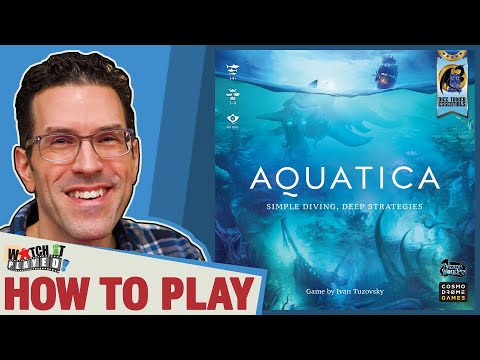





































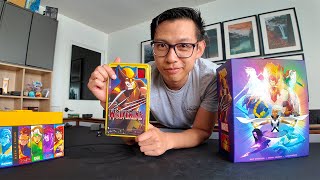

Aquatica is a deep, but easy to learn family engine builder about underwater kingdoms.
In the game you will become one of the mighty ocean kings, struggling to bring glory to his realm. To win the game, you need to capture and buy locations, recruit new characters, and complete goals; each of these actions gives you victory points at the end of the game. To do so, you need to play cards from your hand (each with a unique set of actions) and combine them. Don't think it's simple! With a good strategy during your turn, you can take up to ten actions in a row.
You will encounter plenty of mysterious ocean creatures and take them to your hand. With their help you will explore the unknown locations and raise found resources from the ocean depths to your kingdom. Mechanically this is represented with the help of three-layered player board and the unique mechanism of card-rising.
—description from the publisher
- Engaging dial-driven worker placement with multiple options per space
- Satisfying aquarium-building loop that provides a tangible sense of progression
- Clever adjacency bonuses and bonus economy that reward planning
- Distinct and effective dice progression mechanic keeps round flow clear
- Strong solo mode that still feels satisfying with others
- Pet shop track can feel hard to optimize and underutilized for some players
- Limited discovery/replay value; game can feel straightforward after a few plays
- Fish cards lack explicit names or identities, which can dampen thematic immersion
- Some players may find the track management fiddly or dense at first
- Aquarium management and species display with scoring through habitat development
- Underwater aquarium environment with modular player boards and a central action dial system
- Procedural engine-building with thematic flavor rather than a strong narrative arc
- Tea Garden
Mechanics (from transcript analysis)
- dice_progression — A central die tracks round progression; its value increases, shaping available actions and turn order.
- end_game_scoring — Lionfish tokens and various endgame scoring conditions influence final points.
- engine building — Progress on the encyclopedia and other bonus tracks to unlock powerful endgame points and resources.
- engine_building — Progress on the encyclopedia and other bonus tracks to unlock powerful endgame points and resources.
- Resource management — Manage oxygen, food, pearls, and other resources to perform actions and feed fish.
- resource_management — Manage oxygen, food, pearls, and other resources to perform actions and feed fish.
- set collection — Fish cards and other resources are collected to populate the aquarium and help progress on tracks.
- set_collection — Fish cards and other resources are collected to populate the aquarium and help progress on tracks.
- tableau building — As you acquire fish cards and plants, you build a personal aquarium tableau that grants ongoing bonuses.
- tableau_building — As you acquire fish cards and plants, you build a personal aquarium tableau that grants ongoing bonuses.
- worker_placement — Place a die (your worker) on action spaces; actions can be boosted by spending pearls, and adjacency can grant bonuses.
Video topics + discussion points
Quotes (from this video)
- this is a worker placement and tableau building style game in which you are trying to build up the best aquarium
- I really like the way the worker placement works
- the die... you always know whose turn it is
- the main part of the game is getting fish into your aquarium
- I love that you have multiple choices for each space that you go of what you're going to do
- I think to me the encyclopedia track is really interesting; it provides bailout bonuses and strategic paths
- this is a game that plays as quick as it does, but it has a lot of meat and is really satisfying
- solo is pretty darn satisfying
- do you actually aquaria, bro?
- I will bring it back to the table at a convention when we have 90 minutes for Aquaria
References (from this video)
- Strong combo-driven engine-building that rewards planning and sequencing
- Tight integration of depth mechanics with scoring and goals
- Accessible for families and a good lead-in to more complex games
- Solid components (mantas) that reinforce theme and provide tactile feedback
- Expansions add meaningful variety and replayability
- As a learning curve, some players may find the depth progression and market management a touch dense at first
- Underwater empire-building, exploration, depth-based scoring
- Underwater world where ocean kingdoms compete for glory and control of locations
- Procedural/strategy-driven
Mechanics (from transcript analysis)
- Card-driven actions — Players play cards from their hand to perform actions, with each character card enabling different actions.
- Card/Chit Market — Move location cards from the main market to the top row, discarding excess cards to manage the market.
- Depth tracking and bonuses — Locations have depth circles; advancing a card up grants bonuses and, when fully advanced, yields end-row points.
- Expansion-modified play — Expansions introduce new cards, abilities, and rules (e.g., cold waters, tribes, coral reefs) that modify play balance and strategy.
- free actions — On a turn, players may take any number of free actions after setting them up, allowing for strategic sequencing.
- Goals and scoring — Complete four goals tracked on the board or use scoring piles/goals to maximize points; goals can be altered mid-game.
- King card — Each player has a unique king card granting a special ability, differentiating players.
- Location acquisition — Purchase or conquer location cards, then slide them under your board to reveal depth bonuses and scoring opportunities.
- Mantas (tokens) — Mantas act as a resource and can be flipped to reuse effects or reset for additional actions.
- scout action — Move location cards from the main market to the top row, discarding excess cards to manage the market.
- tile placement — Purchase or conquer location cards, then slide them under your board to reveal depth bonuses and scoring opportunities.
- Track advancement — Locations have depth circles; advancing a card up grants bonuses and, when fully advanced, yields end-row points.
- Treasure/score action — Score by taking a card with no remaining depth and move it to your scoring pile, earning listed points.
Video topics + discussion points
Quotes (from this video)
- Aquatica here is a combo Happy Engine building underwater game that can be played in under an hour and this is the perfect game that I've been able to use to graduate my kids to come to a more complex game you know from the ones that they've been playing but more than that they you know just it's a perfect step to get into more advanced gaming again
- the combos that you can do in this game makes playing this game very satisfying
- this is bro with litz tablet where we get games to the table
- overall Aquatica here is a combo Happy Engine building underwater game that can be played in under an hour
- this is a perfect step to get into more advanced gaming again
References (from this video)
- Rich, multi-layered scoring with diverse objectives
- Strong thematic integration around underwater aquaria
- Tactically deep with meaningful choices on dial placement and resource management
- High learning curve and many moving parts
- Rule ambiguities in the online/printed rules around pet shop bonuses and microflora phase
- Aquarium construction, oxygen management, and end-game scoring via fish, coral, and school formations
- Underwater aquarium environment with modular tanks and vents
- Competitive, multipart scoring with evolving bonuses via dials/tracks
- Power Grid
- Covenant
- SETI
Mechanics (from transcript analysis)
- card drafting — Players pick cards from a display/deck, shaping starting resources and potential bonuses.
- Card drafting and hand management — Players pick cards from a display/deck, shaping starting resources and potential bonuses.
- Endgame scoring via multiple vectors — Lionfish cards, school formations, and color/adjacency bonuses contribute to final points.
- Pattern completion and area control — Filling rows/columns with fish and other tokens yields points; some bonuses depend on adjacency/touching.
- Resource management — Oxygen, pearls, and food are spent/earned; oxygen costs limit placement, pearls multiply actions, and food feeds fish for scoring.
- worker placement — Die on the action wheel represents turn order and available actions; players move a single die to adjacent spots.
Video topics + discussion points
Quotes (from this video)
- Today we're going to play Aquaria.
- This is a three-dimensional thing.
- The learning curve is steep but rewarding.
- I like the designer Thomas Folek.
- This game is surprisingly good with a lot of knobs.
References (from this video)
- Beautiful box and presentation
- Rulebook described as digestible and well-organized
- undersea empire, exploration and combat
- Underwater kingdom with mythic rulers
- mythic adventure with card-driven tableau-like setup
- Everdell
Mechanics (from transcript analysis)
Video topics + discussion points
Quotes (from this video)
- I am very excited to try this out
- I just can't wait to play this so so badly
- Hadrian's Wall the biggest box
- I love the artwork it's stunning
- UK Games Expo in May next year
- I'll definitely make videos about Hen Wall and Aquatica
References (from this video)
- Crunchy decision space with many options and meaningful tradeoffs
- Beautiful, table-friendly components and setup described as very cool looking
- Solid solo/automa implementation for one-player or limited-play sessions
- Clear mechanic integration between color-matching microflora dials and active color
- Variety of actions and multi-layered scoring opportunities
- Relatively long playtime (estimated up to 180 minutes) which may be daunting for some players
- Complex rules and setup can require frequent rule reference, especially in solo mode
- Some actions and market interactions can feel dense or opaque without rules reference
- Array
- Underwater aquarium ecosystem
- Informative
Mechanics (from transcript analysis)
- Aquarium Card Drafting/Market Interaction — Players draft aquarium cards and other related cards from a small market, with options to replace or refresh cards during play.
- card drafting — Players draft aquarium cards and other related cards from a small market, with options to replace or refresh cards during play.
- Central Action Tile and Multi-Option Actions — A central action tile provides a menu of different actions, with varying costs and outcomes, including card placement, gaining resources, and bonuses.
- dice placement — Players place a die on action circles to determine which action they take each turn; the die also tracks how many actions are available per round.
- Feeding Phase and End-Game Scoring — At the end of each round, players feed fish to gain points, contributing to end-of-game scoring tied to resources and cards.
- Microflora Dials with Color Matching — Microflora dials must be oriented toward the round's active color to gain bonuses; the active color changes between rounds.
- Pet Shop and Encyclopedia Tracks — There are dedicated tracks (pet shop and encyclopedia) that advance to grant bonuses and influence future actions.
- Resource management — Oxygen, pearls, and cans are spent or earned to perform actions and affect scoring or placement bonuses.
- Solo Automa (AI) Rules — A solo/Automa mode governs the opponent's actions and tile draws, providing a solo-play experience.
- Track advancement — There are dedicated tracks (pet shop and encyclopedia) that advance to grant bonuses and influence future actions.
Video topics + discussion points
Quotes (from this video)
- This is a very cool looking game, I have to say.
- This is quite a long game. Um, it does estimate I think up to 180 minutes, so um, it's not a very quick one, but we'll see what I can do.
- A lot of good decisions to be made
- pretty crunchy this game is in my opinion because there's just so much you can do.
References (from this video)
- Strong head-to-head play with a challenger (spouse)
- Base game highly regarded by speaker
- 3D model inserts in new components (collector's aspect)
- Aquatic exploration and resource management.
- Underwater world with coral reefs and sea life.
- Competitive, end-game achievement focus
Mechanics (from transcript analysis)
Video topics + discussion points
Quotes (from this video)
- Ahoy number one ... the main game with sustenance during the holidays
- Ahoy gonna be a really fun time to to be had there
- Aquatica non-stop lately
- the base game as it is is perfect it's honestly one of my top 10 games of all time if not top five maybe even top three
- Ready Set bet that's gonna be I probably like the biggest highlights during the next week or so
- Captain sonar you saw me unbox it yesterday we're gonna be playing this for sure
- Frost Haven this one's gonna be for me to enjoy for now until I get going with this
- Paul Grogan from Gaming Rules just released an official tutorial on that video has come in clutch
- it's been super helpful learning this way way easier than trying to absorb with all the information that the manual is giving
- I'll see you all on the next one
References (from this video)
- Wonderland's War
Mechanics (from transcript analysis)
- Combat with potential reactive elements
Video topics + discussion points
Quotes (from this video)
- reactive card play is because it feels so one-dimensional when you're playing a game that involves cards where all you do is play one card in your turn and then your opponent has no way to react
- it increases the level of strategy 10fold because then you have to think about timing.
- the reactive card play is definitely a lot more intuitive when it comes to combat games cuz not all games need that kind of reaction type
References (from this video)
- Aquatica remains a personal favorite; rhythm and interaction feel strong
- Expansion content (Coral Reef) teased as something exciting
- Commentary on the tribes module being optional and not massively transformative
- Oceanic exploration with tribal expansion and creature interactions
- Underwater world with coral reefs and sea-cultures
- Rhythmic, strategic play centered on resource management and combat
Mechanics (from transcript analysis)
Video topics + discussion points
Quotes (from this video)
- June honestly was one of the best months in gaming because we had so many so many good games played.
- Andromeda is so good.
- I cannot wait to share more about ARs and about the one and only Andromeda.
- this is very, very initial early thoughts about this game and I still want to tell you about it
- it's so fun this game is so good y'all
References (from this video)
- Strong card-location synergy
- Engaging slide mechanic; neat physical metaphor
- Contained package with potential for replayability
- Not deeply strategic for some players
- Limited diversity in the card pool may limit replayability for some
- deck-building, location synergies, scoring
- Underwater exploration and card-assisted location-building
- engine-building
- Six Nymph
Mechanics (from transcript analysis)
- card-location synergy — Locations and deck choices interact for scoring power.
- cards sliding under slots to activate effects — As slots slide up on the mat, locations grant benefits.
- deck-building with location cards — Play cards to gather locations that award points and abilities.
- Multi-use cards — Locations and deck choices interact for scoring power.
Video topics + discussion points
Quotes (from this video)
- My first impression was kind of lukewarm with this game.
- There is a lot of randomness in what tiles you are grabbing.
- I really enjoyed the synergies of mechanisms that are featured in this game.
- it's not something that immediately screams replayability to me.
- I did enjoy this game and would happily play it as someone else suggested it.
- Easy to learn and teach.
- This game has offered a lot of fun and replayability.
- The artwork is really nice.
References (from this video)
- Beautiful art
- Engaging action chaining
- Solo mode not explored by the speaker
- Oceanic exploration and building
- Underwater world with coral kingdoms
- Majestic, aquatic
Mechanics (from transcript analysis)
- deck-building with sliding actions — Slide cards on the board to unlock resources and actions.
- set collection — Acquire cards to build locations and gain rewards.
- set collection / building — Acquire cards to build locations and gain rewards.
Video topics + discussion points
Quotes (from this video)
- Concordia is fantastic.
- Endgame scoring is so cool and unique.
- Obsession is such a fun game.
References (from this video)
- Central board mechanic is highly praised and enjoyed for its flexibility and depth
- Adjacency bonuses add meaningful decisions without over-constraining players
- Multiple scoring tracks and randomized bonuses increase replayability
- Accessible balance between crunchy decisions and approachable rules
- Fits well within Delicious Games’ catalog style and design philosophy
- Production and art direction feel inconsistent with the aquarium theme; art is not as striking as some players expect
- Symbol palette can feel overwhelming at first, potentially deterring new players
- Some mechanic synergies (like the filter engine) can take deliberate effort to optimize and may be initially underwhelming
- underwater ecosystem management focused on fish, filters, and lionfish as high-value targets
- 1950s aesthetic with an aquarium theme and dials/controls centered around fish care and display
- informational/educational hub with a playful, retro-industrial veneer
- Underwater Cities
- Praga
- Gricola
- Wingspan
Mechanics (from transcript analysis)
- central action board with dice-driven actions — Players move a die to one of several action spaces; moving to adjacent spaces yields a bonus action, and the middle space is always accessible
- deck/hand management and card acquisition — A central market/hand mechanism where players draw and manage cards to place onto their board for future scoring
- dial/toggle/resource optimization — Players rotate color-coded dials on their personal boards to maximize bonuses and align with round color goals
- end-of-round bonuses and multi-track scoring — Scores are determined across several tracks (encyclopedia, pet store) and end-game bonuses; on-round bonuses trigger based on track positions
- oxygen/resource management — An oxygen track determines what fish can be placed and pays for upkeep; pearls can upgrade actions for stronger results
- placement and end-round scoring of fish — Players place fish on their own boards, paying oxygen costs, and scoring through lionfish cards and end-of-round bonuses
- Resource management — An oxygen track determines what fish can be placed and pays for upkeep; pearls can upgrade actions for stronger results
Video topics + discussion points
Quotes (from this video)
- My favorite part of this game is that central board mechanism.
- There's moving up tracks and there's that whole filter system which I wanted to love more than I did.
- You're never squished. Like I really need fish, then go get them.
- It's a sweet spot for me where I feel like there's lots of crunchy decisions without overwhelming me.
- If you move adjacent, you get the bonus.
References (from this video)
- Beautiful theme and components
- Resource management and location expansion
- Underwater world
- Oceanic exploration with conquest
Mechanics (from transcript analysis)
- Area Control — control aquatica locations
- set collection/resource management — gather resources and upgrade locations
Video topics + discussion points
Quotes (from this video)
- yeah i'm also working on this crazy fast 4x space game called last light that's gonna be coming out
- you can actually build residential buildings and double triple stack tiles to make them taller
- it's a spin-off of the katan series
- final score is 14 out of 20
- you are correct it is rising sun
References (from this video)
- Beautiful components with decorative knobs
- Designer has established track record
- Family-friendly weight level
- Theme of aquarium building not particularly exciting
- Building and managing fish collections in an aquarium
- Aquarium
- No narrative - abstract puzzle game
Mechanics (from transcript analysis)
- placement — Where you place fish on your board determines the oxygen cost - placement next to plants reduces cost
- Resource management — Players use oxygen to purchase fish and manage their aquarium
- set collection — Fish are categorized in different ways, and players are motivated to collect sets of similar fish (schools of fish)
Video topics + discussion points
Quotes (from this video)
- It's a boss fighting game with QR codes. In this game, you're going to get pick one of four heroes and then mix it with one of the four classes
- Every other page in the rule book has this info about how the mechanisms in the game relate to real life
- It's a dice placement game by Stefan Feld. What else do you need to know?
- It's basically trick taking game with a lot of things around it
- If you lose an auction, you also get some rewards
- Let us know which ones are you most excited to try down in the comments
References (from this video)
- neat aquatic theme and visuals
- plays reasonably quickly
- felt lighter and less deep than desired
- not prioritized in this collection
- oceanic life and aquatics
- underwater/sea exploration
- theme-driven exploration
Mechanics (from transcript analysis)
- set collection / engine-building — Light-to-medium complexity game with quick setup and thematic water-world feel.
Video topics + discussion points
Quotes (from this video)
- it's a full-time successful job for me
- the newest macbook pro line is significantly faster
- i'm in a much better headspace about the numbers
- i'm not sitting there thinking that a three video per week plan is sustainable
- there's a lot of evidence to show that putting out more videos is not necessarily better for me
References (from this video)
- distinct economic engine
- expansion adds significant depth
- base game weaker than expansions
- oceanic strategy and economy
- submerged empire with a floating city concept
- tableau-building with thematic flavor
- Concordia
- Century
Mechanics (from transcript analysis)
- Resource management — balance economy, military power, and currency
- tableau-building — players assemble a personal engine of cards to generate resources
Video topics + discussion points
Quotes (from this video)
- Detective Club is going to be one where you have these different cards that are all different kinds of images that are really beautiful and very unique
- it's a clever timeline; accessible and easy to explain to anyone
- the expansion really elevates the gameplay on Aquatica
- it's the best slaughter game and it's very deep, but accessible
References (from this video)
- Strong thematic cohesion
- Engaging puzzle with clear choices
- Some randomness can affect control, depending on setup
- Oceanic exploration and gadgetry
- Undersea/archipelago exploration
- Mechanics-first with thematic veneer
- Gizmos
- Reef
Mechanics (from transcript analysis)
- engine-building / action selection — Choose actions to develop your underwater base and/or engine to acquire resources
- Resource management — Balance resources to activate gizmos and explorations under the sea
Video topics + discussion points
Quotes (from this video)
- Gizmos is my favorite uncomplicated game.
- I want to understand why stuff works and how to pull levers in a game.
- I don't play to win. I'm playing to explore.
- Grow bold or die, my friends.
- There are so many games out there.
References (from this video)
- gateway-plus with depth
- visually appealing
- needs careful teaching to unlock combos
- engine-building with location cards and bonuses
- Undersea city with divers and locations
- gateway-plus feel with depth
- Marcitor (engine-building with location cards)
Mechanics (from transcript analysis)
- location card drafting and engine-building — Acquire new characters and locations to trigger chained bonuses.
- personal player board notches — Slot cards into a personal board to activate bonuses.
Video topics + discussion points
Quotes (from this video)
- this was definitely the hardest to rank these games
- none of these games I thought were bad this month
- this is an absolute delight
- ultra smooth ultra fun
- this is a thinky filler game with a great weight and repercussions
- you can teach this one in 30 seconds
- very elegant and easy to teach
- the elegance of the system is amazing
- I'm absolutely hit for me
References (from this video)
- Cool game design with good combo effects
- Expansion Cold Waters improves the endgame and scoring conditions
- Tribes from expansion add interesting special abilities
- Enjoyable to play after getting to know it better
- Artwork not as awesome compared to games like Abyss
- Rule book could be much better
- Had a slow player experience at initial demo at Essen
- Exploring aquatic depths and discovering sea creatures
- Underwater ocean exploration
- Tableau building with combo mechanics
- Abyss
Mechanics (from transcript analysis)
- Card Combos — Characters generate actions and resources through combination effects
- Resource management — Acquire locations and manage resources to create power turns
- Sliding mechanics — Players tuck and slide locations down their board as they explore
- tableau building — Players build and manipulate locations on their board
Video topics + discussion points
Quotes (from this video)
- It's that great banter game that's just great for like a good party setting
- The game needs to be quick and snappy and that's the way it should work
- When I got the game myself and finally got it out and played it with fellow gamers it was brilliant
- I don't see this really rising further up the top 100 though I think this is going to be its peak
- If there's a slight flaw at this game it's that the card system needs a little bit of tweaking it can get quite swingy
- The fans recommended this game and the fans were right
- It's kind of like that awesome experience that you only get to experience every now and again in a blue moon
- I found brian board to be a big surprise one of those big exceptions to the rule
- It's that great sort of climactic tension where throughout the game you're trying to figure out who is not on our side here
- It's a really clever system there's a decent amount of dice mitigation you know every time you roll those dice you are there racking your brains
References (from this video)
- strong thematic cohesion with aquarium management and fish ecology
- accessible weight with hidden depth for experienced players
- high variability due to random boards, dials, and bonuses, boosting replayability
- interactive card and bonus economy creates meaningful competition for resources
- art and components convey the aquarium theme and feel
- largely multiplayer solitaire with limited direct interaction
- fish-feeding can be punishing if players mismanage resources
- random setup may create uneven early opportunities and luck factor
- end-of-round dial alignment requires careful timing and planning to maximize scoring
- ecosystem management and fish-keeping within a managed aquarium
- Aquarium environment with marine life, built and managed by the players
- eco-engineering puzzle where players balance oxygen, food and habitat
- Seti
Mechanics (from transcript analysis)
- action selection and dice-as-counter — Players perform four actions per round using a die to track available actions; action power scales with pearls spent.
- card drafting — Acquire cards from the display or top of deck; end-of-round bonuses hinge on card choices and color goals.
- Card drafting / set collection — Acquire cards from the display or top of deck; end-of-round bonuses hinge on card choices and color goals.
- dial-based puzzle (microflora dials) — End-of-round dial alignment yields bonuses; cards can rotate dials to adjust color combos.
- engine building — Advancement on the pet shop track unlocks stronger actions and a free card play, creating momentum.
- engine-building progression — Advancement on the pet shop track unlocks stronger actions and a free card play, creating momentum.
- grid/board placement — Personal 4x4 aquarium grid interacts with a central shared area; tile placement influences resources and scoring.
- Resource management — Key resources are oxygen, food and pearls; mismanaging them changes the scoring and feasibility of actions.
Video topics + discussion points
Quotes (from this video)
- this is Aquaria and the designer is Thomas Hollik.
- a midweight grid building game.
- The game is going to play over four rounds and each round you're going to take four actions.
- Plants never cost oxygen. They produce oxygen.
- multiplayer solitaire except that the interaction on this area I mean it's only a little bit of interaction where you can go to the same space as somebody else.
- this is probably the crux of the game. This is getting cards into your aquarium.
- it's a fine game. It's a low interaction game. It's not that complicated a game.
- What makes this game unique is the action.
- The rules are quite simple but the strategy is a little bit more deeper.
- time this wrong and you could lose some points; endgame scoring hinges on precise oxygen management.
References (from this video)
- strong thematic feel
- nice table presence
- setup can be elaborate
- ocean exploration and city-building
- underwater city
- thematic, medium complexity
- Beacon Patrol
- Ulterior Aquatic titles
Mechanics (from transcript analysis)
- polyomino placement — fit custom-shaped pieces to maximize scoring areas
- tile laying — place ocean/underwater tiles to build habitats
Video topics + discussion points
Quotes (from this video)
- "it's Mad Max on steroids where you just killing up folk in your car"
- "this is the addiction show"
- "Stone Age is my favorite worker placement game"
- "it's a trick taking game"
- "Unmatched Slings and Arrows... Shakespeare going to war"
- "be sure to check out moving out"
References (from this video)
- Rich, varied options for card selection and location management
- Multiple end-game paths via objectives and diverse scoring
- Dynamic interaction via scouting and market shifts
- Rule complexity and heavy setup with many mechanics to track
- Scouting/raising/actions can be intricate and slow for new players
- End-game scoring can be opaque without careful planning
- Resource management, area control, card-driven actions
- Underwater empire building with manta-based mechanics
- Tutorial demonstration with playthrough
Mechanics (from transcript analysis)
- Action economy - main action + free actions — On a turn, play one card as main action and then perform any number of free actions.
- Conquer vs. Purchase locations — Use resources to conquer or buy location cards to gain benefits and scoring.
- deck-building / hand management — Players acquire new cards, keep some in hand, recall others; used cards are discarded.
- End-game triggers and scoring — End game triggered by depleted decks or completed objectives; final scoring tallies cards, mantas, and locations.
- King cards — Special king cards grant unique abilities that can alter turn order and options.
- Manta tokens as resources and modifiers — Manta cards flipped to gain resources or abilities; some mantas unlock actions when fully risen.
- Raising / increasing location levels — Raise a location to unlock stronger benefits; raising uses coins/tridents and prerequisites may apply.
- Scouting and market refresh — Scout discards market cards and refreshes with new options; minus costs apply to top four spots.
Video topics + discussion points
Quotes (from this video)
- the only reason this video is being made is because aquatica won the poll that is voted on each month by the patreon supporters of this channel
- on a player's turn they're going to play a single card from their hand and then do whatever that card says
- as soon as a location is all the way to the top you can score it using specific actions
- end game triggers when the entire deck of character cards is depleted or the entire deck of location cards is depleted
References (from this video)
- Still in rotation, regularly played
Mechanics (from transcript analysis)
- tile laying — Exploration and aquifer-based tile placement with aquatic themes.
Video topics + discussion points
Quotes (from this video)
- I will not be going through campaign games in this.
- I want to be more cutthroat than I ever have before.
- Quad Heroes is going. I hate it. I hate it so much.
- Monumental. If Monumental is still here in a year and hasn't been played, if next year's Purge, if I haven't played Monumental, it's going to go.
- Last Light can go. I'm not thinking off the shelf.
References (from this video)
- Intuitive rules for a 3-player game
- Sea-themed and visually appealing
- Limited interaction compared to heavier titles
- Underwater / sea fantasy
- Champions of Sea / other engine-builders
Mechanics (from transcript analysis)
- Card engine-building / dice-less engine — Rising cards trigger engines and complete objectives; thematic sea setting.
Video topics + discussion points
Quotes (from this video)
- I'm very bold in my opinions, I hate it but I'm still willing to give it a second and third try because it's better it's an expensive game
- America blue shell is when you brace Mario Kart and then if you're in last place you get rewarded the blue shell
- it's a shared objective, you really pay attention to what other people are doing
- canvas... what a stinker... you're a pile of poops I love that game
- Rise of X added ... I had the Dreadnought portion and it replaced the main board
- I'll take it from me, I think he's French no he's Jamaican