/pic7476782.jpg)


















ArcheOlogic Deep Dive
What the Community Thinks About ArcheOlogic
Reviewers who cover ArcheOlogic keep reaching for the same reference point: Turing Machine. Stonemaier Games introduces it as "a logic game that's in the vein of Turing Machine," and Going Analog goes further, noting the designer also co-designed Turing Machine and calling ArcheOlogic close enough that it could "almost think of it as a sequel." The Board Game Garden channel arrives at the same comparison from a different angle, saying the game "gives me the same kind of vibes as Turing Machine" despite never having played that title.
Where the channels diverge is on what ArcheOlogic does with that inheritance. Going Analog frames it as a fix for a problem with older deduction games: previous favorites like Crypted relied on a human to keep track of the hidden information, and "if the humans get made an error then your whole deduction was thrown to the wind." ArcheOlogic instead hands clue-giving to a mechanical device, which Going Analog treats as the game's central achievement. The Board Game Garden channel is less concerned with that history and more focused on approachability, describing the polyomino puzzle as "a lot more approachable" than Turing Machine's math-heavy presentation. Both channels land on enthusiasm, but for different reasons: one values the precision of the system, the other values how it lowers the entry barrier to the genre.
Core Mechanics That Define ArcheOlogic
Asking the Device
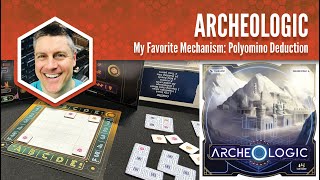
Play centers on a shared device that answers questions instead of a rulebook or a human referee. Stonemaier Games describes choosing "the type of question you are going to ask to the deciphering device" from a shared board, then using whatever the device reveals about a given row or column. Going Analog describes the same apparatus as a wheel with cutouts: spinning two wheels against each other reveals how many shapes or traps sit on a given axis, without any other player able to see the answer. That mechanical layer is what Going Analog credits with removing the human error that could break a game like Crypted, since the device "has to be super precise" for the clues to work.
Polyomino Placement
The clues feed into a spatial puzzle rather than a purely abstract one. The Board Game Garden channel explains that the game is "basically a polyomino deduction game," where irregularly shaped pieces representing buildings have to be placed onto a personal grid, each carrying its own traps to track. Stonemaier Games highlights this pairing directly, noting that a limited, fixed set of polyomino shapes narrows the possibilities compared to looser logic puzzles, so the spatial constraint of fitting a piece onto the mat works alongside the logical constraint of the clues themselves.
The ArcheOlogic Experience
A Race Against the Table
Going Analog describes the table dynamic as a rising tension rather than a simple point count: players sense "people are getting closer and closer" as the round goes on, building toward the moment someone solves the placement first. Because it plays out as a race to be first rather than a final tally, Going Analog notes that finishing second can feel worse than finishing last, and that the game moves quickly enough that a loss does not sting for long.
Solo and Ongoing Play
The Board Game Garden channel spends much of its stream in the solo mode, where players choose a starting clue count from zero to five to set the scenario's difficulty, then work through pre-set scenarios with answers printed in the back of the rulebook. An expert mode and rotating daily puzzles are available through a companion app, accessed by scanning a QR code on the coded card, though the channel confirms the base game can be played without ever opening the app.
What Makes ArcheOlogic Stand Out
A Mechanical Answer to Human Error
Going Analog singles out the device itself as the design achievement, calling the way it delivers precise clues "amazingly designed" and comparing the accomplishment to Turing Machine's own mechanism. Where a game like Crypted put a fallible person in charge of the hidden information, ArcheOlogic's wheel-based apparatus removes that failure point entirely, which Going Analog treats as the reason the puzzle can stay tight from round to round.
An Approachable Take on the Genre
The Board Game Garden channel contrasts the tactile, polyomino-driven presentation with Turing Machine's "sterile and clinical" math theme, finding the physical piece-fitting more inviting. Going Analog makes a similar point about theme, noting that ArcheOlogic leans into its archaeological premise, sending players through a temple and around traps, where Turing Machine's designer "did not mention the theme at all." Both channels treat the added theme and tactility as a meaningful upgrade over a drier, more abstract predecessor.
Potential Drawbacks
Precision-Dependent Clues
The same system that Going Analog praises for its accuracy is also identified as a fragile point: the clue-giving apparatus "has to be super precise because if anything's off it just breaks the game." A single mistake in reading or setting up a clue can undermine the deduction for the whole table, putting real weight on careful handling of the device each round.
Tracking Clues by Hand
Unlike deduction games that hand out a structured clue sheet, ArcheOlogic gives players blank paper and leaves them to take their own notes however they want, which Going Analog calls out as a break from convention. The Board Game Garden channel felt the effect of that freedom directly during solo play, describing the note-taking as tricky to keep track of even while actively writing things down, and hitting repeated moments of confusion while narrowing down a placement. Some of that difficulty eases with practice, but newcomers should expect the early scenarios to take real concentration.
If You Enjoy ArcheOlogic
Every channel that covers ArcheOlogic points back to Turing Machine as the closest touchstone, whether through shared design lineage, a similar deduction rhythm, or comparable vibes at the table. Going Analog also draws a direct line to Crypted, contrasting its human-dependent clue-keeping with ArcheOlogic's mechanical solution. The Board Game Garden channel names Planet X and MindSweeper alongside Crypted as the other deduction games in their collection, mentioning MindSweeper specifically while working through ArcheOlogic's own clues.
What Reviewers Are Saying
"There's a board that's shared by all players where you choose the type of question you are going to ask to the deciphering device. This device in the middle of the screen here. And then you'll use the information that you get from this device to play around with polyomino shapes on your private mat in an attempt to figure out this logic puzzle."
— Stonemaier Games
"It's not a long game either. It's one of those games where being second is sometimes worse than being last."
— Going Analog
"It's basically a polyomino deduction game, which I think is very cool. Basically, these polyomino shapes are needing to go onto this grid in a specific way."
— The Board Game Garden