/pic7310302.jpg)
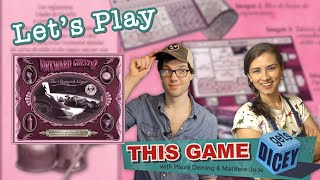
Awkward Guests 2: The Berwick Cases is a title of the Awkward Guests series specifically for two players or teams. It is a dice, mystery and deduction game that challenges you to solve the murder of one of the Berwick twins... and to plan the murder of her sister.
The games recreate the two murders of the Berwick sisters in different ways. The players take different roles in each case. In one they act as the mastermind PLOTTING how the murder occurred, and in the other as the investigator SOLVING the crime. The first investigator to correctly answer these questions first
WHO killed Beatrice/Berenice Berwick?
HOW did the murderer end her life?
WHY did the murderer kill her?
wins the game.
In their turn, the investigator:
Rolls the query dice.
Places the results on the game board according to what information they wish to receive from their rival, the mastermind. They can then interrogate suspects, question the household staff, examine the crime scene, search for clues around the Berwick Mansions, and consult the police reports.
The mastermind reveals the requested information. With this information the investigator can draw conclusions and advance the case.
—description from the publisher


- really like awkward guests
- Went through the rules for this one. There's a lot of things I like about
- Awkward Guests
Mechanics (from transcript analysis)
Video topics + discussion points
Quotes (from this video)
- So, because of that, I actually never got a copy of it um and haven't played it.
- Um so, you drive cars around and shoot at each other. That's basically the game.
- Looks like Carcassonne with Islands. That looks pretty good.
- Do we need a card game version of it? And the answer to that is we really don't. Just play Camel Up.
- This is a war game from Don Greenwood, Avalon Hill.
- But if you like choose your own adventures type games, that's what this is.
- It is a tile laying game that is about as exciting as it looks in this picture here.
- So if you like Klask, um which is a fantastic two-player game, this is just a version for four.
- I really like awkward guests, so why didn't I play the second one?
- He gave it Seal of Approval. A seven out of 10. Well, there you go.
- I think I'm going to have to go with the Bottom of it. It is a fantastic three-player trick-taking game that I like very much and think you definitely should check out.
- If you really like what we're doing here at the Dice Tower, then there are different ways to support the Dice Tower. One of those ways is through Patreon.
References (from this video)

- Similar to the original Awkward Guests, which the host enjoyed.
Mechanics (from transcript analysis)
Video topics + discussion points
Quotes (from this video)
- Um I'd have slight concerns about the replayability of the game, but please do correct me uh on that.
- Maybe a little bit maybe a bit oversaturated in terms of how many there are out there.
- Unfortunately, I'm not familiar with either of those.
- Um I also thought that there wasn't enough mitigation in terms of activating the spots that you wanted.
- Um and pretty much the uh the cards not doing anything terribly interesting either.
- Um but I just like it in every way. But I'm a big sucker for really good Dawn games. I think he's a brilliant designer.
- Um hopefully I'll get copies of those for for sale relatively soon.
References (from this video)

- One of the host's favorite deduction games
- Competitive two-player variant with dice instead of cards
- Traditionally broader audience may prefer the original version
- deduction and investigation with a competitive edge
- murder mystery deduction, two-player variant
- narrative-driven, player-constructed mystery
Mechanics (from transcript analysis)
- Asymmetric Player Powers — Opponent challenges the player's mystery; race to solve the case.
- Deduction — Two players construct and test murder mysteries using a dice-based questioning framework.
- Deduction/Questioning — Two players construct and test murder mysteries using a dice-based questioning framework.
- Two-player asymmetry — Opponent challenges the player's mystery; race to solve the case.
Video topics + discussion points
Quotes (from this video)
- I think out of all of these videos that I've done this is probably the highest quality list that I've done in terms of game recommendations
- gorgeous production I mean the pieces here are absolutely lovely on the table
- one of my favorite deduction games of all time if not my favorite game
- I like how pure and simple it is
- it's criminally underrated
- this one is an absolute absolute belter
- I could not recommend it enough
References (from this video)
- Engaging two-player deduction with a Clue-like vibe that can feel fresh in a familiar genre.
- High replayability due to variable setup, motives, and red herrings that shift with each play.
- Solid integration of movement, clue gathering, and motive mechanics that reward careful planning and logical deduction.
- Accessible for Clue/Cluedo fans who want deeper strategy and a tighter two-player experience.
- Learning curve can be significant due to the density of symbols, decks, and rules interactions.
- Setup and maintenance of multiple decks and tracking components can be table-space intensive and error-prone without careful organization.
- Potential for confusion or misplay if players aren’t meticulous about which clues/card interactions are available on a given turn.
- Murder mystery, social intrigue, family dynamics, deception and deduction.
- A mansion/estate setting where a murder mystery unfolds around twins Beatrice and Bernice; the players alternate between mastermind setup and investigator deduction.
- Two-player, asymmetric narrative: the Mastermind sets up a murder and the Investigator hunts for clues, with surrounded alibis, motives, and hidden paths.
- Clue / Cluedo
- Scandalo
- Alchemists
Mechanics (from transcript analysis)
- Asymmetric roles / hidden information — One player acts as Mastermind who sets up the murder, the other as Investigator who gathers clues and tries to solve the case. Each side hides information and strategically reveals or withholds it.
- Cooperative Game — Both players race to solve the murder, while also pursuing their own opposite objective, creating a tense, back-and-forth dynamic.
- Deck-based clue management — Toe tags, magnifying glasses, and various clue decks structure how information is revealed and how suspects, weapons, rooms, and motives are connected.
- Deduction — Toe tags, magnifying glasses, and various clue decks structure how information is revealed and how suspects, weapons, rooms, and motives are connected.
- Dice-driven query system — On a turn, players roll dice that determine the kinds of questions or investigations they can pursue, including which clues are accessible and where they can gather information.
- Hidden Roles — One player acts as Mastermind who sets up the murder, the other as Investigator who gathers clues and tries to solve the case. Each side hides information and strategically reveals or withholds it.
- Motive and evidence resolution — Each killer has a motive that requires marking off three boxes. Evidence located in rooms and testimonies help confirm or rule out motives and suspects.
- Movement/path deduction — The murderer moves through a sequence of rooms; players deduce the path by eliminating impossible routes, using room connections as a scaffold for narrowing possibilities.
- Testimony / gossip phases — Interrogations and testimony allow players to learn who talked about whom, or who moved where, creating red herrings and strategic deductions.
- Two-player co-op with competitive edges — Both players race to solve the murder, while also pursuing their own opposite objective, creating a tense, back-and-forth dynamic.
Video topics + discussion points
Quotes (from this video)
- I grew up loving clue and then as you played more games you realized clue isn’t actually very good, it’s not a very good game. This is the clue for you.
- Two-player version of that game but it actually feels like you’re playing Awkward Guests, but the system is you’re doing similar things in a different way essentially.
- I genuinely really enjoy these games a lot; I think Awkward Guests 2 nails a two-player deduction vibe.
- This is the clue for you this you need you need these games and well that’s what Awkward Guests is like, right?
- I love Awkward Guests 2; I genuinely think it’s better than Clue on a strategic level for two players.
- We’re solving a murder and we’re racing to be the quickest; it’s a fun race between Mastermind and Investigator.