/pic8491761.png)


/pic6389125.jpg)
/pic6871709.png)
/pic8491761.png)















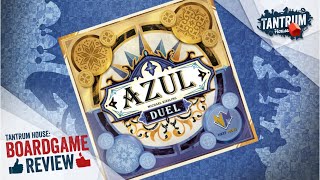

























Azul Duel Deep Dive
What the Community Thinks About Azul Duel
Azul Duel lands in a peculiar position: it is simultaneously one of the most warmly received and most debated entries in the Azul series. Reviewers who grew up on the original Azul tend to greet it as a genuine evolution rather than a cash-in, praising the way it layers new decisions onto a familiar spine. TheGameBoyGeek put it plainly, saying he would never go back to playing the original Azul at two players now that this version exists. Allies or Enemies reached a similar conclusion, noting that while the original Azul works just fine for two, Azul Duel is a game that was designed with two players at its center, making the drafting decisions richer in ways that a larger-player-count game simply cannot.
That enthusiasm is not universal. Tabletop Turtle occupies the moderate middle, giving the game a solid seven while acknowledging it does not produce the craving some games inspire. The Board Gaming Doctor observes that a meaningful segment of the community finds the game too complicated relative to the clean purity of the original, and that some find the added fiddliness unwelcome. The 3 Minute Board Games reviewer raises the sharpest criticism of all: for households that already play Azul regularly, this game may be solving a problem that never existed. Rolling Dice and Taking Names found the experience enjoyable but were puzzled by the choice to restrict it to two players, wondering whether the system could have scaled further.
Where reviewers broadly agree is on the quality of the components, the tightness of the play time, and the fact that if you are a dedicated two-player household, this is the version of Azul worth owning.
Core Mechanics That Define Azul Duel
Building Your Board as You Go
The single biggest departure from its predecessors is that your scoring board is not fixed at the start. Rather than dropping tiles onto a preset grid, both players draft dome plates throughout the game and arrange them in whatever orientation serves their emerging strategy. These plates each hold four colored spaces, and you can rotate each plate freely before placing it. Some plates include a joker space that accepts any color, while others contain a special blank space that triggers a bonus tile and instant points when the surrounding three spaces are filled.
This drafting of the board itself creates a planning puzzle that unfolds across the whole game. As Rolling Dice and Taking Names noted, you spend the game deciding where you want the colors situated on your board, and then working to acquire tiles that fit that plan. Because both players are competing for the same three face-up dome plates, there is a constant pressure to claim the plates you need before your opponent does. Allies or Enemies found that when a scoring card that rewards filling the blank special spaces is in play, dome plate drafting moves to front and center, with both players racing to grab the rainbow plates and avoid the potentially punishing ones.
Stacking and the Moon Mechanic
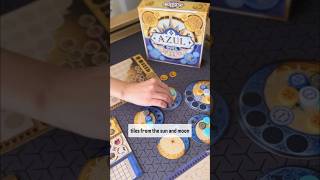
Tile drafting works differently here than in any other Azul. When a player takes a color from a factory's sun area, the remaining tiles do not scatter to a central market. Instead, they are stacked face-up on that factory's moon section in an order chosen by the taking player. This choice is consequential: you can set up beneficial stacks for yourself while burying colors your opponent wants underneath less useful ones.
Allies or Enemies called the stacking decision a huge addition, explaining that it is not just pushing tiles into the middle as in the original. You can try to set things up so you get three of one tile later, but you also run the risk of handing that opportunity to your opponent if you read the situation wrong. A second action, collecting from the moon areas, lets players sweep all matching-color top tiles from every factory at once. The interplay between the two actions creates timing puzzles that TheGameBoyGeek described as another layer of depth on top of an already layered game.
The Azul Duel Experience
A Puzzle That Breathes
Reviewers consistently describe Azul Duel as sitting in the abstract strategy space while feeling more expansive than a cold logic exercise. The combination of a board that evolves, tiles that arrive in an order you can partially influence, and bonus chips that can patch incomplete rows means that the puzzle never locks into one fixed solution. Allies or Enemies, having played the game five times at the time of their review, noted that each session felt different, driven both by the scoring goal cards and by the back-and-forth of reading what your opponent is collecting.
Rolling Dice and Taking Names captured something important about how the game flows: you are always looking at those dome plates, always thinking about where you need a blue or a red to land. That sustained attention to the board state gives the game a particular rhythm. It is not the kind of game where you can tune out on your opponent's turn. You are watching what they draft, watching what they leave, and adjusting your plan accordingly.
The Push and Pull of Competition
The hate-drafting element from the Azul series carries over, but it is modulated in interesting ways. Tabletop Turtle appreciated that the game preserves the wonderful feeling of deliberately denying your opponent tiles they desperately want, while also opening new avenues for interference. Allies or Enemies made the point that because tiles must be placed on dome plates, denying the correct plate is sometimes even more powerful than denying the tile itself. If your opponent needs a plate with three red spaces but you claim the only one with red showing, those red tiles they collect have nowhere to go until a new plate arrives.
The Board Gaming Doctor found that the bonus chip system softens some of the game's rougher edges. Bonus chips, which can substitute for missing tiles when completing a row, mean that a bad round of drafting does not necessarily translate into a scoring disaster. Two matching chips can stand in for a tile of that color, or any three chips together can fill a single gap. This gives players a small recovery mechanism that the original game does not offer.
What Makes Azul Duel Stand Out
More Strategic Depth Without Sacrificing Approachability
Allies or Enemies positioned the game as accomplishing something that Azul: Queen's Garden attempted but did not quite land. That game pushed complexity up a notch, but did so in ways that some found awkward. Azul Duel pursues the same direction more smoothly, adding a sixth pattern line, the dome plate drafting layer, the stacking mechanic, and the bonus chip system, all while remaining accessible within a single teaching session. The two-player constraint, far from being a limitation, is what makes the added complexity manageable. With only one opponent to track, a 30-minute game can support the extra decision points without overstaying its welcome.
TheGameBoyGeek said the game takes the original Azul and makes it deeper in three distinct ways: the dome tiles create a variable board, the stacking creates strategic opportunity, and the bonus chips add a new substitution layer. He described these as three separate additions that each independently add depth, and found the combination compelling enough that it replaced the original in his two-player rotation entirely.
The Small Box That Packs a Lot In
Both Allies or Enemies and Rolling Dice and Taking Names praised the footprint. Azul Duel fits in a box considerably smaller than the original, which reviewers in smaller living spaces found especially valuable. The chunky round tiles feel exactly as good as they always have in the Azul series, described by Allies or Enemies as lovely, chunky, and great to handle. The dome plates themselves are satisfyingly thick, and the bag for drawing tiles is the quality you would expect from this series.
The main production criticism comes from the player boards, which must fold to fit the box and are noticeably thinner than the boards in earlier Azul games. Rolling Dice and Taking Names noted that the fold-and-crease design means the boards can buckle slightly during play, causing scoring tokens to slide. Allies or Enemies acknowledged the tradeoff but came down on the side of accepting it, saying they would rather have the compact box even if the boards are thinner. The dome plates and tiles, which are the components you actually handle most, remain fully up to series standards.
Potential Drawbacks
The Question of Necessity
The sharpest objection in the review community is the one raised most directly by the 3 Minute Board Games review: if you already own Azul and regularly play it with two people, this game may not justify its shelf space. The original plays beautifully at two, and Azul Duel does not replace the experience of playing Stained Glass of Sintra or Summer Pavilion at two players either. BoardGameCo noted that while they found the game enjoyable at release, their enthusiasm cooled somewhat over time, and since they tend to play Azul-series games on Board Game Arena rather than with physical copies, the need to own this one physically was less obvious.
Tabletop Turtle articulated this sense well: they like the game, they think it improves on the original in some ways, but it does not produce the itch to play again. It is a game they enjoyed in the moment without taking anything away that made them eager for a rematch. That quality of being pleasant but not compulsive is a meaningful distinction when shelf space is finite.
Added Complexity as a Barrier
The Board Gaming Doctor relayed that a meaningful portion of the community finds the game more complicated than it needs to be, and that some of that complexity can feel fiddly rather than engaging. The point economy for drawing blind dome plates from the stack adds a layer that players must consciously manage. Knowing how to stack tiles optimally after taking from a factory requires reading the board in ways that can feel overwhelming in the first couple of plays. The sixth pattern line is noticeably harder to complete than any of the five in the original, and Allies or Enemies admitted that getting even three of six rows scored in a game feels like an accomplishment.
The Board Gaming Doctor also observed that the physical experience of playing on Board Game Arena may suit this game better than an in-person session, precisely because the asynchronous format gives players more time to think through the stacking and dome placement decisions that can bog down real-time play. For players who prefer their abstract games to move briskly and cleanly, the original remains the more streamlined option.
If You Enjoy Azul Duel
Players who love Azul Duel are likely to enjoy working through the full Azul series, particularly Azul: Summer Pavilion, which introduces a more flexible tile-placement system with wild tiles. Azul: Stained Glass of Sintra offers a different structure with its column-based scoring and panel replacement mechanic. For a completely different two-player puzzle experience that rewards careful tile management and planning, Jaipur is a frequent comparison in the community, delivering tight back-and-forth competition in a smaller package. Players drawn to the variable-board aspect of Azul Duel, where you construct your own scoring layout over the course of the game, may also find the spatial planning in Azul: Queen's Garden interesting, even though reviewers noted it pushes complexity further than Azul Duel.
What Reviewers Are Saying
"It takes the original Azul and makes it deeper, deeper, deeper in three different ways. And I don't think I would ever play regular two players again. I have to play this one."
— TheGameBoyGeek
"The drafting has been made a lot more interesting because it's not just the one decision of what kind of tile you're going to take. That stacking can be a big choice because it might be setting yourself up for success if you know that you want to get like three of one tile. But then you also run the risk of presenting that option to the other player too."
— Allies or Enemies
"It feels the same but new. It's a new shoe, yet it's comfortable. One of the things you could do on your turn is draft these dome plates to put on your board, deciding okay here's how I want to fill out my board. And that unique thing really gave it a new feel."
— Rolling Dice and Taking Names