/pic2414579.jpg)























Barony Deep Dive
What the Community Thinks About Barony
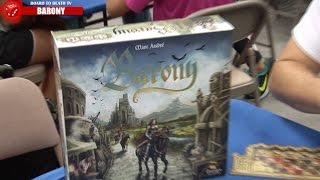
Barony draws strong, specific praise from reviewers who have actually put knights on its hexes. Chairman of the Board placed it at number one on a ranked list of recent plays, calling it wonderful and saying they could not recommend it enough. Hungry Gamer, discussing a new printing of the game on a podcast, said flatly that they love it and called it one of their favorites from designer Marc Andre, the same designer behind Splendor and Majesty for the Realm. Board to Death TV filmed a demo of the game at the Asmodee booth, given by a booth presenter rather than the channel's own reviewer, and came away impressed by how approachable it felt for something that looks, at first glance, like a complicated war game.
Where there is any disagreement, it centers on presentation rather than design. Hungry Gamer was candid that the original edition's artwork did not do the game justice, even while insisting the underlying game is excellent enough that a weaker art package barely mattered to them. Everyone else who weighs in focuses on the board, the terrain, and the decisions, with no pushback on the core system itself.
Core Mechanics That Define Barony
Terrain-Driven Movement and Resource Harvesting
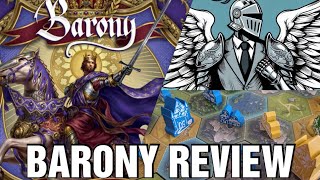
Chairman of the Board describes Barony as a dudes-on-a-map game where players traverse a modular hex board with their knights, then set up villages to harvest resources from the terrain those knights are standing on. Different landscapes behave differently: meadows are fruitful for resources but leave the troops sitting on them vulnerable to attack, wooded areas can be moved through but never hold a castle, and mountains can only ever support one unit at a time, which makes them useful for building a defensive blockade. Board to Death TV's convention walkthrough confirms the same shape of the system from the publisher's side, describing a modular board that is set up differently every game, sized to the number of players, with knights expanding outward across the landscape.
Converting Resources Into Noble Rank
The resources a village produces sit on the board as shields in a temporary state before they are banked. Board to Death TV explains that those shields are at risk the whole time they remain in that temporary form: if an opponent's knights outnumber the ones guarding a spot, the defender's knight is removed and the attacker can steal a shield from them. Chairman of the Board frames the endgame the same way, explaining that players are trying to convert a set amount of banked resource points into their next noble rank and climb through the ranks before anyone else reaches the top, which is what ends the game.
The Barony Experience
Positioning Over Dice, Like Commanding a General
Both Chairman of the Board clips describe Barony as a game of positioning and opportunity cost rather than luck. Combat is resolved by simple majority, with no dice and no charts to consult, and the reviewer says the game still evokes the feeling of being a general, deciding where troops defend, where they expand, and which weaknesses they are willing to accept. Hungry Gamer backs this up from the other side of the table, describing Barony as a perfect information game where everyone starts with the same pieces and the same abilities, which they compare to chess in how it rewards optimizing moves against an opponent who can see exactly what you see.
Quick to Teach, Built to Scale
Board to Death TV's booth demo leans into how approachable the setup looks in practice: a modular board, six simple actions, and a turn order that is easy to pick up even though the box might suggest otherwise. Chairman of the Board adds a time check from actual play, saying the game only takes around an hour and calling that remarkable given how strategically rich it feels, and noting that it scales well because a bigger player count simply means a bigger map.
What Makes Barony Stand Out
Minimalist Rules With Real Strategic Depth
Chairman of the Board singles out how beautifully minimalist Barony's actions are: move troops, spawn new troops, convert them into villages, or convert them into castles. Despite that simplicity, the reviewer says the game has depth and layers, and that every decision carries a real opportunity cost, like choosing to defend a wall and accepting weakness elsewhere as the tradeoff.
Terrain That Actually Matters
The same reviewer calls Barony's use of terrain the best they have seen in a war-style game, because every landscape type has its own strengths and weaknesses that feed directly into strategy: rich meadows worth grabbing early but hard to defend, forests that let troops pass but never host a spawning point, and mountains that choke movement down to a single unit at a time and reward whoever builds a blockade there first.
Potential Drawbacks
The Original Edition's Art Didn't Land
Hungry Gamer is direct that the original edition's artwork was unremarkable and, in their words, a little garish, even though they did not hate it outright. They note the newer edition improves on this, though at the time of that conversation they had only opened the box and had not dug into the new material yet.
Early Resources Are Exposed
The resource system that makes Barony tense can also work against a player who commits too early. Board to Death TV points out that shields sitting in temporary form can simply be taken if an opponent's knights outnumber the defenders on that spot, and that a player with no shields on hand cannot be stolen from at all, which rewards banking resources quickly over sitting on a rich-looking position. Chairman of the Board frames the same tradeoff from the meadow side: the most resource-rich terrain is also the terrain most exposed to attack, so a player who grabs it early has to spend much of the game holding ground that a more patient opponent can simply walk past unopposed.
If You Enjoy Barony
Board to Death TV's demo repeatedly reached for Catan as the easiest comparison, pointing to the opening placement of cities and knights as having a Catan-like setup feel before the game branches into its own area-control structure. Chairman of the Board placed Barony on what they called a Mount Rushmore level of area-control, dudes-on-a-map design, putting it up alongside El Grande as the kind of rich, timeless Euro game they want in their collection.
What Reviewers Are Saying
"For me, this is kind of on the Mount Rushmore level of area control dudes on a map game. Now, I put this one up there with games like El Grande."
— Chairman of the Board
"But it's actually very accessible. So, what we've got here is a modular board. You're going to set it up differently every time you play. And the size of the board depends on the number of players you're going to have."
— Board to Death TV - Board Game Reviews
"It is a area control type game. Everybody starts with the same pieces and everybody has the same abilities and it's chesslike in that you just try to optimize your moves over everybody else's moves."
— Hungry Gamer