/pic3893551.png)









Batman: Gotham City Chronicles Deep Dive
What the Community Thinks About Batman: Gotham City Chronicles
Batman: Gotham City Chronicles generates passionate discussion within the board gaming community, with reviewers consistently highlighting a complex but rewarding experience. The game divides opinion primarily along expectations: those seeking a straightforward superhero action romp may struggle, while players who embrace puzzle-like strategy and tactical planning find themselves deeply engaged. The production quality, particularly the miniatures, receives universal praise, though the rulebook and initial learning curve present genuine barriers to entry.
Core Mechanics That Define Batman: Gotham City Chronicles
The Energy Cube System
The heart of Batman's gameplay revolves around energy cubes that represent both a hero's stamina and their life force. Each hero has a personal board where they manage red cubes across three zones: reserved (available for actions), fatigue (spent but recoverable), and wounds (health damage). To perform any action, whether attacking, moving, or manipulating objects, players spend cubes from their reserved zone. The elegance lies in the tension this creates: spending all your cubes to devastate enemies leaves you vulnerable with minimal health and defensive options. Some heroes recover more cubes when resting than when remaining active, forcing meaningful tactical choices each turn about whether to push forward or consolidate.
Asymmetric One-vs-Many Conflict
Batman features fundamentally different game structures for each side. Heroes operate as a coordinated team where players can take their actions in any order, interrupting each other as needed to achieve objectives like disarming bombs or rescuing hostages. The villain player controls all antagonists through a unique system: character tiles slide through an activation river where position determines cost, with more expensive activations for frequently-used enemies. This asymmetry means the heroes and villain are never playing the same game, with different objectives, different resource management systems, and different relationships to the scenario. Heroes have limited turns to accomplish goals while villains escalate their forces and schemes through the round.
The Batman: Gotham City Chronicles Experience
Tense Strategic Puzzle-Solving
Rather than a tactical skirmish where reaction time determines success, Batman rewards careful planning and hero selection. Each scenario presents specific challenges that determine which heroes are even available for recruitment. Reviewers consistently emphasize that success requires examining each character's abilities before the game even begins, identifying synergies, and building a team specifically for the mission at hand. A lineup that crushes one scenario may collapse against another's specific enemies and objectives. The game feels like a chess problem more than a firefight, where the overwhelming apparent odds of the villain's forces become manageable once players identify the critical path to victory.
Rewarding Mastery With Difficult Opposition
The game presents steep difficulty, particularly for the heroes. Reviewers note that the scenario design consistently favors the villain player, with objectives spread across the map, expensive movement, and enemy arrangements that punish poor positioning. However, this difficulty creates a powerful reward structure: when heroes finally execute a flawless plan and emerge victorious, the satisfaction runs deep. Some players accept failure in early attempts as part of learning the scenario's puzzle, trying different hero combinations and strategies until they discover the winning approach. The game encourages replay and experimentation rather than expecting players to succeed on first contact.
What Makes Batman: Gotham City Chronicles Stand Out
Stunning Physical Production
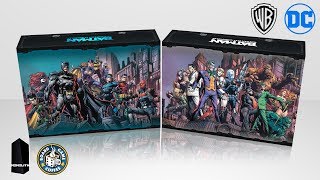
The miniatures in Batman represent some of the finest plastic casting in modern board gaming. Each hero and villain receives attention to sculptural detail and character authenticity. Batman with his cape and cowl, Catwoman in her distinctive outfit, Joker's maniacal grin, and the full rogues gallery of iconic characters bring the licensed property to vivid plastic life. The unique component design extends beyond minis: the bat tablets that function as player boards slide character cards into custom holders, creating an interface that feels thematically appropriate and mechanically elegant. The game boards themselves feature detailed cityscapes with moody lighting and multiple elevation levels that create tactical depth while maintaining visual clarity about line of sight and terrain.
Scenario-Driven Campaign Structure
Rather than procedurally generated encounters, each scenario presents a self-contained mission with specific rules, objectives, and enemy configurations. The mission book provides setup diagrams, victory conditions, and scenario-specific rules (like how villains prime bombs or heroes disarm them) that frame the experience as tactical puzzles rather than random encounters. This structure enables asymmetric objectives where heroes must accomplish concrete goals while villains pursue entirely different win conditions. Scenarios scale from introductory encounters designed to teach mechanics through to escalating complexity, allowing groups to learn gradually while experiencing genuine variety in challenge type.
Potential Drawbacks
Formidable Learning Curve and Rulebook Presentation
The 50-page rulebook represents a significant barrier to entry. Reviewers note that while the underlying systems are actually straightforward (spending cubes to roll dice), the rulebook compartmentalizes information into dense tables and repetitive sections that make extraction difficult. The symbol-heavy character sheets require learning 51 different iconographic meanings before gameplay becomes intuitive. One reviewer described the experience as comparable to absorbing a car manual rather than learning a game. Many players report requiring external resources like fan-made reference sheets or the official how-to-play video to move beyond theoretical understanding. The gap between the game's actual mechanical simplicity and its presentation complexity frustrates some players significantly.
Challenging Hero Viability and Scenario Difficulty Balance
The game is conspicuously difficult for the hero team, particularly for inexperienced players. The apparent ease of the villain player means that groups can watch early attempts dissolve against well-positioned enemies. While this difficulty rewards mastery and encourages strategic deck-building (hero selection), it creates a threshold where new players risk excessive frustration before reaching the satisfying moments of hard-won victory. Additionally, success depends heavily on scenario knowledge and hero selection rather than in-game adaptation. If a player chooses poorly or misunderstands the mission objectives before character selection locks in, they may discover mid-game that their team cannot possibly succeed no matter how skillfully they execute. This can reduce agency for players who prefer organic tactical adaptation to careful pre-game analysis.
If You Enjoy Batman: Gotham City Chronicles
Players who love this game typically gravitate toward similar experiences. Conan shares the same core mechanics and publisher, though reviews suggest Batman refines the system. Zombicide offers the cooperative action fantasy with dice rolling and miniatures, though with less asymmetry and more emphasis on dungeon crawling. Unmatched captures one-vs-one combat with legendary characters across various intellectual properties. Dune provides asymmetric player powers and resource management, though focused on empire building rather than tactical combat. DC Deck-Building Game lets players engage with DC Comics characters through different mechanisms, suitable for those who love the IP but want simpler, more forgiving gameplay.
What Reviewers Are Saying
"You're grinning like a toddler who's just learned how to potty it surrounded by the wake of mayhem and destruction. You spend four energy on a ranged attack, two on defense, you've rerolled some dice, you moved a little bit, and you're grinning like a toddler."
— Board Game Coffee
"The stamina system makes you feel heroic when you spend all your cubes to stomp the bad guys but that leaves you vulnerable to counter-attacks. This is not a cheap game by any means and it takes up a huge amount of space. It's also quite hard to learn initially and keeping track of all the different skills the heroes and villains have is a challenge."
— 3 Minute Board Games
"You really have to go in with a plan. Batman doesn't just go in there swinging and rolling dice. You can but it's not gonna work out. You gotta plan, choose your heroes carefully, go in there knowing what he's up to, know your enemy, and defeat him."
— Board Game Coffee