/pic149717.jpg)
/pic2932872.jpg)
/pic5102612.jpg)
/pic5582704.jpg)
/pic149717.jpg)




























Battle Line Deep Dive
What the Community Thinks About Battle Line
Battle Line shows up again and again on two-player lists, and reviewers keep circling back to how well the design has aged since 2000. BoardGameBollocks placed it at number four on a top ten of two-player-only games, calling it an absolute classic that has stayed in print for two decades. The Dice Tower ranked it 46th in a revised top 100 all-time list, noting it once sat as high as 81st and still deserves a spot near the top even after a slower stretch on the shelf. All You Can Board went further, naming Battle Line the highest ranked two-player-only game on their entire list, ahead of longtime favorites like Lost Cities.
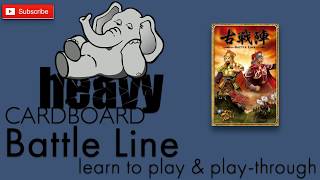
Not every channel plays it with the same frequency. Chairman of the Board keeps Battle Line in their collection as a hallmark piece they could never get rid of, but admits it does not hit the table terribly often because newer two-player releases have crowded the space. Heavy Cardboard, streaming a Chinese-language edition of the game on a slower night, treated it as a short, easy filler that still demands real thought, wrapping their session in about twenty minutes and calling it exactly what it claims to be. Adam in Wales grouped Battle Line with a family of area majority card games, using it as the entry point for explaining how that whole mechanic works before moving on to relatives like Nautilus and Schotten Totten.
Core Mechanics That Define Battle Line
Building Three-Card Poker Hands
Heavy Cardboard's teach lays out the core loop plainly: each player is dealt seven troop cards and plays them across nine flags, building formations of up to three cards on their side of each flag. The ranking runs like poker, from a wedge, a straight flush of the same color, down through a phalanx (three of a kind), a battalion order (a flush), a skirmish (a straight), and finally a host of three unrelated cards. A flag is claimed once a player can prove, using only the open information already on the table, that their opponent cannot possibly beat the formation in front of them. Winning three adjacent flags or five flags total wins the game.
Tactics Cards and Hidden Intentions
All You Can Board points to the deck of tactics cards as the layer that pushes Battle Line past a simple set collection exercise. Instead of drawing a normal troop card, a player can draw a tactics card that lets them manipulate the board directly, changing the value of a card already in play or making room for a fourth card in a formation. Because every card played reveals part of a plan, the hosts describe deliberately spreading cards across several flags at once rather than committing early, so an opponent cannot read what formation is being built and respond before it is finished.
The Battle Line Experience
Deceptively Simple, Genuinely Deep
BoardGameBollocks describes the first impression of Battle Line as almost too simple, cards going into a line, before the strategic layer opens up the more it gets played. Adam in Wales makes a similar point from a different angle, noting that Battle Line looks at first like Lost Cities but actually sits in a different category once the area majority scoring on each flag comes into focus, since success depends on beating whatever the opponent puts on the other side rather than only building your own tableau.
A Guessing Game Played in the Open
All You Can Board frames most of a game as a read on the opponent rather than a race against the deck. Because all of the played cards sit face up on the table, spotting that someone has committed two threes to one flag tells a sharp opponent exactly what is coming next, so both sides spend the match trying to disguise their intentions while decoding the other player's. Heavy Cardboard's session shows the same tension in practice, working out live at the table whether a formation can already be proven unbeatable before committing a card that would give the position away.
What Makes Battle Line Stand Out
A Design That Has Held Up for Decades
The Dice Tower's ranking history is its own evidence: 81st in 2017, 179th in 2021, and still argued for a place near the top 100 today, decades after its release. All You Can Board describes the same effect after returning to it for a run of recent plays, saying the extra layers of depth only unravel once both players know the system well, and that a handful of games with an experienced opponent reveal far more than a first play does.
A Small Box That Plays Big
All You Can Board sums up the appeal as a game that does a great deal with very little, just a deck of cards and nine small flag tokens on the table. Heavy Cardboard's stream backs that up from the production side, noting Battle Line is widely available from GMT Games as the main publisher, with other editions circulating as well, and that a full match wrapped in about twenty minutes without losing any of the thinking that makes it worth playing.
Potential Drawbacks
Competing Against a Crowded Shelf
Chairman of the Board is candid that Battle Line does not come off the shelf as often as it used to, pointing to stiff competition from newer two-player games that have arrived since its release. The design itself is not the complaint; the channel still calls it one of the most boiled down versions of a tug of war game and singles out the hand management as excellent, but a crowded genre means older favorites compete for fewer play sessions.
Tactics Cards Split Opinion
Heavy Cardboard acknowledges that some players are not keen on the tactics cards, even while landing on the side that finds them fine in practice. The same layer that adds depth also raises the mental load: All You Can Board notes the need to keep spreading a hand across multiple flags and avoid giving away too many hints, since a single careless placement can tip off exactly what an opponent is trying to build before it can be finished.
If You Enjoy Battle Line
The comparison reviewers reach for most often is Lost Cities, cited directly by The Dice Tower and echoed by All You Can Board, both of whom point to the shared feel of building small poker-style hands and racing to complete them before an opponent catches on. Players who want the same duel in a different skin can look to Schotten Totten, which The Dice Tower describes as a remake of Battle Line that later folded its special cards back in, and which Adam in Wales calls Battle Line's more recent incarnation.
What Reviewers Are Saying
"There's also tactic cards that you can play onto the battle line that will alter the way that the scores are calculated, or basically mess with the rules a little bit. But Battle Line looks really really simple, but again it's one of these games that opens up strategic possibilities the more that you play it, and it is an absolute classic."
— BoardGameBollocks
"I have it ranked here as a nine, which means maybe it should be close to my top 100 at least, for sure, and maybe just because I haven't played it in a while, but Battle Line is a great two-player game. So, this is one I think has really held up over this test of time."
— The Dice Tower
"There's something about Battle Line, or I should say a couple things that I love about Battle Line a bit more than Lost Cities. The fact that you have the spots on the board where you're fighting over, basically the first to win either five flags anywhere, or five battles, or whatever, or any three consecutive, means that where you play the cards out on there is so important."
— All You Can Board