





























Star Wars: The Deckbuilding Game - Battle of Hoth Deep Dive
What the Community Thinks About Star Wars: The Deckbuilding Game - Battle of Hoth
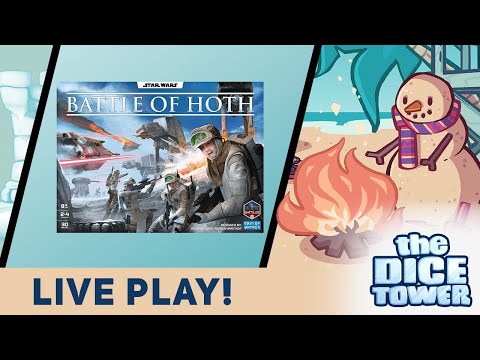
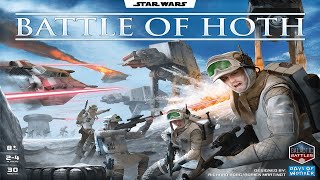
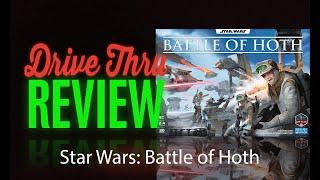
Star Wars: The Deckbuilding Game - Battle of Hoth lands in a curious sweet spot: reviewers almost universally enjoy playing it, yet they disagree sharply on whether it delivers something meaningfully new. Published by Fantasy Flight Games and Days of Wonder, the game is built on Richard Borg and Adrien Martineau's Command and Colors engine, the same framework that powers Memoir '44, and that heritage shapes nearly every conversation about it.
Board Stupid called it "a certified banger" and described multiple enthusiastic sessions with friends, emphasizing that the joy of the experience outweighs any mechanical reservations. The Discriminating Gamer went even further, rating the epic two-board scenario a 10 out of 10 after playing it with a second copy. Board Game Critique put it plainly: "one of the best two-player skirmish games released this year," praising the board clarity and tight thematic mechanics. TheGameBoyGeek, approaching it from outside his comfort zone as a non-war-game player, found it accessible enough to recommend as a gateway into the genre, comparing the decision space to "a game of chess with some random elements."
Shelfside offered the most pointed critical voice, giving the base game a 6 out of 10 and arguing that the card system feels "antiquated by 2025 standards," citing the dual sources of randomness (card draw and dice) as a weakness that other modern games handle more elegantly. Watch It Played provided a thorough rules tutorial, and BoardGameGeek's game night crew captured the genuine delight of first-timers, with players describing their inner child coming alive seeing Star Wars units on a hex board.
The through line across all perspectives: Battle of Hoth is a fast, accessible, theme-forward tactical game that excels in shorter sessions and shines brightest at exactly two players. Its critics wish the underlying system had evolved more since Memoir '44. Its enthusiasts argue that for 30 to 45 minutes of Star Wars combat, it does precisely what it sets out to do.
Core Mechanics That Define Star Wars: The Deckbuilding Game - Battle of Hoth
Hand Management and the Command Card System
The beating heart of Battle of Hoth is its command card system, which functions as a form of hand management that forces players to work with what fate deals them rather than executing a perfect plan. Each player holds a hand of cards drawn from a 16-card faction-specific deck. On each turn, they play one card face up, and that card dictates which section of the hexagon battlefield, left, center, or right, can receive orders, and how many units can be activated. Tactics cards break from section logic entirely, enabling special unit-specific actions.
Board Game Critique captured the tension this creates perfectly: "You aren't a god moving pieces at will. You're a commander dealing with bad radio frequencies. It forces you to make the best of a bad situation." One reviewer described holding only right-flank cards while their snow speeders sat perfectly positioned on the left, unable to act. That friction is the system's defining feature. TheGameBoyGeek noted it rewards players who "like being able to plan now and maybe a turn in the future, maybe two at most," because longer strategic arcs are impossible to guarantee. The deck also offers a pre-game customization layer: each side can shuffle one of three leader figures' card sets into their deck, adding cards themed around Princess Leia, Han Solo, Darth Vader, or other commanders, giving players a known set of powerful options to build toward.
Line of Sight on a Hexagon Grid
Movement and combat in Battle of Hoth play out on a hexagon grid where terrain shapes every decision. Checking line of sight is done by imagining a line from the center of the attacker's hex to the center of the target's hex: if that line passes through a blocking obstacle, the attack is illegal. Terrain types carry distinct rules. Ridges block line of sight and grant a defense bonus to units standing on them, but AT-ATs can never climb them. Crevasses are impassable to everyone except snow speeders, which can fly across freely. Soraks and structures block movement and sight entirely.
Watch It Played's Rodney Smith walked through the nuances carefully, including the rule that a line touching the edge of an obstructing hex on both sides simultaneously is blocked, even without fully crossing it. Shelfside highlighted how the terrain creates meaningful moment-to-moment choices: "Maybe I want to take this ridge on the left side to help secure my position. Or do I want to take this opportunity to fly over the crevice and shoot first?" Board Stupid praised the reference card system that explains every terrain interaction clearly, noting that players "will never go back and be like, what was that rule?" The hexagon grid also determines how many attack dice a unit rolls: units in adjacent hexes roll the maximum, and dice count drops as distance increases, so controlling proximity is a constant tactical concern.
The Star Wars: The Deckbuilding Game - Battle of Hoth Experience
Narrative-Driven
Battle of Hoth is built around the iconic clash from The Empire Strikes Back, and reviewers consistently describe a game that generates stories rather than just scores. Board Game Critique contrasted it directly with a competitor: "In Star Wars, even when I lost, I had stories. Remember when my snow speeders held the line? Remember that lucky artillery shot? The game generates memories." The Discriminating Gamer recounted a tense epic scenario where Imperial walkers advanced on the base, a rebel scout unit bought time on one flank, and transport tokens provided an alternative path to victory, playing out like a compressed version of the film.
The AT-AT destruction mechanic drives much of this storytelling. To destroy a walker, a player must first roll a vehicle or blast hit result, then re-roll each successful die and hope for at least one blast confirmation. Board Game Critique described it as "heartbreaking" and "perfectly captures that feeling from The Empire Strikes Back where the rebel blasters are just bouncing off the hull." Board Stupid called successful AT-AT kills "very cinematic and rewarding." Each of the 17 included scenarios frames a distinct tactical situation with its own objectives, from simple skirmishes to shield generator defense to evacuation races, so the narrative context shifts with every session.
Gateway and Accessible
Despite its tactical depth, Battle of Hoth teaches quickly and plays quickly. Shelfside noted that units can start dying as early as turn three, and BoardGameGeek's players found the game playable from a standing start within minutes. Board Stupid placed it at "just after beginner level, start of the intermediate," noting that the rules are printed directly on cards and reference sheets, so players rarely need to stop and check the rulebook. TheGameBoyGeek positioned it as "a great game to see if this style of game is something you're going to like," comparing it to a streamlined, thematic alternative to Risk for players curious about tactical war games.
Watch It Played's comprehensive tutorial revealed how the game eases players in through the scenario book, which starts with simple elimination missions and gradually introduces shields generators, objectives, special forces units, and campaign rules across 17 scenarios. Board Game Critique noted they taught a new player named Mike in about 10 minutes. The card holders included in the box, and the visual clarity of the graphic design, received specific praise from Shelfside: "The symbols and general graphic design in the game are all super clear, which makes a whole loop of draw a new card, see what it does, make strategy much easier."
What Makes Star Wars: The Deckbuilding Game - Battle of Hoth Stand Out
Lavish Components and Table Presence
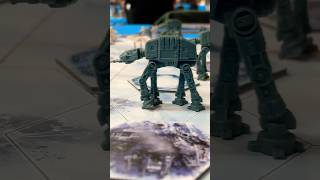
Every reviewer who addressed production quality came away impressed. Shelfside praised the miniatures as "all fantastic quality and feel great to hold," specifically noting the durable infantry figures that survive repeated handling. Board Stupid described the overall production as "one of the best for that price point you can find," and one reviewer said simply, "you can just stare at the minis and just be happy." Board Game Critique described setup as building a movie set: "just seeing the AT-AT walkers looming over the Echo Bay shield generator tiles, it sets a mood. It promises a story."
The game includes 74 miniatures across multiple unit types. The double-sided terrain tiles, double-sided player summary sheets, included card holders that curve to protect cards, and the scenario book with 17 missions all contribute to a sense of completeness. The insert received specific praise from Shelfside: "Zero plastic bags needed." BoardGameGeek's players described the experience of seeing the board set up as evoking childhood memories of Star Wars toys, with one participant saying their "inner 12-year-old" came alive at the table.
Asymmetric Faction Design and Scenario Variety
Each side in Battle of Hoth feels genuinely different, and that asymmetry was consistently cited as an improvement over Memoir '44. The Rebel Alliance fields snow speeders that move up to three hexes and roll four attack dice in close combat, lighter infantry units with only three figures, and immobile artillery that hits hard but grants no medals when destroyed. The Galactic Empire has heavier four-figure infantry squads, Imperial probe droids that move two hexes and still fire, and the formidable AT-ATs with their armor-confirmation destruction mechanic.
Board Game Critique described the emotional difference of playing each side: "As the Empire, I felt this slow, crushing inevitability. I didn't care if I lost a few snow troopers. I had reserves. As the Rebels, I was sweating over every single loss." Shelfside explained that the card decks mirror this asymmetry: Rebel cards tend to favor attacking while Imperial cards tend to favor movement. The leader selection adds a pre-game customization layer on top of faction asymmetry. The Discriminating Gamer praised the scenario book's epic mode, which combines two copies of the game into a single massive board with special victory conditions for both sides, calling it "the way the game is meant to be played."
Potential Drawbacks
Randomness from Two Sources
The most substantive criticism raised across reviews is that Battle of Hoth draws on two heavy sources of randomness simultaneously: what cards you draw and how dice fall. Shelfside argued that other games in the genre handle this better, pointing to Undaunted, where deck-building gives players agency over their card pool, and War of the Ring, where a long game allows wild results to smooth out over time. In Battle of Hoth, with a 16-card deck and games ending in as few as 10 to 15 turns, players may simply never draw certain key cards. BoardGameGeek's players noted drawing two recon cards at the start and feeling limited before any meaningful strategy could develop.
Board Stupid addressed this directly, saying the game "is not supposed to be perfectly balanced" and that some scenarios will favor one side over the other due to dice variance. Their solution was practical: at 30 minutes per game, a bad run simply ends quickly and players can reset. Shelfside was less forgiving, arguing the card system is "so basic and missing some type of nuance in how to play cards" with no real card advantage mechanisms to moderate luck. Both critics and fans agreed that the game's short runtime is a double-edged factor: it limits how badly randomness can hurt, but it also limits how much players can recover from a poor start.
Four-Player Mode Adds Downtime
Battle of Hoth is designed for two players but includes a team mode for three or four. Reviewers who tried the four-player mode were generally underwhelmed. Board Game Critique recounted a turn as right-flank general where the overall commander played a left-flank card, leaving one player with "literally nothing to do. I couldn't move my guys. I couldn't roll dice. I just sat there watching you play for 3 minutes." Their conclusion was direct: "Star Wars: Battle of Hoth is a fantastic two-player game. It is a mediocre four-player game."
TheGameBoyGeek agreed, noting there are "better games for four players" and recommending the two-player format as the optimal experience. BoardGameGeek's four-player session was enthusiastic overall, but players acknowledged that with only two cards each in team play rather than four, individual control diminishes. The downtime issue is structural: the command card system activates units in specific sections, and when a card doesn't touch your section, your turn as a team member is simply over. For players who want to share the experience with more than one friend, the team mode works, but it is a lesser version of the core two-player duel.
If You Enjoy Star Wars: The Deckbuilding Game - Battle of Hoth
Memoir '44 is the direct ancestor here, built on the same Command and Colors system by Richard Borg. Players who love Battle of Hoth and want more scenarios, more terrain variety, and a longer playtime will find Memoir '44 a natural companion. Several reviewers noted that playing Battle of Hoth made them want to return to Memoir '44's larger board and deeper expansion library.
BattleLore uses a related Command and Colors framework in a fantasy setting and offers similar section-based activation combined with special unit types, making it a strong recommendation for players who enjoy the card-driven command system but want a different theme.
Star Wars Rebellion appears as the go-to recommendation for players who enjoy the Star Wars universe but want more strategic depth. Shelfside stated directly that for a deeper 1v1 Star Wars game, "Star Wars Rebellion is the way to go." Board Stupid agreed, noting it delivers "a similar feeling" but requires four to five hours and a rulebook reread. Battle of Hoth scratches the same thematic itch in 30 minutes.
Undaunted is recommended by Shelfside as a point of comparison for players who want more agency over their card draw. Undaunted uses a deck-building mechanism where the deck you draw from evolves during play, providing more strategic control over randomness while maintaining the tactical war game feel.
War of the Ring and Company of Heroes represent the heavier end of what Battle of Hoth reviewers reached for when imagining something more mechanically complex, though both require significantly more time and rules investment. They suit players who have outgrown the accessible end of the genre and want deeper tactical simulation.
What Reviewers Are Saying
"You aren't a god moving pieces at will. You're a commander dealing with bad radio frequencies. It forces you to make the best of a bad situation. In that game, you ended up using your center card to move some infantry into a trench just to delay me, which turned out to be a game-winning stall tactic. It rewards adaptation. You have to have a plan B and a plan C."
— Board Game Critique
"The AT-AT armor mechanic is the single best thing Richard Borg put in this box. Usually in these games, you roll hits and they count. But against the AT-AT, you rolled a hit and then you have to take those hit dice and re-roll them to confirm with a blast symbol. It perfectly captures that feeling from The Empire Strikes Back where the rebel blasters are just bouncing off the hull. It made the AT-ATs feel scary in a way that just giving them more health wouldn't have achieved."
— Board Game Critique
"Me at being seven years old playing with my Star Wars toys on the floor, making like moving troops and doing that, this is the exact feeling that I had and that's why this game to me is something special. It's not the most complex. It's more like games that are going to stay in forever the collection of a lot of people. But to me personally, this is a joy to play. Literally joy."
— Board Stupid