/pic7439416.jpg)





























Beacon Patrol Deep Dive
What the Community Thinks About Beacon Patrol
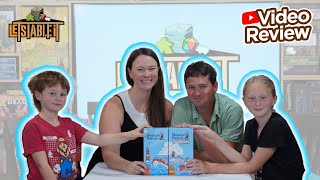
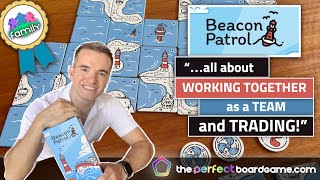
Across the channels that have put Beacon Patrol on the table, the reaction lands somewhere between cozy affection and mild disagreement about how restrictive the tile placement really is. Board Game Dad frames it as fantastically simple to teach and calls it a puzzle players solve together rather than a traditional tile-placer, since the real skill is reading what other players are holding and trading efficiently. Crimsonboardgames leans hard into the presentation, praising the rounded, simple artwork and the way the movement rules make placement feel different from an ordinary tile-placement game. Let's Table It, reviewing as a family, split on the fixed tile orientation: one voice found it restrictive, another found the same constraint made every placement feel meaningful, and the group agreed the trading mechanism kept the game from feeling too locked in.
The Board Game Garden's overview was sponsored by Pandasaurus Games, the publisher, ahead of the game's retail release, and it leans into the components and rules rather than a critical take, though the host repeatedly calls the pieces cute and the solo mode a favorite feature. On a top-picks list, Where There's A Wilz, There's a Play ranked Beacon Patrol among their top games, citing the depth in deciding which tiles to place where, especially once trading and solo play come into it. The clearest point of agreement across sources is that this is a low-conflict, cooperative tile game that rewards communication over cutthroat play.
Core Mechanics That Define Beacon Patrol
Tile Placement and Orientation
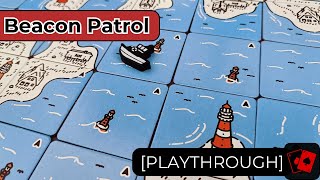
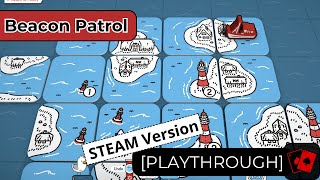
Players draw and lay tiles to build out a shared coastline, and every tile carries an arrow that must point the same direction, so tiles cannot be rotated or flipped to fit a gap. Board Game Dad demonstrates that a tile can only be placed adjacent to a player's boat, and only if the boat can then move onto that new tile across water, since boats cannot cross land. A tile only scores at the end of the game if it ends up fully explored, meaning it is surrounded on all four sides by other tiles, so an isolated or awkwardly placed tile earns nothing. Let's Table It noted that a beautifully filled map can still score poorly if too many of those tiles were never fully connected.
Movement, Trading, and Cooperation
On a turn, players can place tiles from their hand, spend movement tokens to shift their ship without placing a tile, or trade a tile with another player. Board Game Dad walked through how a player who cannot legally place any of their tiles can instead trade with someone else at the table, or use a movement token to reposition first. Because every hand refreshes and unplaced tiles get discarded at the end of a turn, the group has to talk through who is stuck and who can bail them out. Crimsonboardgames highlighted the same swapping option, noting a player can exchange one tile per turn with another player if it helps either side make a placement they otherwise could not.
The Beacon Patrol Experience
A Relaxed, Puzzly Feel
Reviewers consistently describe the game as low-key rather than tense. Board Game Dad called it fantastically intuitive, low entry, and something that plays well as a one-handed game since players never conceal tiles in a hand. Crimsonboardgames described the movement rules as satisfying and the tile placement as refreshing for something this bite-sized, adding that the constraint of moving through water rather than freely placing tiles makes the puzzle feel different from a typical tile-placement game. Let's Table It agreed the cooperative format opens up conversation and strategy-building at the table, since players can bounce ideas off each other about where tiles should go.
Solo and Multiplayer Play
The game supports one to four players, and several channels called out the solo mode specifically. Where There's A Wilz, There's a Play played it solo extensively before teaching it to a second player, and said they would love to try it with three or four people to see how much more of the map could be explored together. Crimsonboardgames, playing solo, said the game is just as fun with a full table, noting that in multiplayer each person gets their own ship to explore their own section of the coast, while playing alone means navigating the whole sea single-handedly.
What Makes Beacon Patrol Stand Out
The Trading Mechanism
Multiple reviewers singled out tile trading as the feature that keeps the game from feeling too restrictive. Let's Table It said the ability to trade tiles around the table stopped players from feeling locked in in the base game. Where There's A Wilz, There's a Play called the multiplayer trading one of their favorite parts, describing how a tile that will not work for one player can go back and forth between players until it lands somewhere useful for the group.
Movement Tied to Theme
Board Game Dad pointed out that the theme is not just painted on top of the mechanics, since a boat has to physically move through water to reach a new tile and land becomes a real obstacle to route around rather than through. Crimsonboardgames echoed that the movement constraint changes how placement feels compared to a normal tile-placement game, since a tile might be perfect for scoring but unreachable until the ship works its way around by water.
Potential Drawbacks
Restrictive Tile Orientation
The single fixed orientation for every tile was the most consistent complaint. In Let's Table It, one player called the base game a little restrictive because tiles can only go in one orientation, making it hard to get the placement a player actually wanted. The same review noted that a spread-out board with tiles that were never fully surrounded can still score poorly, even after a satisfying session of laying tiles.
Low Stakes, No Real Threat
Board Game Dad's one reservation was that the game is dry and low-key by design, since the group cannot lose and is only ever chasing a high score. They contrasted this directly with Pandemic, pointing out that a cooperative game built around real pressure and the possibility of losing tends to feel more engaging, while Beacon Patrol's stakes are limited to how well the group scores rather than whether they win or lose.
If You Enjoy Beacon Patrol
Game Night Picks - Pair Of Dice Paradise recommended Beacon Patrol directly to fans of Carcassonne, calling out the shared appeal of square tiles and puzzly placement while noting Beacon Patrol adds ship movement and a cooperative structure that Carcassonne does not offer, along with solid solo play. Crimsonboardgames compared the tone and scale of the game to Dorfromantik, describing Beacon Patrol as a simpler, more bite-sized take on that style of cute, cozy design.
What Reviewers Are Saying
"The thing that is very interesting is it looks like a tile placing game, but this is a game that is really all about working together as a team and trading. It's not about how you play the tiles, but rather the force that you have to look at what other people are holding and try to make efficient trades so that as few tiles as possible are wasted."
— Board Game Dad
"I like that when you had to be very meaningful about how you place things, and to me that puzzle was the fact that you couldn't flip things around. Sometimes it would be a little frustrating, but if you could get things to work that's when it really felt good."
— Let's Table It
"I really like the movement element and I really like how it makes you think differently, because you might have a tile and think, oh, that's perfect to go there, but if I'm here with my ship I can't place it cuz you have to move through water. So I have to either go up this way, or if that's not possible, I have to make my way around to even be able to place it there."
— Crimsonboardgames