


































Beast Deep Dive
What the Community Thinks About Beast
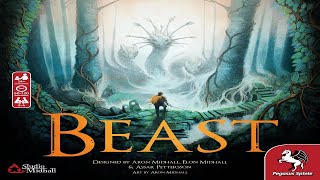
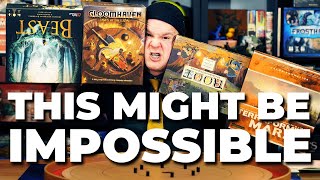
Beast has earned genuine enthusiasm from reviewers who cover hidden-movement games. The consensus is that Studio Midhall has produced one of the sharpest designs in the genre, building a cat-and-mouse experience with enough asymmetric depth to reward repeated play. Sir Thecos dedicated a full review to dissecting how the game balances hidden and open information, concluding that the approach is "really smart." Foster the Meeple ranked Beast as their number nine game of 2023, praising both its thematic identity and how it solves a common pain point in hidden-movement games: the problem of hunters falling hopelessly behind. The Dice Tower gave it a brief but warm mention. Where reviewers find friction is narrow: some note board readability issues, and the trail tokens can be fiddly. But those remain minor against a design that most reviewers describe as tense, thematic, and clever.
Core Mechanics That Define Beast
Hidden Movement
Beast's central mechanism is how it handles hidden movement. The Beast player does not move a figure on the shared board. Instead, movement is recorded privately using a small personal board, a dry-erase pen, and a stack of face-down movement cards. Hunters always see the Beast's last known location and how many moves it has made since then, but not where it actually is now. Movement cards that indicate no movement at all allow the Beast to stay still while appearing to have gone somewhere, adding a bluffing layer on top of positional tracking.
Crucially, Sir Thecos points out that this information asymmetry runs in one direction: the Beast knows exactly where every hunter stands, while hunters work from trail tokens and deduction. This contrasts directly with a game like Terascape, where the information imbalance runs the other way. Both approaches work, but the choice shapes how each game feels at the table.
Whenever the Beast attacks a settler, animal, or hunter, it must reveal itself. Foster the Meeple highlights this as one of the game's best design decisions: unlike Mind MGMT, where a hidden player can disappear entirely for long stretches, Beast forces periodic surfacing. "When the Beast does an action, normally when it kills someone, it's going to pop up on the board briefly, and then you have some idea where they're at," they observed. That creates a rhythm of tension and partial clarity that keeps both sides engaged throughout.
Hand Management and the Shared Draft
Each round begins with a card draft that both the Beast and the hunters pull from the same deck. The clever twist is that each card has a hunter ability on the top half and a Beast ability on the bottom half. So every card you take is simultaneously a card you are denying your opponent. Sir Thecos notes that experienced players will sometimes draft a card not because they want its effect but because they do not want the Beast to have it, and that this strategic dimension "actually comes up in the games." The drafting system is also adapted cleanly for two players: the solo hunter controls two characters but works with a single hand of cards during drafting, which splits afterward. This keeps overhead manageable without stripping the mind-game element from the draft.
The Beast Experience
Tense and Suspenseful
Reviewers consistently describe Beast as a game that keeps players leaned in. The tension comes from two sources: the hunters never quite knowing where the Beast is, and the Beast knowing it must reveal itself to accomplish its goals. Sir Thecos frames this as "the key tension of the game. The beast wants to strike, but attacking gives away its position every time." That push-pull is not abstract. Every attack is a calculated gamble, and every failed search is a moment of sustained dread for the hunters. The trail tokens and watchtower mechanics give hunters clues without resolving the mystery cleanly, which keeps the suspense alive until someone commits to a confrontation.
Thematic Immersion
The mechanics and the theme reinforce each other in ways that reviewers notice. A fire trap deals damage to the Beast when it is revealed at that location, which is intuitive. A shriker trap does not deal damage at all. Instead, it alerts hunters and lets them move toward the Beast's position, because a shriker's job is to raise an alarm, not to wound. Sir Thecos specifically calls out this kind of design: "That is such a nice thematic implementation, and I really appreciate when mechanisms and theme come together like that." Foster the Meeple echoed the sentiment directly, calling Beast "thematically the best" of the hidden-movement games they have played, including Mind MGMT and Mr. Jack.
What Makes Beast Stand Out
Open Information as a Design Choice
Most hidden-movement games wrap secrecy around as many game elements as possible. Beast takes a different path. Except for the Beast's exact location and movement cards, almost everything else is visible: discarded cards, upgrade purchases, grudge totals, and trap placements are all open. Sir Thecos calls this "a really smart approach," because it keeps the deduction focused on the one meaningful secret rather than forcing players to track multiple unknowns at once. That clarity makes the hidden-movement tension feel purposeful rather than exhausting.
Production and Component Thoughtfulness
Sir Thecos spends meaningful time on Beast's physical design, and the praise is specific. The Beast's screen inserts directly into its personal board, a small ergonomic decision that reflects careful thought about how the game is actually played. Locations and paths carry a slightly glossy finish that improves readability and gives the board strong table presence. Wooden meeples with screen printing represent the animals and settlers rather than generic tokens. The game includes two maps: one scaled for two or three players, another for four. Each map also comes with distinct contracts (scenario configurations), which add variety across sessions. Double-layered player boards and a workable insert round out a production that reviewers characterize as well-executed throughout.
Potential Drawbacks
Board Readability
The board's visual style is a strength and a mild weakness at the same time. Sir Thecos observes that while the artwork is genuinely attractive, "it can feel a little bit cluttered at times." Paths between locations are not always easy to trace at a glance, and some region names blend into the surrounding art. The route overview is printed on one side of the board only, meaning it sits naturally for the Beast player but not for the hunters. Printing it on both sides, oriented toward each end of the table, would have served all players more evenly.
Trail Token Fiddliness
Each beast in the game has its own specific trail tokens, and Sir Thecos notes that finding the right token during play can slow things down: "you sometimes have to look through all the tokens to find the right one." Mechanically, any token works, so players who are not invested in the thematic specificity can simply grab whichever is closest. But for players who want to play it straight, the token sorting adds friction at moments when the game is otherwise flowing well. A paired front-and-back design that made token types quicker to identify would have smoothed this over.
If You Enjoy Beast
Mind MGMT shares the hidden-movement DNA and is a natural companion for Beast owners. Foster the Meeple plays both and describes them as differently paced experiences: Mind MGMT can leave hunters completely in the dark for extended stretches, while Beast's forced reveal mechanic keeps the gap from widening too far. Mr. Jack is the other game Foster the Meeple name-checks alongside Beast in the same breath, a shorter and more abstract hidden-movement puzzle with a different player-count focus. Terascape, mentioned by Sir Thecos as a direct design contrast, flips the information asymmetry: the survivors know where the threat is while the threat hunts blind. Playing all three gives a strong survey of what different information structures do to the hidden-movement genre.
What Reviewers Are Saying
"The hunters are constantly trying to close in on the beast while the beast is trying to stay one step ahead, strike at the right moment, and disappear again."
— Sir Thecos
"Beast I felt was thematically the best of them, and I also really liked the aspect where when the Beast does a thing it pops up onto the board briefly and then you have some idea where they're at. I really like that mechanism."
— Foster the Meeple
"Except for the beast's exact movement and current location, almost everything is open information. And I think that's a really smart approach."
— Sir Thecos