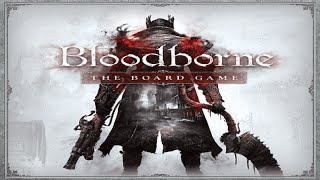

Bloodborne: The Board Game box art

Bloodborne: The Board Game

Game ID: GID0049054
Collection Status
Description

Revered for its healing techniques, the town of Yharnam is rapidly degrading as a plague that turns people into beasts spreads uncontrollably. As a Hunter, it falls to you to quell this growing threat. You will have to fight through beasts, monsters, and townsfolk alike to survive the night and discover the source of this madness.

In the campaign-based action-adventure Bloodborne: The Board Game, players take on the role of Hunters, working together against the game to uncover the mysteries hidden within the city of Yharnam and beyond. Featuring unique Trick Weapons, each with various forms and powers, Hunters have to think quickly and adapt their tactics to overcome the multitude of foes that stand in their way. Learn their behavior, exploit their weaknesses, and strike them down! Featuring unique card-driven combat, luck has little place here — success or failure depends on your choices and how you approach each engagement!

Of course, against such horrific foes, death is a common occurrence, but worry not as death is no end for a Hunter. Those who fall in combat awaken in the Hunter's Dream, ready to return fresh to the fight. Be warned, however, that upon awakening you might find previous foes and obstacles returned, Worse, time is not on your side as the Blood Moon rises ever higher into the sky, spreading its madness across Yharnam. You must press ever forward if you and your comrades hope to complete the Hunt before the city meets an unfortunate end.

As you set out onto the Hunt, always remember the old adage:

"We are born of the blood, made men by the blood, undone by the blood. Our eyes are yet to open... Fear the old blood."

-description from designer

Year Published
2021
Transcript Analysis
Browse transcript mentions, sentiments, pros/cons, mechanics, topics, quotes, and references.
Total mentions: 7
This page: 7
Sentiment: pos 5 · mix 1 · neu 0 · neg 1
Mentions per page
Top
Showing 1–7 of 7
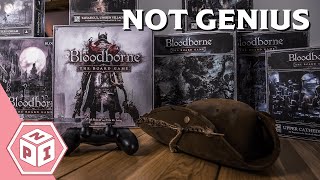
Video MrCV7DT-1H8 Unknown Channel game_review at 1:04 sentiment: mixed
video_pk 31744 · mention_pk 93519
Unknown Channel - Bloodborne: The Board Game video thumbnail
Click to watch at 1:04 · YouTube ↗
Overall sentiment (raw)
mixed
Pros
  • Elegant core deck-based combat system that rewards planning and timing
  • Three-speed action timing creates tense, meaningful decisions
  • Campaign progression with meaningful deck upgrades and evolving play
  • Boss/encounter design provides a climactic sense of escalation and discovery
  • Strong thematic fit with Bloodborne’s hunter aesthetic and tone
Cons
  • Overproduced and plastic-heavy components; quality and cost are problematic for some players
  • Arbitrary map tile shuffling can undermine narrative coherence and map memorability
  • Some campaigns feel repetitive and less challenging over time since enemies recycle with limited variability
  • Healing and certain upgrades impose heavy opportunity costs that can slow momentum
  • Kickstarter model fosters an expansion-heavy ecosystem that some see as bloated or exploitative
Thematic elements
  • hunting, risk-reward escalation, survival against overwhelming odds, and mastery via optimized deck management
  • Johannam, a gothic European-inspired hellscape, rendered as a tabletop dungeon crawler where hunters explore mapped districts and confront eldritch creatures.
  • narrative emerges through branching side quests, lore hints, and interleaved campaign arcs rather than a linear, strongly scripted story
Comparison games
  • Dark Souls (video game)
  • Demon's Souls (video game)
  • Sekiro: Shadows Die Twice
Mechanics (from transcript analysis)
  • Action resolution and card discard — To perform an action you discard a card; fighting requires placing a card into an attack slot, which then resolves with envelope-like timing against the enemy’s response.
  • boss battler — Each monster draws from an enemy action deck with basic, special, and ability cards, while bosses use phase-specific boss activation decks that cycle through two distinct phases.
  • Campaign structure and tiles — Three chapters form a campaign, each chapter presents a monster roster and a set of tiles that are shuffled to create a procedurally arranged map, introducing arbitrariness and replayability.
  • Combat: Damage Based — There are three attack speeds (fast, normal, slow) and three enemy response speeds. The relative speeds determine whether you hit first or get hit first, creating precise, dance-like combat tension.
  • Consumables and firearms — Consumables grant one-time effects; firearms generally enable stagger or other temporary boosts, adding variety to tactical planning between campaigns.
  • Deck building — Each hunter starts with a deck of 12 cards (three copies of four basic cards). Cards drive actions—move, loot, heal, reload—and form the core engine as the campaign progresses.
  • deck-building — Each hunter starts with a deck of 12 cards (three copies of four basic cards). Cards drive actions—move, loot, heal, reload—and form the core engine as the campaign progresses.
  • Enemy and boss decks — Each monster draws from an enemy action deck with basic, special, and ability cards, while bosses use phase-specific boss activation decks that cycle through two distinct phases.
  • Healing and risk budget — Healing exists but is costly in time and turns; some characters heal by killing enemies or via weapon-specific slots, yet optimal healing can require a large opportunity cost.
  • Narrative choice — Inside missions offer branching narrative moments which can evolve the plot, but the random map layout can obscure threads you started and reduce a tightly woven story.
  • Narrative divergences and side quests — Inside missions offer branching narrative moments which can evolve the plot, but the random map layout can obscure threads you started and reduce a tightly woven story.
  • Once-Per-Game Abilities — Consumables grant one-time effects; firearms generally enable stagger or other temporary boosts, adding variety to tactical planning between campaigns.
  • Round tracker and map resets — Rounds progress on a tracker; red spaces reset non-permanent progress and health on the map and can wipe mission progress, adding a tempo and risk to every decision.
  • Speed-based combat — There are three attack speeds (fast, normal, slow) and three enemy response speeds. The relative speeds determine whether you hit first or get hit first, creating precise, dance-like combat tension.
  • Track advancement — Rounds progress on a tracker; red spaces reset non-permanent progress and health on the map and can wipe mission progress, adding a tempo and risk to every decision.
  • Trick weapons and dual-side cards — Trick weapons have two sides with distinct abilities; after committing a card to an attack, you may flip the weapon to access the other suite of abilities, changing timing, damage, or healing options.
  • Upgrades and blood echoes — Blood echoes earned from defeating monsters can be spent to upgrade decks, but they are wiped if you die before using them, creating a stark cost/benefit governance.
Video topics + discussion points
No key topics recorded for this video.
Quotes (from this video)
  • this deck drives everything you do
  • bloodborne the board game nails it
  • this game is genius
  • the most minute details create the most profound differences
  • this is how you end up with Zack Snyder's Watchmen
  • it's a good game just a disappointing one
  • blood echoes are spent to upgrade your deck
  • bosses stand in as glue that patches this system together
  • get into scrapes and push yourself into danger
  • this is damon lindelof's watchman
References (from this video)
No references stored for this video.
Video Ympm8kS_QZA Robert's Solo Board Games Channel top_50_list at 18:39 sentiment: positive
video_pk 13230 · mention_pk 38730
Robert's Solo Board Games Channel - Bloodborne: The Board Game video thumbnail
Click to watch at 18:39 · YouTube ↗
Overall sentiment (raw)
positive
Pros
  • excellent solo play, tight combat rhythm
Cons
  • expensive, expansions exist
Thematic elements
  • Dungeon crawl meets video-game adaptation
  • Gothic city, Lovecraftian horror vibe
  • Campaign-like with modular boss runs
Comparison games
none
Mechanics (from transcript analysis)
  • campaign-like missions — short campaigns with replayability
  • deck-building — card-driven combat and boss fights
Video topics + discussion points
No key topics recorded for this video.
Quotes (from this video)
  • it's always your turn
  • one of the best solo deck builders you can get
  • this is one of the most impressive solo titles from GMT
  • this is such a fantastic puzzle
  • a masterpiece of minimalism
  • it's such a satisfying card play
References (from this video)
No references stored for this video.
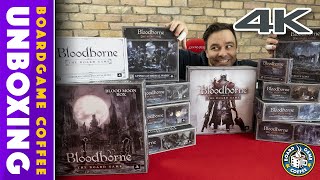
Video q_2eUEpCzDA Board Game Coffee unboxing at 0:00 sentiment: positive
video_pk 11906 · mention_pk 34915
Board Game Coffee - Bloodborne: The Board Game video thumbnail
Click to watch at 0:00 · YouTube ↗
Overall sentiment (raw)
positive
Pros
  • stunning, highly detailed minis with evocative sculpts
  • gorgeous, atmospheric artwork that mirrors the video game
  • strong production quality and licensed IP polish
  • robust campaign/drama with multiple chapters and boss encounters
  • ample variety across boxes and expansions for ongoing play
Cons
  • very heavy, boxy production requiring substantial table space
  • long setup and unpacking with many sub-boxes can be time consuming
  • certain expansion boxes receive mixed in–box lid designs or organization notes
Thematic elements
  • eldritch horror, hunter-patient mortal peril, cosmic dread
  • Yharnam and surrounding nightmare domains in a gothic, Lovecraftian-inspired world
  • campaign-driven with modular adventures and character/story cards
Comparison games
  • Demon's Souls
  • Dark Souls
  • Bloodborne (video game)
Mechanics (from transcript analysis)
  • boss battler — enemies and bosses have phase-based mechanics and evolving abilities across combats.
  • Card-driven actions — players select actions from character decks/cards to perform movement, attacks, and interactions.
  • Character progression and upgrades — player dashboards allow upgrading abilities and equipment across encounters.
  • Cooperative Game — 1–4 players work together to survive encounters and progress through the campaign.
  • cooperative play — 1–4 players work together to survive encounters and progress through the campaign.
  • double-sided weapon/equipment cards — weapons and tools present different effects when flipped, enabling strategic choices.
  • enemy AI with multi-phase bosses — enemies and bosses have phase-based mechanics and evolving abilities across combats.
  • tile-based exploration — environment tiles create the dungeon layout, providing varied terrain and encounter areas.
Video topics + discussion points
No key topics recorded for this video.
Quotes (from this video)
  • epic minis.
  • the game is gorgeous.
  • Eric Lang worked on this.
  • I can't wait to play this weekend.
  • Bloodborne the Board Game is going to be epic on the table.
References (from this video)
No references stored for this video.
Video tQ6Zdjov3W8 Unknown Channel top_10_list at 55:32 sentiment: negative
video_pk 7021 · mention_pk 20812
Unknown Channel - Bloodborne: The Board Game video thumbnail
Click to watch at 55:32 · YouTube ↗
Overall sentiment (raw)
negative
Pros
  • Base game had strong potential to evoke Bloodborne atmosphere
Cons
  • Base game felt unlike the video game
  • Solo mode and house rules required to salvage experience
Thematic elements
Comparison games
none
Mechanics (from transcript analysis)
Mechanics unknown.
Video topics + discussion points
No key topics recorded for this video.
Quotes (from this video)
  • I absolutely adore Raiders of the North Sea
  • Massive Darkness is the best Dungeon Crawler I've got
  • the story was pants in all honesty
  • I love space Hulk and so that one will always be staying
  • Bloodborne the board game is terrible
References (from this video)
No references stored for this video.
Video GU3ONxUJIOc Unknown Channel top_20_list at 5:03 sentiment: positive
video_pk 5527 · mention_pk 16424
Unknown Channel - Bloodborne: The Board Game video thumbnail
Click to watch at 5:03 · YouTube ↗
Overall sentiment (raw)
positive
Pros
  • Solid dungeon-crawler embodiment of the video game aesthetic
  • Versatile for solo play and small groups
  • Varied campaigns with replay potential
Cons
  • Some players miss traditional dice or more overt RPG elements
  • Campaigns can feel short if one is seeking longer arcs
Thematic elements
  • Dungeon crawler with a heavy emphasis on atmosphere and atmosphere-driven pacing
  • Gothic, Lovecraftian-inspired Yharnam-like city
  • Campaign-like, but with strong episodic scenarios
Comparison games
  • Dark Souls: The Card Game
  • Gloomhaven: Jaws of the Lion
Mechanics (from transcript analysis)
  • Deck-based combat and loot — Combat and loot mechanics revolve around card management and timing rather than dice.
  • scenario-based campaigns — Campaigns unfold through linked scenarios with varying objectives.
  • Single-character viability — Designed to be played effectively with a single investigator, though you can use more.
Video topics + discussion points
No key topics recorded for this video.
Quotes (from this video)
  • This game is amazing at creating an emerging narrative.
  • I voted this number one adventuring game this year.
  • Emerging narratives are just fantastic in Explor It.
  • The lore, the art, the setting—the Gothic vibe here is unmatched.
  • You can play solo without a DM and still have a deep experience.
  • This is one of the best dungeon crawlers you can buy today.
References (from this video)
No references stored for this video.
Video -9S3ptTDoRo Robert's Tabletop Tech Talk top_10_list at 29:53 sentiment: positive
video_pk 4993 · mention_pk 14852
Robert's Tabletop Tech Talk - Bloodborne: The Board Game video thumbnail
Click to watch at 29:53 · YouTube ↗
Overall sentiment (raw)
positive
Pros
  • Strong IP translation and satisfying dungeon crawl
  • No dice mechanic (some players prefer dice-free)
Cons
  • Steep learning curve and rulebook concerns
  • Campaign length may feel long for casual players
Thematic elements
  • Brutal dungeon crawler with deck-building and boss encounters
  • Bloodborne IP, gothic horror campaign
  • Campaign-driven with narrative-driven boss fights
Comparison games
  • Dark Souls: The Card Game
  • Mage Knight
Mechanics (from transcript analysis)
  • Campaign progression with story-driven missions — Progress through a series of interconnected missions
  • Deck-building with health as a resource — Your deck doubles as your health and equipment pool
Video topics + discussion points
No key topics recorded for this video.
Quotes (from this video)
  • it's such a bizarre game
  • this is one of the best translations from video game IPs into board game form
  • it's basically like Star Wars themed XCOM
  • the closest thing you'll get to a first person shooter in board game form
References (from this video)
No references stored for this video.
Video xTKTLhTnhsE Meet Me At The Table playthrough at 0:05 sentiment: positive
video_pk 1209 · mention_pk 3508
Meet Me At The Table - Bloodborne: The Board Game video thumbnail
Click to watch at 0:05 · YouTube ↗
Overall sentiment (raw)
positive
Pros
  • Cooperative two-player play with meaningful boss encounters
  • Tight, evolving deck-building and card-driven combat
  • Strong thematic integration with Bloodborne IP
  • Deluxe painting and minis visually enhance the experience
  • Campaign progression with upgrades and new strategic options
  • Dynamic terrain and encounter setup create varied playthroughs
Cons
  • Steep learning curve and setup time
  • Poison and timing can punish mistakes heavily
  • Campaign randomness can affect balance and pacing
  • Expensive to collect all content and expansions
Thematic elements
  • Hunting, survival, and exploration in a cursed city
  • Old Yharnam-inspired gothic horror setting with hunters and beasts
  • Campaign-driven, boss-focused with evolving encounters and story cards
Comparison games
none
Mechanics (from transcript analysis)
  • blood echoes economy — Echo tokens are earned from enemies and spent to upgrade cards and equipment.
  • Combat: Deck/Hand — Enemies use a defined deck of basic, special, and ability cards to determine their actions.
  • Deck building — Each hunter assembles and upgrades a 12-card deck, using blood echoes to purchase new cards.
  • deck-building — Each hunter assembles and upgrades a 12-card deck, using blood echoes to purchase new cards.
  • enemy/action decks — Enemies use a defined deck of basic, special, and ability cards to determine their actions.
  • fog gates and lamp tiles — Fog gates block lamp-based spawns; lamps serve as starting points and travel anchors.
  • hunt track timer — A time track progresses each round; reaching red spaces can trigger events or end the hunt.
  • Status Effects — Poison, stagger, and other effects influence combat flow and card play.
  • Time track — A time track progresses each round; reaching red spaces can trigger events or end the hunt.
  • trick weapons flip sides — Weapons have two sides; players flip between sides to access different attacks and effects.
Video topics + discussion points
No key topics recorded for this video.
Quotes (from this video)
  • this game is actually really cool
  • I'm pretty excited for this one
  • this has been a lot of fun
  • bloodborne the board game by Cool Mini or Not
References (from this video)
No references stored for this video.
Transcript Navigation
Top
Showing 1–7 of 7
View on BoardGameGeek