/pic7014527.jpg)
































Bloodstones Deep Dive
What the Community Thinks About Bloodstones
Bloodstones divides player expectations in fascinating ways. Designer Martin Wallace's release through Wallace Designs has impressed reviewers with its production quality and mechanical tightness, though reception of the gameplay experience itself varies significantly. Some find it a sophisticated wargame that rewards careful positioning and hand management, while others feel it lacks the immediate engagement or progression systems they crave in longer games.
Core Mechanics That Define Bloodstones
Multi-Use Tile System with Bag Building
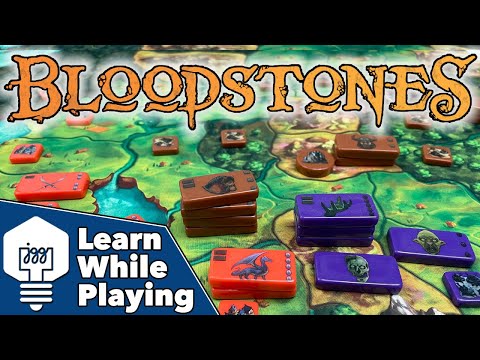
Bloodstones revolves around drawing six tiles from your personal bag each turn, with every tile serving multiple purposes. These domino-shaped tiles function as units when placed on the board, providing combat strength based on type and terrain. In your hand, the same tiles become resources used for movement via pip values, spawning new units, building villages, or enhancing combat rolls. This creates constant tension between immediate unit deployment and resource conservation. The reverse bag-building mechanic adds intrigue: as you spawn units, they leave your bag, potentially narrowing your future draws to more powerful remaining tiles.
Tight Combat Resolution
Combat unfolds when armies occupy the same space, with both sides drawing tiles from identical combat bags to determine damage. Drawing more units grants a numerical advantage, creating incentive to build strong armies. However, the attacker can replace one drawn tile with a tile from hand, rewarding careful hand management and forward planning. Cavalry units prove critically impactful, preventing opponent withdrawal when in sufficient numbers, which dramatically shifts positioning strategy throughout the game. This creates what reviewers describe as elegant yet crunchy decision-making around army composition and movement.
The Bloodstones Experience
Old-School War Gaming Progression
Bloodstones captures a classic war gaming feel reminiscent of designs from the 1990s. Early game focuses on village placement and territory control, with lighter combat. As players progress through tile draws and regrouping phases, armies accumulate and more climactic battles emerge in the endgame. The tension escalates naturally as painted targets and accumulated forces create higher stakes. Reviewers note that late-game decisions become extraordinarily consequential, with last-turn positioning determining whether controlled villages survive capture from advancing opponents.
Asymmetry Creating Distinct Playstyles
Each of the six factions plays fundamentally differently. The Horse Lords enjoy extra tile draws and leader units, creating action efficiency. Dragon Riders wield powerful flying units that bypass terrain but consume themselves when attacking. The Necromancers build undead armies that move free of cost. Corsairs escape via sea routes and substitute tiles last in combat. Hill Folk defend fortified regions with cheap castles and giants. The Chaos Horde spawns anywhere without villages, capturing enemy settlements mid-turn. This asymmetry ensures radically different game experiences and strategies depending on faction choice and player position on the board.
What Makes Bloodstones Stand Out
Rich Component Production and Theming
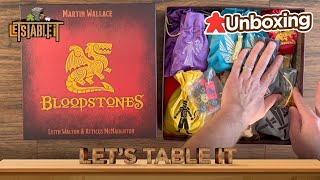
Reviewers universally praise the components. Cloth maps for six scenarios provide excellent visual appeal and durability. Thick domino-shaped tiles with clear artwork allow quick identification of unit types. Each faction receives its own sturdy bag, feeling premium and thematic. The embroidered bag textures and quality production extend throughout. The art direction succeeds in creating a cohesive fantasy war world, with distinct visual identities for each faction that support gameplay legibility without sacrificing beauty. Few games succeed this thoroughly at marrying theme with mechanical clarity.
Elegant System Discouraging Deathballing
The game's incentive structure actively penalizes concentrating forces into one massive army. Moving individual units costs resources, and winning combat against smaller forces yields only one point per unit defeated. Conversely, losing fights can swing games significantly, as victors gain points equal to enemy army size. This creates a system where careful, distributed positioning proves superior to massive force concentration, encouraging the spatial play and terrain consideration that make wargames interesting. Players feel rewarded for setting up strong positions, then exploiting tactical opportunities through multi-unit turns.
Potential Drawbacks
Component Clarity Issues at Higher Player Counts
Maps contain numerous hexes, but some contain only one or two spaces for pieces. When armies cluster in specific regions, tiles overflow into adjacent spaces, creating visual confusion about unit placement. This problem intensifies with four to six players and worsens on smaller maps like Tyrant Lament. Reviewers mention constant tile restacking and occasional misidentification of villages as units amid the chaos. While larger maps like Lady of the Lake alleviate this, the core issue suggests maps might need larger hex areas or that army markers would clarify positioning. Rivers shown on maps also create confusion since they appear decorative but don't actually block movement.
Faction and Player Count Balance Concerns
The Chaos Horde dramatically shifts three-to-four player games by forcing players to defend widely and reconsider positioning. Without them, three-to-four player games often lock into "Mexican standoff" fronts where neighbors position armies against each other while distant players remain isolated. Early combat winners can compound advantages into insurmountable leads, with losing players struggling to recover. Reviewers note this doesn't happen at five-to-six players where more borders create constant pressure, nor at two players with singular fronts. Additionally, the Dragon Riders' raw power and Horse Lords' action efficiency sometimes overshadow other factions, making faction selection and map choice more impactful than intended. Newcomers need guidance about faction-map pairings to avoid frustration.
If You Enjoy Bloodstones
Consider Twilight Imperium for its similar asymmetric factions and deep strategic positioning. Tigris and Euphrates offers comparable tile-manipulation elegance with area control tension. Dune: The Board Game provides wargame negotiation with faction uniqueness. War of the Ring delivers fantasy war gaming with excellent thematic integration. Rising Sun features area control with escalating ages. Blood Rage combines area control with asymmetric powers in shorter play time. Each shares Bloodstones' love of meaningful asymmetry and tight decision-making.
What Reviewers Are Saying
"The crunchy yet elegant combat system that the entire game revolves around makes Bloodstones stand out, where fighting is influenced by unit quantity, strength, and the ability to replace tiles with something from your hand."
— Shelfside
"For me this was a game that looked good, and after playing it I'm super impressed with it, because the fact that you gain points for placing villages and not just attacking, combined with each player being asymmetrical, really makes this game great."
— Meeple Mountain
"Martin Wallace has made some great games, but I think he's really achieved what he set out to do, to have a thematic playground with minimal components where a dragon works, all while maintaining tight wargaming mechanics."
— Let's Table It