/pic6961607.png)























Bonsai Deep Dive
What the Community Thinks About Bonsai
Bonsai has quietly earned recognition as a meditative tile-placement experience that balances serene aesthetics with engaging spatial puzzles. The game draws players in with its beautiful art and components, then rewards them with surprising strategic depth across a compact 30-45 minute playtime. For solitary and multiplayer players alike, Bonsai delivers a satisfying experience built on elegant core mechanics and meaningful decision-making.
Core Mechanics That Define Bonsai
Tile Placement and Tree Building
At its heart, Bonsai is a spatial puzzle. Players collect tiles representing wood, leaves, flowers, and fruits, then place them according to strict adjacency rules: wood connects to wood; leaves must touch wood; flowers attach to leaves; fruits wedge between two adjacent leaves. The placement rules create a three-dimensional jigsaw where each decision shapes the final form of your tree. Because tiles can extend beyond the pot's edges and even hang below it, players have surprising freedom in how they construct their miniature landscape. The result is that no two trees look alike, even when built from identical tile pools.
Engine Building Through Cards
Bonsai's second pillar is its card-driven engine. Players alternate between two actions: meditating to collect cards that grant tiles and capacity increases, or cultivating to place tiles from their personal supply onto their tree. Growth cards displayed alongside your seishi tile determine how many tiles you can place each turn, creating an engine-building layer. As you accumulate tools, helpers, and growth cards, your placement capacity grows, enabling more ambitious tree constructions in later rounds. This creates satisfying progression: early turns feel restrictive, but by mid-game, your engine hums with possibility.
The Bonsai Experience
Serene and Calming Atmosphere
Reviewers consistently describe Bonsai as a peaceful, meditative experience. One solo player noted it "gives me a calm gentle feel" and felt "very relaxing," comparing the experience to "a gentle rain" because "it's just very relaxing and you're just placing the tiles making your tree look pretty it doesn't feel rushed." The game's pacing never hurries; turns unfold at a contemplative pace, and the act of physically arranging wooden pieces into organic shapes carries inherent satisfaction. This calming quality makes Bonsai ideal for players who seek board games as a means to unwind rather than to compete aggressively.
Puzzly and Crunchy Decision-Making
Beneath the serene surface lies legitimate strategic depth. The game demands constant evaluation: which card to take, when to cultivate versus meditate, how to arrange limited tiles for maximum future growth, whether to claim a goal tile or renounce it for harder prizes. One reviewer called it "a fast-paced game with a family-friendly level of puzzly decision-making," while another found it "definitely a very fun game very puzzly which obviously I love." Every turn presents spatial constraints and opportunity costs that reward foresight and careful planning.
What Makes Bonsai Stand Out
Beautiful Aesthetics and Component Quality
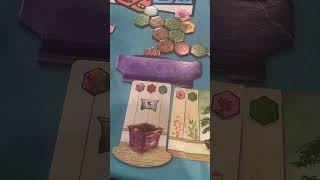
The presentation elevates the entire experience. Reviewers praised the art as "beautiful" with "perfect" design execution that avoids overembellishment. The inclusion of colorful bonsai pots, a center board, and dozens of wooden tiles creates impressive table presence. Even the box interior delights, featuring "watercolor" art that signals thoughtful production throughout. The components feel tactile and premium, and the eco-friendly paper wrapping for cards instead of plastic demonstrates publisher care. This marriage of beautiful design with functional components creates an inviting physical experience that justifies the time investment.
Solo Scenarios That Extend Replayability
The included solo mode fundamentally changes how players experience Bonsai. Rather than an afterthought, solo scenarios offer challenging, distinct objectives that demand different strategic approaches than multiplayer games. One reviewer noted that "solo challenges that to me just really changes up a game much more and it makes you think differently about the game." The scenarios require specific goal combinations and point thresholds that create meaningful puzzle variations. This solo support transforms Bonsai from a social game into a personal journey of mastery and skill development, ensuring long-term engagement even for players without a regular gaming group.
Potential Drawbacks
Rapid Game Pacing and Tight Decision Windows
Bonsai's compact 30-45 minute structure means turns cycle quickly and the card deck empties faster than some expect. In solo play, one reviewer expressed surprise at how "the game ends by the way when we are with when the pile is run out that's when the game ends" and noted "it goes so quickly." This swift pacing creates urgency in decision-making; players must commit to strategies before they fully develop. While this pressure generates engaging choices, some may find the time constraints frustrating, particularly in early games before learning optimal card sequencing.
Potential for Repetitive Tree Construction Over Repeated Plays
Once players master Bonsai's puzzle structure, the core tree-building patterns may calcify into familiar shapes. One reviewer observed that "once you've done this a lot uh building the tree I think you just do the same thing over and over" and acknowledged that "if you would just play this multiplayer after a while I think it would get a bit tedious." However, the same reviewer immediately qualified this: "everybody gets a very different tree" in multiplayer because competing players force alternative strategies. The solo scenarios explicitly counteract repetition by introducing novel goal combinations and point requirements that necessitate completely different tree architectures.
If You Enjoy Bonsai
Bonsai will appeal to players who treasure contemplative, puzzle-forward games with elegant mechanics and minimal conflict. If you appreciate spatial tile-placement games like Carcassonne or Azul, or enjoy zen-like experiences such as Calico, Bonsai shares that meditative quality while adding satisfying engine-building complexity. The game shines for solo players seeking replayable challenges and for groups that value beautiful components and table presence. Its 1-4 player flexibility and low complexity ceiling make it accessible to family audiences, while the parchment cards and endgame bonuses reward deeper strategic planning. Above all, Bonsai suits anyone who views board gaming as a restorative practice rather than purely competitive conquest.
What Reviewers Are Saying
"I really love the calm gentle feel that this game gives me and I'm very excited to share it with you guys so without much further ado let's go."
— Crimson Board Games
"It's a fast-paced game with a family-friendly level of puzzly decision-making."
— Board Game Dad
"The art is beautiful I love bonsai trees by the way and you see some more art on the side it's really really uh thoughtful designs."
— DaniCha