











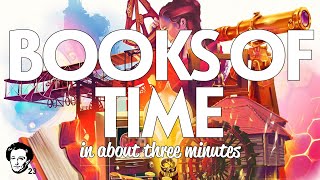

The history of humankind has been written down for thousands of years. Our technological achievements, geographical discoveries, and the will to prosper are woven into intricate threads spread throughout books that tell the story of our time on Earth. Now you have the chance to shape this story.
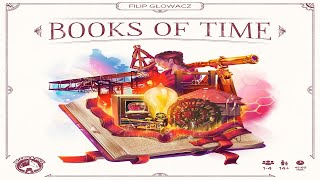
Books of Time puts a unique and exciting twist on tableau building, allowing you to construct three great books, each with their own sets of special abilities that you can write, thereby creating incredible combinations. The story of a civilization is now truly at your fingertips.
Three types of pages go into player books: trade, science, and industry. During the game, you add pages to these books to create powerful combinations of actions that you can activate. You need to efficiently manage your resources to create the books that will meet your personal objectives and score you the most points.
—description from the publisher
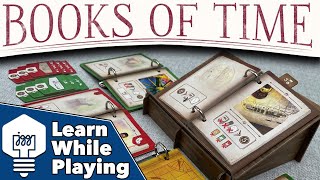
Books of Time - Solo Playthrough
- Fast, tight decision-making that rewards planning and sequencing
- Engaging solo mode with a clear and tense endgame objective
- Dynamic setup with varied objectives and card types creates replayability
- Rules can be tricky to learn, and memory of flipping the correct pages is important
- Bookkeeping and the number of moving parts can feel fiddly for new players
- Risk of misremembering or missing subtle rule interactions during live play
- Knowledge accumulation and symbolic set collection driving endgame scoring
- Historical scientific exploration across pages representing science, technology, and trade, with a Chronicle mechanic guiding endgame pacing
- Array of mechanics described in the gameplay: page activation, resource management (Pages, Pens, Folders, and Book Pages), page drafting and insertion into a personal book, page closing for end-of-book bonuses, track advancement for scoring, and a Chronicle-driven solo endgame structure
- Lost Ruins of Arnak
Mechanics (from transcript analysis)
- action selection — On each turn you choose one of six actions, most commonly activating two pages to gain or spend resources and trigger effects on both pages.
- Chronicle and endgame timing — The Chronicle tile surfaces each turn, limiting when bonuses are taken (beginning or end of turn) and signaling the final phases of play in solo mode.
- end game bonuses — Players complete endgame objectives by collecting symbol sets (e.g., camel, boat, wagon) and matching various card types across Science, Technology, and Trade.
- Endgame scoring via objectives — Players complete endgame objectives by collecting symbol sets (e.g., camel, boat, wagon) and matching various card types across Science, Technology, and Trade.
- Page drafting and book building — Pages are drafted, spent, or added to your book; closing or flipping the book triggers bonuses and endgame timing effects.
- Refill and take mechanics — When certain cards are taken, the discard/row refills to keep a flowing pool of options, with some cards providing immediate bonuses upon take.
- Resource management — Three principal resources: Pages (various types), Pens, and Folders, plus Page cards that go into your book. You spend or add them to advance and fulfill objectives.
- Solo variant with challenges — In solo play, players select a difficulty level and a row of three challenges to target a fixed end score within 16 turns.
Video topics + discussion points
Quotes (from this video)
- this is the first solo playthrough or playthrough at all that has happened on this channel
- this is a pretty quick moving game
- I love it when a game comes down to the wire like that
- I was so happy to have that win
References (from this video)
- Unique triple-book drafting mechanic
- Distinct solo variant with approachable rules
- Solid resource-management loop
- Theme may feel niche to some players
- Three-book system can require a learning curve
- Literature, knowledge exchange, and archival drafting
- A world of books, drafting pages and three different books
- Deck-building-lite with three integrated books
Mechanics (from transcript analysis)
- Drafting pages / book-based engine — Draft pages and place them into three different books to activate abilities.
- engine building — Pages activate abilities across three distinct books with resource dynamics.
- Resource management — Optimize resource flows to advance on tracks and maximize points.
- Resource management / exchange — Optimize resource flows to advance on tracks and maximize points.
- Three-book engine-building — Pages activate abilities across three distinct books with resource dynamics.
Video topics + discussion points
Quotes (from this video)
- Arc Nova solo I really enjoy.
- the solo variant is so easy and so quick.
- Parks was a great fit for July.
- freaking pencil crayons for cartographers.
- the gameplay it is quick and challenging and I really enjoyed it.
References (from this video)
- Accessible mid-weight euro with a distinctive book-flip mechanic that drives decisions
- Three interlinked books plus a chronicle timer create a fresh engine-building rhythm
- Personal market adds depth to timing and strategic denial of access
- High-quality components and tactile feel (binders, chronicle stand, and pages with nice art)
- Iconography and player reference help ease teaching and play afterward
- Potential for solo play adds replayability and a different pacing
- Rule set can be dense for newcomers, especially around combineable page effects and market timing
- Iconography-heavy design may require frequent reference checks during first plays
- End-game optimization depends on chronicling progress, which may constrain early aggressive play
- Knowledge accumulation and strategic development through book pages, market manipulation, and objective-focused scoring.
- Three distinct books (Science in red, Industry in green, Trade in yellow) hosted within a chronicle-driven world; players manage pages, symbols, and resources across a shared timeline.
- Abstract/engine-building with a historical flavor, built around the ritual of turning and flipping pages to unlock abilities.
- T-Series (Board & Dice)
Mechanics (from transcript analysis)
- Book pages and activation — Each player has three books; flipping and activating pages triggers discrete benefits and access to additional resources.
- Chronicle action option — Each turn allows a Chronicle action either before or after the main action, introducing strategic tempo and planning.
- Chronicle cycle and end-game trigger — The chronicle book flips pages each round, providing a countdown and signaling the end when the book reaches certain markers.
- Civilization/track actions — Three civilization tracks (Science, Industry, Trade) provide track actions with varying VP and icon-based rewards as you ascend.
- Close/Turn pages and instant benefits — Closing or turning pages grants immediate benefits that can chain into future rounds, influencing pacing and resource availability.
- Market drafting system — A central market (the Offer) is shared; players place selected pages into a personal market to deny access to others and time their purchases.
- Objective advancement and scoring — Science, Industry, and Trade objectives can be advanced to higher levels, increasing end-game VP potential and shaping decisions throughout the game.
- Resource management — Players manage pens, papers, and a wild resource (file) to fuel actions and book page activations.
- solo play mode — The game design accommodates a solo mode for single-player experimentation—demoed via a planned or available solo run.
- Track advancement — Science, Industry, and Trade objectives can be advanced to higher levels, increasing end-game VP potential and shaping decisions throughout the game.
Video topics + discussion points
Quotes (from this video)
- this is freaking adorable I love how there's a little stand for the book
- the binder rings close and open really really nicely they are super sturdy
- this is a slightly lighter game which I am really really happy to see it coming from board and dice
- solo playthrough of Books of Time over on my twitch Channel tomorrow
- I love you guys so so much remember you are somebody's reason to smile
References (from this video)
- Gorgeous production and visual design
- Three-deck deck-building puzzle offers a fresh rhythm
- Official solo mode available; adds value
- May skew lighter for some players compared to heavier euro games
- book collecting and time-based action selection
- three book decks and a library-time puzzle
- puzzle-driven, book/library theming
Mechanics (from transcript analysis)
- Deck building — players build and utilize three separate decks representing different book categories
- deck-building — players build and utilize three separate decks representing different book categories
- Resource management — managing various resources to optimize actions and victory points
- Track advancement — advancing tracks to gain resources and influence end-game scoring
- Track progression — advancing tracks to gain resources and influence end-game scoring
Video topics + discussion points
Quotes (from this video)
- Heaven and Ale is a fantastic game and I would love to see a reprinting of this one.
- Books of Time is fantastic.
- Animal Kingdoms is fantastic.
- Wizards of the Grimoire is fantastic.
- The Magnificent is fantastic.
- Chakra is such a wonderful game.
References (from this video)
- Innovative components (binder clips)
- high production value
- Binder clips can be fragile; more expensive components
- time, literature, binding books
- Binder-book tableau-building
- thematic, educational
Mechanics (from transcript analysis)
- binder-clip resource management — binder clips serve as a core resource across rounds
- scoring via binding quality — points for how well you compile your books/tableau
- tableau building — players build books using binder clips as pages
Video topics + discussion points
Quotes (from this video)
- it's live folks it's live
- the cute factor is off the charts
- binder clips... off the charts
- I can't wait to see that too
- it's so cute and you've got your little board that's got the that moves you can put the little trays in there
- the year of the card games
References (from this video)
- Unique book-themed mechanic
- Engaging puzzle feel
- Accessibility for new players may be challenging
- book/page-turning narrative interface
- Similo
- Dixit
Mechanics (from transcript analysis)
- Card placement — placing cards in a book-like structure and turning pages to reveal interactions
Video topics + discussion points
Quotes (from this video)
- five times if you don't you got to get rid of those games
- you're going to pick which pile I have to play five times or else I'm getting rid of that pile anyways
- my board game collection this is my board game shop
- Wingspan killer did I say that cuz I meant it
- it's a unique game where you're placing cards and literally a book and then turning pages
- thank you for watching
References (from this video)
- novel and tactile mechanic
- potential for interesting design space
- execution felt abstracted; not fully realized in this iteration
- book manipulation as action economy
- Book-world mechanic with pages and a flip-book action surface
- physical book interaction driving actions
Mechanics (from transcript analysis)
- book actions — open pages, insert pages, flip through to perform actions
- page manipulation — flick and reconfigure the pages to reset and modify effects
Video topics + discussion points
Quotes (from this video)
- these awards are 100% my Awards
- Acropolis is a very fast-paced tile Drafting and set collection game
- three-dimensionality... stacking things up in the game does get you more points
- this game does very little that is original that hasn't been covered in other games before
- it's such a nice tight package of a game everything is just in there
- I'm a massive Motorsport fan
- Heat Pedal to the Metal is our game of the year; our solo game of the year; our patron's choice
- the best New Zealand game of the year is Scholars of the South Tigress
- the fact you get a limited number of cards but everyone gets the same card so it all starts off from equal positions
- it's fast it's vicious, backstabbing, and it's clever
- this is such a cool racing game that feels like a racing game
References (from this video)
- Fresh and intriguing book-based mechanics that differentiate the game
- Central book design provides a unique home for actions and decision points
- Book format allows exploration of new ideas and mechanics within a single framework
- Varied actions per turn and potential for interesting pacing and strategy
- Potential for strong longevity and replayability depending on player preference
- Books can be awkward or cumbersome to use for some players
- Iconography is not the most user-friendly, contributing to a steeper learning curve
- Theme of building a civilization isn’t strongly communicated or thematic within the pages
- Initial novelty of the book mechanic may wear off for some groups
- Knowledge and literacy as the engine for societal development
- Civilization-building through written word across eras
- Book/page-driven actions that feed drafting, scoring, and progression
- Seven Wonders
- Scholars of the South Tigris
Mechanics (from transcript analysis)
- Action selection via central book — On each turn, players choose actions from a central 'book' that drives resources and VP
- drafting — Draft Pages for your history books from a face-up display; pages contribute to scoring and resource generation
- end game bonuses — Closing a book yields a bonus; turning pages grants bottom-of-page bonuses
- Open/close book and page-bonus mechanics — Closing a book yields a bonus; turning pages grants bottom-of-page bonuses
- Page turning / book progression — Turning pages within books to advance progression and trigger bonuses
- Resource management — Gaining pens and paper when adding pages; folders act as wild cards for both resources
- set collection — Collecting sets of pages with symbol variety to unlock scoring opportunities
Video topics + discussion points
Quotes (from this video)
- Books of time is something a little different and its book based mechanics are very fresh and intriguing
- the central book and how it has different actions you can select each turn
- I also really like the central book
- the best thing about this game is how the book format allowed it to explore some new ideas, it's Unique
- the books take a bit of getting used to and some players found them awkward and cumbersome to use
- probably my biggest issue is while the books are a cool idea I just don't feel the theme of building a civilization comes through it all
References (from this video)
- Novel tile-placement through book actions
- Interesting assassination tile concept
- Rulebook gaps and awkward endgame pacing
- Time manipulation and family legacy
- Future characters travel back in time to shape events
- Story-driven, probabilistic/world-shaping
Mechanics (from transcript analysis)
- engine-building via books — Place action cards into book pages to enable actions
- time-changing events — Assassination tile mechanic and event manipulation
Video topics + discussion points
Quotes (from this video)
- it's really quick it takes around an hour to play feels like this epic scope
- the coolest part is during some of those phases you will also activate all the robots in a single line and they have different powers
- it's one of my favorite Euro games
- I would put it into another person's collection
- we played it just last week
- please be our supporter because it's the best way how we can make these videos and continue making videos