/pic4636173.jpg)




























Bosk Deep Dive
What the Community Thinks About Bosk
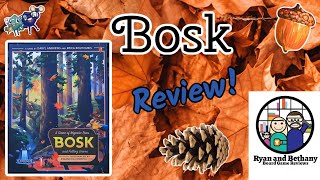
Bosk has quickly captured the hearts of board gamers with its stunning presentation and elegant design. Reviewers consistently praise the game as an exceptional blend of accessibility and strategic depth, making it a standout title that appeals to both new and experienced gamers. The game's beautiful aesthetic and intuitive mechanics have earned it recognition as a gorgeous, easy-to-teach gateway to area control gaming.
Core Mechanics That Define Bosk
Tree Placement and Trail Scoring
The foundation of Bosk begins in spring, when players take turns placing their colored trees onto the board at any intersection point. This seemingly simple setup phase proves deceptively important, as reviewers note that tree placement matters throughout the entire game. During summer, the park board comes alive as hikers traverse every row and column, the trails, counting the values printed on players' trees. The scoring system rewards both first and second place on each trail with different point values, creating moments of strategic tension as players realize their spring placements directly determine their summer scores.
Autumn's Wind-Driven Leaf Mechanics
Autumn introduces the game's most dynamic element: falling leaves driven by wind direction. Players select numbered trees matching the current wind marker and choose leaf tiles representing how many leaves they'll drop. These leaves cascade from their chosen tree in the direction the wind is blowing, and players can stack leaves on top of each other, though covering an opponent's leaf requires discarding additional leaves as payment. This creates a push-your-luck tension where players must decide whether to claim territory early or save leaves for strategic positioning later. The wind direction changes each round, forcing players to think several moves ahead about which trees they'll need and where they'll want their leaves to fall.
The Bosk Experience
A Beautiful Journey Through Seasons
From setup to final scoring, Bosk guides players through a thematic year in a national park. The presentation reinforces this journey seamlessly, reviewers note that the gameplay flows naturally from season to season without requiring board resets or complicated transitions. The artwork captures an autumnal color palette that brings the forest to life, while the rulebook includes interesting facts about national parks and forests. The game is genuinely photogenic, and experienced players often find themselves drawn to take photographs as leaves accumulate and regions fill with color throughout the autumn round. This visual progression from sparse spring placement to dense autumn coverage creates a satisfying arc that enhances the experience beyond mere mechanics.
Intuitive Yet Thoughtful Gameplay
What makes Bosk exceptional is how its elegant theme supports its mechanics rather than merely dressing them up. Players inherently understand that wind blows leaves, hikers traverse trails, and controlling regions in a national park translates to competitive advantage. Reviewers emphasize that the game is easy to teach because the mechanics make intuitive sense, yet this simplicity masks surprising strategic depth. The rulebook is notably compact and clear, and gameplay moves smoothly, new players can jump in after a brief explanation and feel engaged from the first turn. Experienced gamers, meanwhile, find themselves contemplating tree placements and leaf decisions with the kind of analytical rigor that rewards repeated plays.
What Makes Bosk Stand Out
Perfect Balance of Accessibility and Strategy
Reviewers emphasize that Bosk achieves a rare feat: it is genuinely easy to teach and learn, yet offers enough tactical decision-making to engage competitive gamers. The game doesn't require players to memorize complex rules or track multiple resource types. Instead, every decision flows logically from the theme and board state. Players who enjoy thinking several moves ahead will find plenty to contemplate, where should you place trees knowing that the wind will blow from specific directions? Which regions should you target with your leaves? Should you block opponents early or conserve leaves for later opportunities? These questions create meaningful decisions without overwhelming casual players.
Versatility Across Player Counts and Experience Levels
The game scales elegantly from two to four players using different board configurations. Reviewers note it plays equally well with young children, families, casual gamers, and competitive enthusiasts. New players enjoy learning how the seasons flow together and watching their trees and leaves create patterns on the board. Experienced gamers appreciate the spatial reasoning required for tree placement and the area control tactics that emerge during autumn. The straightforward ruleset means setup and learning time are minimal, making it an excellent choice for game nights where multiple plays might happen back-to-back.
Potential Drawbacks
Initial Complexity in Understanding Tree Placement Impact
Some reviewers note that the significance of spring placement decisions may not be immediately apparent on first play. The game rewards players who understand how their tree positions will affect both summer trail scoring and autumn leaf placement, but new players sometimes place trees without fully grasping these downstream effects. Reviewers recommend playing at least once with a teaching player who can help explain how spring decisions ripple through summer and autumn, or playing a second game once players understand the full seasonal arc. This is not a drawback that prevents enjoyment, merely a learning curve that clarifies in the second play.
Snake Score Track Presentation
While reviewers appreciate the overall production quality, one mentioned a minor complaint about the score track design. The snake track can occasionally be visually confusing, though the publisher thoughtfully includes an alternative version to address this concern. This is a minor presentation issue that doesn't impact gameplay and reflects attention to accessibility rather than a design flaw.
If You Enjoy Bosk
Players who love Bosk often appreciate games with beautiful production and natural themes. Reviewers sometimes compare it to Photosynthesis, which similarly features standing tree components and attractive aesthetics. However, the games are mechanically quite different and serve different purposes in a collection, both deserve space on your shelf. If you enjoy area control games like El Grande or gateway-level strategy games, Bosk's elegant design and forgiving learning curve make it an excellent addition. Those who appreciate games that combine straightforward rules with surprising strategic depth will find much to love, as will anyone drawn to games with strong thematic integration and gorgeous visual presentation.
What Reviewers Are Saying
"Bosk is a gorgeous looking game from Floodgate Games that has you planting trees and blowing leaves to control areas of a national park. The artwork makes this one of the prettiest games out there with that autumnal color palette spreading across the board."
— Actualol
"This game is so photogenic. Every time we put it out there I'm just tempted to take pictures of it, and the more players the more trees and the more colors the more colorful it is. The whole production is pretty great in terms of the presentation of it."
— Ryan and Bethany Board Game Reviews
"This game is easy to teach, it's easy to learn and it's easy to play. The thing that brings it all together is it's so intuitive, people know the wind is going to blow leaves, it just makes sense. And people going on this hike, the more trees you see on these hikes the more points you're going to get."
— Ryan and Bethany Board Game Reviews