/pic6149105.jpg)






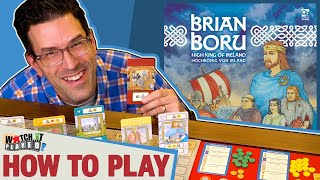
















Brian Boru: High King of Ireland Deep Dive
What the Community Thinks About Brian Boru: High King of Ireland
Brian Boru stands out as a surprising success story among Euro gamers and trick-taking enthusiasts alike. Reviewers consistently praise its elegant design despite a deceptively modest aesthetic, with one calling it "a big brother to The King Is Dead" that manages to synthesize trick-taking with area control in a way few would expect to work. Multiple reviewers note the game exceeded their initial skepticism, the beige board and historical theme created low expectations that the brilliant mechanics shattered immediately. Players describe an experience rich with meaningful decisions, describing the satisfaction of discovering improbable victories and outmaneuvering opponents through careful card play.
Core Mechanics That Define Brian Boru: High King of Ireland
Trick-Taking as Gateway to Area Control
The heart of Brian Boru lies in its unconventional use of trick-taking. Unlike traditional trick-takers, the game inverts the typical win-condition calculus: winning is sometimes undesirable. Players lead with a colored card to claim a specific town, but whether winning or losing the trick determines which action the card provides. Winning with a low-value card delivers superior rewards because the top action on cards tends to be substantially better. Losing with a high-value card, while costly in apparent card strength, often provides access to more powerful secondary actions. This creates a constant tension, do you sacrifice a strong card to access a bottom-action bonus, or conserve it for when you truly need to claim territory?
One reviewer noted the design brilliance of this inversion, explaining that on low cards, winning is genuinely challenging, so the game compensates by making the win action particularly valuable, while high cards suffer the opposite dynamic. This reward structure makes every card action a genuine dilemma, distinguishing it sharply from games where the path forward feels obvious.
Hand Management Through Intentional Loss
The act of card drafting creates a unique dynamic where you routinely distribute cards to opponents knowing full well they'll use those cards against you. Each round, players pass cards to neighbors, creating nemesis relationships, the player on your right constantly sabotages your possibilities while the player on your left receives your least desirable cards. Reviewers highlight how this draft mechanic generates memorable moments: one described crafting an entire strategy around never passing red cards to a specific opponent, thereby preventing them from ever winning on the Viking track, while simultaneously securing all Viking tokens for yourself and deciding which of their towns become Viking-controlled. The interplay between these passing decisions and their eventual consequences created emergent narrative arcs unique to each playthrough.
The Brian Boru: High King of Ireland Experience
Controlled Chaos Across Multiple Scoring Tracks
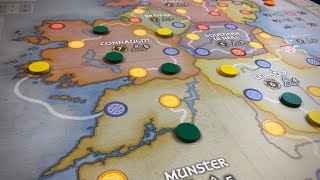
Brian Boru simultaneously manages four distinct competition areas: the marriage track (yellow cards), the church influence track (blue cards), Viking repulsion (red cards), and direct area control. Rather than feeling fragmented, these systems interweave into a coherent whole. The marriage track awards victory points and additional towns to leading competitors. Church control grants monasteries, which both double a town's area-control value and potentially grant first-player status for selecting the next town to compete for. Viking management prevents opponents from seizing your controlled towns while potentially forcing them to contribute resources to unlock occupied territories. One reviewer emphasized how the tension builds through the rounds, early turns feel relatively open with abundant options, but by rounds three and four, every decision carries acute weight as the board fills and regions approach scoring thresholds.
The Precision Satisfaction of Card Valuation
Success in Brian Boru rewards players who internalize how the card deck is distributed across colors. The 25-card deck doesn't contain equal numbers of each color; high cards cluster unevenly (the 25 is blue, 24 red, 23 yellow), creating asymmetries that experienced players exploit. A reviewer explained the satisfaction of calculating whether anyone possesses a card higher than their 11 red, allowing them to win a trick not just claiming a town but also earning a coin bonus, the kind of elegant reward for successful card counting that makes trick-taking enthusiasts grin. This works both ways: recognizing when a trick is unwinnable allows you to deploy suboptimal cards to trigger superior secondary actions.
What Makes Brian Boru: High King of Ireland Stand Out
Winning Requires Losing at the Right Time
The game's most distinctive feature is how it legitimizes defeat within individual tricks. Reviewers note that understanding when to concede a trick, and thus accessing powerful secondary actions, separates strong play from weak play. One described a pivotal moment where, despite losing, they moved multiple spaces up the marriage track while opponents competed over towns, generating unanticipated value. This mechanic creates decision trees of startling depth given the game's relatively straightforward teach. It transforms what could have been a simple area-control game into an exercise in subtle calculation and risk assessment.
Aesthetics and Authenticity Despite Minimalism
Reviewers praised the visual design's restraint, noting that the board avoids stereotypical Irish imagery despite its setting. St. Patrick's blue dominates the cover rather than green, with subtle linen patterns providing visual interest without resorting to cliché. One noted appreciation for the authentic presentation: the design feels genuinely grounded without sacrificing clean, functional aesthetics. The production quality, particularly the UV gloss effect on the board that catches light, elevates what could have been a drab area-control map into something visually compelling. That said, one reviewer flagged color-accessibility concerns, noting that yellow player discs mingling with yellow town spaces creates confusion, and red towns paired with green player discs fail to accommodate colorblind players ideally.
Potential Drawbacks
Rule Books That Assume Existing Knowledge
Multiple reviewers noted that while the basic rules teach cleanly, the rulebook assumes players already understand trick-taking conventions and doesn't always explain why certain iconographic conventions exist. The card distribution across colors, while elegant in play, isn't explicitly documented, forcing players to discover these patterns through play or resort to community resources. One reviewer wished for a reference card clearly listing which cards exist in which colors, as this knowledge genuinely matters for competitive play and isn't obvious from the components alone. The upside: the game rewards deeper learning. The downside: new players will inevitably make suboptimal plays simply through ignorance rather than miscalculation.
Limited Teaching Tools and Accessibility for Newcomers
Because the game lacks video tutorials or widespread digital implementations, teaching falls entirely to your group's experienced players. A reviewer noted that someone familiar with Brian Boru will possess a significant advantage over newcomers, not because the game is inherently complex but because understanding which cards they haven't seen yet, and calculating probabilities around card distribution, requires repeated plays. This isn't a flaw exactly, many excellent games reward experience, but it does create barrier-to-entry issues, particularly for solo teaching scenarios where you can't rely on regular play partners to accelerate learning curves.
If You Enjoy Brian Boru: High King of Ireland
Fans of trick-taking games who want more mechanical depth should explore other Peer Sylvester designs, particularly The King Is Dead, which uses similar area-control systems with different triggering mechanics. Players who treasure elegant designs that respect their intelligence, games that don't telegraph the "correct" move but instead invite mastery through repeated play, will find kindred spirits in titles like Inis, another Celtic-themed area-control game, or Hansa Teutonica, which similarly rewards precise spatial calculation. Those drawn to the marriage between card play and spatial conflict should investigate recent designs blending trick-taking with other mechanics, as this represents a renaissance in game design.
The game scales well across player counts, though reviewers noted it plays differently depending on table size. Five-player games generate more chaos and surprise, while two-player games become more puzzle-like and tense. Four-player games reportedly drag slightly during teaching but stabilize once everyone understands the patterns.
What Reviewers Are Saying
"Nothing prepared me for the nail biting finale of each of Brian Boru's rounds. You spend your turns playing cards, maneuvering, pivoting, bluffing, trying to wrest control of important locations, and then the game reminds you of all the things you've forgotten that aren't just important but they swing the precarious balance of power in four different directions."
— No Pun Included
"Sometimes you purposely want to lose tricks so that you can go up on the marriage track or go up on the church track. It's really interesting because of that trick taking aspect where you're kind of meta gaming people. I have not played a game like this before."
— Before You Play
"I really love this, I think it's cool. For him to unite Ireland at that time, he used marriage, keeping the Danes away, but also making those relationships with those churches and monasteries. It was super abstracted but it was enough to get me to be like, man, I really love this."
— Rolling Dice and Taking Names