



Burning Banners Deep Dive
What the Community Thinks About Burning Banners
Reviewers almost always start with the presentation. Burning Banners is a fantasy war game from Compass Games, designed by Christopher Moeller, and many people first noticed it through its maps. Jamie of Stonemaier Games said the map art is stunning enough to make a viewer want to learn about the world it depicts. The Discriminating Gamer praised the production and noted that the designer also created all of the artwork. Quackalope, which received a finished copy of the game from the publisher, described it as a unique indie gem that surprised them once it reached the table and said the storytelling and artwork won them over.
Opinions diverge on pace and tone. Jamie of Stonemaier Games found the game a little long for a title they would return to often, especially with four players, and said they would come back to it for the art and world building, ideally with a shorter scenario and fewer players. Zilla Blitz, in an upcoming wargames roundup, called Burning Banners one of Compass Games' most popular releases and highlighted a seasonal sale price. The Brothers Murph, who are known for games that play well across player counts, described the game as a very interesting war game that stands out for its design approach. Across these channels, the consensus is that the game is a strong pick for players who enjoy war games, with a caution that it asks for time and a taste for combat.
Core Mechanics That Define Burning Banners
Variable Set-Up: Player
The asymmetry between factions is the foundation of the game. The Discriminating Gamer described the setup as a fantasy war with humans, elves, orcs, and a vampire race, and emphasized that the factions have total asymmetry in how they play. Because each side brings different units, abilities, and starting positions onto a shared map, the opening decisions shape the rest of the war. Reviewers say this variety is part of why each scenario feels distinct, even though every player follows the same core rules.
Hand Management
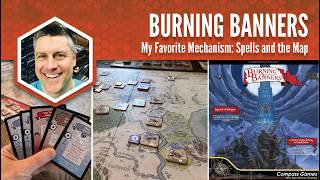
Spell cards give players a way to manage the randomness of combat. Jamie of Stonemaier Games explained that battles are resolved with dice, with players generally aiming for fives and sixes, and some dice going up to eight sides. Spells help players reduce the impact of bad rolls, either by improving their odds or by rolling more dice. At the end of each round, players can discard some of their spells and then replenish their hand up to three cards. Jamie noted that the number of cards a player may discard is tied to a magic token that is flipped at the end of each player's turn to show how much magic is in the world. Reviewers see the decision as less about what you draw and more about how well you spend the spells you already hold.
The Burning Banners Experience
Immersive Historical Reenactment in a Fictional World
Reviewers describe the game as a historical reenactment set in a fantasy world that resembles ours without copying it. Jamie of Stonemaier Games appreciated that the game asks players to replay a fictional history, and said the maps reward idle moments between turns because players can study the terrain and think about the events that took place there. The feeling is one of discovery. Players learn the names, places, and shape of a world that does not exist, and the map becomes the reason to keep playing.
Long, Combat-Heavy Turns
The tone shifts when reviewers talk about turns and conflict. Turns can take a long time because players often act with nearly every unit they control, and much of the game involves fighting other players. Jamie of Stonemaier Games described the experience as a long turn of combat that can leave players waiting for their next action. For players who enjoy deliberate, contested battles over cities and territory, that tension is the appeal. For players who want quick turns, the same design can feel slow and demanding.
What Makes Burning Banners Stand Out
Maps and Art From the Designer
Reviewers consistently praise the fact that the designer also illustrated the game. Jamie of Stonemaier Games, who placed Burning Banners in a list of favorite games where the designer is also the artist, said the map art is so stunning and immersive that it makes them want to know more about the world. Jamie also pointed out that some scenarios use several map boards that connect into one large playing surface, and described that as a remarkable feature. The Discriminating Gamer host echoed the praise for the artwork and the overall production quality.
Scenarios Built Around Player Count
Reviewers highlight how the game adapts to the number of players. In a BoardGameGeek list of games that scale well, the presenters noted that Burning Banners offers different maps, factions, and scenarios configured for different player counts, including dedicated two-player skirmishes. The Brothers Murph likewise said the game's different scenarios for different player counts make it work in many different ways. Reviewers see this as a way for a large-scale war to remain accessible to smaller groups without requiring a separate game.
Potential Drawbacks
Length and Downtime
Reviewers agree that the game can run long. Jamie of Stonemaier Games found the length a concern for a game they would revisit often, and noted that the scenario and the four-player count may have contributed. Because players take long turns and handle many units, others at the table may spend extended periods waiting. Reviewers who value a brisk table may find this the biggest obstacle to frequent play.
A Combat-Focused Design
Some reviewers say that the game's core is fighting other players, which is not a style everyone enjoys. Jamie of Stonemaier Games said combat is not usually their preference and that the game's appeal lies in its art and world building rather than its battles. The Discriminating Gamer host, who clearly enjoys the combat, described the rolling and hit confirmation as tremendous fun. The divide suggests that the game is best suited to players who are comfortable with a war game that puts fighting at the center of the experience.
If You Enjoy Burning Banners
Players who enjoy Burning Banners's combat-driven hex play will find similar satisfaction in Command & Colors: Napoleonics, which The Discriminating Gamer praised for its detailed infantry and artillery rules. Players who enjoy Burning Banners's dice-based battles supported by a steady supply of tactical resources will find similar satisfaction in Undaunted: Stalingrad, a deck-building tactical war game that The Discriminating Gamer described as a clever way to combine deck building with war gaming. Players who enjoy Burning Banners's asymmetric factions and hex encounter structure will find similar satisfaction in Space Empires 4X from GMT Games, which The Discriminating Gamer called a great hex encounter 4X war game.
What Reviewers Are Saying
"So, I like that the game not only gives you a way to mitigate that luck factor, but also the game gives you a lot of spells. At the end of every round, the game gives you chances to discard a certain number of spells and then replenish up to three spell cards in your hand."
— Jamie, Stonemaier Games
"I freaking love Burning Banners. It's a great production. It's probably my favorite game from Compass Games, and they do a lot of good games, but it's just beautiful artwork. The guy that designed the game did all the artwork, and it's amazing."
— The Discriminating Gamer
"they have different scenarios for different player counts. So, it works in a lot of different ways. Very, very interesting game."
— Nick, The Brothers Murph