/pic5410171.jpg)































Café Deep Dive
What the Community Thinks About Café
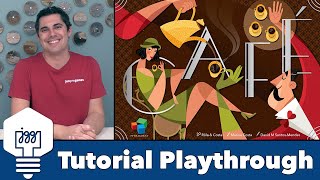
Reviewers who cover Café keep landing on the same overall impression: a small box that plays fast and asks a surprising amount of careful thinking for its size. Jamie of Tabletoptiktok frames it as a multiplayer solitaire experience that stays thinky and quick no matter how many players are at the table, running fifteen to twenty minutes either way. Totally Tabled slots it into a list of cozy solo games built around beating a personal high score rather than fighting for a win or loss, and singles out the card drafting as low-stakes and satisfying. Getting Games walks through a full three-player game start to finish and treats the tableau-building puzzle as the entire draw, while All You Can Board describes coming back to the game again and again because every card placement forces a fresh set of sacrifices.
Where opinions diverge is on weight. The Dice Tower's panel guessed low on Café's complexity before landing closer to the real number, calling it a great weight level for the kind of tension the game produces, and adding that Café is a great little thematically charged food game where the mechanisms flow well within the theme. The Board Gaming Doctor also enjoyed a solo session, this time on Board Game Arena, but concluded the game does not offer the complexity and depth they generally look for. Getting Games' step-by-step teach surfaces a more fiddly side of that same puzzle: lining up production spaces so a single action covers several fields at once turns out to be harder in practice than it sounds when a new card keeps burying what was already there.
Core Mechanics That Define Café
Covering Your Own Tableau
Every turn in Café centers on the same choice: which of several available cards to add to a personal tableau, and where to put it. All You Can Board explains that new cards are longer strips divided into sections, and playing one means covering a minimum of two spaces on cards already on the table, so a card can never simply slide underneath what is already there. Jamie of Tabletoptiktok adds that placement only works one way: a new card has to go on top, and a player can never cover up every coffee cup icon, since those icons set how many actions are available that round. Getting Games' teach confirms the same rule while playing through it live, noting that a new card has to cover two, three, or four segments of whatever is already down before any of its own icons can be used.
The Four-Step Coffee Chain
Getting Games lays out the production chain that keeps coming up across reviews: beans are produced, then dried on a drying field, then roasted, and finally delivered either to a personal warehouse or to one of the face-up cafes in a player's tableau for bonus points. All You Can Board notes that clustering matching production spaces next to each other lets a single action work across all of them at once, which is why so much of the puzzle comes down to grouping icons of the same type before they get buried under a later card. Jamie of Tabletoptiktok points out that the two lowest bean types left sitting in a player's warehouse still score points at game end, so hoarding one color unevenly can quietly cost a player at the finish.
The Café Experience
Quick, Thinky Sessions
Jamie of Tabletoptiktok describes finishing a full game in about fifteen to twenty minutes, and because most of a turn happens simultaneously, the runtime barely changes whether one person is playing or four. The Board Gaming Doctor found a similar rhythm on Board Game Arena, clocking games around twenty to forty-five minutes and calling the result an interesting puzzle to solve rather than a long strategic grind. Totally Tabled adds that the step-by-step process of turning beans into finished coffee feels satisfying and easy to follow, which is part of what makes the game an easygoing pick for a solo session.
Grueling, Satisfying Decisions
All You Can Board compares the feeling to Lost Cities: every placement is grueling because it always covers something useful, yet that tension is exactly what keeps pulling the reviewer back for another round. The same reviewer contrasts Café favorably with Corrosion, a game whose temporary engines they found unsatisfying, explaining that Café's constant need to break down and rebuild its own tableau is what makes deciding where to place a single card feel like it matters every time. The Dice Tower echoes that tension from the other side of the table, describing the pull between what to cover and what to leave open as the source of the game's extra weight.
What Makes Café Stand Out
A Theme That Matches the Mechanics
The Dice Tower calls Café a great little thematic food game and points to how well the mechanisms flow within that theme: growing, drying, and roasting beans before shipping them out mirrors the real coffee production process the game is named for. The Board Gaming Doctor makes a related point while introducing the game, noting that the word cafe simply means coffee in Portuguese, which ties the small card game directly back to its subject matter.
An Engine You Can Never Let Sit Still
All You Can Board singles out the way Café forces players to keep breaking their own production line apart, since a new card that improves one part of the tableau usually has to bury another. Rather than reading it as a flaw, the reviewer treats it as the game's biggest strength, saying it is exactly what made a corresponding mechanic in another recent release feel disappointing by comparison, because that other game's engines were only temporary rather than something a player kept actively reshaping.
Potential Drawbacks
Fiddly Optimization
Getting Games' turn-by-turn teach runs into the puzzle's rough edge directly, at one point wishing two roasters sat next to each other so a single action could clear them both, then admitting it is hard to actually arrange a tableau that cleanly while new cards keep needing a home. The same footage shows that grouping same-type spaces together is easy to plan in theory but gets harder to maintain as more cards go down and cover what was already lined up.
Not Enough Depth for Heavier Tastes
The Board Gaming Doctor rated the game a 6.9 out of 10 after a solo run, enjoying the puzzle of card placement but concluding it does not offer the complexity and depth they look for in a game overall. That review frames Café as better suited to players who want a quick, coffee-themed puzzle than to those chasing a meatier strategic challenge.
If You Enjoy Café
The Board Gaming Doctor says Café reminded them of Trailblazers, a game the reviewer covered on the podcast a couple of years earlier. For players who like this style of card placement puzzle but want more complexity, the same review points toward Pipelines, from the same designer. Totally Tabled draws a different comparison, noting that Cascadia shares Café's mix of drafting and tile laying along with its same relaxed, low-pressure pace.
What Reviewers Are Saying
"You can play this in about 15 to 20 minutes, and because it's for the most part simultaneous play, it doesn't change a lot based on player count. It's great, it's thinky, it's quick, it's one you can pull out while you're having a cup of coffee and enjoy it. I definitely recommend the game Cafe."
— Jamie, Tabletoptiktok
"You can roast them and process them and then ship them to your warehouse or to these cafe houses which will allow you to get points as well. This game is somewhat simple to teach, but it does offer a little bit of complexity, and it kind of reminded me of Trailblazers, the game that came out a couple of years ago."
— The Board Gaming Doctor
"You're always gonna be making decisions that you're gonna look back on and say, should I cover, should I have covered that, could have done this differently. And that's going to kind of be what draws you back in to play it again. It's inexpensive, it's small, it doesn't take up a lot of shelf space, and I think it's going to be one that has tons of variability every time you come back to it."
— All You Can Board