

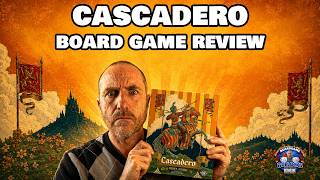







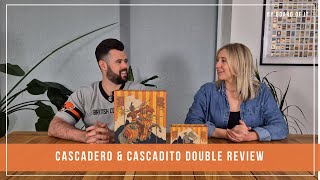

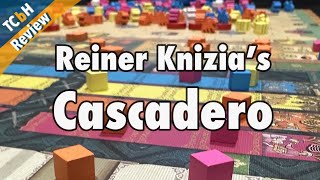
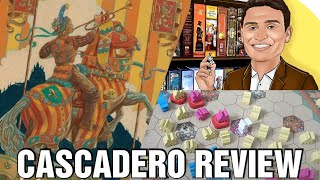

The kingdom is shattered, its towns are divided, and its people are distrusting. The newly crowned ruler, El Cascadero, seeks to reunite the land, but he can’t do it alone. Thus, he appoints four ministers to visit the people and restore civil harmony. While the ministers are obligated to bring prosperity to the entire land, each of them also has one dedicated responsibility: Farming, Crafting, Mining, and Markets. El Cascadero also records in his book the successes of his ministers…
Cascadero is the next epic tile placement strategy game from acclaimed designer Reiner Knizia. Ministers visit towns by placing their envoys adjacent to them; but towns are distrusting of single envoys, so newly placed envoys will only trigger town scoring when they are part of an established group or carry an official seal from El Cascadero himself. Towns with Royal Messengers at them or a history of envoy visits are even more valuable, as they willingly collaborate for even greater successes.
Players must decide between two competing strategies: build long chains of their envoys to achieve synergies and objectives, or establish smaller, separate groups of envoys to trigger timely town scoring. Both will award victory points, yet your victory points will mean nothing if you don’t also reach the end of your appointed success column.
By triggering town scoring, you’ll advance along that town’s matching success column, gaining bonuses as you pass over them. Bonuses include earning victory points, advancing further on any success column, claiming an official seal, repositioning an envoy, or even acquiring an additional turn. Through careful timing and clever plans, players can trigger a cascading combo of exciting bonuses that swing momentum in their favor.
Cascadero provides a wealth of replayability through emergent player interaction, variable board and tile setups, and an advanced player mode featuring traveling heralds. Yet the game will always end in one of two ways: when one player reaches fifty victory points or must place a tile but has no tiles left. The players who reached the end of their appointed success column qualify for victory, and whoever among them has the most victory points wins.
—description from the publisher
- Very light on rules but heavy on strategy
- Combo-rich turns from a single envoy placement feel highly satisfying
- Strong player interaction through achievements and block opportunities
- Excellent production quality and aesthetically pleasing design
- Compact, space-saving box with clever production touches
- High variability through heralds, farmer variant, and multiple maps
- Price point is higher than some peers for this weight/box size
- Not obviously a top-tier Riina Kiscia title, with stronger contenders in her catalog
- Endgame can feel abrupt in some playthroughs, making long-term planning feel abrupt
- Network-building and track progression with tokens, seals, and heralds
- A fictional Euro-style region where players place envoys to connect towns and advance color tracks
- Abstract, Euro-game feel with light thematic flavor and modular variability
- Through the Desert
Mechanics (from transcript analysis)
- Ach Achievements and scoring — Competing for various achievements that grant points and can be blocked by other players.
- End-game triggers and scoring — Game ends when a player reaches a point threshold (50+) or when players run out of envoys; scoring emphasizes track positions and bonuses.
- Envoy placement — On your turn, place an Envoy on a non-town space to begin or extend a connection to a town.
- Heralds and Farmer variant — Starting Herald placements and an alternate Farmer-side board with bonus tiles add variability.
- Seals and group formation — Seals can transform a single envoy into a connected group, altering strategy and options.
- Town connections and track advancement — Connecting a group of envoys to a town moves your color track forward and unlocks bonuses.
- Track advancement — Connecting a group of envoys to a town moves your color track forward and unlocks bonuses.
Video topics + discussion points
Quotes (from this video)
- it is quite light on rules but it is very big on strategy
- there's a lot of points of player interaction, particularly the achievements where players are racing to get them
- the seals are also interesting in themselves because they basically make a single horse or Envoy become a group
- the production again this is a very aesthetically pleasing game
- there's no formal rounds as they were, it's just when the dice will empty
- there are four maps and they get more complex as they go along
- the end game can come when as a collective group all players complete the achievements which can only be done by one player
References (from this video)
- Clear, accessible dice mechanism; good for quick sessions
- Strong map-based variability across four maps
- Beautiful production quality and packaging
- Good production touches and travel-friendly flip box
- Generic feel for a roll-and-write; lacks the sharp edges of stronger RIa designs
- Only five colors with a blank sixth face; can feel awkward or unbalanced
- Endgame can feel opaque, as players may not know how close others are to the ending
- Less player interaction compared to Cascadero; more solitary due to drafting randomness
- Roll-and-write variant where dice determine where you can mark adjacent to towns
- Dice-driven counterpart to Cascadero, using town connections and track-marking
- Variant of a classic Euro feel with dice-based action selection
- Through the Desert
Mechanics (from transcript analysis)
- Achievements and end-game triggers — Achievements exist for color-town connections, with end conditions based on collective or single-player completion.
- dice drafting — Roll dice, remove unusable colors, then players draft dice to mark spaces adjacent to towns of the chosen color.
- Dice drafting and marking — Roll dice, remove unusable colors, then players draft dice to mark spaces adjacent to towns of the chosen color.
- Dice pool non-uniformity — The dice pool is not always balanced; some colors may be absent in early maps, affecting choice.
- end game bonuses — Achievements exist for color-town connections, with end conditions based on collective or single-player completion.
- Map-based scoring and actions — Four maps with increasing complexity provide different scoring opportunities and interaction.
- Multiple maps with unique challenges — Each map adds new constraints and scoring opportunities, enhancing variability.
Video topics + discussion points
Quotes (from this video)
- it is quite light on rules but it is very big on strategy
- there's a lot of points of player interaction, particularly the achievements where players are racing to get them
- the seals are also interesting in themselves because they basically make a single horse or Envoy become a group
- the production again this is a very aesthetically pleasing game
- there's no formal rounds as they were, it's just when the dice will empty
- there are four maps and they get more complex as they go along
- the end game can come when as a collective group all players complete the achievements which can only be done by one player
References (from this video)
- Fast, accessible, and relaxing
- Good introduction to roll-and-write variants
- Depth may be shallower than Cascadia
- Potential repetitiveness over long runs
- Nature, wildlife, map-building
- Roll-and-write map game inspired by Cascadia
- Relaxed puzzle-like drafting
- Cascadia
Mechanics (from transcript analysis)
- Flip/Roll and Write — Roll dice and draft two dice per round to place into a map grid
- opponent AI — An automaton opponent tracks progress and affects turns
- Pattern Building — Fill map spaces to align patterns and gain points
- pattern-building/map completion — Fill map spaces to align patterns and gain points
- roll-and-write — Roll dice and draft two dice per round to place into a map grid
Video topics + discussion points
Quotes (from this video)
- The look of this game is absolutely stunning
- I love the look of these green tokens
- it's very satisfying to place the chips onto your itinerary
- I am really excited to play this
- the components are absolutely fantastic
- I loved drawing in all of the rooms on this little like vellum sheet
- I did not do well at all in blueprints of Mad King Ludwig
- I ended up with a score of 226 which is not amazing
References (from this video)
- succinct in its roll-and-write mechanics
- tight mechanisms that align well with Cascade themes
- not as compelling as Cascadia in the reviewer’s view
- still not perfect; the reviewer remains lukewarm overall
- roll-and-write adaptation of Cascadia with cascade mechanics
- Cascadia
Mechanics (from transcript analysis)
- Flip/Roll and Write — dice determine actions; players draft actions and create patterns on paper.
- Pattern Building — building patterns and managing card/tiles to optimize scoring via cascades.
- Pattern-building and set collection — building patterns and managing card/tiles to optimize scoring via cascades.
- roll-and-write — dice determine actions; players draft actions and create patterns on paper.
Video topics + discussion points
Quotes (from this video)
- this is bonfire... kind of one of his more recent ones
- I thoroughly thoroughly enjoyed this two-player game
- it's remarkably fast as well I think I played it in about 75 minutes
- I think it's absolutely fantastic and one of the best two-player games I've played this year
- I love this game because the dice system in Bora Bora is great and the powers help balance outcomes
- expansion Mekka & Bah definitely did make a big change in the gameplay
- Caesar's Empire ... an evergreen feeling game that should be up there with Ticket to Ride
References (from this video)
- Abstract design with hidden depth via achievement scoring
- Tactical blocking and route-building elements
- Elegant integration of track and area control
- Abstract nature may put off some players
- Potentially punishing if behind
- Network-building with track-driven scoring
- Hex-grid, token-placement, and city connections reminiscent of Through the Desert
- Abstract with thematic hints
- Through the Desert
Mechanics (from transcript analysis)
- Achievement-based scoring — Achievements grant additional victory points beyond standard scoring
- Token placement and chaining — Place wooden tokens to form groups and connect to towns
- Track advancement — Move tokens up color tracks to unlock points
Video topics + discussion points
Quotes (from this video)
- two action wheels and they interact together
- the best racing game that's been released this year
- hands down the best game that we have played in 2024
References (from this video)
- Stunning production and artwork that blends medieval aesthetics with vibrant colors
- Rich potential for combos and synergies when tracks align with bonuses
- Two-sided board options add variety and alternate tactical emphasis
- Clear components and intuitive symbol language when explained
- Flow between grid movement and track climbing can feel disjointed
- General tension and urgency diminish with fewer players (2-3 players)
- Big, dramatic turns are lacking; the game can feel subtle for long portions
- Replayability may be limited if the number of unique paths doesn't provide enough variety
- Route-building, city connectivity, and color-themed tracks with scoring on first-to-reach
- Medieval-themed hex-grid map where players deploy envoys to towns and cities
- Abstract engine-building with objective-based scoring and modular board variants
- Babylonia
- Celtis
- Cascadeo
Mechanics (from transcript analysis)
- Blocking and route management — Players can block paths; strategic blocking creates friction and tension, particularly near key towns
- Envoy placement — On your turn you place an envoy anywhere on the hex map to trigger bonuses and progress on color tracks
- Network/route building — Players can block paths; strategic blocking creates friction and tension, particularly near key towns
- Objective tiles — Public objectives give points for specific formations or connections; some are race-based and require urgency
- Seals and grouping — Landing a seal places a bonus when deploying an envoy, and seals can count as a group to qualify encounters quickly
- Track advancement — Advancing on color tracks grants victory points; first player to reach the top moves differently than later players
- track climbing — Advancing on color tracks grants victory points; first player to reach the top moves differently than later players
- White city bonuses — White cities (special towns) provide stronger advancement, with multiplicative effects for early players
Video topics + discussion points
Quotes (from this video)
- I'm a huge Rin Kitzia fan and I'm a particular fan of this style of game
- the flow of this game isn't quite as smooth as some of his others
- it's a little bit too subtle and maybe even lacks that fun factor
- this game was a little bit of a disappointment for me
- production wise I think this game looks fantastic
References (from this video)
- visually striking
- ambitious design
- felt convoluted and clunky
- ecosystem and growth
- root-building style, strategic development
- dense, strategic
Mechanics (from transcript analysis)
- engine building — build a grounded, connected structure via root-like growth
- engine/root-building — build a grounded, connected structure via root-like growth
Video topics + discussion points
Quotes (from this video)
- it's really tight this Bard is and the opportunity cost of doing one thing
- there are so many different ways you can score in this game
- it's punchy
- the game end really does rush up on you
- polished, refined, gorgeous to look at
- you can just take the pieces off the board and go again
References (from this video)
- visually striking
- offers a deep, thematic approach
- felt convoluted and clunky; not aligned with the reviewer’s taste
- ecosystem/land development
- root-building style game (theme around roots and growth)
- complex, strategic
- Cascadia
- Calico
Mechanics (from transcript analysis)
- engine building — players develop a landscape using root-like connections
- engine-building/root-building — players develop a landscape using root-like connections
Video topics + discussion points
Quotes (from this video)
- it's really tight this Bard is and the opportunity cost of doing one thing
- there are so many different ways you can score in this game
- it's punchy
- the game end really does rush up on you
- polished, refined, gorgeous to look at
- you can just take the pieces off the board and go again