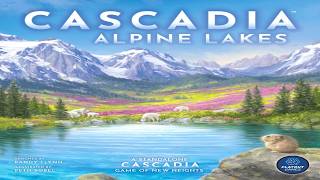
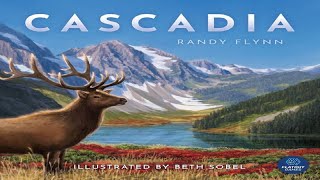
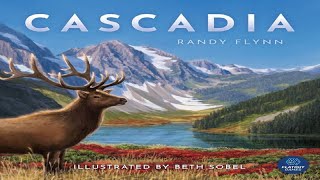
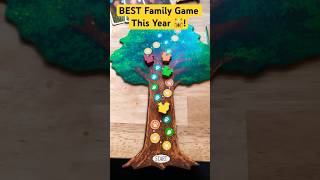
Cascadia is a puzzly tile-laying and token-drafting game featuring the habitats and wildlife of the Pacific Northwest.
In the game, you take turns building out your own terrain area and populating it with wildlife. You start with three hexagonal habitat tiles (with the five types of habitat in the game), and on a turn you choose a new habitat tile that's paired with a wildlife token, then place that tile next to your other ones and place the wildlife token on an appropriate habitat. (Each tile depicts 1-3 types of wildlife from the five types in the game, and you can place at most one tile on a habitat.) Four tiles are on display, with each tile being paired at random with a wildlife token, so you must make the best of what's available — unless you have a nature token to spend so that you can pick your choice of each item.
Ideally you can place habitat tiles to create matching terrain that reduces fragmentation and creates wildlife corridors, mostly because you score for the largest area of each type of habitat at game's end, with a bonus if your group is larger than each other player's. At the same time, you want to place wildlife tokens so that you can maximize the number of points scored by them, with the wildlife goals being determined at random by one of the four scoring cards for each type of wildlife. Maybe hawks want to be separate from other hawks, while foxes want lots of different animals surrounding them and bears want to be in pairs. Can you make it happen?
Cascadia - Playthrough & Review
- simplified yet satisfying
- endless replay value
- relaxing to play
- Calico
- Patchwork
Mechanics (from transcript analysis)
Video topics + discussion points
Quotes (from this video)
- blue lagoon is a great game
- it's got so colorful so much fun
- there's this great moment in blue lagoon where you just realize that you've got a certain island secured
- it's a sandbox style pirate game
- i'm going to buy this for myself 100
- Ethnos is an awesome very simple area majority game
- Ticket to Ride Europe
- Nidavellir
- Dune Imperium
- Code Names is just so great that it's word games are just easy for no i shouldn't say they're easy for everyone to get into
References (from this video)
- easy to learn, deeply satisfying decision space
- beautiful integration of theme
Mechanics (from transcript analysis)
Video topics + discussion points
Quotes (from this video)
- it's just such a satisfying game for me to play
- the scoring is so low it makes every point matter so much
- this is a voting game that you are going after you're interested in manipulating tokens on the board
- Mission Deep Sea is the Pinnacle version of the crew
- Ghost Stories is fantastic cooperative game
- Cascadia is such a great game
- Kingdom Builder ... it goes up to five to six players
- KeyForge unlike anything else I've played out there
References (from this video)
- Beautiful production; high-table presence
- easy to teach, quick to play
- Low direct interaction; sometimes feels solitaire at the same table
- nature habitat-building
- North American Pacific Northwest ecosystem, habitats and wildlife
- abstract, tile-drafting engine
Mechanics (from transcript analysis)
- set collection — players collect animal cards to score points.
- tile-drafting — players select habitat tiles to place in their personal board.
Video topics + discussion points
Quotes (from this video)
- It's not engagement. It's everyone doing their own puzzle in the same room.
- Gorgeous production quality, but multiple simultaneous subsystems that can feel complex initially for new players.
- Turn order determines a lot in this game's economy.
- One wrong move with how the link network system works, and you've completely invalidated your entire strategy.
- The clue giver walks a razor line between clever and intuitive that new players haven't calibrated.
- Eight-hour day commitment, full group attendance, full mental energy required throughout.
References (from this video)
- Fresh mechanics that expand Cascadia without breaking it
- Accessible and quick to teach
- New depth from stacking and elevation
- Environment scoring cards add replayability
- More complex scoring can take time to explain
- Difficult to excel in all scoring categories
- Involves more tracking and bookkeeping than base Cascadia
- Habitat construction with animals; elevation and stacking dynamics
- Alpine habitat with double-hex tiles and elevation-based scoring
- Abstract ecological puzzle
- Cascadia
Mechanics (from transcript analysis)
- animal placement and scoring — Place animals on tiles to gain points, with bonuses for top stacks.
- Compound Scoring — Each habitat has its own scoring condition.
- optional environment scoring cards — Optional cards add additional scoring goals and decisions.
- stacking/elevation — Stack tiles to raise levels and move animals; higher levels score differently.
- tile placement — Place double-hex tiles to build a habitat.
- variable habitat scoring — Each habitat has its own scoring condition.
Video topics + discussion points
Quotes (from this video)
- One of my favorite things is how stacking changes the puzzle.
- Alpine Lakes really nails the balance of fresh and familiar.
- If you've loved the original Cascadia, Alpine Lakes is definitely worth adding to your collection.
References (from this video)
- Cozy and relaxing to play
- Open, non-punishing, even solo mode
- Good scalability and variants for families
- Can feel slow for impatient players at times
- Some seek more harsh competition in other games
- Habitat building and tile placement
- Pacific Northwest habitats with wildlife tiles
- Calm, contemplative, zen-like
- Calico
- Castles of Burgundy
Mechanics (from transcript analysis)
- Compound Scoring — Score based on specific animal patterns and habitat completeness.
- Open-ended placement options — Many viable placement choices create a broad decision space.
- pattern-based scoring — Score based on specific animal patterns and habitat completeness.
- tile drafting and placement — Draft landscape tiles and animal tokens to lay out habitats.
- tile placement — Draft landscape tiles and animal tokens to lay out habitats.
- worker placement — Many viable placement choices create a broad decision space.
Video topics + discussion points
Quotes (from this video)
- Camel Up is a super zany lucky camel racing game
- This is your game. It is 100% trying to get a ship out of danger
- Creature Comforts. It is the coziest of the strategy I think for me
- one of my absolute favorites, The Crew
- And this is another one that is a cozy favorite of mine
References (from this video)
- Accessible and relaxing pattern-building
- Beautiful art and components
- Fast to teach and play
- Some randomness in tile/draft may affect stability
- ecosystem balance and biodiversity
- Pacific Northwest wildlife habitat
- abstract, pattern-building puzzle
Mechanics (from transcript analysis)
- Pattern Building — draft wildlife and habitat tiles to complete scoring patterns
- pattern-building / drafting wildlife — draft wildlife and habitat tiles to complete scoring patterns
- tile placement — place habitat tiles to form patterns across the board
Video topics + discussion points
Quotes (from this video)
- Cascadia in Northwest in it. Yeah this side
- Northwest is white when it's white.
References (from this video)
- calm, relaxing, and easy to teach
- tight integration between terrain types and animal scoring
- serves as a gateway to Calico for the player who enjoys tile/animal combos
- strong solo mode with clear scoring direction
- endgame scoring can be unforgiving if not optimized
- some players may find the tile grid restrictive
- solo scoring rules require careful reading and can be slightly confusing at first
- ecosystem balance through tile placement and animal collecting
- Pacific Northwest wilderness and wildlife habitats
- informational/educational commentary with playthrough flavor
- Calico
Mechanics (from transcript analysis)
- scoring by patterns and adjacency — points awarded for habitat groups, animal groupings, and adjacency conditions
- set collection / pattern-building — collecting animal tokens to pair with habitat tiles for points
- tile placement — placing habitat tiles to form scoring patterns while matching animal tokens
- wild token usage — wild tokens act as flexible pieces to enable better placement and scoring opportunities
Video topics + discussion points
Quotes (from this video)
- Cascadia was my Gateway I guess into Calico
- this is you know similar in a different uh style
- it's such a great morning relax St game
References (from this video)
- accessible gateway game with a satisfying puzzle
- pleasant art and components
- engaging and quick to teach
- can feel solitaire if players chase individual patterns
- some players may prefer higher interaction
- pattern-building ecosystem puzzle
- Pacific Northwest ecosystem with wildlife patterns
- tile placement and wildlife token scoring
Mechanics (from transcript analysis)
- Pattern Building — create aesthetically pleasing and high-scoring habitat patterns.
- pattern-building — create aesthetically pleasing and high-scoring habitat patterns.
- set collection — collect animal and terrain cards to maximize points.
- tile placement — place habitat tiles and wildlife tokens to form scoring patterns.
- variable scoring — points shift based on chosen patterns and token placements.
Video topics + discussion points
Quotes (from this video)
- UKGE is the biggest board game convention in the United Kingdom.
- there is space upon space upon space it does get busy you might find that you haven't always the space for open gaming.
- there's always somewhere to go, there's loads of space.
- there will be a play testing area for people bringing games to market in the future.
References (from this video)
- beautiful and accessible
- double puzzle (tile placement + scoring tokens)
- great multiplayer experience
- solo play is less compelling
- ecosystem puzzle
- habitat and wildlife in Cascadia
- abstract
- Calico
Mechanics (from transcript analysis)
- Animal token placement — place animal tokens on habitats to maximize points
- tile placement — place habitat tiles to form scoring patterns
Video topics + discussion points
Quotes (from this video)
- it's like a double puzzle absolutely wonderful absolutely amazing
- the dice in this game are gorgeous
- it's quick it's beautiful it has a puzzle element
- it's basically a dice placement slash worker placement game
- I will forever love it
- Andrew Bosley is just the MVP
- Clank is just so great
- please God let it happen at some point
References (from this video)
- Family-friendly
- Strong solo and social play
- Beautiful components
- Can feel light for players seeking deeper strategy
- Ecosystem building, habitats and wildlife
- Pacific Northwest wilderness
- Abstract
Mechanics (from transcript analysis)
- Pattern scoring / set collection — Score points for matching habitats and animals.
- tile placement — Place tiles to form a cohesive landscape.
- tile-drafting — Draft habitat tiles and animal tokens to build your landscape.
- Tile-laying — Place tiles to form a cohesive landscape.
Video topics + discussion points
Quotes (from this video)
- Calico is one of my favorite games that I discovered this year.
- Cascadia was my first game that I bought in 2024 and I played it so much in January that it was incredible.
- Hadrian's Wall is an incredible game, I love Hadrian's Wall, it's so crunchy and thinky.
- Harvest... solo challenges, it's so great, solo I love it.
References (from this video)
- Accessible and relaxing
- Great with casual and board-game-curious friends
- Can feel repetitive for long sessions
- Nature habitat construction
Mechanics (from transcript analysis)
- tile placement — Draft and place habitat tiles to create balanced patterns.
Video topics + discussion points
Quotes (from this video)
- It's not personal, it's business, okay?
- We need to remedy that and quickly.
- I am going to be cutthroat with some of these games.
- I feel better prepared already for Spiel.
- This shelf is absolutely beautiful, but we have to make space.
References (from this video)
- Widely enjoyed and accessible
- Fresh due to roll-and-write variant
- Roll-and-write fatigue can affect some players
- habitat construction and wildlife management
- pacific northwest wildlife reserve
- Array
Mechanics (from transcript analysis)
Video topics + discussion points
Quotes (from this video)
- it's the midyear board game tag
- Obsession it's a beautiful game
- it's so quick to set up
- it's a new era of board games that's how it feels like to me
- I can't pick one game that's impossible
- Cascadia rolling... I love Cascadia
References (from this video)
- Accessible gateway game with elegant tile placement
- Beautiful components (wooden tokens, art)
- High replayability due to variable scoring cards
- Clear rules and approachable yet strategic
- Not as deep as heavier abstracts for experienced gamers
- Possible analysis paralysis with higher player counts
- habitat creation and wildlife management
- Pacific Northwest forests and mountains
- procedural puzzle with light thematic framing
- Isle of Cats
- Calico
- King Domino
Mechanics (from transcript analysis)
- Animal token placement — Place animal tokens on tiles to trigger scoring rules and form groups.
- Area/terrain scoring — Points awarded for terrain type groups and animal placements.
- Campaign — Optional 'campaign' style achievements add challenge.
- campaign-like achievements — Optional 'campaign' style achievements add challenge.
- Compound Scoring — Before each game, pick scoring cards for each animal to modify scoring rules.
- keystone tokens — Keystone tiles grant a one-time bonus when used.
- replayability through randomness — Different tile/animal card combos yield new puzzles each game.
- scoring cards (variable) — Before each game, pick scoring cards for each animal to modify scoring rules.
- solo mode scoring challenge — Solitaire mode focuses on solving a self-imposed puzzle.
- tile placement — Place land tiles to form terrain regions and enable animal placement.
- variable scoring — Scoring changes across games due to different scoring cards.
Video topics + discussion points
Quotes (from this video)
- it's a gateway game with simple mechanics and a great look
- the stars of the show are the wooden animal tokens
- this is one of the places that cascadia shines with a terrific balance of the right amount of extra quality without going over the top
- for newbies it has more layers than something like King Domino but without pushing too hard
References (from this video)
- Stunning art by Beth Sobel and a convincing Pacific Northwest feel
- High replay value due to varied scoring conditions
- Accessible, quick turns with depth emerging over play
- Can feel simple to new players but offers subtle depth
- Some players may want more thematic narrative than abstract scoring
- ecosystem design and wildlife balance
- Pacific Northwest habitat with wildlife
- zen puzzle feel with high variability
- Calico
- Tiny Towns
Mechanics (from transcript analysis)
- Compound Scoring — cards specify how landscapes and animals score, adding variety
- grid/region scoring and adjacency — end-game scoring based on the size and richness of regions and animal groups
- set scoring conditions via cards — cards specify how landscapes and animals score, adding variety
- tile drafting — draft landscape tiles in pairs and select one to keep
- token placement / pattern building — place animal tokens on matching icons on the landscape tiles
Video topics + discussion points
Quotes (from this video)
- it's so beachy and it's all of these nice kind of beach pinks and blues and I just I love love love the look of it and I genuinely like the components as well the seashells
- Turns go really really quickly
- the best mobile art is great it's just it looks so uh it looks like the Pacific Northwest and it's so inviting
- the higher scoring cats are a lot harder for those goals to accomplish
- this game can be a little bit frustrating and it can be surprisingly mean for the cute animals that are on the front here
References (from this video)
- elegant and calming
- deep decisions from simple rules
- solid with multiple players
- some players want more thematic hooks
- tile drafting and wildlife scoring
- nature and wildlife-focused landscape-building
- calm, puzzle-like experience
- Parade
- Welcome to
Mechanics (from transcript analysis)
- tile placement — place terrain tiles to shape a landscape
- tile_and_animal_scoring — combine terrain and animal tokens for points
- tile_placement — place terrain tiles to shape a landscape
Video topics + discussion points
Quotes (from this video)
- Clank is a great deck builder that you're going down into the caverns and you're trying to gather as much stuff and then come back up before you get killed by a dragon basically
- the story lines work really well on this but even without that part and sometimes we'll just play with just the cards that have no story
- it's a heads down euro-y experience and I love how the systems interact so tightly
- it's immediately fun and interesting and it's got this really cool mechanic where you're putting down dudes and the more dudes on a thing the more of whatever that resource trees or rocks whatever you get
- eight totally different maps that all use the same system so it all uses the same deck of cards and then kind of three different sets come out and simultaneously you have to pick which one you're going to use
References (from this video)
- Beautiful art and thematic cohesion
- Accessible to new players yet with satisfying strategic layers
- Great for two players and solo play variants
- Some players may crave deeper engine-building divergence
- Habitat drafting and ecological harmony
- Pacific Northwest ecosystem with native wildlife
- Calm and contemplative with a nature-forward aesthetic
- Calico
- Calimala
Mechanics (from transcript analysis)
- Animal drafting — Draft animals to score points by matching habitats and objectives.
- Deck-drafting and point optimization — A balance of drafting choices and scoring opportunities across rounds.
- tile placement — Draft and place landscape tiles to create contiguous habitats.
Video topics + discussion points
Quotes (from this video)
- "Terra Mystica is a game that maybe would be higher if it wasn't four player only"
- "Clank is very much a competitive game because you're going down in the dungeon"
- "This is like Star Wars built from the ground up"
- "it's a dopamine machine"
- "Cascadia is just a beautiful kind of chill tile placement game"
- "it's such a weird fun time"
- "Meadow is beautiful each of the cards looks like its own individual painting"
- "Village is thematically strong and very atmospheric with age progression and a strong border between generations"
- "Unmatched is my number 31"
- "parade is a card game and it's golf rules so the lowest score wins"
References (from this video)
- Elegant, approachable puzzle with strong theme
- High replayability due to variable scoring decks
- Calm, satisfying gameplay
- Some players want more player interaction
- Array
- Pacific Northwest wildlife and habitats
- Abstract strategy
Mechanics (from transcript analysis)
- Drafting paired with tile placement — Draft landscape tiles and matching animal tokens in tandem
- tile placement — Place tiles to form landscapes and place animals into habitats for scoring
- Tile placement and pattern scoring — Place tiles to form landscapes and place animals into habitats for scoring
Video topics + discussion points
Quotes (from this video)
- My number 60 is Istanbul and I feel like this is one that flew under the radar a little bit.
- There's still plenty of time to join in the Kickstarter.
- I love the challenge of this game.
- Istanbul big box because we waited for the big box, and it was worth it.
- Jaipur is a two-player specific card game.
- Unlock is an escape room in a box.
- Marvel United does simplicity so so well.
- Cascadia has a theme I love; I grew up near the Rockies.
- Brass Birmingham is such a smart game.
References (from this video)
- Very accessible and easy to teach
- Family-friendly, suitable for non-gamers
- Varied scoring cards increase depth and replayability
- Forgiving gameplay with tokens to mitigate luck
- Beautiful, calming table presence
- Can feel repetitive after many plays
- Lacks high tension / competitive pull
- Mostly multiplayer solitaire
- Can look flat on the table compared to other games
- habitat creation and wildlife scoring
- North American parks; nature tile placement
- procedural, relaxing
- Harmonies
Mechanics (from transcript analysis)
- Compound Scoring — scoring via variable scoring cards with different patterns
- Nature tokens — nature/pine cone tokens to mitigate luck and adjust scoring
- Pattern scoring — scoring via variable scoring cards with different patterns
- tile drafting — draft animal tokens and landscape tiles from a central market
- tile placement — place tiles to build habitats and scenic landscapes
Video topics + discussion points
Quotes (from this video)
- The easiest one is just the pure accessibility of this game. You can teach this to basically anybody.
- It's very forgiving gameplay loop. It’s forgiving of mistakes.
- Harmonies looks like a kids game, but it's not
- If you want something that has a higher crunch factor, Harmonies does give you more crunch
References (from this video)
- tight, elegant puzzle
- good replayability through multiple goals
- scales across player counts with minimal added complexity
- initial scoring concepts can be a bit confusing
- expansion adds extra layers to consider on top of the base game
- eco-systems and habitat-based scoring
- Pacific Northwest wildlife and habitats
- abstract puzzle
Mechanics (from transcript analysis)
- Compound Scoring — animals placed score points based on habitat alignment and objective cards.
- habitat and species strategy — players plan around habitat groups and wildlife placements for scoring.
- pine cone currency — pine cones are used to influence draws and optimize placements.
- tile drafting — players draft habitat tiles and wildlife tokens to build their personal board.
- tile placement — place tiles to form habitat patterns and score via objectives.
- wildlife scoring through objectives — animals placed score points based on habitat alignment and objective cards.
Video topics + discussion points
Quotes (from this video)
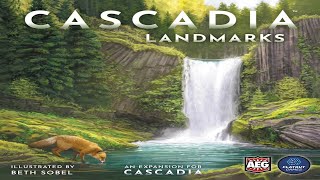
- Cascadia Landmark expansion contains 35 Wildlife tokens
- brand new scorecard
- five to six player compatibility
- shorter game mode
- Landmarks are such an easy addition
- this changes the game a bit
- it's a great expansion to an already amazing game
- I think this adds a layer of complexity that might pull your brain into a lot of different directions
- this is Cascadia landmarks and what we think about it there's a lot that comes in this box it's a great expansion to an already amazing game
- it's very pretty
- Beth is a legend
References (from this video)
- beautiful art and satisfying component interaction
- high replayability with multiple variants
- very approachable yet deeply strategic
- thematic coherence relies on the animal scoring cards
- some players may prefer more direct conflict
- habitat-building and tile/toke-n drafting
- Pacific Northwest habitat with wildlife
- procedural puzzle
- Quacks of Quedlinburg
- Calico
Mechanics (from transcript analysis)
- Compound Scoring — multiple scoring cards alter how animals and tiles score each game.
- set scoring with variable cards — multiple scoring cards alter how animals and tiles score each game.
- tile drafting with tokens — draft a landscape tile and an animal token to place on a growing tableau.
Video topics + discussion points
Quotes (from this video)
- This is something that's a living document, which is really, really cool.
- It's driven by y'all.
- Dominion put deck building on the map.
- Sky Team won. That's incredible.
- It's truly one of the most replayable games ever.
References (from this video)
- easy to teach
- light and relaxing puzzle
- beautiful artwork
- luck of objective cards can influence outcomes
- scoring complexity may vary with objective cards
- habitat building and wildlife
- Pacific Northwest
- abstract ecological mapping and tile placement
Mechanics (from transcript analysis)
- Compound Scoring — score points based on objective cards and habitat configurations
- set-collection / scoring objectives — score points based on objective cards and habitat configurations
- tile drafting — players draft habitat tiles to build their own map
- tile placement / pattern building — place tiles to form habitats and maximize scoring patterns
Video topics + discussion points
Quotes (from this video)
- these are 10 board games that are quick to teach
- the artwork's Beautiful so if you're looking for a light puzzle I highly recommend Cascadia
- it's very quick to teach and very quick to learn
- a lot of this top 10 list is about accessibility and group play
References (from this video)
- beautiful art and components
- strong family-friendly design
- can lead to some analysis paralysis for new players
- habitat-building with landscapes and wildlife tokens
- Pacific Northwest habitat
- Calico
- Verdant
- Nocturn
Mechanics (from transcript analysis)
- Pattern Building — achieve scoring patterns through tile placement
- set collection — collect animals for scoring bonuses
- tile placement — place landscape hex tiles to form a cohesive habitat
Video topics + discussion points
Quotes (from this video)
- Point City replaces Point Salad for me
- this is one to four players
- it's about 15 to 30 minutes a game
- Cascadia I want Cascadia I like Cascadia I will play this I will share it I will enjoy it it's just my all-time favorite of their games
- Calico is a lovely strategy game it is a cozy spatial game but boy is it thinky
- Verdant is at the bottom I think mostly because of the restriction and luck of the draw
- Nocturn stacks up as a strong, open bidding game with back-and-forth tension
- the games come in these small boxes these are really nice size boxes great artwork and super super affordable
References (from this video)
- tight, crunchy puzzle
- shorter playtime with good depth
- strong two-player potential
- luck of animal/die draw can influence pacing
- pattern-building and terrain optimization
- Pacific Northwest natural habitat and wildlife
- puzzle-driven, calm but competitive
Mechanics (from transcript analysis)
- Compound Scoring — base terrain scoring plus animal-pattern bonuses
- Pattern Building — create patterns to score points based on adjacency and diversity
- pattern-building — create patterns to score points based on adjacency and diversity
- scoring — base terrain scoring plus animal-pattern bonuses
- tile-drafting — draft terrain tiles and wildlife tokens to place on your map
Video topics + discussion points
Quotes (from this video)
- Dead of Winter, a crossroads game.
- it's nostalgic.
- the campaign ends on the final draw.
- I think this puzzle to me is more crunchy and satisfying than something like Cascadia.
- Cascadia is pretty chill.
- What a good game.
References (from this video)
- very easy to teach
- great for all player counts
- tile placement and ecological pattern-building
- Pacific Northwest ecosystem with wildlife habitats
Mechanics (from transcript analysis)
- Pattern Building — Animals must be placed in scoring-aligned patterns
- pattern-building — Animals must be placed in scoring-aligned patterns
- tile placement — Place habitat tiles to form your park.
- Tile-laying — Place habitat tiles to form your park.
Video topics + discussion points
Quotes (from this video)
- it's a war game for all intents
- Love Letter is the game I think I've probably played the most
- Cascadia is a fantastic game
- Heat is amazing
- Undaunted is fabulous
- It's pure fun
References (from this video)
- Accessible yet deep enough for thoughtful planning
- Replayable with high variance in layouts
- Some players may prefer more thematic flavor over abstract scoring
- ecosystem-building with wildlife patterns
- Pacific Northwest habitat creation
- abstract/pattern-driven
- Calico
- Root
Mechanics (from transcript analysis)
- set collection / pattern scoring — Scores accrue from matching wildlife patterns and terrain configurations.
- tile drafting — Draft terrain tiles and wildlife tokens to create a personal ecosystem grid.
Video topics + discussion points
Quotes (from this video)
- Wingspan absolutely slaps it is a great game
- Katon being ranked at 554 is criminally underrated
- Pineapple does have a place on Pizza
- Unmatched is not a good game all right
- Heat is boring
References (from this video)
- Accessible and relaxing puzzle experience
- Digital version is visually appealing and intuitive
- Supports solo play against AI and online multiplayer
- habitat construction and wildlife pattern-building
- Pacific Northwest habitats and wildlife in a stylized, nature-forward environment
- procedural puzzle-oriented
Mechanics (from transcript analysis)
- pattern scoring / objectives — Scoring cards specify patterns or combinations of terrain and animals that yield points, guiding placement decisions.
- set collection / wildlife tokens — Wildlife tokens are drafted and placed to complement tiles, contributing to scoring opportunities.
- tile drafting — Players draft habitat tiles (and associated wildlife tokens) to assemble a mosaic of biomes on their personal board.
- tile laying / placement — Drafted tiles are placed to form contiguous habitat areas while meeting adjacency and pattern scoring requirements.
- tile placement — Drafted tiles are placed to form contiguous habitat areas while meeting adjacency and pattern scoring requirements.
Video topics + discussion points
Quotes (from this video)
- Cascadia is a light puzzle tile Lane game where you're creating your own little habitat
- the app is very intuitive and absolutely beautiful
- it's currently $10 on the App Store
- I've really enjoyed it
- Finally out digitally and it's available on iPhones and Androids
References (from this video)
- Shorter, family-friendly variant that captures core Cascadia mechanics
- Clear, accessible scoring focused on groups of terrain and animals
- Fast-paced and suitable for kids while retaining strategic feel
- Reduced decision space due to only two tile options per turn
- Less depth than the original Cascadia
- Less variability in scoring due to streamlined tokens
- Terrestrial habitats and animal grouping
- Nature-themed tile-laying set in a wilderness resembling Cascadia’s ecosystem
- abstract, family-friendly
- Cascadia
Mechanics (from transcript analysis)
- Compound Scoring — Tokens serve to mark tiles that have been scored, affecting end-game scoring dynamics.
- End-game scoring via random tokens — For each scoring group a random token (worth 1 or 2 points) is earned, and tokens indicate tiles already scored.
- set collection — Formation of groups of three same terrain or three of the same animal species yields scoring opportunities.
- set collection / grouping — Formation of groups of three same terrain or three of the same animal species yields scoring opportunities.
- tile placement — Players place hex-pair tiles to create contiguous groups of terrain types and animal symbols.
- Tile/Map Shifting — Only two tiles are available to choose from on a turn, streamlining choices.
- Token-based scoring reveal — Tokens serve to mark tiles that have been scored, affecting end-game scoring dynamics.
- Variable tile options — Only two tiles are available to choose from on a turn, streamlining choices.
Video topics + discussion points
Quotes (from this video)
- Cascadia Jr is a two to four player tile placing game that shortens and streamlines the original popular game Cascadia
- there are 10 turns in this game compared to the original 20
- each tile features a Terrain and an animal printed on the tile
- for each group of three terrain or three animals the player will take a random token worth either one or two points
- the randomization really levels the playing field
- when tokens are revealed at the end of the game anyone can win
- for a family with kids this does a great job of encapsulating the original Cascadia
References (from this video)
- cozy, nature-forward theme
- accessible entry point among environmental games
- nature / naturalistic
- Nature-focused habitat and ecosystem
- calm, cozy, nature-inspired
- Ark Nova
- Life in the Amazonia
Mechanics (from transcript analysis)
- tile drafting / pattern building — Players draft terrain tiles to build habitats and match patterns.
Video topics + discussion points
Quotes (from this video)
- I feel like theme really matters to me if I want to put myself in a setting in a board game and have a relatively good understanding of how to play
- the theme that it's set in as well as how well those mechanisms integrate with the theme
- I think it's my number one theme because of how interested I am in games that I'm previewing and looking at further in the Horizon
References (from this video)
- easy to teach
- great introductory engine-builder feel
- expansion option adds depth
- could be repetitive for experienced players
- score math can be fiddly for newcomers
- cozy, nature-focused tile drafting and set collection
- North American wildlife habitat
- calm, logical puzzle feel with evolving boards
Mechanics (from transcript analysis)
- set collection — collect animal tokens and river cards to score
- tile placement — drafting and placing habitat tiles to build a park
Video topics + discussion points
Quotes (from this video)
- we're going to give you five amazing games each each so 10 in total
- the maximum play time is 60 minutes
- PanAm is inevitable so it's gonna come and get you
- adrenaline rush of a board game
- Starship Troopers in a box
- it's just a fabulous game
- Ra simple as that
References (from this video)
- calming and relaxing puzzle
- strong solo experience with clear scoring rules
- high replayability via variable tile/animal combinations
- works well for streaming and chat interaction
- on-stream interruptions (pets) can disrupt flow
- can be nuanced for new players due to scoring intricacies
- not a heavy-weight game for hardcore puzzle enthusiasts
- habitat selection and wildlife balance
- Pacific Northwest wilderness habitat region
- puzzle/solitaire with live chat interaction
- Calico
- Merchants of the Dark Road
- Hadrian's Wall
- Everdale
- Guild of Merchant Explorers
Mechanics (from transcript analysis)
- Pattern-building scoring — score based on adjacency and combinations of animals and habitats
- set-collection / token scoring — collect animal tokens to fulfill scoring patterns linked to habitats
- solo puzzle / objective-driven scoring — achieve specific patterns and thresholds in a solo variant
- tile placement — place landscape tiles to form habitats and shape the board
- tile-placement — place landscape tiles to form habitats and shape the board
Video topics + discussion points
Quotes (from this video)
- it's been a very fun month
- Cascadia solo is a lot easier which is nice
- Cascadia has a really good replayability where like even if you change out one of the cards it still feels really different
- it is a great unwinding after a long day kind of game
- Cascadia is one of the most mathematically balanced games; must have taken so much play testing
- it's just a great like brain puzzle for you to week workout
- Cascadia solo is easier, which is nice
References (from this video)
- comfort game status
- great family play with parents
- some might find tile-drafting predictable
- Habitat building and wildlife placement
- Cascadia region habitats
- Abstract
- Meadow
Mechanics (from transcript analysis)
- Compound Scoring — Place tokens to form habitat groups for scoring.
- drafting — Draft habitat tiles and animal tokens to build a landscape.
- Placement/Scoring — Place tokens to form habitat groups for scoring.
Video topics + discussion points
Quotes (from this video)
- it's a cute little puzzle it's very therapeutic
- the art in this is just oh it's insane
- the drafting pool is bigger than usual
- it's a challenge and it's a challenge that I want to keep on trying to go back to and beat it
- Cascadia has quickly become one of my comfort games
- Final Girl is a solo only game
- Hadrian's Wall was released in 2021
- Arc Nova is a fantastic Zoo management game
References (from this video)
- extremely accessible and family-friendly
- high replayability and broad appeal
- quick to teach and quick to play
- some players prefer more direct interaction
- occasionally feels a bit abstract
- habitat construction and wildlife management
- North American wilderness ecosystems
- light, thematic without heavy storytelling
Mechanics (from transcript analysis)
- pattern/hand management — Draft a pattern of terrain and animals while minimizing conflicts
- Set collection/ scoring patterns — Score via predefined scoring patterns that reward habitat balance
- tile placement — Place landscape tiles and wildlife tokens to build habitats
Video topics + discussion points
Quotes (from this video)
- Raiders of the North Sea
- it's a work placement game which does clever very very clever things with workers you have one worker and that is it you place a worker do an action you pick up another one and you do that action
- Cascadia cuz he's I think it's simple as a banger and MH but delivers a lot I like it it's very simple to to put on the table
- Root is a world that I I it's the closest to a board game world I just want to live in
- Pizza Pizza you can't beat Pizza Pizza is always you can't argue with your genetics
References (from this video)
- high variability and replayability
- landmarks expansion adds new goals
- solo challenges in back of rulebook
- tile-laying puzzle about habitats and wildlife
- Pacific Northwest nature habitat
- abstract/nature-inspired
- Calico
- Verdant
- Fit to Print
- Nocturn
Mechanics (from transcript analysis)
- Compound Scoring — score based on arrangements of animals and habitats
- pattern-based scoring — score based on arrangements of animals and habitats
- resource spending with tokens — spend nature tokens to take additional actions or tiles
- tile drafting — draft terrain tiles and animal tokens to build your landscape
- tile placement — place tiles to connect habitats and form scoring patterns
- tile placement with adjacency — place tiles to connect habitats and form scoring patterns
Video topics + discussion points
Quotes (from this video)
- Cascadia is my number 10, it is a fantastic puzzly tiling game
- the veil of Eternity this game is so good
- Twist on Hadrian's Wall in Paladins feels similar but fresh
- Wayfarers of the South Tigress, carvan mechanic is one of my favorite things in a game
- Castles of Burgundy is my number one game of all time
References (from this video)
- Fabulous game for the whole family, from experienced gamers to new players
- Celebrates environment and wildlife of the Pacific Northwest
- No drawbacks explicitly mentioned in the transcript
- Environment and wildlife appreciation
- Pacific Northwest environment and wildlife
- Family-friendly and engaging
- Meadow
- Parks
Mechanics (from transcript analysis)
- drafting — Draft terrain tiles and animal tokens from the same column
- Pattern Building — Place tiles to form large regions and place animals to score points with pattern-based rules that change per game
- tile laying with pattern scoring — Place tiles to form large regions and place animals to score points with pattern-based rules that change per game
Video topics + discussion points
Quotes (from this video)
- This game contains over 200 cards with stunning hand painted watercolor illustrations of landscapes, plants, insects, birds and other animals.
- The rule book also contains scientific facts about every plant and animal in the game so you can learn something while you play.
- The result is so lovely and really captures the beauty of nature.
- Parks is a 1 to four player worker placement game
- these gorgeous prints feature a mix of artists and were made to celebrate and support the US National Park system
- Cascadia is a fabulous game that the entire family can enjoy from experienced Gamers to new players I highly recommend
- Naturop is a one to two player light 18 card micro game that plays in 15 minutes
- you'll have a different set of goal cards each game it packs Unlimited replayability in just 18 cards
References (from this video)
- Quick teach, high scalability
- Appealing visuals
- Great solo variant
- Some players may want heavier depth
- Tiling / engine-building with nature motifs
- Pacific Northwest ecosystem, wildlife and terrain
- Zen, deterministic
Mechanics (from transcript analysis)
- puzzle-like efficiency — optimizing layout for maximum scoring
- set collection — collect animal tiles and terrain hexes for points
- tile placement — place hex tiles to build habitats and landscapes
Video topics + discussion points
Quotes (from this video)
- My heart is set on Miyabi it's happening
- Paint the Roses is gonna win
- Seize the Bean that's the winner
- I think I'm going with Katan y'all
- I think Cascadia is still going to be my choice
References (from this video)
- very accessible and relaxing
- nature theme is comforting when sick
- can feel casual for some players
- tidy, calming nature puzzle
- nature-focused ecological region
- casual, nature-tinged
Mechanics (from transcript analysis)
- tile drafting and pattern-based scoring — Draft landscape tiles and animal tokens, place them to maximize scoring cards—emphasizing regional and animal pairings.
Video topics + discussion points
Quotes (from this video)
- these games tend to fly off the shelf because they just work so well they have few components so setup is super easy
- I love the coziness of this design and how quickly it can spiral completely out of control
- The Twist here is that police meeples are being randomly placed in locations as well and at the end of the round your workers need to be able to trace a clear path back to your hideout
- Cascadia feels super casual and when you're feeling bad a nature theme is exactly what the doctor ordered
- it's my ultimate comfort food game for so many reasons
- everything about this game is quirky from its theme to its artwork to the gameplay which is really unlike anything I've played before
References (from this video)
- Clear setup and step-by-step tutorial in video
- Flexible scoring paths via habitat cards and lakes
- Supports multiple player counts with scalable rules
- Includes family, intermediate, and solo variants for accessibility
- Situational mechanics like elevation and keystones add depth
- Some rule interactions (e.g., tile placement on elevation and wildlife matching) can be fiddly for new players

- The number of choices per turn may feel overwhelming to first-time players
- Requires careful tracking of tokens and elevation to maximize scoring
- Habitat construction, ecological balancing and elevation-based scoring
- Alpine Cascadia environment featuring forests, meadows, alpine lakes and glaciers
- educational/tutorial style that walks through setup, core actions and scoring
- Cascadia
Mechanics (from transcript analysis)
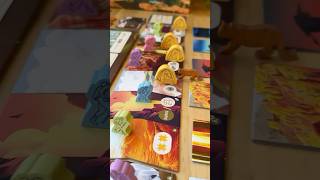
- Elevation and stacking — Tiles can be placed adjacent or stacked atop existing tiles, with elevation constraints that require stair-step progression.
- End-game and tie-breakers — Game ends after 20 turns; scoring includes tie-breakers by highest wildlife type and token counts.
- Keystone hexes — Certain tiles feature keystone hexes that reward a nature token when occupied.
- Nature tokens — Nature tokens can be spent to modify draws; at game end, remaining tokens are worth points.
- Scoring cards and lakes — Three habitat scoring cards (and optional environment cards) dictate scoring conditions for forest, meadow and glacier areas, lakes and wildlife elevation.
- tile drafting — Players select habitat tiles and wildlife tokens from a central pool, guiding environment development and scoring opportunities.
- Token Pairing — Wildlife tokens are placed on hexes that match icon requirements, with rules about placement, elevation changes, and keystone bonuses.
- variant rules — Family, intermediate, and solo variants adjust scoring, setup and end-game conditions; achievements and scenarios are available.
- wildlife token placement — Wildlife tokens are placed on hexes that match icon requirements, with rules about placement, elevation changes, and keystone bonuses.
Video topics + discussion points
Quotes (from this video)
- In Cascadia Alpine Lakes, you'll draft habitat tiles and wildlife tokens to build your own environment.
- You can spend as many nature tokens as you have.
- The game ends immediately, and you'll now proceed to scoring.
- These wildlife tokens act in the same way as if you've just placed them.
References (from this video)
- Accessible for all ages; simplified version of Cascadia
- Fast play (about 15-20 minutes)
- Enjoyable decision-making without extra complexity
- Artwork retains Cascadia quality while appealing to kids
- Randomized scoring helps balance play and allow younger players to lead
- Random scoring can undermine consistent skill-based reward
- Ceiling in complexity; not as deep as original Cascadia
- No nature tokens or varying scoring conditions beyond fixed patterns
- Tied scores can occur, potentially requiring luck or handicaps
- Nature and ecosystems
- Nature-inspired wildlife environment built on hex tiles
- procedural/abstract
- Cascadia
Mechanics (from transcript analysis)
- Compound Scoring — Back of annual cards shows specific patterns to match for extra tokens
- pattern-based scoring — Back of annual cards shows specific patterns to match for extra tokens
- randomized scoring tokens — Scoring tokens are worth 1 or 2 points, values determined randomly
- scoring by groups of three — Score immediately when you complete a group of three of the same terrain or animal
- tile placement — Place tiles into your environment to form groups
- tile-drafting — Draft one of two hexagonal domino tiles each turn
Video topics + discussion points
Quotes (from this video)
- This is a really fun decision-making space.
- this does a brilliant job of stripping the original Cascadia down into an accessible game for all ages
- it's a faster game
- randomized point value
- it's perfect perfect perfect for that
- shortness it's so cool to have a game that you can play in like 15 minutes
- perfect for introducing kids to board games
References (from this video)
- infinitely replayable
- smooth solo puzzle experience
- some variants can be contemplative and quiet
- ecology and biodiversity
- habitat-building with wildlife in a nature-focused ecosystem
- puzzle-driven, abstract
- Calico
Mechanics (from transcript analysis)
- set-collection/pattern scoring — score points based on adjacency and matching animal requirements.
- single-player puzzle — solving a deterministic solo variant with consistent challenges.
- tile drafting — select habitat tiles and animal tokens to build a cohesive habitat.
Video topics + discussion points
Quotes (from this video)
- I honestly can say that I enjoy playing solo more than I do multiplayer
- I freaking love Cascadia solo
- Hadrian's Wall is my number one solo game
- it's such a fantastic solo puzzle
- I am obsessed with the way that the solo variant works
- this is one of the crunchier Roll-and-Writes that I have
- I love the sister thing, it's fun
- I love to combo things in Castles of Burgundy
- it's so easy to implement a solo variant
- this is such a wonderful game it just brings me so much joy and comfort
References (from this video)
- Beautiful, highly polished prototype components
- Elevation and tile-stacking mechanic adds new strategic depth
- Lakes are strongly integrated and central to scoring decisions
- Multiple play variants (solo, family) and an optional expansion path
- Includes a mini-expansion feel that lets you play Cascadia components with Alpine Lakes
- Habitat-based scoring cards create clear, varied strategies
- Prototype is subject to change as noted by the presenter
- Only three habitat types may feel limiting vs. Cascadia’s original five for some players
- Increased complexity due to stacking, elevation, and new scoring layers could be intimidating for new players
- Precise placement rules (especially stacking) may slow down first plays until players internalize them
- habitat building and wildlife management with elevation stacking
- Northwest habitat with alpine lakes, elevation-based layouts
- procedural, instructional, demo-preview
- Cascadia
- Calico
- Knitting Circle
Mechanics (from transcript analysis)
- animal elevation scoring — Animals score based on the elevation of their highest presence. Ties are resolved by counting the next highest elevations, with potential share of points.
- Compound Scoring — Scoring pivots from animal-based scoring to habitat-focused scoring cards. These define how groups of habitats and their associated animals score at game end.
- environment scoring cards (advanced) — Optional environment scoring cards add new objectives across habitat, animal, and spatial dimensions to increase variety and replayability.
- habitat type limitation and lakes — This edition uses three habitat types (meadows, glaciers, forests) plus lakes, diverging from Cascadia’s original habitat count and integrating lakes as a core mechanic.
- habitat-based scoring cards — Scoring pivots from animal-based scoring to habitat-focused scoring cards. These define how groups of habitats and their associated animals score at game end.
- keystone and nature tokens — Certain placements on keystone icons grant nature tokens. Tokens can be spent to take extra actions or refresh wildlife, and unspent tokens grant end-game points.
- lakes elevation scoring — Lakes are scored by elevation levels. Surrounding lakes can double a lake’s score, adding strategic tiling and adjacency considerations.
- mini expansion compatibility — The set includes a mini expansion concept that enables Cascadia Alpine Lakes components to be used with the original Cascadia, enabling mixed-config games.
- nature tokens scoring — Nature tokens function as a point reservoir: each unspent token is worth 1 VP at the end, but tokens can also be spent to manipulate draws and placements during play.
- overpopulation rule — If three of the same animal type appear, a wipe-and-refresh action may be taken (limited to once per turn). If four of a kind appear, those tokens are immediately refreshed with new ones.
- start tiles and setup variants — Each player begins with a starting tile set and there are variants including family and solo play. Optional environment scoring cards can be added for extra objectives.
- tile drafting — On a turn you draft a set of two habitat tiles paired with an animal token (or use nature tokens) to begin your action, creating an incremental puzzle of placement and scoring potential.
- tile placement — Tiles can be placed on top of existing tiles under strict rules: must have a flat foundation, must leave room for animal placement, and must form a valid staircase progression as you build upward.
- tile placement with stacking — Tiles can be placed on top of existing tiles under strict rules: must have a flat foundation, must leave room for animal placement, and must form a valid staircase progression as you build upward.
- Token Pairing — After placing a tile, you place an animal token on a hex that displays that animal. If no valid space exists for that animal, the token is discarded.
- wildlife token placement — After placing a tile, you place an animal token on a hex that displays that animal. If no valid space exists for that animal, the token is discarded.
Video topics + discussion points
Quotes (from this video)
- This is Cascadia Alpine Lakes, which it is a standalone kind of next version of Cascadia.
- Elevation has come into play with this where you are going to be building up and out instead of just out.
- I am a huge fan of Cascadia. This has always been one of my comfort games.
- The lakes are a big part of the game.
- This edition includes a mini expansion feel that lets you play Cascadia components with Alpine Lakes.
References (from this video)
- accessible for families and new players
- beautiful components and relaxing feel
- great for groups with varied play styles
- scoring can feel opaque to new players
- solitaire-like scoring sheets may be fiddly for some
- ecology and habitat optimization
- Pacific Northwest habitats and wildlife
- nature simulation
Mechanics (from transcript analysis)
- Pattern Building — matching animal tokens to landscape patterns for scoring.
- pattern-building — matching animal tokens to landscape patterns for scoring.
- tile laying — placing habitat tiles to form a cohesive landscape.
- tile placement — placing habitat tiles to form a cohesive landscape.
Video topics + discussion points
Quotes (from this video)
- "Cascadia is a fantastic game"
- "Time's Up is such a fantastic game"
- "Lacrimosa is a great game Francis and I really enjoyed it"
- "Architects of the West Kingdom... I love this game"
- "Kid-friendly, cozy and cute, Creature Comforts is the cutest thing"
- "Thank you so much for including me in this Charity Auction"
References (from this video)
- beautiful production and components
- high replayability and accessible complexity
- flexible rules with scalable puzzle
- scoring can feel abstract to some players
- Eco-themed puzzle and tile drafting
- North American wildlife habitats
- Abstract, puzzle-driven
Mechanics (from transcript analysis)
- tile placement — place habitat tiles to form ecologies
- tile_drafting — draft terrain tiles and animal tokens for scoring
- tile_laying — place habitat tiles to form ecologies
- variable_rules — expansions or card sets alter scoring patterns
Video topics + discussion points
Quotes (from this video)
- It's a Space Opera you go in with your race
- the production is fantastic
- the best two-player game to win the YIS
- Cascadia is fantastic game, I love it
- Western Legends is the best Western game you can buy
- Undaunted Normandy or North Africa if you've played those a lot
References (from this video)
- beautiful production and calming, satisfying gameplay
- high replayability due to random tile/animal mix
- great for both family and hobby gamers
- not highly interactive between players
- eco-system optimization and biodiversity
- Pacific Northwest wildlife and habitats
- abstract puzzle with naturalistic pieces
- Meadow
- Wingspan
Mechanics (from transcript analysis)
- closed drafting — players select terrain tiles and animal tokens from a bag, building a personal ecosystem board
- open drafting — players select terrain tiles and animal tokens from a bag, building a personal ecosystem board
- tile placement — tiles are laid to form a coherent landscape while matching animal tokens for scoring criteria
Video topics + discussion points
Quotes (from this video)
- "tile placement and open market..., it's a smooth and perfect tile placement game"
- "Cascadia is a fantastic game that you can play with everyone"
- "endless winter paleo Americans is wide and thinky; a big, ambitious euro"
- "mind management is the best sort of one game you can buy"
- "production is insane—deluxe, beautiful components"
- "unsettled is a giant puzzle with every planet different"
- "Iki is a tremendous Euro game I absolutely love"
References (from this video)
- Cozy aesthetic with tight, bite-sized decisions
- Engaging hate-drafting in a friendly setting
- Some may find it abstract without animal/land motifs
- Tile drafting and wildlife/terrain objectives
- Pacific Northwest habitat
- Cozy, competitive tiling with hate-drafting flavor
- Carcassonne
- Cascadia
Mechanics (from transcript analysis)
- tile drafting — Draft tiles to form your personal map and wildlife tableau
Video topics + discussion points
Quotes (from this video)
- "Bonanza does a great job of putting that negotiation forward and creating more of a social interactive experience that I feel like Katan offers as a Euro game that is somewhat unique amongst Euro games today"
- "Katan by creating that social interaction the fluidity and the kind of non-scripted approach to that"
- "Sleeping Gods is an amazing experience very reminiscent of an open world game"
- "This is definitely a step up in complexity"
References (from this video)
- entra into lighter competition; easy to teach
- less heavy than top five
Mechanics (from transcript analysis)
- Tile drafting / tile placement — build habitat grids and place animal tokens for score
- tile placement — build habitat grids and place animal tokens for score
Video topics + discussion points
Quotes (from this video)
- Castles of Burgundy oh my goodness I love this game so much
- Cascadia is definitely one of the lighter of the bunch
- I would freaking love in the future to compete in this
References (from this video)
- simple core rules with deep strategic depth
- fantastic for teaching pattern recognition and spatial layout
- very accessible and quick to learn
- scoring can feel a bit abstract to newcomers
- some cycles can feel similar across games
- ecosystem balance, spatial strategy
- nature-themed habitat drafting and tile/pattern matching
- puzzle-like with ecological flavor
- Calico
- Isle of Cats
Mechanics (from transcript analysis)
- pattern drafting — players draft landscape tiles and animal tokens to form scoring patterns.
- tile/draft and placement optimization — placing tiles creates contiguous habitats that yield points via animals.
Video topics + discussion points
Quotes (from this video)
- It's subjective if you've not tried pu me4 ranking engine which presents two different options of games out of the list.
- The best racing game of that pure style; Heat pedal to the metal is a standout.
- This is one of those games that's easy to pick up and play but if you manage to get to grips with the action queuing you can get some really satisfying interactions.
- Terraforming Mars is a heavy game with a dense drafting layer but incredibly rewarding.
References (from this video)
- easy to teach
- low downtime
- great puzzle feel
- may rely on luck of tile order
- ecosystem building through tile drafting and wildlife tokens
- North American Pacific Northwest habitat
- abstract puzzle
- Above and Below
Mechanics (from transcript analysis)
- Pattern Building — connect similar habitats for bigger scores
- set collection — score for largest habitats and animal groups
- set collection / grouping — score for largest habitats and animal groups
- tile drafting — draft habitat tiles and animal tokens to place on your board
Video topics + discussion points
Quotes (from this video)
- the garden is growing
- spirit island is my number two
- near and far is my number one
- you are somebody's reason to smile
References (from this video)
- very easy to teach
- great solo puzzle
- accessible yet satisfying
- repetition in scoring objectives may feel similar over sessions
- ecosystem harmony and wildlife
- Pacific Northwest habitats
- puzzle-like habitat creation
- Isle of Cats
- Isle of Cats (tile-drafting comparison)
Mechanics (from transcript analysis)
- Compound Scoring — score via multiple objective cards with varied goals
- Scoring objectives — score via multiple objective cards with varied goals
- tile placement — place hex tiles to form habitats and unlock points
- token drafting — choose animal tokens and foods to complete habitats
Video topics + discussion points
Quotes (from this video)
- this solo variant is very much like that where Becky or Becca whatever the heck her name is you are just doing a few things back and forth with her
- the three different tracks you're going up and you're trying to bring all of these different rides into your park
- it's a really good like set collection game you're collecting different flowers and different bugs in order to gain some points
- i scored 50. so i don't know if i just scored it wrong but i was very proud of myself
- it's so easy at the table it's such a good puzzle
- i'm very excited to get cartographers and cartographers heroes to the table more
- this is one of my favorite solo games and i did play it in august
References (from this video)
- beautiful components
- great 'intro to nature games' with depth
- some might find it abstract
- weighty for absolute beginners
- ecology and rug patching
- northwest nature ecosystem
- engine-building with spatial placement
- Parks
- Wingspan
Mechanics (from transcript analysis)
- engine building — Gains via chained effects from placed tiles.
- tile placement — Place habitat tiles to build a landscape.
Video topics + discussion points
Quotes (from this video)
- Monopoly isn't a great game, but it's a game that everybody knows about.
- Non-gamers love Exploding Kittens.
- Code Names morphs and transforms based on the group that is playing it.
- Cascadia to me is one of the best introductions to nature games.
- Star Wars Deck Building Game is a dumb title. And what a great game.
- Deep Sea Adventure... you are going out from the submarine trying to get treasure and the oxygen runs out.
References (from this video)
- beautiful production and approachable
- easy to teach and accessible to families
- offers depth through variable scoring without punishing mistakes
- scoring map variability can feel opaque at first
- some players may seek more direct interaction
- habitat and wildlife harmony
- nature reserve / Pacific Northwest-inspired ecosystem
- calm, serene
Mechanics (from transcript analysis)
- set collection — collecting tiles and animals to score according to a scoring map that changes each game.
- tile drafting — players draft landscape and animal tiles to build their nature reserve.
Video topics + discussion points
Quotes (from this video)
- It's a pub friendly experience.
- Love that game. So simple, but so fun and infinite replayability.
- Cascadia is such a wonderful timeless design.
- Bag building game where you're going to be buying new ingredients for your potion, your cauldron.
- Bombbusters is another award winner from 2024.
- Azul, beautiful production.
- Ticket to Ride, the classic beginner game.
- Just One got limited communication word game where you're trying to work with the rest of the group trying to give clues to one person to decipher a word.