/pic1258597.jpg)
/pic5416481.jpg)
/pic3478320.jpg)
/pic1258597.jpg)












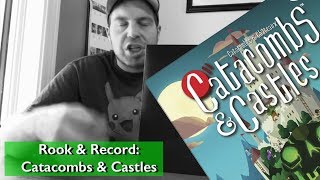

Catacombs Deep Dive
What the Community Thinks About Catacombs
Catacombs stands apart in the dexterity game genre as a title that has earned genuine respect from board game enthusiasts. Far from being dismissed as a mere flicking novelty, reviewers like Adam in Wales and The Cardboard Herald consistently praise it for achieving something rare: a dexterity mechanism that does not just feel tactile and satisfying, but genuinely serves the theme and conveys complex game concepts in intuitive, physical ways. The game manages to be both approachable fun and deeply strategic, with enough content between the base game and expansions to sustain many hours of play.
Core Mechanics That Define Catacombs
Disc Flicking and Physical Combat
At the heart of Catacombs lies the flicking mechanism, where players propel wooden discs across the board to attack enemies. Rather than rolling dice to resolve combat, you are literally performing the action you intend: if you want to shoot an arrow, you flick a disc. If you want your hero to move behind terrain for cover, you slide them into position. This directness creates an immersive connection between what you want to do and how you do it. Each character flicks their own disc, and contact with an enemy disc or board feature creates tactile, immediate consequences that feel earned rather than rolled.
Differentiated Disc Sizes and Roles
Catacombs employs discs of many different sizes to represent creatures of varying threat levels. Tiny pieces represent rats and snakes, mid-sized discs are standard heroes and monsters, and massive pieces represent dragons and other bosses. This scaling is more than cosmetic: it affects how discs move, how they stack, and how much damage they can take. There is even a humongous gelatinous cube piece with its own unique rules. The size variation makes combat feel thematic without needing elaborate rule explanations, since the physical heft of a piece communicates its danger.
The Catacombs Experience
Barrier-Based Tactical Depth
The game comes with a variety of different boards, each featuring large blocking pieces and pits that create tactical opportunities. These barriers are not just obstacles to navigate around; they define strategic positioning. Players use terrain to take cover, set up ambushes, and control sightlines. The physical board layout directly impacts whether a flick will succeed, creating a layer of spatial puzzle-solving that evolves throughout each room and rewards players who think about angles before they shoot.
Scenario-Driven Campaign Structure
Rather than a single endless game, Catacombs structures play around scenarios. Players work through a series of dungeons, each presenting different monsters and tactical challenges. Between dungeons, heroes can purchase upgrade items, weapons, and abilities, building up character power as they prepare to face big bosses. This progression creates investment and narrative momentum while providing the sheer amount of content that keeps the game fresh across many sessions.
What Makes Catacombs Stand Out
Thematic Integration Through Mechanics
Catacombs achieves something uncommon in dexterity games: tight thematic coherence. Casting a freezing spell leaves a frozen disc on the creature until it is knocked off. Hiding behind cover means moving your disc behind a pillar and using a one-inch marker to shoot around the corner. Traveling through open ground is dangerous because there is nothing to hide behind, making you vulnerable to being shot. These mechanical expressions of theme are intuitive enough that new players instantly understand them without lengthy explanation.
Asymmetric Roles and Special Powers
The game features an enormous variety of heroes, monsters, and bosses, each with different unique powers. Some pieces can shoot fireballs, others use area templates to damage opponents or move in special ways, and some can even teleport across the board. The Overseer, controlling the monsters, has fundamentally different goals and tools than the heroes, creating genuinely asymmetric gameplay that makes each playthrough distinct.
Potential Drawbacks
Skill-Dependent Success
Catacombs has a high degree of skill involved, particularly with precision flicking. Success often depends on the ability to control disc movement accurately. If you are not great at flicking, or if you simply do not enjoy the physical skill element, no amount of scenarios or variable powers will make the game fun for you. The enjoyment of the core mechanic is fundamental to enjoying Catacombs.
Learning Curve and Component Volume
The sheer amount of content between the base game and the various expansions can be overwhelming. New players face a learning curve not just in understanding the flicking mechanics, but in navigating the breadth of monsters, abilities, and special effects that different creatures bring to the table. Organizing and setting up the wide assortment of pieces also adds time before play begins.
If You Enjoy Catacombs
You might explore other dexterity games that share similar strengths. Flick 'em Up offers comparable physical gameplay with a Wild West theme, featuring cowboys who flick discs as movement tokens and tiny discs as bullets. Crokinole provides the satisfying precision of flicking discs on a highly polished surface with minimal resistance. Cube Quest uses light dice that players flick directly at opponents in a more chaotic but equally thematic battle experience.
What Reviewers Are Saying
"Catacombs is incredibly thematic and mind-blowingly clever. It is able to convey complex ideas that would normally take endless explanation in intuitive ways, merely by operating in physical space. Casting a freezing spell leaves the frozen disc on the creature until it is knocked off, making for one of the most imaginative dungeon crawl experiences."
— The Cardboard Herald
"Catacombs has heroes shooting different sized discs for ranged attacks. It is a really immersive thematic system. It is really satisfying to shoot a tiny disc at the enemy before flicking your hero disc behind some blocking terrain to take cover."
— Adam in Wales
"Catacombs players work through a series of dungeons, each with different monsters in them. They can purchase upgrade items, weapons and abilities between dungeons and build up to fighting big bosses. It is a massive, rich, immersive system."
— Adam in Wales