
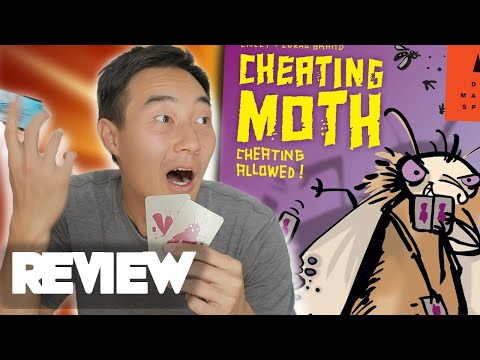
Cheating is forbidden? Not in this naughty game of cards – in fact, you'll probably have to cheat in order to win.
In Mogel Motte you want to get rid of all the cards in your hand before anyone else. Each player starts the round with a hand of eight cards, with one player (the oldest) receiving the guard bug – which stays on the table throughout the game – and one card being turnd face-up to start a discard pile. The cards are numbered 1-5, with the majority of them having only numbers; some cards have special abilities that come into play when added to the discard pile or in a player's hand.
On a turn, a player places one card from her hand onto the discard pile; that card must be numbered exactly one higher or lower than the card on top of the discard pile. (The numbers wrap, so a 1 can be played on a 5 and vice versa.) If a player can't play a card, she draws one from the deck and her turn ends.
There's another way to rid yourself of cards, though: cheating! Throughout the round, you can make cards disappear by dropping them on the floor, hiding them up your sleeve and so on. You must keep your hand of cards above the table at all times, you can't vanish more than one card at once, and you can't rid yourself of your final card this way. The player with the guard bug – and only him! – can call out other players for cheating, and no one can cheat while the accusation is being resolved. If the accusation was false, the Guard must draw a card; otherwise the cheating player takes back the card she tried to lose, is given a card from the Guard's hand as additional punishment, and becomes the new Guard.
Cheating is a necessity as the "Cheating Moth" cards can't be played onto the discard pile, but must be disappeared via cheating. (The Guard, however, can play these cards as the Guard is not allowed to cheat.)
The action cards work as follows:
Ant: After an ant is played, everyone but the active player must take a card from the draw pile.
Cockroach: After a cockroach is played, everyone races to play an identically-numbered card on top of it. Only the fastest player gets to leave her card in place.
Mosquito: After a mosquito is played, everyone but the active player must slap the pile of cards. Whoever is slowest receives a card from the hand of all other players.
Spider: After playing this, give a non-Cheating Moth card from your hand to another player.
When one player has no cards in hand, the round ends. All other players score 10 points for each Cheating Moth in hand, 5 points for each action card, and 1 point for each number card. After a number of rounds equal to the number of players, the game ends and the player with the lowest score wins.
Images


- Most fun and funny experience
- Pure fun, makes atmosphere electric
- Insane ways to get rid of cards
- Simplistic but engaging
- Simplistic
- Getting rid of cards secretly
- Uno
Mechanics (from transcript analysis)
- Hand Management — You literally get a hand of cards and you are trying to get rid of them in any way possible.
- Social Deduction — You're trying to secretly get rid of these cards so that no one else knows about it. And if someone notices it, the security person, that's a huge negative to you.
- Take That — You can get rid of your cards by throwing them across the room, by sitting on them by literally you could win the game by eating a card.
Video topics + discussion points
Quotes (from this video)
- After today, we are going to be halfway through the list and then the second half, the 50 to number one, my co-host Scott is going to join us.
- So, let's get through this one so we can get Scott here.
- Oh my goodness is it beautiful on the table.
- I love everything they've done from Honey Buzz to this game.
- I think I own every game they've ever published.
- Absolutely love everything they've done.
- Flamecraft Duel would have made my top 100.
- I think I might like it better than the base game, even though they play absolutely nothing alike.
- I cannot tell you the number of people that have told me that they have played this game, built their character, and then gone and taken that character into their RPG session and played it.
- I have not yet to play a bad Bruno Catala game.
- If you're able to take that train all the way to the end and ring the bell and get bonus points, that's such a fulfilling aspect.
- I just don't have the level of praise that I'm sure some of you do, but I think it is well deserving of the praise it gets.
- It's the reason I really enjoy Welcome to New Las Vegas because I really get to get into the puzzle of of building out your city.
- This has turned into my number one fun game.
- I cannot recommend it enough.
- Scott will be joining me to break it down with me as well.
- I'm so excited to see his top 50.
- Thank you for sticking with the series this long.
- There's plenty of great games to come.
- Please comment down below which of these 10 games was your favorite or which of these 10 games are you most excited to get to the table yourself?
- What sounded the most interesting to you?
- Be sure to hit the like button down below.
- Subscribe.
- We have so much more fun content coming for you.
References (from this video)

- Novel cheating-centric premise with strong group interaction
- Accessible card-based core that’s easy to teach
- High potential for creative, varied cheating scenarios
- Short playtime suits casual gatherings and repeat play
- Rule ambiguities beyond the four core cheating rules
- Scoring can feel imbalanced (large negative points for certain cards)
- New players may need extra help understanding the nuances
- Guard bug management can be stressful or fraught for some groups
- Array
- Casual social setting
- Humorous, chaotic
- Uno
- Munchkin
- Cosby Encounter
Mechanics (from transcript analysis)
- Card Play — Players place a card onto a central discard pile that must be one higher or lower than the previous card, driving the flow of the game.
- Environmental adaptability — Players must adapt cheating strategies to varying physical environments (table size, floor texture, lighting, seating arrangements).
- Guard bug / central moderator — A single guard bug tracks cheating actions and can reverse cheating by awarding a card, effectively becoming the new examiner.
- Sleight of hand / cheating — The central premise is to cheat in controlled ways to shed cards, with emphasis on deception and misdirection.
- Social bluffing / perception of tells — Players rely on tells, social engineering, and distraction to conceal cheating and identify others’ attempts.
- Special ability cards — Insects represented on cards provide special abilities that impact play (e.g., spider gives a card to another player, mosquito forces drawing, etc.).
Video topics + discussion points
Quotes (from this video)
- this game is about slide of hand and playing cards to a central discard pile
- Cheating moth thrives in chaos and all the trickery you want to do
- Uno where you win by cheating
- the cheating potential here is huge in variety
- short game under 15 minutes ... well under the projected 15 to 25 minutes
- you have to cheat, you must, you must cheat me
- the very concept of cheating outside of those four restrictions just makes this game such a breath of creative fresh air