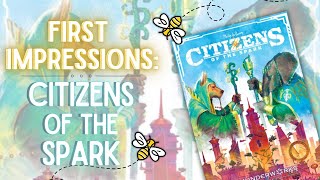






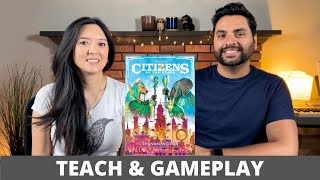
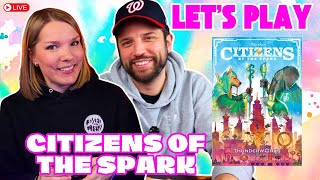
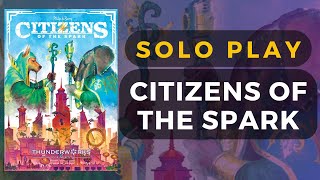
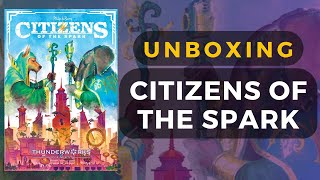


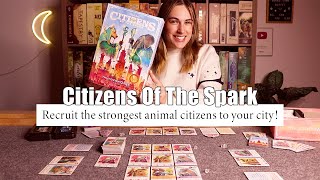


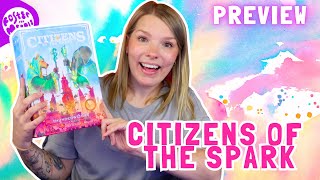
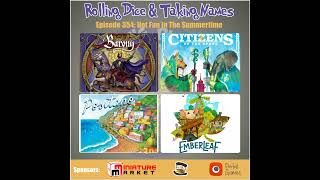
The fate of creatures touched by the spark of intelligence hangs in the balance. You must recruit strong animal allies to your city and unlock the potential of your citizens if your settlement is to survive the days to come...
Citizens of the Spark is a variable set-up card game in which players take turns attracting citizens, taking actions, and claiming sparks. The more citizen cards a player has of a specific type, the more powerful that citizen's action becomes. The player with the most sparks in their city when the deck runs out wins!
Play with 7-10 animal citizen types per game, chosen from 30 available creatures and combined into one shared deck. Every citizen type has distinct powers, making each game's action combos uniquely variable.
On your turn, recruit multiple citizens by selecting an available group of cards, placing them in your city tableau, and grouping like citizens together to grow their action strength. Next, select one type of citizen in your tableau to activate, taking the effect of the card and discarding it from your city. But keep watch on rival cities, because when you activate a citizen, all players can follow your move and activate a matching citizen of their own!
- Vibrant art; lots of variety; strong solo mode
- Complexity at higher player counts
- Citizen types; spark-based scoring; neighborhood interactions
- Anthropomorphic animal world; city-building dynamics
- City tableau with evolving factions
Mechanics (from transcript analysis)
- card drafting — Draft cards, activate animal-themed citizens to trigger actions
- card drafting and activation — Draft cards, activate animal-themed citizens to trigger actions
- neighbor interaction — Scores tied to neighbor city states and activated symbols
- Neighbor interaction and scoring — Scores tied to neighbor city states and activated symbols
- Variable factions and board interaction — Many factions with unique abilities; repeatable play with varied experiences
Video topics + discussion points
Quotes (from this video)
- Dimension is both a dexterity game. It's actually it's more of an abstract puzzle game than it is a dexterity game.
- Hookie is a really wonderful game where you are trying to figure out which three kids are playing hookie.
- Mystic Paths is pretty darn unique. It's a word association game. Cooperative.
- I love Village Rails. VILLAGE RAILS. GOSH, I love Village Rails.
- This is one of the biggest surprises for me, I think, ever in terms of like what I've found and loved it.
- Citizens of the Spark... I think this game is massively underrated for how good it is.
References (from this video)
- rich variability from distinct citizen powers
- strong solo-game potential due to procedural deck variety
- animal-theme is appealing and thematic
- recruiting and unlocking potential of animal citizens to thrive in a shared city
- A city-building setting inhabited by animal citizens touched by a spark of intelligence
- storytelling through evolving citizen powers and city development
Mechanics (from transcript analysis)
- Deck building — a shar deck composed of animal citizen types with distinct powers
- deck-building — a shar deck composed of animal citizen types with distinct powers
- Unique player powers — each citizen type provides unique action possibilities, creating different action combinations each game
- Variable Powers — each citizen type provides unique action possibilities, creating different action combinations each game
Video topics + discussion points
Quotes (from this video)
- The fate of creatures touched by the spark of intelligence hangs in the balance
- This is a flip and roll and scratch and stamp and whatever else you want to do and write
- open world Cooperative Adventure game even for solo
- windmill valley was a big hit for me Solo in 2024
- you start as a child and as such you will have limited sense of interest and skills that will determine your development
References (from this video)
- High level of player interaction due to the follow mechanic and shared activations
- Large faction variety (30 options) offers strong replayability
- Rulebook includes a guide for selecting factions to shape game type and length
- political influence, alliance-building, and tactical timing of actions via faction powers.
- A futuristic, faction-driven city-building scenario where rival groups vie for influence within a shared metropolis.
- mechanics-first with thematic flavor provided by faction abilities and city-building
Mechanics (from transcript analysis)
- card drafting — Players draft a row of faction cards each round, adding them to their city tableau and shaping future options.
- faction-powered activations — Activating a faction ability uses the power value scaled by how many cards you control for that faction.
- shared-follow mechanic — When a faction ability is activated, other players who possess the same faction card may also execute the ability, increasing interaction and strategic tension.
- stacking duplicates — Newly drafted duplicates are placed on top of existing faction cards, creating a stacked hierarchy of powers.
Video topics + discussion points
Quotes (from this video)
- Citizens of the Spark is juicy and fun.
- Whenever you activate a Faction ability, anybody else with a card of that faction can follow you and also do the ability.
- You draft a row of cards and add them to your city.
- Citizens of the Spark is on Kickstarter now.
References (from this video)
- High replayability due to large citizen card variety (30 types) and configurable setups
- Clear card layouts and organized components, including solo mode
- Fast playtime for a mid-weight game (about 45-60 minutes for 1-5 players)
- Multiple interaction levels and strategic options via citizen abilities
- Can be complex to learn due to many card abilities and interaction rules
- Some card effects can slow down play or feel punitive when targeting others
- Endgame scoring with outcast cards can be unforgiving if not managed
- civilization-building with city-building mechanics and a vertical progression of citizens
- An undeveloped planet named Farah where an ancient transmission awakens intelligent animal civilizations and sparks a race to build the single top city.
- story-driven, fable-like with cosmic interference
Mechanics (from transcript analysis)
- Action resolution with levels — Activating a citizen's ability depends on how many copies of that citizen you have, increasing level.
- card drafting — Players draft one of three rows of three cards per turn, adding chosen citizens to their city.
- Card drafting from rows — Players draft one of three rows of three cards per turn, adding chosen citizens to their city.
- City-building by citizen types — Citizens occupy columns by type; the number of cards in a city determines action levels.
- Deck draw and discard — Perform actions allow drawing from the deck; cards are discarded when finished.
- deck manipulation — Perform actions allow drawing from the deck; cards are discarded when finished.
- Endgame and Scoring — Final scoring tallies Sparks, card counts in city (one Spark per card), and any endgame scoring from specific citizens.
- Follow mechanics — Neighbors may follow an action if they have matching citizen cards, gaining Sparks and cards.
- hidden victory points — Sparks are the in-game currency used for scoring at the end.
- Sparks as victory points — Sparks are the in-game currency used for scoring at the end.
- Variable citizen pool — 30 different citizen cards; setup mixes and matches with presets for different game lengths and interaction levels.
Video topics + discussion points
Quotes (from this video)
- the Sparks which are the main kind of victory points for this game ultimately the person with the most Sparks at the end of the game is going to be the winner
- there are actually 30 different types of Citizen cards
- you are drafting one of the rows
- these cards will then be added to my city
References (from this video)
- strong art and component aesthetics
- 30 unique citizen cards with varied abilities
- interesting combinations and synergies between cards
- concept of Spark economy is engaging in theory
- randomization of which groups come out can limit meaningful choice
- often feels mechanical and lacks memorable plays
- lead/follow mechanic can be disengaging
- way Spark tokens are moved around can be fiddly and time-consuming
- end-game can drag if players prolong the run-out of cards
- Civic development and resource management centered on Spark tokens
- A city of anthropomorphic animals competing for influence and Spark tokens
- Scenario-driven citizen group drafting with evolving interactions
- Dominion
Mechanics (from transcript analysis)
- card abilities and interactions — Citizens have varied abilities, including copying actions, attacking or blocking, and synergy with other citizens.
- deck manipulation — A deck-based mechanism to reveal and add cards to groups; cards have top and bottom symbols that drive effects.
- deck-drawn action sequencing — A deck-based mechanism to reveal and add cards to groups; cards have top and bottom symbols that drive effects.
- end game bonuses — Game ends when the draw deck is depleted; points come from total Spark and the number of citizens, with end-game bonuses.
- end-of-game and scoring — Game ends when the draw deck is depleted; points come from total Spark and the number of citizens, with end-game bonuses.
- group drafting — On your turn you draft one of three citizen groups to your city, with optional actions and variable group sizes based on player count.
- set collection — Gaining Spark tokens by activating symbols on cards, then spending or collecting them for scoring.
- set-collection / spark economy — Gaining Spark tokens by activating symbols on cards, then spending or collecting them for scoring.
- token movement / fiddliness — Moving Spark tokens between groups and tracking values adds some administrative fiddliness.
Video topics + discussion points
Quotes (from this video)
- great card quality, good symbology
- This game has some interesting ideas to it.
- I love the concept of 30 different cards
- This is a six out of 10 for me.
- lead and follow mechanism, I didn't find to be particularly engaging.
- But a good product. I'm adding it to the dice library because I think people will enjoy it.
References (from this video)
- Accessible, quick setup
- Engaging solo mode with a straightforward AI
- Clear component affordances
- Endgame can swing dramatically due to bandits
- Theme is abstract; some players may want stronger narrative
- City-building with resource-based scoring around groups and symbols
- A city-building scenario centered on drafting and arranging citizen types to maximize sparks
- Abstract/mechanistic
Mechanics (from transcript analysis)
- drafting — Players pick from rows of cards to expand their city.
- endgame_scoring — Score based on citizen types, advisors, and remaining cards.
- Resource management — Sparks are gained and spent to trigger actions and score.
- resource_management — Sparks are gained and spent to trigger actions and score.
- set collection — Groups of citizen types yield bonuses and points.
- set/collection — Groups of citizen types yield bonuses and points.
- solo_opponent_interaction — A built-in solo deck acts as an opponent, following and scoring.
- tableau building — Construct a city tableau to manage actions and scoring.
- tableau_building — Construct a city tableau to manage actions and scoring.
Video topics + discussion points
Quotes (from this video)
- I'm going to teach the rules as I go, just like I always do.
- That is setup complete.
- Wow, so many outcasts.
- I think we're going to be doing some heavy duty ranching here.
- There you have it. That was a complete solo game of Citizens of the Spark.
- Thank you so much for watching and goodbye.
References (from this video)
- beautiful art with striking inverted colors
- fast, scalable, and replayable across player counts
- learning curve for new players; rules can be fiddly at first
- tableau-building and faction synergy
- inverted-color city tableau with citizen categories
- playful, theme-forward drafting
- Seven Wonders
Mechanics (from transcript analysis)
- follow actions — If a citizen in your town matches an activated action, others can participate and gain value.
- row drafting — Draft a row of 3-4 cards from a set; remaining rows score later via spark tokens.
- Set collection and scoring — Assembled citizens form sets; sparks determine end-game scoring.
Video topics + discussion points
Quotes (from this video)
- This is a fighting game. If you ever played Street Fighter, this is basically that in card form.
- I would not break this out as a casual game.
References (from this video)
- Designer with strong recent output
- Variable character combinations each game
- Entwined drafting mechanic
- Strong production quality
- Limited information
- character archetypes
- fantasy
Mechanics (from transcript analysis)
Video topics + discussion points
Quotes (from this video)
- I'm not here to talk about that I'm here to talk about games
- catch-up games has been on fire
- I love his Cooperative design sensibilities
- how does this game not already exist
- I want more games that tell in 2025 a positive story about how we can work in unison with nature
- 2025 might be the year of co-ops
- pure Feld simple Elegance that leads to deep challenging decisions
- Coming of age is by far my number one most anticipated game
References (from this video)
- Vibrant variability due to many factions
- Tiger faction provides cat-theme alignment and distinct playstyle
- Requires using a specific faction to be truly cat-themed, which may limit who enjoys it
- Complexity may be off-putting to casual players
- animal city-building with tiger as a distinctive cat-aligned faction
- A city-building tableau with animal factions vying for influence and sparks as a resource.
- colorful, high-variability, faction-driven play
- Calico
- Citizens of the Spark (self-reflexive)
Mechanics (from transcript analysis)
- faction-driven engine / city-building — Recruit various animals to your city and trigger their abilities based on counts of each type to generate sparks.
- variable setup / high replayability — Multiple factions create diverse playstyles and keep variability high each game.
Video topics + discussion points
Quotes (from this video)
- This is an essential cat game.
- This is a cat game because cats and kittens boop on beds.
- Calico is an extreme puzzle brain burn kind of game.
- You are making quilts to appease the cats.
References (from this video)
- massive variety (35+ cards, many animals/types)
- highly interactive and dynamic
- starter guidance via play-pack rules and suggested setups
- heavy variability can be overwhelming
- learning curve with many card interactions
- city-building through animal types
- animal world with depots and sparks
- interactive, strategic
- Everdell
- Dwellings
Mechanics (from transcript analysis)
- depots/draft-to-activate — on your turn, you draft a depot of cards and activate a type to gain Spark points.
- player interaction — orange 'mean' cards can affect other players; some cards trigger endgame scoring.
- Positive player interaction — orange 'mean' cards can affect other players; some cards trigger endgame scoring.
- tableau building — activate all copies of a chosen type; you manage a tableau to maximize spark generation.
- tableau-building — activate all copies of a chosen type; you manage a tableau to maximize spark generation.
Video topics + discussion points
Quotes (from this video)
- This is the perfect kind of game to play like late in the evening with maybe some people who aren't into like super heavy games.
- I played it 80 times as a result.
- Moon Colony Blood Bath. Try and think of a crazier name. You can't.
References (from this video)
- infinite replayability due to thousands of card combinations
- deep, flexible engine-building and scoring
- strong components and artwork; rulebook is clear
- accessible entry point with potential for complex setups
- learning curve can be steep; recommended setups help new players
- risk of analysis paralysis with many options
- set collection and engine building with vast card synergies
- anthropomorphic animals in a city-building / engine-building setting
- grand strategic, modular and highly combinatorial
- Puerto Rico
- Power Grid
- Castle Combo
Mechanics (from transcript analysis)
- Drafting and tableau building — Group drafting selects rows of cards to add to your personal tableau.
- duplicate stacking — Taking duplicate cards stacks powers, increasing their potency.
- endgame threshold with extended play — Game ends when a scoring threshold is reached, then one final round determines the winner.
- Engine Building: Triggered/Cascading — Trigger powers when cards are activated and when opponents have matching suits on their cards.
- Stacking and Balancing — Taking duplicate cards stacks powers, increasing their potency.
- trigger chaining — Trigger powers when cards are activated and when opponents have matching suits on their cards.
Video topics + discussion points
Quotes (from this video)
- pretty slick and smooth game. Definitely elegant in its nature.
- I prefer these shedding games where every single decision matters.
- I think this is going to be a huge hit for 2025
- Citizens of the Spark is the engine-building tableau-building card game.
- this is exactly the kind of game that I like because there's infinite replayability
- the sky is the limit with Citizens of the Spark
- I can't remember which one's which, but one suit will let you draw more cards
- it's fast at least. It scales relatively well.
References (from this video)
- very engaging and minimizes downtime
- high replayability due to many factions
- larger box size can be less portable
- complexity may deter casual players
- competitive faction powers with minimal downtime
- faction-driven sci-fi card drafting
- engaged, interactive drafting
Mechanics (from transcript analysis)
- faction powers — activating powers that scale with more cards of the same faction
- no downtime drafting — pass-and-play style turns keep all players involved
- set/activation synergy — activate powers that affect multiple players if they have identical factions
Video topics + discussion points
Quotes (from this video)
- This is just you're playing cards onto lanes and you are trying to out clever your opponent.
- I travel a lot both to comedy clubs and board game conventions and card games are just really portable.
- It's all about finding cool card combos, finding synergies between the cards you play.
- I did not care about this game when I heard about it. And then I played it... this game is way more fun, way more thinky and strategic than I expected it to be.
- There are 30 different faction decks in the box. Each round, you only play with 10 factions.
- no downtime in Citizens of the Spark, you're always involved.
References (from this video)
- engaging engine-builder feel with minimal downtime
- high variability and replayability due to many citizen types and setups
- beautiful, colorful artwork and thematic components
- strong player interaction via action-follow mechanics and combat-like steals
- flexible setups catering to different player counts and play styles
- clear teaching path with a compact, understandable rules approach on video
- potential downtime for players to observe others' actions and plan follows
- a moderate-to-high rule density for new players despite approachable teaching
- randomized citizen decks can introduce variability that may complicate optimal planning
- Guild-like factions and neighborhood interactions with a spark economy driving victory points.
- A variable-setup card city-builder where players attract citizens, perform actions, and vie for sparks in a shared, evolving city.
- Procedural and emergent narrative shaped by citizen cards and the order of activations.
Mechanics (from transcript analysis)
- action_following — Other players may follow your action if they own a copy of the activating citizen; followers discard after use.
- attack_and_snatch — Bandit-type citizens grant attack actions to steal Sparks from opponents under certain conditions.
- card_background_cues — Different card backgrounds (white, orange, pink) indicate normal, attack, and ability actions with triggers.
- endgame_scoring — Game ends when the citizen deck runs out; scoring totals Sparks, city populace, and any end-game scoring citizens.
- stacked_activation — Activating a citizen is based on the size of the stack you choose; larger stacks grant stronger actions.
- variable_setup — At game start you select groups of citizen cards to form your city, creating unique starting conditions each game.
Video topics + discussion points
Quotes (from this video)
- Citizens of the Spark is a variable setup card game where players take turns attracting citizens taking actions and claiming Sparks
- Sparks are victory points
- Look how pretty and sparkly we have ones we have fives we have tens and 25s
- If you enjoy a good engine builder with a minimal downtime this game could be a fit for you
- you should definitely check this out
- engine builder with tactical, minimal downtime and lots of variability
References (from this video)
- High interaction and engine-building depth
- Good variability with citizen cards
- Accessible for families while offering strategic depth
- Can feel chaotic with higher player counts
- Theme and flavor may not appeal to everyone
- co-op/open drafting with set-collection and strategy
- a city-state populated by citizens with sparks as a resource
- interactive civic management with bandit-triggered effects
Mechanics (from transcript analysis)
- bandit/lead-player activation — the lead player picks an action others may follow; turns circulate around the table
- multi-player interaction — steal, trade, flip or discard to disrupt others' engines
- open drafting — draft citizens to build an engine and score points
- set collection / sparks — activate cards to generate sparks and end-game scoring bonuses
Video topics + discussion points
Quotes (from this video)
- The card play of this game was a lot of fun.
- I wish the momentum would pick up.
- This is a really clever card game.
- The art on this box is absolutely stunning.
References (from this video)
Mechanics (from transcript analysis)
Video topics + discussion points
Quotes (from this video)
- it's been a Bonkers year in general
- we are going to do kind of like a bit of a bigger wrap up
- Jamie is an incredibly talented human being in multiple facets
- we've found a studio space
- I'm tired we're just so tired I'm tired all the time
- please say hi
- we might miss a video or two because of travel
- this is the best outcome I think long term
- we're transitioning a little bit into this becoming you know a bigger part of Jam's professional career
- Jamie will stress her mental and physical health out to put a video out
References (from this video)
- Beautiful card art
- High variability in play
- Rich theme and flavor
- tableau-building and character synergies
- fantasy city/empire with a steampunk vibe
- varied, with modular goals
Mechanics (from transcript analysis)
- tableau building — Players curate a tableau of cards to generate resources and points while triggering combos.
- tableau-building — Players curate a tableau of cards to generate resources and points while triggering combos.
Video topics + discussion points
Quotes (from this video)
- Posture is important and these have great ergonomical backs.
- This is their biggest sale of the year, so grab yours while it lasts.
- If you've never been to a convention before, I recommend that you go because they're super fun and there's so many to choose from.
- Let's just learn as we go.
- It's a two-player exclusively for the most part.