/pic4223934.jpg)

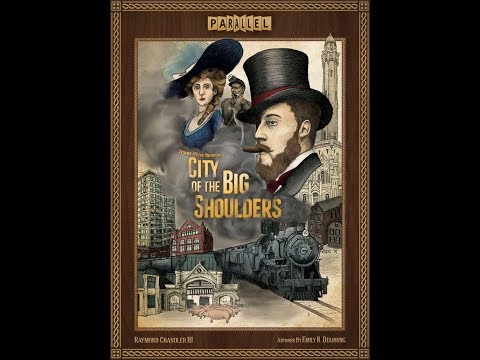
















City of the Big Shoulders Deep Dive
What the Community Thinks About City of the Big Shoulders
City of the Big Shoulders lands in a special niche within the heavy economic simulation genre. Reviewers consistently praise its mechanical depth and thematic authenticity, celebrating a game that nails the tension of navigating Chicago's industrial boom while punishing indecision and rewarding clever financial maneuvering. Board to Death TV highlight the spatial tactics and racing feeling, Getting Games singles out the shared-building drafting, and Chairman of the Board respects the design even while flagging its demanding length. The published Parallel Games title sits as a respected but time-hungry entry for dedicated euro players.
Core Mechanics That Define City of the Big Shoulders
The Stock Market as Strategic Backbone
The game's stock system mirrors 18xx games, where players buy, hold, and sell company shares to accumulate wealth. What makes City of the Big Shoulders distinctive is the interplay between personal investment and corporate operation. You start by choosing a company and setting its initial stock price, then must balance your own shareholdings against the need to invest in other players' companies for dividends. Selling stocks lowers their value, creating a tension between cashing out early and riding winners. Board to Death TV note the sense of racing for the top spots as you monitor both your portfolio and which companies are producing, making stock management an underrated but critical lever.
Worker Placement on Dynamic Action Spaces
Each era, players draft building tiles from their hands and place them onto their company tracks, creating new worker placement spaces for the action phase. A unique wrinkle: any player can use another player's buildings by paying a fee to that player's company, meaning your construction decisions ripple across the entire table. The action phase unfolds with variable turn order, forcing players to consider not just where they place workers, but when. Building tiles evolve across eras with new, more powerful effects, preventing the game from feeling repetitive despite its five-round structure. This system gives the game a sense of spatial control and meaningful tactical positioning.
The City of the Big Shoulders Experience
A Satisfying Economic Engine in Motion
Once you grasp the operating phase, the game delivers genuine satisfaction as companies run their factories, purchase resources, activate assets, and sell goods to generate income and rise on the stock track. Players invest in hiring workers, acquiring assets, and building production chains that pay dividends. The dividends themselves trigger stock movement, single, double, or triple jumps depending on profitability, creating a visible climb toward victory. Board to Death TV emphasize the resource management and the racing feeling as you compete for position on the money track. The interplay between external pressures and personal greed generates natural narrative tension at the table.
Thematic Depth and Historical Authenticity
The game grounds itself in the real history of industrial Chicago after the Great Fire of 1871. Each company in the base game carries historical flavor with distinct rules and asymmetries, meaning a game built around manufacturing plays differently from one centered on transport. The theme is not mere window dressing; it is woven into the mechanics. Reviewers appreciated the component quality and clear iconography, with a minor caveat about color confusion between manager and salesman tokens, and noted that the expansion adds new companies with special rules that further deepen the asymmetry and replayability.
What Makes City of the Big Shoulders Stand Out
Depth and Replayability Through Company Asymmetry
The base game includes a roster of distinct companies, each with unique mechanics that shape how you operate. The expansion adds more, each with quirky special rules. This design choice means that a session with one company constellation plays fundamentally differently from another, preventing the game from settling into predictable patterns. Building tiles evolve across eras with new powerful spaces, alleviating the potential repetitiveness of a five-round structure. Board to Death TV call the sheer amount of tactics and strategy available impressive, noting that decisions about when to start a new company, when to buy or sell stock, where to place workers, and turn order positioning all matter immensely.
Heavy Euro Credibility and Mechanical Elegance
For fans of economic simulations and engine builders, City of the Big Shoulders delivers the mechanical complexity and decision space they crave. The game offers the worker placement and area majority mechanics expected from the genre, but ties them together with a stock market that feels consequential rather than bolted-on. Reviewers noted the game's ability to sustain depth without becoming fiddly in execution: the rules are learnable, the board state is transparent, and the economic logic flows clearly once you understand the flow of phases.
Potential Drawbacks
A Grueling Time Commitment
The game's Achilles heel is length. Chairman of the Board reported a five-hour play with teaching, describing it as completely unforgivable for their personal preferences and noting they lost interest in playing again as a result. For a heavy euro, City of the Big Shoulders sits on the longer end of the spectrum, and if you have a table that moves slowly or enjoys exploring every option, you can easily breach the four to five hour mark. This is not a flaw in design so much as a reality: a game with this much economic simulation demands time.
Complexity and Teach Burden
The rule density is genuine. The game has multiple phases per round, several company operations to track, a stock market with value tracks, and dozens of action spaces to navigate. Teaching it requires patience and clarity. While a thorough walkthrough makes it digestible, new players need time to internalize how everything connects. The asymmetric companies add replayability but also initial cognitive load for explaining how each one operates.
If You Enjoy City of the Big Shoulders
You will likely gravitate toward the 18xx family, especially 1846: The Race for the Midwest, which shares the stock market and operation DNA. Brass: Lancashire and Brass: Birmingham offer similar economic tension with networked building and shared resource competition. For engine-building with stock elements, Furnace provides comparable strategic depth in a lighter package. If you prefer lighter economic games with stock systems, Airlines Europe offers streamlined area majority and shareholding without the 18xx complexity. Any game from the Martin Wallace catalog, such as Age of Industry, will feel thematically kindred.
What Reviewers Are Saying
"There's a lot of tactics and strategies available for the players, including when to start a new company to compete with another, when to buy stocks and more importantly when to sell stocks, which was overlooked in the game. Where to place your partners in the available action spaces. Turn order is extremely important in all these decisions. I like the resource management of the game and the sense of racing for the top spots."
— Board to Death TV
"There's so much going on that I genuinely forgot a small part of it involves putting down these tiles that everybody can use, and I really like that part of the game. You were picking these options from your hand and putting them out there and kind of building out those actions. I thought that was a super cool part of City of the Big Shoulders."
— Getting Games
"It's a heavy complex economic simulation style game where you're trying to take control of these companies, you're investing in other players' companies, increasing the production of these companies in order to get your share of the dividends. There's a lot going on here. But why is this at the bottom? It is way too long. This took us over five hours to play with a teach, and that for me is completely unforgivable."
— Chairman of the Board