/pic6683729.jpg)











































Cloudspire Deep Dive
What the Community Thinks About Cloudspire
Reviewers agree almost without exception that Cloudspire is a production spectacle and a genuinely deep tower-defense MOBA, and disagree sharply about whether the competitive side of the game is worth the trouble it takes to learn. No Pun Included called the finished product "absolutely ridiculous," loved the solo and cooperative scenarios, and concluded flatly that the head-to-head mode is not worth recommending to most people. Board Games UnLocked, playing from a review copy Chip Theory Games sent them, landed in a similar place from a different angle: once one player understands their faction faster than the other, a match can feel wildly unbalanced, and the channel compared teaching it to teaching Root, something neither host wants to inflict on a casual guest. BoardGameCo took the opposite emotional stance, calling Cloudspire a masterpiece even while explaining why it was leaving their own collection. Brains On Games, also working from a publisher-provided copy that included the Harbinger expansion, focused on how much game there is to work through rather than on the competitive-versus-cooperative split. Game Night Picks found the rulebook well written on the page but still spent more of its first session flipping through rules than moving pieces, and Cloudspire's own asymmetry between factions is exactly what both 3 Minute Board Games and Board Games UnLocked pointed to as the game's sharpest edge, for better and for worse.
Core Mechanics That Define Cloudspire
Asymmetric Factions and Three Unit Types
Every faction in Cloudspire runs on its own toolkit rather than a shared rulebook with reskinned pieces. 3 Minute Board Games broke the units down into three categories: heroes who move independently, minions who advance along pre-programmed paths, and spires that never move at all, each carrying health, damage, speed, recruit cost, and unique special abilities on double-sided chips. Board Games UnLocked emphasized just how far that asymmetry goes, ranking the game's factions from least to most complex and noting that one faction alone, the Narora, has what the hosts called a million different units to track. No Pun Included highlighted a related wrinkle: units can be stacked, with one placed underneath another to protect it, and when the top unit finally dies the hidden one underneath is revealed at full health, changing the shape of a fight in an instant.
Waves, Source, and the Event Deck
A game unfolds across four waves, and No Pun Included laid out the phase structure precisely: each wave runs through event, income, market, build, prep, and onslaught phases, with players spending source on the market and on fortress upgrades before recruiting minions and heroes with command points. 3 Minute Board Games described the round more mechanically, noting that source income rises from five on the first turn to eleven by the fourth, funding both mercenary recruitment and spire construction. Combat resolves differently depending on what is attacking: Game Night Picks pointed out that units deal a fixed amount of damage equal to their attack power, while spires instead roll dice equal to their attack power, so the results vary. Board Games UnLocked spent real time comparing spire placement strategies, contrasting a defensive approach of keeping spires close to the gate against pushing them further out to contest ground before an opponent's units ever arrive.
The Cloudspire Experience
A Tower Defense MOBA With Real Weight
Game Night Picks summed up the fantasy the game is chasing directly, saying it made them feel like they were playing the tabletop version of something like Warcraft 3. Brains On Games echoed that video-game lineage, describing Cloudspire as feeling a lot like the tower-defense and battler games their son plays, right down to upgrading a base and upgrading characters between fights. No Pun Included framed the tactical texture of a match as closer to a hexagonal chess puzzle than a typical war game, since minions must advance toward their target even when that forces an awkward path, and skilled play comes from bending that restriction rather than escaping it.
Two Very Different Games Under One Box
The competitive and cooperative sides of Cloudspire play almost like separate products. No Pun Included described teaching the competitive rules to a partner and getting no laughter roughly eighty-five percent of the way through the explanation, then losing the first match after getting close to a third of the rules wrong, yet still wanted to return specifically for the solo puzzles once the event deck and head-to-head clutter were stripped away. BoardGameCo drew the opposite conclusion about where the game's satisfaction actually lives, saying that building up an army in Cloudspire never felt as rewarding as the character progression in Too Many Bones or Elder Scrolls, even while insisting the game itself is a masterpiece.
What Makes Cloudspire Stand Out
Production That Reviewers Keep Returning To
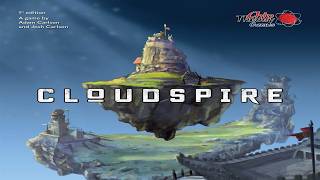
Almost every source singled out the components before anything else. 3 Minute Board Games called the production values "through the roof," specifically praising the weight of the poker chips used to track health and upgrades. Game Night Picks agreed the neoprene player mats and map tiles "immediately capture everyone's attention," noting that people not even playing the game stopped to admire them. No Pun Included went further, describing the whole box as built from plastic, neoprene, and "yours and mine favorite plastic," calling it the first board game to offer neoprene-on-neoprene play.
Scenario Depth and Replayability
No Pun Included tallied the scope of the solo and cooperative content directly: sixteen solo scenarios across the base four factions, twenty once the fifth faction is counted, plus ten cooperative scenarios, for a total of thirty different games inside one box. Brains On Games, working through the Harbinger expansion on top of the base game, said there is so much content that a player could spend a month with Cloudspire and still not see everything it offers, pointing to the eight additional solo missions Harbinger adds as an example of how deep that well goes.
Potential Drawbacks
A Steep, Cluttered Learning Curve
Nearly every reviewer flagged how much has to be absorbed before a first game runs smoothly. Game Night Picks estimated that about sixty-five percent of their first session was spent referencing the rulebook rather than actually playing, and singled out unresolved edge cases around movement and retaliation that the group had to settle by house-rule vote. Board Games UnLocked wished the factions carried a built-in complexity rating so a new player would not be handed the hardest faction in the box by accident, and No Pun Included compared the whole endeavor to an elephant riding a bicycle, arguing that the appeal of outsmarting an opponent gets buried under so much special-case clutter that most players will never fully surface it.
Randomness and Imbalance in Head-to-Head Play
The event deck drew particular criticism. No Pun Included described its swings as inconsistent to the point of unfairness, saying a single card can be so mild it barely matters or so drastic that a player might as well concede on the spot. Board Games UnLocked raised a related concern about the competitive mode specifically, arguing that once one player grasps their faction's abilities faster than the other, the game can snowball into something that feels wildly unbalanced rather than genuinely competitive.
If You Enjoy Cloudspire
Board Games UnLocked has played Cloudspire alongside two other tabletop takes on the MOBA genre, Onward and Guards of Atlantis, and also pointed to Too Many Bones as the Chip Theory Games release they would rather bring to the table when they want that publisher's depth without Cloudspire's competitive friction. BoardGameCo made the same comparison from the other direction, keeping Too Many Bones and Elder Scrolls in their collection over Cloudspire specifically because those games deliver character progression that felt more satisfying to them. For a different kind of tower-defense fan, 3 Minute Board Games recommended Dawn of the Zeds to anyone drawn to the idea of defending against swarms of attackers, and suggested Captain is Dead or Dangerous Planet to players who like the concept but want something considerably simpler.
What Reviewers Are Saying
"Since you start each game clean from the beginning, there's more strategies and secrets to discover here than in your creepy aunts loft. This is just a treasure trove full of ideas, and you can't wait to dive in."
— No Pun Included
"Cloudspire is not a cheap game, but its production values are through the roof. In particular the poker chips are weighty and feel wonderful to play with. Cloudspire is for people who want an intensely competitive and mentally challenging chess match of a game."
— 3 Minute Board Games
"It's a game you can truly master if you have the time, if you have the attention. Cloudspire is an absolute masterpiece of a game. I I do not use that word lightly."
— BoardGameCo