/pic3466068.jpg)
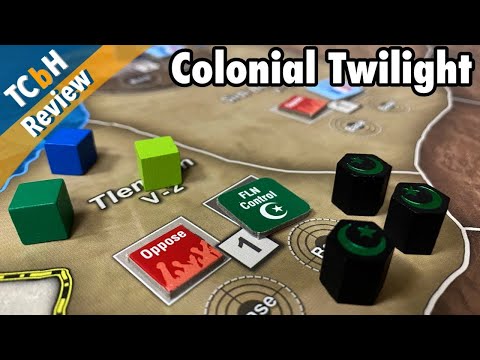
Colonial Twilight takes 1 to 2 players into the tangled web of military and political actions comprising the French-Algerian war of 1954-62.
The insurgent Front de Liberation Nationale (FLN), starting from modest beginnings, must build massive and enduring popular support for its cause and organize to assume power when Algeria finally gains its independence. The Government, representing both the colonial authorities and France’s military leadership, must engage the nationalist insurgency decisively while striving to preserve the support and commitment of the civilian government and society. Players will enter the “heart of darkness” as they use military, political, and economic actions and exploit events to build and maneuver forces to influence or control the population or otherwise achieve their aims along the twisting route to independence.
This installment in GMT’s popular COIN Series system is the first to be designed for two players. You must carefully consider just what it is you want to do, and how much of it, before the initiative slips from your fingers.
It also includes rules for a solitaire FLN bot AI opponent. (There is no French bot, so the only solitaire option is for the human to play as the government against the insurgent bot.)
From the Casbah to the Aures, are you ready to run the gauntlet?

- Opportunity to learn about an unknown historical period
- Not a beginner game
- Historical simulation
- Historical conflict (specific era not detailed)
Mechanics (from transcript analysis)
- COIN (COunter-INSurgency) series — Mentioned as a two-player COIN game.
Video topics + discussion points
Quotes (from this video)
- to me that was a very simple game easy to learn but kind of recreated what really happened during that time
- if y'all ever seen a GMT rule book They're they're not pretty books with glossy pages and big images and very few words per page they're double column they're they're numbered almost like a contract a legal document that's just how they're formatted
- it's basically the conflict between uh uh basically the US and and that region of the world between China and us trying to influence and control that area
- this is coming from somebody who complained I did a 45 minute history lesson on Cuba Libra when I taught it to you
- I knew nothing about how Castro took over CU I I knew he did it how he did it and why I don't know but playing that game three or four times now I have a I'm not a master by any means but I have a much better understanding of what really happened during that time
- I am learning about stuff that happened during the Vietnam war knew nothing about super excited as I play through this game learning about that
- you do learn as you're playing the game how the forces had to build towards that final battle of waterl you learn the players that took place
- yes I have that one I've never play amazing historical game from Marton Wallace yes I had some Muro stuff in it but I actually learned a lot about that from Lincoln
- we got access and allies coming up talking about jumping to the deep end we'll jump straight into that
References (from this video)

Mechanics (from transcript analysis)
Video topics + discussion points
Quotes (from this video)
- clash of giants civil war battle of gettysburg it's lee's greatest victory but also his greatest defeat
- not be a typical rules tutorial from this channel
- we're going to learn how to play cuba libra together
- grab your favorite beverage get comfortable and let's go on an adventure
- this could take a while
References (from this video)
- Compact map and approachable entry into coin-style games
- Clear thematic tie-in with colonial history
- NPC needs can be awkward with lower player counts
- Rulebook dense and exacting
- Colonial politics, influence, and economic power plays
- Late 18th- to early 19th-century colonial conflicts; two-player strategic focus
- Historically flavored strategy with asymmetrical goals
- Cuba Libre
- Fort Sumter
Mechanics (from transcript analysis)
- area control and resource management — Control spaces to gain resources and victory points.
- Card-driven actions — Event cards drive actions and progress.
- Two-player asymmetry — Sides have distinct goals and actions that shape play every turn.
Video topics + discussion points
Quotes (from this video)
- production is absolutely top-notch
- hot for teacher
- the event deck and the action selection mechanic
- this is the core of all the coin games I've played
- we're all about games here that tell stories
- do not be intimidated by this game
References (from this video)
- Dense, nuanced, and thematically integrated design
- Clever and satisfying action selection mechanics
- Strong solo play support with a guided automation option
- Covert operations and shadow mechanics add meaningful depth
- Rulebook clarity and tutorial structure help with learning the system
- Steep learning curve requiring frequent rule reference
- The event deck can feel rigid or unpredictable, depending on the play session
- Solo automation flowcharts can be overwhelming at first and require time to master
- Towering complexity may deter casual players seeking lighter experiences
- colonialism, counterinsurgency, local populations, foreign occupation
- mid-20th century French Algeria during the Algerian War of Independence
- asymmetric, event-driven historical simulation with thematic tension
Mechanics (from transcript analysis)
- action grid with priority ordering — The first player selects an action in a grid; the second player must choose an action adjacent to that selection, with color coding indicating overall capability for the round.
- control of round events — Each round flips an event card that drives round-specific effects and determines immediate pressures on both sides.
- covert operations via face-down units — Factions can use face-down units (shadow warriors) to perform covert operations and potentially flip the balance of power without exposing overt force.
- gang/organization mechanics and resource management — Gorilla units (FLN) have face-up and face-down states that affect combat, resource gathering, and covert options, creating a layered decision space.
- major/minor operations — Actions in a round rely on a repertoire of major or minor operations available to each faction, shaping resource production and territorial influence.
- propaganda and upkeep cycle — Propaganda cards trigger victory checks and upkeep, creating a pacing mechanic that rewards strategic timing and long-term planning.
- Resource Management — Gorilla units (FLN) have face-up and face-down states that affect combat, resource gathering, and covert options, creating a layered decision space.
- solo/automated play with flowcharts — A dedicated automated FLN mode exists for solo play, accompanied by a detailed flowchart that guides the single-player experience.
Video topics + discussion points
Quotes (from this video)
- it's one of the crunchier more nuanced games i've played
- the vent deck felt to me like the most rigid aspect of the game
- diving into colonial twilight has been such a rewarding experience
- the rule books are well laid out and the tutorial is structured and effectively carries you through learning the game
- you can flip them face up to participate in combat or gather resources but face down these are shadow warriors who can perform covert operations
- i preferred the single player as both sides method of play over the automated fln since it reduced both complexity and pressure and felt like i was a third party facilitating a story with tense and dynamic interactions
- meticulously crafted dutifully thematic and beautifully albeit modestly presented colonial twilight has only deepened my fascination with the coin series
References (from this video)

- historical texture
- clear COIN mechanics
- potentially dense for new players
- insurgency and counterinsurgency with historical framing
- colonial era conflicts in Africa/colonial theaters
- historical strategy with COIN sensibilities
- Cuba Libre
- Spirit Island
Mechanics (from transcript analysis)
- COIN-style multi-scenario play — branching scenarios with evolving strategic goals
Video topics + discussion points
Quotes (from this video)
- it's a net extreme positive
- the stress that i was experiencing in my job is completely gone
- there are no weekends when you work for yourself
- the discovery aspect of content creation
- learning multi-cam editing changed my life
- we call games three times a year for the math trades