/pic7660747.jpg)




















Colosseum Deep Dive
What the Community Thinks About Colosseum
Colosseum stands as a testament to timeless game design. Originally published by Days of Wonder in 2007, this Roman spectacle-building game has found renewed appreciation through Fantasia Games' recent and eagerly anticipated reprint. The game appears consistently on community "best of" lists and resonates strongly with players who value both strategic depth and thematic integration. Reviewers celebrate its elegant mechanics paired with gorgeous components and celebrate its place in the broader revival of classic games from the 1990s and 2000s that were previously hard to access.
Core Mechanics That Define Colosseum
Auction and Investment
At its heart, Colosseum employs an auction system where players bid for performances to add to their arenas. The bidding mechanic drives the central tension of the game; players must manage their finances carefully while competing to secure the best performers. The auction determines not just who gets the performance, but also sets the price structure for scoring. This creates compelling decisions around when to bid aggressively and when to conserve resources for future rounds. The Dice Tower notes that the game creates "a good time frame with five players" while maintaining "the full experience" of trading and negotiation.
Area Control and Trading
Beyond the auction, Colosseum incorporates area control through the competition for noble attendance and show sponsorship. Players position their performances to attract the Emperor, senators, and other nobles who contribute to scoring. The trading phase becomes a crucial negotiation element where players can forge deals, swap performers, and form temporary alliances. The Dice Tower emphasizes that "the trading is better" at five players specifically, and notes that "you're fighting over the shows a little bit more because with four you could have everyone just kind of go their own way."
The Colosseum Experience
Accessible Yet Strategic Gameplay
Colosseum manages a delicate balance between accessibility and meaningful decision-making. New players grasp the core concept quickly: bid for performances, manage finances, attract audiences, and score victory points. Yet beneath this simple surface lies substantial strategic depth. Players must evaluate not only the immediate value of a performer but also how that choice affects the board state, noble positions, and future bidding opportunities. The game scales smoothly across different player counts, though it shines particularly at specific counts where interaction peaks.
Thematic Immersion Through Elegant Design
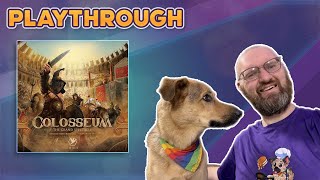
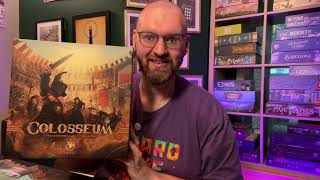
What elevates Colosseum is how seamlessly its theme integrates with its mechanics. Players genuinely feel like Roman impresarios managing their spectacles. The concept of attracting nobility through increasingly impressive performances mirrors real historical ambitions. Component quality in the Fantasia reprint amplifies this immersion; the artwork by the MO brings Roman aesthetics to life with beautiful character illustrations and performance cards. Board Gaymes James notes that the redesigned board "makes a lot more thematic sense," featuring a single shared colosseum with player-controlled gates rather than separate arenas, creating a unified spectacle where all performances occur in the same magnificent venue.
What Makes Colosseum Stand Out
Elegant Reprint Revitalization
The Fantasia Games reprint addresses the original production while honoring the core design. The game previously appeared in versions that ranged from adequate to problematic in component quality. The new edition features enhanced artwork, improved card stock, and an upgraded board layout. Notably, the reprint streamlines the rules into a four-round structure option while preserving the original five-round ruleset for players who prefer the classic experience. Board Gaymes James highlights the new design updates, mentioning the introduction of Temples of Fortuna that offer flexible noble movement and Patrons that replace season tickets, creating new strategic pathways.
Optimal Player Experience at Five
While Colosseum plays across multiple player counts, the five-player configuration represents its sweet spot. The Dice Tower ranked Colosseum as their number three choice for five-player games, noting it ranks alongside negotiation and area control favorites. The five-player count prevents any single player from dominating the spectacle boards; nobles must be distributed across more performers, forcing competition and negotiation. The game maintains pacing without becoming unwieldy, and the trading phase gains significant depth with more parties involved in dealmaking.
Potential Drawbacks
Player Count Sensitivity
Colosseum's strategic flavor shifts depending on player count. With fewer players, individual arenas can develop more isolated strategies; with more players, the board becomes congested and negotiation dominates. Some configurations may feel either too narrow or too chaotic depending on expectations. Players seeking a consistent experience should commit to their preferred player count rather than expecting identical play across 3-5 participants.
Rules and Edition Confusion
The existence of multiple editions with different rulesets creates potential friction. The Fantasia Games reprint offers both streamlined four-round rules and original five-round rules, each with distinct mechanic variations like Temples of Fortuna and Patrons versus original systems. New players must understand which edition they own and which ruleset applies, adding an onboarding step. Players upgrading from older editions should clarify which mechanics appear in their copy.
If You Enjoy Colosseum
Players who appreciate Colosseum typically enjoy area control games that reward negotiation and temporary alliances. The comparison games mentioned in similar contexts include Wallenstein, which shares cube-tower combat resolution and action selection; Puerto Rico, which emphasizes role selection and tight economic competition; and El Grande, which pioneered the area majority mechanic this game refines. Fans of trading-intensive experiences like Catan variants or negotiation-focused games like Cosmic Encounter and Sheriff of Nottingham will find Colosseum's blend of auctions and alliance-building rewarding. The game appeals to players who value thematic coherence alongside strategic decision-making and who appreciate reprints that revitalize older designs with fresh production values.
What Reviewers Are Saying
"This game to me feels like a five-player game. The trading is better. Yeah. With five. And there's also you're fighting over the shows a little bit more because with four you could have everyone just kind of go their own way."
— The Dice Tower
"The board changes you'll notice that there is now one coliseum instead of multiple coliseums. This makes a lot more thematic sense. And so instead of you building out your own arenas, we're all going to have these gates into the coliseum."
— Board Gaymes James
"Coliseum is so Fantasia are doing a new print of Coliseum so that's very exciting as well. It's one of those games from the late 2000s that was out of print, and now you got a new flashy version like you can actually play it again."
— Board Stupid