/pic2869710.jpg)
/pic5179567.jpg)

/pic2869710.jpg)






































Colt Express Deep Dive
What the Community Thinks About Colt Express
Channels that have spent real time with Colt Express keep landing on the same word: chaos. Drive Thru Games calls the mayhem intentional, describing a train robbery where the fun comes from watching plans collide, and Meeple University agrees that the action-programming format means the best laid plans can be placed in ruins by an opponent's timing. Stonemaier Games slots the game into a personal top ten list of heist-themed favorites, praising the way its train literally has multiple levels to rob. Our Family Plays Games describes the complete collection with genuine affection, calling the whole package a unique thing built around bandits scrambling over a train car by car.
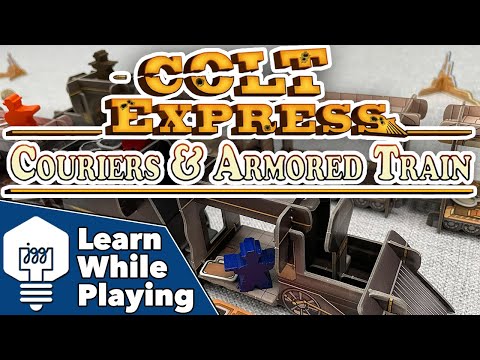
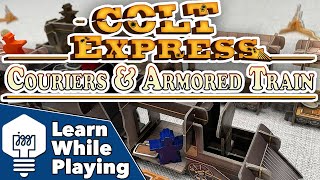
The disagreement shows up around how well that chaos holds up over repeated plays. Rolls in the Family owned the game for years, enjoyed the resolving phase, and still eventually moved it out of the collection because the swings started to make individual decisions feel less important. Drive Thru Games takes the opposite read on the same randomness, arguing that once a table leans into it, the loss of predictability at higher player counts becomes a feature rather than a flaw, more a kick-back-and-relax experience than a strategic one. Getting Games, teaching the base rules alongside the Couriers and Armored Train expansion, stays neutral on the debate and simply walks through how the shared stack of action cards produces that unpredictability in the first place.
Core Mechanics That Define Colt Express
Programming Cards Into a Shared Stack
Getting Games explains the core loop plainly: each round, every player plays action cards from their hand into a single shared stack, face up or face down depending on the round card in play, and once the right number of cards has been placed the whole stack gets flipped over and resolved one card at a time from the top. Meeple University adds that at the start of every round players shuffle their action cards and draw a fresh hand of six, so the choices available change round to round, and the round card itself dictates how many actions each player gets to take as well as any special effect in play that round, such as the train braking at the end.
Moving and Shooting Through Three Levels of Train
Drive Thru Games breaks down the specific cards that make the train itself playable space: a simple move card to shift between cars, a second movement card to climb between a car and the roof, a punch card that forces an adjacent bandit to drop what they are carrying, and a fire card that can shoot someone in an adjacent car, or along the whole rooftop if the shooter is up top. Stonemaier Games frames the same system in terms of what it does for the heist theme, noting that bandits are moving left to right along the train but also up and down between roof and car, and that this verticality changes who a player can interact with and what they can actually reach to steal.
The Colt Express Experience
Embracing Barely Controlled Chaos
Rolls in the Family describes the moment the stack of cards resolves as fun but also a little too chaotic for their taste, to the point that a player's decision can start to feel like it barely matters once everyone else's cards start flipping over. Drive Thru Games frames that same unpredictability as the point of the design at higher player counts: with four or more bandits at the table, the strategic planning gives way to something closer to a beer-and-pretzels session, watching the mayhem of a train robbery play out rather than trying to control it.
A Tighter Puzzle at Two Players
Drive Thru Games singles out the two-player mode as a different game entirely, where each side controls a team of two bandits sharing a single mixed deck of cards, which turns tracking a partner's position and remaining cards into what the channel calls a real brain burner. That mode does drop the gunslinger bonus that rewards spending the most bullets, and it comes with its own bit of dark comedy: because a revealed card must be carried out exactly as written, a player can end up shooting their own teammate. Meeple University confirms the game ships with these modified two-player team rules as one of its variant options alongside an expert mode.
What Makes Colt Express Stand Out
The 3D Train and Physical Presence
The physical train comes up unprompted across multiple channels. Rolls in the Family calls out the cool visual presentation of a literal three-dimensional train with characters climbing over it, and Drive Thru Games says the components speak for themselves, singling out the 3D train and its little decorations as something worth setting up just to look at. Our Family Plays Games extends that praise to the complete collection specifically, describing a unique setup with two trains and a connecting wagon, miniature bandits standing in for the original tokens, and bandits climbing on top of or inside the train while, as the channel puts it, trying to collect loot and avoid the sheriff.
Distinct Bandit Abilities
Drive Thru Games runs through several of the playable characters and how their special abilities bend the shared rules: Cheyenne steals loot directly from a punched opponent instead of dropping it to the ground, Belle can deflect a punch or a shot onto someone else sharing her car, Doc draws seven action cards a round instead of six, and Ghost can always play the first card of a round face down. Meeple University walks through a concrete example of Belle's passive power, noting she can only be punched or shot if she is the only opponent within range, which can force an attacker to target a different bandit than the one they intended.
Potential Drawbacks
Decisions Can Feel Inconsequential
The clearest complaint comes from Rolls in the Family, who found that once the shared stack of cards starts resolving, a player's own choices can stop feeling like they matter, since an opponent's punch or a marshal's shove can undo careful planning in an instant. That pattern was part of why the game eventually left the household's collection after years of ownership, even though the channel still calls it a fine game that could be played again with the right people. Drive Thru Games sees the same dynamic from a different angle, noting that with four or more players the strategy largely goes out the window in favor of pure chaos.
Complete Collection Size and Storage
Our Family Plays Games points out that the newer complete collection keeps growing in scope, packing in two trains, a connecting wagon, and every expansion the base game has picked up over the years, all in a box that the channel notes is bigger than the big box edition that came before it. That density of components is presented as a selling point in the video, but it also means a household weighing the complete collection is taking on a larger, heavier box than the original release.
If You Enjoy Colt Express
Drive Thru Games places RoboRally alongside Colt Express as a point of comparison, describing Colt Express as a sort of action programmatic type of game, similar to RoboRally, where everyone commits actions from a hand of cards before watching how those choices play out together.
What Reviewers Are Saying
"I love the 3D train and all the little decorations that you can set aside outside the terrain. It's a really cool game and I think it's going to work good for kids."
— Drive Thru Games
"It was such a unique thing. You have this train and you've got your guys that can go on top of the train or in the train. They're trying to collect loot and all this stuff trying to avoid the sheriff."
— Our Family Plays Games
"It's not a bad game by any means. I could totally play game Colt Express again."
— Rolls in the Family