/pic1425438.jpg)
Copycat, or as it is known in German, Fremde Federn (which means roughly "to adorn oneself with borrowed plumes," or something like "strange feathers"), is about borrowing elements from well-known games (Eurogames) and constructing a new game out of them.
Copycat is a deck-building, worker-placement, drafting race game. You are a politician who tries to gather enough money and influence to become the next president. Of course, you depend on the work of others to get the needed influence. You start with a set of 10 cards (7 of them are "fatherly friends," which give you 1 money each and 3 of them yield 1 influence each (VPs)). Each round you draw 5 cards from your deck and use one card for the turn order to place your workers. The workers go to the different offices in the government building to buy new cards for you, get influence or to carry out other actions. Each round there is one more space in which you can choose to place your workers. On the game board is a row of cards which you can choose to buy and each round the empty places in this row are filled from a deck of cards divided into 4 different "Ages." The last cards of the deck are Doctoral degrees which you can buy with your money; these give you 1 VP for each unit of money spent. The game ends when all of the Doctoral degrees are bought or when one player has 95 VPs or more.



- Favorite in the Soda Pop series
- Interesting decisions
- Can think ahead
- Under appreciated
- Simple rule set, deep strategy
- Strategic depth from movement
Mechanics (from transcript analysis)
- abstract movement — Players move caps based on the number of adjacent caps, with specific movement rules.
- Blocking — Players can block opponent's movement or trap their pieces.
- Goal Achievement — The goal is to get a piece to the opposite side of the board or to trap the opponent.
Video topics + discussion points
Quotes (from this video)
- do more of what makes you happy
- this is an economic Market type of game with a personal spatial tile puzzle
- the cost is the space that you're occupying
- the game is very clever
- light rules but it has real depth
- it's very clever game plays pretty quick as well
- simple but deep it's really good
- this is not usually Terence typical games that he likes but yet he likes it
- you're always one step behind you're like one round behind what the game is going to throw at you
- the choices you're making in the morning phase or the choices you make with like the laws that you pass
- the dusk deck Works in frostpunk is up there
- a good game is has hard choices
- thematically it's a game within a game
- it's the gambling game played by goblins when they're in prison so there's no theme at all
- this is a great dice puzzle with meeple puzzle
- there's a lot of in-game multipliers
References (from this video)
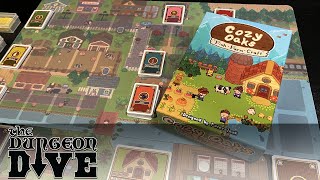
- Easy to learn and teach
- Cozy, pleasant atmosphere
- Strong solo mode
- Clever time and upgrade system creates snowball progression
- Engaging combination of engine-building, set collection, and action selection
- Optional neoprene mats add table presence
- Not typically the reviewer’s preferred genre (subjective)
- Turns can be longer at the beginning
- cozy, pastoral, resource and time management
- Three-year farming life with seasons; farm management and village life
- semi-competitive with a distinct solo mode; light thematic emphasis
- Stardew Valley
- Cult of the Lamb
- Harvest Moon
- Quest for the Lost Pixel
Mechanics (from transcript analysis)
- action_time_resolution — Actions consume time; the duration of each action shapes turn planning and pacing.
- crafting_and_cooking — Materials are used to craft items and prepare meals from a deck of recipes.
- Hand Management — Players manage a hand of skill cards with upgrades and time costs.
- hand_management — Players manage a hand of skill cards with upgrades and time costs.
- Resource Management — Crops, animals, and crafted items produce resources for revenue and scoring.
- resource_generation — Crops, animals, and crafted items produce resources for revenue and scoring.
- seasonal_progression — Gameplay unfolds over three years, each split into seasons (spring, summer, fall, winter).
- Set Collection — Players collect crops, insects, ores, fish, and other items to score points.
- set_collection — Players collect crops, insects, ores, fish, and other items to score points.
- solo_mode — A solo variant uses a villagers deck to introduce constraints and scoring targets.
- Time Track — Turns are governed by time measured in cards; upgrading skills can increase time costs.
- time_management — Turns are governed by time measured in cards; upgrading skills can increase time costs.
- upgradable_skills — Skills can be upgraded to higher levels, altering abilities and time costs.
Video topics + discussion points
Quotes (from this video)
- "Cozy Oaks is a farming simulation game and it is at its core a competitive game but it also has a unique solo mode"
- "it's not brain burner but it is quick it's snappy it's cozy it's pleasant and most of all it is a fun solo game"
- "every single one of these skills except for sleeping can be upgraded"
References (from this video)
Mechanics (from transcript analysis)
- Reveal Effect — An effect that triggers when a card is revealed.
Video topics + discussion points
Quotes (from this video)
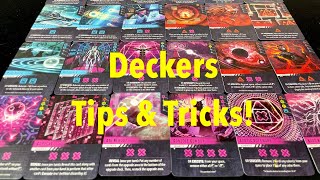
- So, we're going to learn some of the tricks, some of the secrets, some of the perhaps little skills of playing this game well that you may not have picked up um as you've been learning the game.
- It's not always as straightforward.
- Always look for opportunities to exploit the idea of overpaying.
- Reveal effects are some of the most powerful effects in the game.
- One of the hardest things to do in Decas is defeat a white guardian.
- So, creating guardians to get sparks back in the supply if you're facing something like spider, which is probably the first time you might think about doing this.
- Magnetic pulse is a really neat card.
- Once you've played your first game and you're familiar with the rules, have a look through the appendices.
- So, when you're setting up, setting up in this game is part of the game.
References (from this video)

- short, elegant, and highly accessible
- strong complement to Catacomb in the Soda Pop quartet
- portable and highly replayable
- very abstract; may lack thematic flavor for some players
- stoic top-cat control and stacking dynamics
- abstract, cat-themed two-player strategy on a compact board
- minimalist, puzzle-focused
- Catacomb
- Genesis
Mechanics (from transcript analysis)
- grid-based placement and stacking — players place and stack tokens, aiming to secure top-positioned stacks and color dominance
- top-of-stack objectives — control of color-topped stacks provides strategic leverage; height limits guide decisions
- two-player abstract tension — short, sharp battles designed for rapid rounds in a travel-friendly format
Video topics + discussion points
Quotes (from this video)
- Not only is it a clever name, it is a deceptively clever game.
- this is such a unique and cool idea the fact that you have soda pop cans
- it's so simple but so strategically good
- Gonzalo continues to knock things out
- I would keep in my backpack all the time especially because it's so small
- I am very stoked for it
- it's the size of a koozie
References (from this video)

- Distinctive visual identity akin to occult sigils
- Strong core idea with flexible scoring cards and campaigns
- Light in terms of depth for some players
- Crowdfunding-based production may vary in availability
- sigils and line intersections
- Abstract, geometry-inspired puzzle world
- puzzle-focused with mystical vibe
- Welcome To
- Ctographers
- Quacks
Mechanics (from transcript analysis)
- card-driven scoring — scoring cards vary per campaign; wild numbers after second use
- Roll and Write — three dice per round guide line drawing on cards
Video topics + discussion points
Quotes (from this video)
- This is your permission to click away now.
- I won't be including games that I designed myself.
- The steady flow of games should continue for at least another year or two.
- It's time for my end-of-year roundup.
- The algorithm is not loving my content at the moment.
References (from this video)
- Innovative combination
- Complex hybrid system
- Ambitious scope
- Not a perfect fit
- civilization
- agriculture
- economic
- Dominion
- Agricola
Mechanics (from transcript analysis)
Video topics + discussion points
Quotes (from this video)
- board games are diverse but card games really could feature anything
- players are all doing this simultaneously and so you want to be the player that stays in the longest
- if you turn over to many matching cards then you end up with nothing
- auction games are are well served by the sort of card game mechanisms
- play very quickly for three to six players
- an excellent excellent game
- take that card games or I think the most combative sort of card games
- totally silly extremely random but essentially we're playing cards to attack other players
- still one of my favorite games
- each card is a floor on a building
- there's a whole genre of what we call take that card games
- you could place bombs or or murderers into these buildings or the police can then take away a murderer
- Seven Wonders was the sort of figurehead for the cloud drafting games
- sushi go has been an enormous hit
- now the figurehead for the genre is probably sushi go
- deck building was created really by the game of Dominion
- there's something delightful about the simplicity of a game like Dominion
- you can teach to people really easily and play very very quickly
- a form of set collection again
- classic tableau builder would be something like San Juan
- this is a fantastic card game
- buying cards laying them out in front of us and they're going to keep generating us money
- this really is one of my favorite genres
- anybody can play these games and not everybody can play them well
- I love speed games I think it's a fantastic category of card games
- trick-taking games very very straightforward in their basic format
- the basic mechanism can be turned into all these different games
- all tweak it slightly in different ways
- my top ten card game mechanisms
- hopefully I've given you a broad picture of the world of card games
References (from this video)
- Heartwarming story
- Emotional depth
- Passion project
- Short runtime (2-3 hours)
- Finding home and belonging
- Animal shelter and suburbs
- Emotional and thought-provoking
Mechanics (from transcript analysis)
Video topics + discussion points
Quotes (from this video)
- what is the true meaning of home is it the place you grew up is it the place where you feel wanted