/pic4944567.png)
Game Info
Year
2020
Players
1-5
Playtime
45 min
Collection
Ratings
Mechanic profile
Percentile rank vs. all games
Vibe profile
How this game feels to play
Description
Asteroids blast through the cosmos, each one packed with possibilities. One may be your perfect new home, but it takes a stellar team to build a cosmic colony...
Cosmic Colonies is an orbit-drafting game of building a home in the stars. Players must leverage their workers' unique abilities to gather resources and construct new buildings while cleverly expanding their colonies. Each round brings new opportunities — and new talent. Your old workers will blast off to other players, while their workers orbit around to join your team!
Featured Videos
Rules Teach
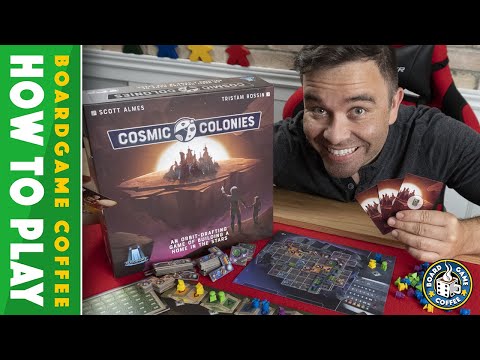
Cosmic Colonies - How to Play (Official Video)
Playthrough

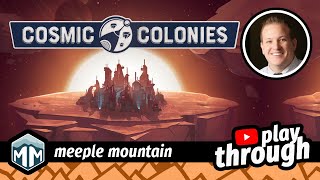
Cosmic Colonies - Playthrough & Review
Ask a Rules Question
All mentions
Browse transcript mentions, sentiments, pros/cons, mechanics, topics, quotes, and references.
Total mentions: 7
This page: 7
Sentiment:
pos 6 ·
mix 0 ·
neu 0 ·
neg 0
Showing 1–7 of 7
Video OCV3Pu5CPJQ
Getting Games Top 26 List at 10:44
video_pk 90957 · mention_pk 243589

Click to watch at 10:44 · YouTube ↗
Pros
none
Cons
none
Thematic elements
Comparison games
none
Mechanics (from transcript analysis)
Mechanics unknown.
Video topics + discussion points
No key topics recorded for this video.
Quotes (from this video)
- I am definitely interested in learning more about this.
- I like Roland Wright style games.
References (from this video)
No references stored for this video.
Video OGBUCbRgbbE
Rahdo Runs Through Top List at 18:54 sentiment: positive
video_pk 83976 · mention_pk 212694
Click to watch at 18:54 · YouTube ↗
Overall sentiment (raw)
Very Positive
Pros
- Innovative and clever card drafting mechanism
- Tight resource management
- Fast gameplay
- Small table footprint
- Visually appealing
Cons
none
Thematic elements
- Setting up a mining colony
- An asteroid
Comparison games
none
Mechanics (from transcript analysis)
- Card Drafting — A unique card drafting system where played cards are passed to opponents, and unplayed cards are kept.
- initiative bidding — Cards have initiative values; lower values go faster but may have less powerful actions.
- Multi-Use Cards — Cards have different powers depending on whether they are played during the day or night.
- Resource Management — Harvesting resources to build machinery, equipment, and industry.
- Tile Placement — Players use polyomino-style tiles to cover areas to harvest resources.
Video topics + discussion points
No key topics recorded for this video.
Quotes (from this video)
- Castle Combo just came out of nowhere and I think blew everybody away.
- This is, I think, the tightest tile air I'm talking about today.
- So, this is the crunchiest of filler games because you have to think so hard and accomplish so much in such a fast time frame.
- Globe Trotters... We're writing on globes because it's our job to plot out the ideal worldwide trip.
- What makes this one stand out is its insane depth if you want it.
- It is a blast. Jen loves it too.
References (from this video)
No references stored for this video.
Video m5ONIgNXFn0
Meeple Mountain Playthrough at 0:00 sentiment: positive
video_pk 28138 · mention_pk 82335
Click to watch at 0:00 · YouTube ↗
Overall sentiment (raw)
positive
Pros
- Engaging spatial puzzle with meaningful decision points
- AI opponent provides tension and variability
- Clear, multi-faceted scoring with multiple viable strategies
Cons
- Card draw and resource randomness can affect planning rigidity
- Filling the board completely is challenging, which may frustrate some players
Thematic elements
- space colonization and terrain control
- space exploration and planetary terraforming with terrain-based tile placement
- procedural tile-laying puzzle with AI opposition
Comparison games
none
Mechanics (from transcript analysis)
- artificial opponent (robot) scoring — the robot has its own board and scoring rules that can punish or reward depending on tiles collected
- card-driven turn order / actions — rounds involve drawing and playing cards that determine who acts first; lower-numbered cards act first
- endgame terrain coverage scoring — final score combines terrain coverage, tile sets, and card bonuses
- Resource Management — players acquire and spend resources to buy tiles and power actions
- set collection / terrain sets — points are earned for completing terrain type sets and for meeting card bonuses
- Tile Placement — players place tiles on their own board to match terrain types and form connected patterns
Video topics + discussion points
No key topics recorded for this video.
Quotes (from this video)
- cosmic colonies here it is
- it's impossible to get everything
- the reds are the most important to cover because they score you more points
References (from this video)
No references stored for this video.
Video CDOUtPqUNUQ
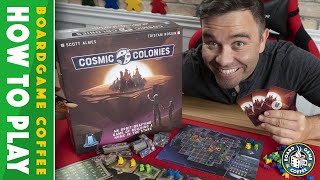
Board Game Coffee Rules Teach at 0:00 sentiment: positive
video_pk 12946 · mention_pk 37893
Click to watch at 0:00 · YouTube ↗
Overall sentiment (raw)
positive
Pros
- Clear, structured teaching of phases
- Accessible for 3-player basic game
- Covers advanced rules and two-player adjustments
- Illustrates core mechanism via concrete examples
Cons
- Some edge cases rely on card text; may require referencing the rulebook
- Dense rules can be challenging for new players
- Advanced mode details only partially explored
Thematic elements
- Terraforming, building and resource management on an asteroid
- Space exploration and asteroid colonization
- Abstract/strategic
Comparison games
none
Mechanics (from transcript analysis)
- Action selection: collect or build — On a turn, players either collect resources from locations or construct buildings on their asteroid according to costs.
- Card Drafting — Players manage a hand of worker cards, drawing and discarding as rounds proceed; in the end, scoring includes private objectives.
- Card drafting and hand management — Players manage a hand of worker cards, drawing and discarding as rounds proceed; in the end, scoring includes private objectives.
- Resource Management — Resources collected are stored in a warehouse with a capacity limit; excess must go to the supply.
- Resource management and warehouse capacity — Resources collected are stored in a warehouse with a capacity limit; excess must go to the supply.
- Round-based structure and eight-round game — The game progresses through eight rounds with refresh phases to replenish resources/buildings.
- Set collection and private objectives for scoring — Points are earned for terrain coverage, complete building sets, and private objective cards.
- Tile Placement — Built shapes (tetromino-like tiles) are placed on a grid, respecting placement rules (inside the grid, edges touch, can be rotated/flipped).
- tile/shape placement — Built shapes (tetromino-like tiles) are placed on a grid, respecting placement rules (inside the grid, edges touch, can be rotated/flipped).
- Worker Placement — Players secretly choose a worker card to determine turn order for the round; the chosen worker is then used to perform actions.
- worker placement and turn order — Players secretly choose a worker card to determine turn order for the round; the chosen worker is then used to perform actions.
Video topics + discussion points
No key topics recorded for this video.
Quotes (from this video)
- The objective of the game is to use these tetris-like shapes to cover up as much of these three different terrain types as possible.
- The action phase is where players will select their workers and choose whether to build a structure or collect resources.
- That's how you play a basic three-player game of Cosmic Colonies.
References (from this video)
No references stored for this video.
Video eYKW__hoq3Y
Board Game Spotlight Playthrough at 0:00 sentiment: positive
video_pk 10528 · mention_pk 30947
Click to watch at 0:00 · YouTube ↗
Overall sentiment (raw)
positive
Pros
- fast, engaging two-player pacing with a tight back-and-forth rhythm that rewards careful sequencing
- beautiful production values, clean iconography, and strong color palette that enhances readability
- high replayability due to double-sided boards, variable objectives, and the diversity of card abilities
- colorblind-friendly icons and accessibility in component design
- solid solo-mode support and potential for scalable play beyond two players
Cons
- early rounds can feel memory-intensive as players learn the interaction of cards and board choices
- sophisticated interactions between asymmetric cards may require a second viewing or a short tutorial for new players
- some players might prefer a longer playtime or heavier strategic weight than a quick abstract puzzle provides
Thematic elements
- space exploration, resource management, and spatial puzzle-solving with polyomino tiling
- Asteroid mining and space colony construction in a near-future sci-fi setting
- abstract/puzzle-forward with scenic, modular components
Comparison games
- Mission Red Planet
- Barren Park
Mechanics (from transcript analysis)
- Asymmetric Player Powers — each card carries a unique ability that affects future rounds and interacts with the opponent’s options, creating a constantly evolving decision space.
- asymmetric_card_abilities — each card carries a unique ability that affects future rounds and interacts with the opponent’s options, creating a constantly evolving decision space.
- Polyomino — players place Tetris-like polyomino shapes onto their personal boards to cover terrain types and maximize local and end-game scoring. shapes come in five basic forms and one can be swapped or upgraded per round based on resource constraints.
- polyomino_placement — players place Tetris-like polyomino shapes onto their personal boards to cover terrain types and maximize local and end-game scoring. shapes come in five basic forms and one can be swapped or upgraded per round based on resource constraints.
- Resource Management — on each turn players collect resources according to a revealed card and must spend those resources to acquire shapes or perform board actions. resource amounts per card are limited and influence pacing.
- resource_management — on each turn players collect resources according to a revealed card and must spend those resources to acquire shapes or perform board actions. resource amounts per card are limited and influence pacing.
- set_collection_and_scoring — end-game scoring rewards sets of terrain types, completed shapes, and the end-game objective pieces. diversity of shapes and distribution of terrain govern final tallies.
- simultaneous_card_play — each round both players pick two cards face-down. cards are revealed and lowest-numbered card resolves first. this creates tension and planning beyond purely turn-based actions.
- variable_board_and_tiles — the board is double-sided and round-by-round tile availability shifts as shapes are bought, making each round live and dynamic with fresh strategy.
Video topics + discussion points
No key topics recorded for this video.
Quotes (from this video)
- the simultaneous card play that's what sets this apart from other polyomino games
- it plays quickly with two players, back and forth, with a really interesting abstract spatial puzzle of the polyominoes
- it's like Mission Red Planet meets Barren Park
- the icons are colorblind-friendly
- replayability is through the roof with double-sided boards and advanced cards
- this is such a good card I'm going to play it; hold on now
References (from this video)
No references stored for this video.
Video IVAhcDxxi-o
Board Game Coffee Discussion at 10:18 sentiment: positive
video_pk 8490 · mention_pk 25007

Click to watch at 10:18 · YouTube ↗
Overall sentiment (raw)
positive
Pros
- solid how-to-play video that improves clarity
- tight rules and teachability
Cons
- not as flashy as other space-themed games
Thematic elements
- sci-fi colony expansion
- space colonization and settlement building
- resource-driven, strategic
Comparison games
- Terraforming Mars
- Gaia Project
Mechanics (from transcript analysis)
- Tile Placement — place tiles to optimize colony growth
Video topics + discussion points
No key topics recorded for this video.
Quotes (from this video)
- Spirit Island not Spirit Away mind you it's a great movie if we were giving away Badges of approval for movies Spirited Away a batch of approval but Spirit Island also and this is greater than games
- Spirit Island is a fabulous game... it's fantastic
- Terraforming Mars yes it's our favorite ugly game terrifying Mars is amazing
- I would play that anytime you brought it out
- it's so freaking cool
- we're giving away four copies of Sagrada to four different people
References (from this video)
No references stored for this video.
Video C4CT1SUmV2o
Before You Play Playthrough at 0:00 sentiment: positive
video_pk 1030 · mention_pk 2904
Click to watch at 0:00 · YouTube ↗
Overall sentiment (raw)
positive
Pros
- Easy to learn and quick to play
- Strong hand management adds depth and replayability
- Two-player variant works well and adds card economy
- Thematic and charming artwork; fun sci-fi vibe
- Two decks offer accessible and more complex play
- Scales well to different player counts
Cons
- Memory/tracking of circulating cards can be challenging in longer games or higher player counts
- End-game scoring requires careful planning and can be unforgiving for new players
- Limited to eight rounds; pacing depends on round length
- Swingy card effects can heavily influence a single round
Thematic elements
- Space colony development with tile placement and resource management
- Space/asteroid colonies; players colonize an asteroid
- Card-driven, simultaneous action resolution with daytime/nighttime modes
Comparison games
none
Mechanics (from transcript analysis)
- Card-driven actions — Each card provides a daytime and nighttime action; order determined by card numbers
- Deck Building — Basic deck vs Advanced deck; advanced split into day/night actions
- Deck variants — Basic deck vs Advanced deck; advanced split into day/night actions
- End-game scoring — Score by covered vs visible spaces by color; set collection bonus
- Hidden Victory Points — Each player has a secret objective card scored at end
- Private objective — Each player has a secret objective card scored at end
- Resource Management — Manage four resource types to pay build costs and trigger scoring
- Tile Placement — Place tiles on a shared asteroid board, orthogonally adjacent after first tile
- Worker Placement — Cards represent workers with carrying capacity and actions
- Worker tokens — Cards represent workers with carrying capacity and actions
Video topics + discussion points
No key topics recorded for this video.
Quotes (from this video)
- it's a light strategy game
- it's easy to learn
- the flow of the round is very quick
- hand management is the key
- replayability due to deck variants
- two decks offer accessible and more complex play
- highly accessible
References (from this video)
No references stored for this video.
Transcript Navigation
Showing 1–7 of 7