/pic8004908.jpg)
Game Info
Year
2024
Players
2-5
Age
8+
Playtime
20 min
Collection
Ratings
Mechanic profile
Percentile rank vs. all games
Vibe profile
Not enough video data yet
Description
Tonight, the queen holds a banquet that everyone will attend. Will they leave a good impression? Backstabbing is fair game, and no trick is too dirty if it allows you to place your favorite families in the spotlight.
In Courtisans, you receive and play three cards on each of your turns. One is played at the Queen's table to sway a family's influence, whether in a positive or negative manner. The two other cards are played in your domain and in an opponent's domain, and they can be worth positive or negative points, depending on their family's status at the end of the game. Choose where best to place your three cards if you want to end up with the most points and win.
—description from the publisher
Featured Videos
Review

Courtisans
Rules Teach

Courtisans - How to Play Board Game
Playthrough
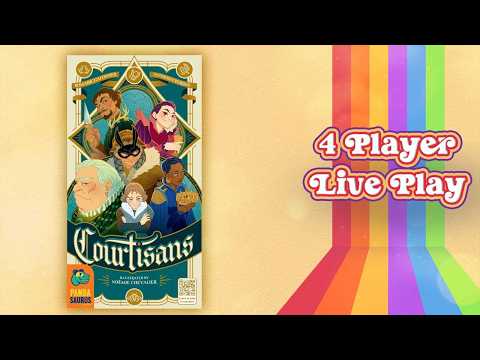
Courtisans 4 Player Live Play
Ask a Rules Question
All mentions
Browse transcript mentions, sentiments, pros/cons, mechanics, topics, quotes, and references.
Total mentions: 12
This page: 12
Sentiment:
pos 11 ·
mix 0 ·
neu 0 ·
neg 0
Showing 1–12 of 12
Video 2JJItGDkYUU
Top List at 0:27 sentiment: positive
video_pk 134236 · mention_pk 382061

Click to watch at 0:27 · YouTube ↗
Overall sentiment (raw)
positive
Pros
- Experiences are out of this world if you like take that
- So fun, so good
- Has been a hit with everybody played with
Cons
- The board is fabric material and doesn't lay flat
Thematic elements
- Elevating or having someone fall from grace based on objectives
- At the queen's table
Comparison games
none
Mechanics (from transcript analysis)
- Objective Cards — Players are trying to achieve objectives based on their cards.
- Take That — A core element of the game is 'take that' mechanics.
Video topics + discussion points
No key topics recorded for this video.
Quotes (from this video)
- It's just about the most perfect game I could come up with. I think it really is the perfect game for you. Like, as a player, I think it it just hits all of those notes.
- there was no other game that could be number one on my list this year.
- This is absolutely my favorite favorite game. I love it so much. I love literally everything about it.
- So, like sometimes I'm like, oh, they're really building up conservation. I'm watching an opponent and I'm thinking they're going to cross paths and end the game before I want it to end.
- It's just a very good, perfect game for me.
References (from this video)
No references stored for this video.
Video 1bVusUTJofU
Brains On Games Discussion at 0:30 sentiment: positive
video_pk 87440 · mention_pk 228523
Click to watch at 0:30 · YouTube ↗
Overall sentiment (raw)
positive
Pros
- extremely quick and easy to teach
- great for introducing non-gamers to modern board games
- compact form factor with attractive components (foil accents, woven board)
- take-that flavor is balanced and fun, not mean-spirited
- strong table presence despite simple rules
- replayability with different card reveals and deductions
Cons
- cloth board can wrinkle and be finicky to flatten
- back coating and lack of care instructions may require hand-washing or careful handling
- some players may wish for more pronounced strategic depth with higher player counts
Thematic elements
- court intrigue, shifting alliances, reputation management
- Queen's Court with factions vying for esteem
- bluffing, hidden information, deduction
Comparison games
none
Mechanics (from transcript analysis)
- Action triad — On each turn, a player selects three cards to place: one in front of themselves (Tableau), one at the Queen's Court, and one in front of an opponent.
- Assassination — Assassin cards allow you to discard or remove an opponent's card, influencing scoring and strategy.
- guard mechanics — Guard cards prevent assassination, providing protection to a card in your Tableau or at the Court.
- hidden information / spies — Spy cards are played face down, keeping identity hidden and making deduction important for future turns.
- negative scoring and dynamic endgame — Most cards are neutral or point-neutral by design, but falling Grace or other conditions can turn cards negative, creating a tense endgame.
- Tableau Building — Cards in your Tableau are worth points or penalties based on how the top/bottom of each suit are arranged in the Court; the Court determines whether sets are esteemed or fallen from Grace.
- tableau scoring and misdirection — Cards in your Tableau are worth points or penalties based on how the top/bottom of each suit are arranged in the Court; the Court determines whether sets are esteemed or fallen from Grace.
Video topics + discussion points
No key topics recorded for this video.
Quotes (from this video)
- it's so quick to play it's so simple to teach and to learn
- it's a huge surprise to me
- what a lot of fun
- it's so small you can carry it anywhere
- I like the art style on these cards and the woven board
- it's a take that focus
References (from this video)
No references stored for this video.
Video 46tPJLG2Fwg
Ryan and Bethany Board Game Reviews Top 10 List at 24:25 sentiment: positive
video_pk 86794 · mention_pk 225920

Click to watch at 24:25 · YouTube ↗
Overall sentiment (raw)
positive
Pros
- deep, tense social manipulation
- mechanics scale well with players
Cons
- can be stressful and complex for casual players
Thematic elements
- influence, negotiation, faction scoring
- royal banquet / queen's table
- political intrigue and social maneuvering
Comparison games
none
Mechanics (from transcript analysis)
- Compound Scoring — each player has private goals in addition to house-based scoring
- multi-directional card play — play cards to self, to the banquet, or to opponents to influence favor
- Multi-Use Cards — play cards to self, to the banquet, or to opponents to influence favor
- personal/objective scoring — each player has private goals in addition to house-based scoring
Video topics + discussion points
No key topics recorded for this video.
Quotes (from this video)
- it's so tense you're basically the big old government and then the rebellion in this futuristic dystopian world
- it's so fast just play it again switch sides cuz they're both very different
- graphic design in this game is absolutely perfect cuz it immerses you in the theme without taking away from the gam play
- this game replaces code names I know that's like really popular in our community
- it's hilarious
- embrace the chaos of this one
References (from this video)
No references stored for this video.
Video ecpUwJ8Btlc
The Cardboard Herald Top List at 8:35 sentiment: positive
video_pk 86525 · mention_pk 224073

Click to watch at 8:35 · YouTube ↗
Overall sentiment (raw)
positive
Pros
- Bluffing and deduction elements
- Tricky gameplay
- Hidden movements
- Backstabbing
- Fun for a small box
Cons
none
Thematic elements
Comparison games
none
Mechanics (from transcript analysis)
- bluffing — a game that sort of a little bit about bluffing deduction
- Deduction — a game that sort of a little bit about bluffing deduction
- Hidden Movement — it's a tricky game that has some hidden movements
Video topics + discussion points
No key topics recorded for this video.
Quotes (from this video)
- you know that this is directly inspired by Shadow of the Colossus
- apart from the verticality it's just such a smart creative cool package where each hero is a combination of a character class and a couple hero cards shuffled together and kind of played as if it were a deck building game that you're not doing any addition to throughout the game itself
- it has such an amazing intuitive simple system for telegraphing what the oppositional behavior of this Leviathan that you're climbing is going to be and giving you time most of the time to react to it
- Ironwood is an asymmetrical hard driven tactical game with multi-use cards Ironclad and wood walkers have different decks different Victory conditions move around the board differently fantastic components and artwork
- Pagan fate of Rowan Oak which is an expandable asymmetrical deduction card game where one player plays as a witch the other player is playing as the Witch Hunter and the witch is playing cards to try to perform this Grand ritual whereas the Witch Hunter is trying to figure out who the witch is and then bring them to justice
- React the Arts of War this one was super under my radar until packs unplugged but this is a onev one grid-based card dueling game with these highly asymmetrical artist characters that are very unique in their play style very thematic you are moving your artists around the board trying to damage the other artists you're competing against so thematic and extremely
- River of gold if you had told me 5 years ago that they were going to be making a Euro set in rokuan the setting of my personal Obsession as a teenager and young adult I would have well I would have believed you but I would have flipped my lid and even still now I'm kind of in shock at how good of a game it pulled off in being especially under a younger Studio like office dog
- River of gold is an exceptional worker placement with a linear aspect as you navigate these boats down the river and progressively more and more buildings are constructed along the ways
- it has just the right blending of approachable economics and astounding capabilities that you can roll into and is magnificently produced with these beautiful gold reflective elements throughout the otherwise kind of watercolor esque board
- first up we have SEI I know this is on a lot of other people's lists but it has a fantastic solo mode it uses an automa where the automa uh will do somewhat of a random action but the actions will be more powerful than anything that you can do on your turn so it ends up being very competitive you can see here I just finished a solo game and the scores were pretty close actually within 10 points
- arcs it is difficult to talk about this game without getting into the Weeds about how beautifully the mechanics interact with each other in this game to create an epic space conflict but at the same time a game about making do with what few actions you have
- it's hard to imagine arcs not being in the top three of this list in what we have talked about as an absolute Bonkers of a year it's cunning inventive and original while still being all that much more approachable than many of Leader's prior works
- the depths to which you can explore the systems involved is really something
- the last recommendation on my list is I Napoleon designed by Ted racer uh and GMT games it's another card driven game what I like about this one is the historical aspect of it and how true to the life of Napoleon it is uh first you start by playing as uh Napoleon when he was a commander you move up to uh first console and then ultimately Emperor if you make that far and there's a ton of ways to lose um but you can go through his entire life it's a fantastic solo experience highly recommend it
- Harvest the number one game of 2024 the Box really does say it best a fantastically fun fur filled farming Affair that is tricky to say but the game is just that much fun too
- Harvest is an amazing game it is a knife fight in a hay bale your turns are so few that you cannot Dilly nor dally but the adorable theme makes something that should be an inherently stressful game into a cute little farming experience
- it has the deep deep complexity of trying to maximize your turns to give it legs to even the most astute of board gamers was some serious debate Among Us contributors on the channel as to whether Harvest should take the number one slot
- taking the raw elements that TMG had rightly gone with but bringing it to a more Modern Standard giving it both a visual overhaul but also giving at a tight mechanical system that is shockingly deep for how mechanically narrow it may seem at first to have this level of function in a farming game that is played in a mere four rounds only 12 placements for the entire game is the Pinnacle of refined game design
- making Harvest our 2024 game of the year
References (from this video)
No references stored for this video.
Video ewdfzVQZrF8
TheGameBoyGeek - Hi Quality Hi Energy Board Game Reviews Analysis at 17:12 sentiment: positive
video_pk 85457 · mention_pk 219059
Click to watch at 17:12 · YouTube ↗
Overall sentiment (raw)
positive
Pros
- Fun little game.
- Really light but really good.
Cons
none
Thematic elements
- Scoring points based on card placement in courts
Comparison games
- Azul
Mechanics (from transcript analysis)
- Card game — Gameplay revolves around playing cards.
- Set Collection — Players collect cards to score points.
- Tableau Building — Players build a personal area with cards.
Video topics + discussion points
No key topics recorded for this video.
Quotes (from this video)
- Nontaku Temple of the Ice. This is a cosmos game by designer Kane Keno. Fantastic game drafting set collection. Building a three-dimensional pyramid area control. Not super heavy. It's pretty light, but it's probably a little too heavy for the spiel. This is a perfect kenner spiel pick.
- Aqua, Biodiversity in the Oceans from the OP. Uh, another great one that is again a little heavier than a Spielus. A puzzly game where you're tile laying, you're trying to attract animals to your coral and then have bigger animals eat the animals that you've already got. It's a puzzly game. Very good. Little too heavy for Spiel, I think, but perfect for Ken Spiel.
- This next one is probably the heaviest of this list. Craft Wagon Age of Engineering. This is a re-implementation of a of a heavier mediumweight Euro game, Craft Wagon.
- And the last one I'm going to mention is Enaria demo by Michael Keesling. This is like a step heavier than Azul, but has lots of similarities to Azul. Uh so, but it's definitely heavier.
- I'm sure I'm going to get a lot of hate mail in the comments just like I did last year when I or two years ago when I uh was blasting the the the challengers whole debacle and then the Sky Team thing. I'm sure I'm going to get a lot of people from Germany hating this video, but this is how people outside of Germany feel about the award and it doesn't seem like the Germans really care.
References (from this video)
No references stored for this video.
Video sZ5JThUvgQE
Allies or Enemies Top 100 List at 10:57 sentiment: positive
video_pk 84496 · mention_pk 214757

Click to watch at 10:57 · YouTube ↗
Overall sentiment (raw)
positive
Pros
- easy to learn and quick to play
- light, mean-spirited interaction that can be fun in social settings
Cons
none
Thematic elements
- cutthroat social interaction with negative scoring
- mean-spirited card-ticking game
Comparison games
none
Mechanics (from transcript analysis)
- Compound Scoring — aim to tank others' scores by card actions
- negative scoring focus — aim to tank others' scores by card actions
- three-card play — play one card to yourself, one to another, and one to the center
Video topics + discussion points
No key topics recorded for this video.
Quotes (from this video)
- "this is an adorable looking game"
- "it's chaos"
- "an adventure in about an hour"
- "this is a Star Wars game"
References (from this video)
No references stored for this video.
Video GDxDZl07dR0
Board Gaymes James Playthrough at 4:06 sentiment: positive
video_pk 82380 · mention_pk 206994
Click to watch at 4:06 · YouTube ↗
Overall sentiment (raw)
positive
Pros
- Engaging interactive play with infighting and manipulation
- Short/mid length play with an accessible theme
- Hidden information and spy mechanics add tension
- Endgame scoring by house majority creates dynamic decisions
Cons
- Can be confusing at first; some players discuss not understanding rules
- Spy/assassin heavy, can lead to chaotic moments
- Requires tracking of numerous cards and color groups; may be mentally taxing
Thematic elements
- Array
Comparison games
- Love Letter
- Lorenzo il Magnifico
- Blanco
Mechanics (from transcript analysis)
- Assassination / killing — Daggers/assassins remove or negate cards, affecting scoring.
- Card play / tableau building — Each turn you play a card to the table, to an opponent's tableau, and to your tableau to influence scoring.
- End-game scoring by majority by house — At game end, owning cards of the majority house (and sometimes other groups) yields points.
- Hidden information / face-down actions — Some cards can be revealed or kept hidden; spies' colors are not always known.
- Hidden Roles — Some cards can be revealed or kept hidden; spies' colors are not always known.
- Spies and hidden scoring — Spies contribute to color-specific scoring and can be revealed or kept hidden.
- Tableau Building — Each turn you play a card to the table, to an opponent's tableau, and to your tableau to influence scoring.
Video topics + discussion points
No key topics recorded for this video.
Quotes (from this video)
- This is a stock manipulation game.
- I actually really like this game cuz it kind of reminds you of like Love Letterish.
- This is a spyheavy game.
- the goal is just to encourage infighting
References (from this video)
No references stored for this video.
Video fjVK4Lotnds
Allies or Enemies Top List at 9:42 sentiment: positive
video_pk 80306 · mention_pk 195219
Click to watch at 9:42 · YouTube ↗
Overall sentiment (raw)
positive
Pros
- Simple
- Very mean (in a fun way)
- Quick
- Deceptive scoring
- Looks good
Cons
- Can be very mean
Thematic elements
- giving cards to opponents to score points
Comparison games
none
Mechanics (from transcript analysis)
- Card Drafting — on your turn, you have three cards, you give one to an opponent, you keep one to yourself, and you put one in the middle.
- Set Collection — you compare all of the characters you have to the cards in the middle for whether they're worth positive or negative points.
- Take That — You're always going to either give them something that's bad or you're going to make it bad and then you're going to give it to them.
Video topics + discussion points
No key topics recorded for this video.
Quotes (from this video)
- So today we are talking about 10 games that we would recommend for playing at a picnic.
- first of all, they've got to have a small enough box that they're going to be easy to take to a picnic.
- Second, they've got to actually fit on a picnic blanket.
- And third, we want them to be at least a little bit safe from the wind.
- If you haven't heard us mention them, go check them out. They are great backpack games.
- This is one of these games that I'm like, I why didn't I think of this? This is so smart.
- So, you're just like constantly like trying to trick each other.
- So, once you've got two of those, you're so scared of taking the upside down card.
- It feels a little bit like Bomberman, where you set off these bombs and then they're going to blow up sometimes like in all directions.
- The tiles are pretty neat. They're like this like thick paper cardboard that have this great texture.
- We do talk about this one a lot, but it's so good, especially for this, especially when you're teaching this to new players.
- I've not taught this to someone who hasn't gone out and bought it or even bought it while we're playing it.
- It is really tricky to manage that limit of 10 because most well, all of the groups will score more if you have more of them.
- I just I love a game like this that you can teach like I taught you the whole rules.
- This does play excellently for picnics, especially if there's not a lot of wind because you are playing cards down to the ground.
- To win by tragedy, which is probably the most fun way, you are trying to cause different characters to die, and they're going to die in all different thematic ways.
- it makes it really tricky to draft cuz every time when you draft cards, your opponent plays first, giving them the opportunity to possibly win.
References (from this video)
No references stored for this video.
Video WhFQ7z5WAZg
Meeple University Rules Teach
video_pk 69899 · mention_pk 166788

Pros
none
Cons
none
Thematic elements
none
Comparison games
none
Mechanics (from transcript analysis)
Mechanics unknown.
Video topics + discussion points
No key topics recorded for this video.
Quotes (from this video)
No quotes stored for this video.
References (from this video)
No references stored for this video.
Video 9YH8T5nc6lo
Jamie, Tabletoptiktok Review at 0:03 sentiment: positive
video_pk 61342 · mention_pk 154010
Click to watch at 0:03 · YouTube ↗
Overall sentiment (raw)
positive
Pros
- Engaging push-pull scoring mechanic with esteem vs fallen
- Short rounds with fixed number of turns per player for fairness
- Hidden objectives add tactical depth
- Rich take-that interactions (assassins, spies)
- Accessible to a wide age range; good social interaction at 3-5 players
- Pretty card design with foil accents
Cons
- Two-player variant is less appealing due to reduced interaction
- The mat/card components wrinkle easily
- Some players may find early-game information sparse and luck-influenced
Thematic elements
- Political intrigue, manipulation and scoring through esteem or fall
- A royal court with six families vying for influence
- Hidden objectives with public goals, shifting alliances, push-pull scoring
Comparison games
none
Mechanics (from transcript analysis)
- Area control / scoring by above/below table — Points are earned or lost based on how many cards of each family are placed above or below the table.
- Card Drafting — Each turn you draw three cards and must place them into three areas, choosing where to place and what to reveal.
- card drafting / hand management — Each turn you draw three cards and must place them into three areas, choosing where to place and what to reveal.
- Endgame deck exhaustion — Game ends when the deck runs out for equal turns; then scoring occurs.
- Hidden Victory Points — Public display of some cards while private goals determine points.
- Simultaneous/hidden information scoring — Public display of some cards while private goals determine points.
- special-card abilities — Cards with shields, dagger (assassin), spies (face-down influence), times two.
- Take That — Assassins and spies can affect other players' cards or the queen's pile.
- take-that interactions — Assassins and spies can affect other players' cards or the queen's pile.
Video topics + discussion points
No key topics recorded for this video.
Quotes (from this video)
- two to five player game Cortisans.
- three points is a lot, I have found.
- This shield means that wherever it is played, it cannot be moved or harmed in any way.
- they can essentially take out any card in the game except for one with a shield.
- times two... counts as two people.
- I don't love this game at two players as much. I mean, you definitely can play it is at two and it is really then that head-to-head, but I like being able to spread things around a little bit more at that three, four, and five player mark.
- I really enjoy this game.
- this is a really fun card game for pretty much all ages
References (from this video)
No references stored for this video.
Video qeh_QBv0FD8
Board Stupid Review at 1:05 sentiment: positive
video_pk 31982 · mention_pk 94385
Click to watch at 1:05 · YouTube ↗
Overall sentiment (raw)
positive
Pros
- Very quick and accessible (roughly 10–15 minutes per game)
- Highly interactive and combative in a light, portable package
- Elegant three-card mechanic that keeps decisions tight
- Secret objectives and spies add depth and variability
- Excellent production quality for a small box
Cons
- Spy cards could use more variety or depth
- Artwork style (cartoonish/Disney-like) may not appeal to all tastes
- Box design omits a traditional board, which some players would prefer
- Two-player games can feel less dynamic and easier to collude against one player
Thematic elements
- Power, favor, betrayal, and hidden agendas
- Medieval court intrigue around the Queen's table
- Competitive negotiation with hidden objectives and covert actions
Comparison games
- Coup
- Animology
Mechanics (from transcript analysis)
- Action Interruption — An Assassin card allows removing a card from the table, eliminating its potential scoring impact.
- Assassin action — An Assassin card allows removing a card from the table, eliminating its potential scoring impact.
- Hidden Roles — Players start with hidden goals that push them to favor or disgrace certain families.
- Majority scoring at the Queen's table — End-of-round scoring grants points for cards in your personal pile that match those in majority at the Queen's table.
- Secret objectives — Players start with hidden goals that push them to favor or disgrace certain families.
- Spy and hidden information — Spy cards are secret and reveal at the end, adding a layer of uncertainty about who might win.
- Three-card turn structure — On your turn you draw three cards, give one to yourself, one to another player, and place one at the Queen's table either in favor or in disgrace.
Video topics + discussion points
No key topics recorded for this video.
Quotes (from this video)
- it's such a wonderful game to look at
- it's such a wonderfully easy game to teach as well
- I think this is a fantastic game
- strong recommendation to go and get cortis it's fantastic
- this is a beginner game
References (from this video)
No references stored for this video.
Video l-XEZJBPjTM
No Rolls Barred Playthrough at 8:58 sentiment: positive
video_pk 7205 · mention_pk 115443
Click to watch at 8:58 · YouTube ↗
Overall sentiment (raw)
positive
Pros
- quick to learn rules
- engaging gameplay
- good for groups
Cons
- can take time with indecisive players
Thematic elements
- court intrigue
- political influence
- medieval court
Comparison games
none
Mechanics (from transcript analysis)
Mechanics unknown.
Video topics + discussion points
No key topics recorded for this video.
Quotes (from this video)
- We're the first rule of board game club 200 is we don't have time for a rule of board game club 200 cuz we got to play as many games as we can in 200 minutes
- We will be matching donations up to 5,000 British pounds
- Making them accessible to all people is a really really good cause
- We're raising money for accessibility tools to people with physical disabilities
- Let's do it. I love no thanks
References (from this video)
No references stored for this video.
Transcript Navigation
Showing 1–12 of 12