








Crash Octopus Deep Dive
What the Community Thinks About Crash Octopus
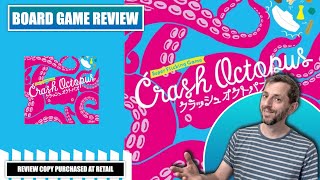
Crash Octopus, published by Itten in 2021, is a dexterity game for two to five players, and reviewers tend to describe it through its looks and its chaos. Nearly every reviewer agrees that the game is striking on the table. They diverge on whether the physical play holds up beyond a few sessions. Adam in Wales, who grades games on a structured engagement ladder, lands on a measured middle ground. The game is "bright and colorful" and "unusual enough to draw players in," but the reviewer finds the flicking and dice-dropping too imprecise to deliver the tense highs and lows of the flicking games it resembles. Gaming with Edo & Jessica is far warmer, ranking Crash Octopus among their favorite dexterity titles. John Gets Games is enthusiastic at first, then notes that the game felt clunkier on later plays and stopped coming off the shelf. All You Can Board reached the most critical verdict, with the group feeling the game lacked the big moments they had seen in other Crash Octopus games. Guest Derek Funkhouser, on a dexterity-focused episode of Board Game Spotlight, offers the most enthusiastic endorsement, calling the game "stupid fun" and placing it among their favorite dexterity titles.
Core Mechanics That Define Crash Octopus
Flicking
Flicking is the game's central action, and its tool is unusual. Players do not flick with their fingers. Each player holds a dowel topped with a flag, spins it, and uses the flag to propel a treasure across the table toward their ship. Adam in Wales explains the rule that gives the mechanic its tension: a player may never flick the treasure closest to their own ship, even when they want it badly. The reviewer calls this "clever," because it stops the easiest prize from being an automatic choice and forces players to weigh which cargo to challenge. The same flag also flicks an anchor to move a ship, so each turn asks players to choose between navigating and loading treasure. Itten's design asks the flag to stand in for a finger, and reviewers repeatedly identify that substitution as the point where the game's feel is most compromised.
Combat: Dice
The octopus attack is resolved by dropping a die onto the octopus head. If the die bounces off and strikes a ship, any treasure toppled from that ship is lost to the ocean. A blank result moves a tentacle beside the die, and the pink result moves the head. Adam in Wales argues that this is where the design loses its footing. Dropping a die vertically, the reviewer says, "removes any real skill and all physical feedback," and the attack becomes a question of where the die happens to land. John Gets Games takes the opposite view of the same moment, describing an octopus that jumped over several tentacles as a memorable highlight. The contrast captures the mechanic's double nature. The attack delivers spectacle and swing, but the outcome sits closer to chance than to the careful aim the flicking tools seem to invite.
The Crash Octopus Experience
Table Mayhem and Low Control
Crash Octopus feels loud, quick, and unpredictable. A single turn can reshape the whole board, a dropped die can strip a player of much of their cargo, and control of the wind can pass to another player at any moment. Adam in Wales identifies the central tension as a kind of waiting rather than a decision. Players spend much of the game "hoping that the die doesn't bounce in your direction," and the reviewer finds that this out-of-control stress makes the game feel unfair when it goes against you. Other reviewers enjoy the same looseness. John Gets Games praises how quickly the game can be taught and played, which suits a table that wants a burst of flicking and laughter without a long commitment. The experience works best when players accept that the chaos is part of the entertainment rather than a test of skill.
Joyful Table Presence
The second feeling is delight, and it begins with the physical object. Reviewers talk about the bright colors, the thick wooden components, and an octopus whose head and tentacles move as separate pieces. Adam in Wales calls the game "a joyful product" and says the table presence "does a lot of the work." Gaming with Edo & Jessica describes it as a neat little flick game with incredible components, and John Gets Games calls it a very photogenic game with great pieces. The silly premise, in which treasure hunters load cargo while dodging a giant octopus and a pink pirate ship, adds to the charm. Even reviewers who find the rules thin tend to acknowledge that the game looks and sounds like a good time before anyone flicks a treasure.
What Makes Crash Octopus Stand Out
Components and Table Presence
The most consistent praise concerns how the game looks in use. Adam in Wales notes that the octopus head and tentacles operate as separate entities, which gives the board a sense of movement that most dexterity games lack. The bright palette and striking box art make the game stand out on a shelf and on a crowded table alike. Edo and Jessica call the production fantastic, and John Gets Games describes the pieces as a reason the game photographs so well. Reviewers who dislike the mechanics still tend to praise the presentation, which suggests the components carry a good share of the game's appeal on their own.
Onboarding That Gets Groups Playing Fast
Reviewers also value how quickly a group can start. Adam in Wales reports that the rules are easy to follow, well laid out, and that the table was up and playing in no time. The reviewer also points to the rulebook's layout as a strength, saying onboarding is a breeze. John Gets Games makes a similar point, describing the game as very quick to teach and very quick to play. For a dexterity game that a host may want to bring to a mixed group, that low barrier matters, and it explains why reviewers who otherwise feel lukewarm still recommend it as an easy introduction to flicking.
Potential Drawbacks
Imprecise Physical Tools
The most frequent criticism concerns how the physical tools feel. Adam in Wales finds the flags to be the flimsiest items in an otherwise sturdy set of wooden components, and reports that flicking a disc with them "just doesn't feel good." The reviewer also says aiming with a flag is far harder than a finger flick, which leaves players with less of the satisfying, skill-based feedback that games such as Cube Quest and Mondrian: The Dice Game deliver. John Gets Games reports a similar pattern across repeated sessions. The first few plays were a delight, but the game began to feel clunky, and the reviewer found it hard to pinpoint why it stopped reaching the table.
Thin Long-Term Payoff
The second concern is that the game can feel anticlimactic. All You Can Board found that the session lacked the big moments the group associated with other Crash Octopus games, and one player felt the game never gave anyone a real reason to move their ship. Adam in Wales makes a related point, arguing that the game serves up what it has in the first couple of plays, and that its mini-games and variants do little to add depth to the main event. The reviewer still describes the game as enjoyable for a handful of sessions, which suggests that players who want a long-lived campaign of flicking may find it lighter than expected.
If You Enjoy Crash Octopus
Players who enjoy the flicking at the heart of Crash Octopus will find a more reliable version of that satisfaction in Pitch Out and Flick Em Up. Adam in Wales lists both among favorite flicking games, and the feel of a well-aimed disc is exactly what Crash Octopus struggles to replicate. Players who want that same precision with dice instead should try Mondrian: The Dice Game, which Adam in Wales holds up for the satisfaction of accurately hitting a target. Players who enjoy the swings and the sense of a table on edge may appreciate Ravensburger's Strike, which the reviewer describes as very random yet tremendously engaging. Readers who like the look of Crash Octopus should also consider Tokyo Highway, the earlier Itten release that shares its striking aesthetic and, in the reviewer's view, pairs that look with more satisfying gameplay. For players who want a harder balancing challenge, Men at Work offers the kind of frustrating, high-stakes dexterity that some reviewers find more rewarding than the octopus's chaos.
What Reviewers Are Saying
"Crash Octopus is this fantastic production where it's a dexterity game and you like collecting treasures, and you're moving your ships around, very neat little flick game with incredible components."
— Gaming with Edo & Jessica
"The flags are the flimsiest items in a gorgeous set of thick wooden components. Flicking a disc with these flags just doesn't feel good."
— Adam in Wales - Board Game Design
"It felt a little anticlimactic for me. I, again, it had to do with the hype, that I, the table present's amazing, the component look so cool, stacking everything. I can see where the tension is. But in practice, when we play that play at the cabin, I was, it lacked those big moments that I've seen happen in other games of Crash Octopus."
— All You Can Board