/pic7497404.jpg)





















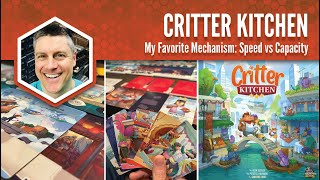









Creature Caravan Deep Dive
What the Community Thinks About Creature Caravan
Creature Caravan arrived in 2024 as something of a quiet revelation. Reviewers who picked it up without sky-high expectations found themselves immediately wanting another play. Tabletop Turtle called it "the surprise hit of the year," noting that when they first saw the bright cartoon art they assumed it would be a lightweight children's game, only to discover genuine layers beneath the surface. Going Analog went further, declaring it their favorite Red Raven game to date after comparing it against a catalog that includes Above and Below, Near and Far, and Sleeping Gods. The Board Game Garden's Jenna backed it on Kickstarter specifically because she had done her research, knew she would love it, and proved herself right, placing it in her top solo games of 2024. BoardGameCo placed it at number 71 on a cumulative top 100 list, offering it as a satisfying tableau-building alternative with a tighter economy than Everdell.
The consensus across reviewers is warm but clear-eyed. The game draws in players with accessibility, then rewards them with a satisfying engine that builds meaningfully over 12 turns. Criticisms do exist, especially around card draw and late-game hand quality, but they rarely overshadow the overall enjoyment. Reviewers with very different tastes, from solo specialists to multiplayer-focused podcasters, landed in similar places: this is a game worth keeping.
Core Mechanics That Define Creature Caravan
Dice Placement and the Expanding Tableau
At its foundation, Creature Caravan is a dice placement game built around a growing personal display of creature cards. Each round, players roll five dice simultaneously and then assign them across their player board and tableau cards. The player board starts with basic action spots, each gated by a minimum die value, with sixes acting as universal keys that can substitute for any requirement. As Neon Gorilla explains it, the player board provides the building blocks of the economy: bread for purchasing cards, bags and coins for trading, movement for advancing down the map, and swords for fighting the Ember zombies you encounter along the way.
The real expansion happens as players add cards to their caravan. Each card played into the tableau opens new dice placement spots with better returns. A card might let you move into mountain terrain with a three-result die, or generate a bread plus a bag plus a card draw whenever you achieve a certain keyword threshold. Going Analog captured the layered feeling well: there is a movement engine, a scoring engine, and a zombie-fighting engine all operating simultaneously, and they interconnect in satisfying ways. By the final rounds, players face a genuine puzzle fitting five dice across a dozen cards while chasing the most valuable combinations.
The Journey Board and Set Collection
Running parallel to the tableau is a physical journey across a modular map. Players move their caravan from left to right across four double-sided tiles, placing a tent on each space they camp. The tent placement serves as both a scoring mechanism and a timer: twelve tents over twelve turns means the game ends at a defined moment. Each column advanced is worth a point, each space camped earns a point, and reaching Easterly at the far end grants a five-point bonus.
The map introduces terrain diversity that directly shapes strategy. Grass, mountains, canyons, and lakes each require a matching movement type, and certain cards add movement symbols to your available options. Special map spaces add further texture: camping on a castle draws three cards, fruit spots let you change any die face to a one (a powerful wild effect), and treasure chests provide immediate bonuses and end-game points. The zombie spaces are the map's main hazard. Each zombie encountered attaches to your caravan as a potential negative point, defeatable only through sword strength on dedicated spots. The zombie scoring board uses a closing-lane mechanic that creates a race among players, as Jenna noted from The Board Game Garden: once a slot is claimed, others have one final round to fill that same tier before it closes forever.
Card keywords tie the tableau and journey together. Every card carries one or more keyword types such as nocturnal, folk, machine, or fish. Collecting matching keywords reduces card costs, triggers bonus effects, and builds end-game scoring engines. As Neon Gorilla describes in detail, a card like the Fish Folk Captain generates a bread, a bag, and a card draw every turn once you have three nocturnal cards in play, making keyword synergy the deepest strategic layer in the game.
The Creature Caravan Experience
Breezy and Simultaneous, Yet Genuinely Puzzly
One of the most consistent points across all reviews is the simultaneous action format. Every player rolls and places dice at the same time, which eliminates downtime almost entirely. Tabletop Turtle put on music and everyone focused on their own puzzle. Neon Gorilla called simultaneous play "a complete godsend" for a game this internally complex, noting that even when a player takes longer to think, everyone else is doing something useful rather than waiting. The Board Game Garden's Jenna made an interesting admission: she generally prefers solo play over multiplayer for simultaneous games because she wants player interaction when sitting with friends, yet she still found Creature Caravan enjoyable across both formats.
The snappy rhythm of rolling dice and assigning them gives the game a satisfying tactile loop. Jamie from Tabletoptiktok praised the metallic pips on the dice as a small but pleasing physical detail. Turns feel decisive rather than endless, and the 60-minute runtime means the game concludes before any sense of drag sets in. Tabletop Turtle noted that the game "plays in like 30 minutes" in their experience, making it easy to justify another session immediately.
Building Something That Feels Like Yours
The tableau building dimension provides a strong sense of personal ownership over each run. Because cards are drawn rather than selected from an open market, no two caravans develop the same way. Jamie highlighted variability and replayability as primary appeals, and Jenna confirmed that no game unfolds identically because the card pool is large enough to produce fundamentally different keyword constellations each time.
When an engine clicks together, the feeling is notably satisfying. Going Analog described the moment when you have built enough movement cards to fly through terrain that previously blocked you, or when your zombie-fighting setup clears a high-value slot ahead of competitors. BoardGameCo appreciated the tagging system in which cards pair with each other the way they do in Everdell, though they noted finding synergistic combinations can be challenging when the card pool is uncooperative. The payoff when it works is what keeps players returning: Tabletop Turtle described playing it once, then needing to play again, then again, eventually rating it S-tier in their personal rankings.
What Makes Creature Caravan Stand Out
Gorgeous Art and Accessible Presentation
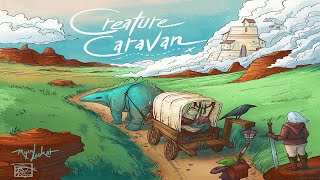
Red Raven Games is known for distinctive visual identities, and Creature Caravan builds on that reputation with a bright, cartoon-leaning style from artist Ryan Lockett. Tabletop Turtle initially assumed the artwork signaled a lighter experience meant for children. Going Analog noted the art is more colorful and sharply outlined than some earlier Red Raven titles, landing in a "little bit more traditional cartoon drawing" register that is immediately welcoming without feeling juvenile. Board Games for One (Mike) was drawn to the game partly because of the artwork before learning the mechanics, and Jamie's first impression emphasized the "quirky" charm of the whole presentation.
The production includes metal coins that multiple reviewers singled out positively. Neon Gorilla appreciated the metallic die pips. The modular board tiles with terrain variety give each session a visually distinct layout. The player boards are clean enough to read at a glance even as the tableau grows in complexity.
A Solo Mode That Plays Like a Real Opponent
For solo players, Creature Caravan includes a bot system printed on the back of each player board. Jamie from Tabletoptiktok explained that the bot rolls its own five dice and follows explicit instructions, mimicking a real player's interactions with the board rather than simply setting a target score to beat. The bot competes for market spots, zombie board slots, and map position in a way that creates genuine pressure. Jamie found the bot difficult to defeat, which she presented as a strength. Jenna at The Board Game Garden placed Creature Caravan fifth in her top 10 solo games of 2024, noting it as the simultaneous game she most enjoyed playing alone. Board Games for One bought it partly for its solo potential, drawn to the theme of shepherding creatures to safety as a natural solo narrative.
Potential Drawbacks
The Card Draw Gamble
Neon Gorilla offered the most thorough critique of the game's card system. Unlike many engine builders, Creature Caravan does not feature an open card market where players choose from a visible selection. Cards arrive purely through draw, which means keyword synergies depend partly on luck. Neon Gorilla described situations where expensive high-power cards arrived early when the economy could not afford them, and cheap low-value cards piled up late when plenty of bread was available to spend but nothing worth buying. They identified this as a structural tension that can produce anticlimactic endings, and suggested an optional card market might address it, while acknowledging the current design makes card-draw actions on certain cards more meaningful.
The card pool of roughly 135 cards ensures variety, but only around 40 deal meaningfully with combos and conditional bonuses. Players chasing specific keyword combinations may find sessions where the target third card for a powerful threshold never appears, leaving a strong card in the tableau without its full activation.
Analysis Paralysis in the Late Game
As the tableau grows, so does the number of available dice placements. Going Analog flagged analysis paralysis as a real risk in the final rounds, when a player might have nearly a dozen cards in play plus multiple dice-manipulation options and terrain movement decisions all feeding into each turn. The simultaneous format mitigates this significantly, because slower players are thinking at the same time as everyone else rather than holding up the group. But Going Analog noted that one consistently slow player can still create noticeable pauses even within the simultaneous model.
Neon Gorilla also pointed to the keyword tracking challenge for new players. With multiple card types referencing multiple keyword categories, keeping track of which cards unlock which effects takes time to internalize. Early games may involve discarding useful keyword cards before recognizing their value, a learning curve that smooths out with experience but that can make first sessions feel less cohesive than later ones.
If You Enjoy Creature Caravan
Reviewers reached for several comparison points when situating Creature Caravan in the broader landscape. Everdell came up most frequently: BoardGameCo described both games as tableau builders with tight economies and keyword tagging systems, while noting Creature Caravan replaces worker placement with dice placement and adds the journey board as a distinct spatial dimension. Players who love Everdell but want something that plays faster and includes simultaneous turns will likely find Creature Caravan a comfortable fit.
Going Analog compared it favorably to other Red Raven titles including Above and Below and Near and Far, noting that Creature Caravan offers a more self-contained and mechanically focused experience compared to those more narrative-driven designs. For players who enjoyed the world of Arum but prefer structured turn decisions over story branching, Creature Caravan is a natural next step.
Neon Gorilla compared it directly to Wondrous Creatures, another creature-themed tableau builder with different action selection. If the worker placement of Wondrous Creatures did not click for you, Creature Caravan's dice-driven approach may offer a fresher angle on a similar fantasy. For players interested in lighter set collection with card synergies and quick play, Fantasy Realms shares some of the keyword-matching DNA, though Creature Caravan is significantly richer in its overall systems.
What Reviewers Are Saying
"This is definitely the surprise hit of the year. I was not expecting much when I first played this game. I played it once and then I was like, I got to play it again. There was just something about it that I just found very charming, very engaging. The mechanics are really well done. It's all relatively simple, but I'm okay with that. The whole game just goes together really smoothly."
— Tabletop Turtle
"This game might be my favorite Red Raven game to date, and we like a lot of their games. After I played it I'm like, I think this is my favorite Red Raven game. I love dice placement games, and the way all these different races for scoring and getting to the end just all comes together really well. There's a movement engine building, there's a scoring engine building, there's zombie killing engine building, so there's a lot going on in this game, but in a very very good way."
— Going Analog
"I knew I was going to enjoy it the moment that I saw it up on crowdfunding, and that is exactly why I did back it. I've enjoyed this game so much solo. Every game is completely different because you're always working with different cards, and you're working with a ton of cards in this game. No game is going to be the same because you always have different cards that you're building up your tableau with."
— The Board Game Garden